
TL;DR:
- Sidewalks significantly lower pedestrian crash rates by creating a physical barrier between pedestrians and vehicles. They enhance safety, property values, and community cohesion, especially for vulnerable populations. Proper design and maintenance are vital for maximizing safety benefits and ensuring sustainable infrastructure.
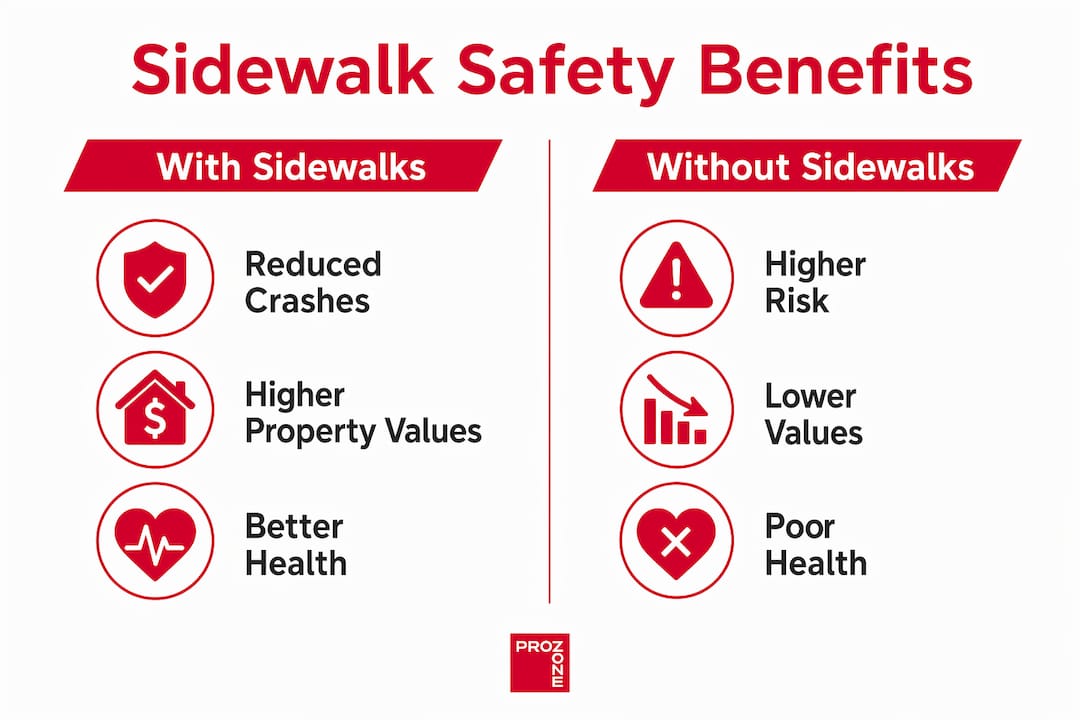
Sidewalks are defined as the primary physical infrastructure that separates pedestrians from vehicular traffic, and their presence directly determines pedestrian crash rates in residential and urban corridors. The role of sidewalks in community safety extends well beyond simple path provision. Roads without sidewalks carry more than double the pedestrian crash rate compared to roads with them, with crash reductions of 50%–90% documented in residential corridors. Sidewalks also support physical activity, social interaction, and neighbourhood cohesion, making them one of the highest-return investments a municipality can make in public infrastructure.
How do sidewalks reduce pedestrian crash rates and improve safety?
The mechanism is straightforward: physical separation between pedestrians and moving vehicles removes the most common cause of pedestrian injury. When a dedicated walkway exists, pedestrians are not forced to share the travel lane with cars, trucks, and cyclists operating at speed.
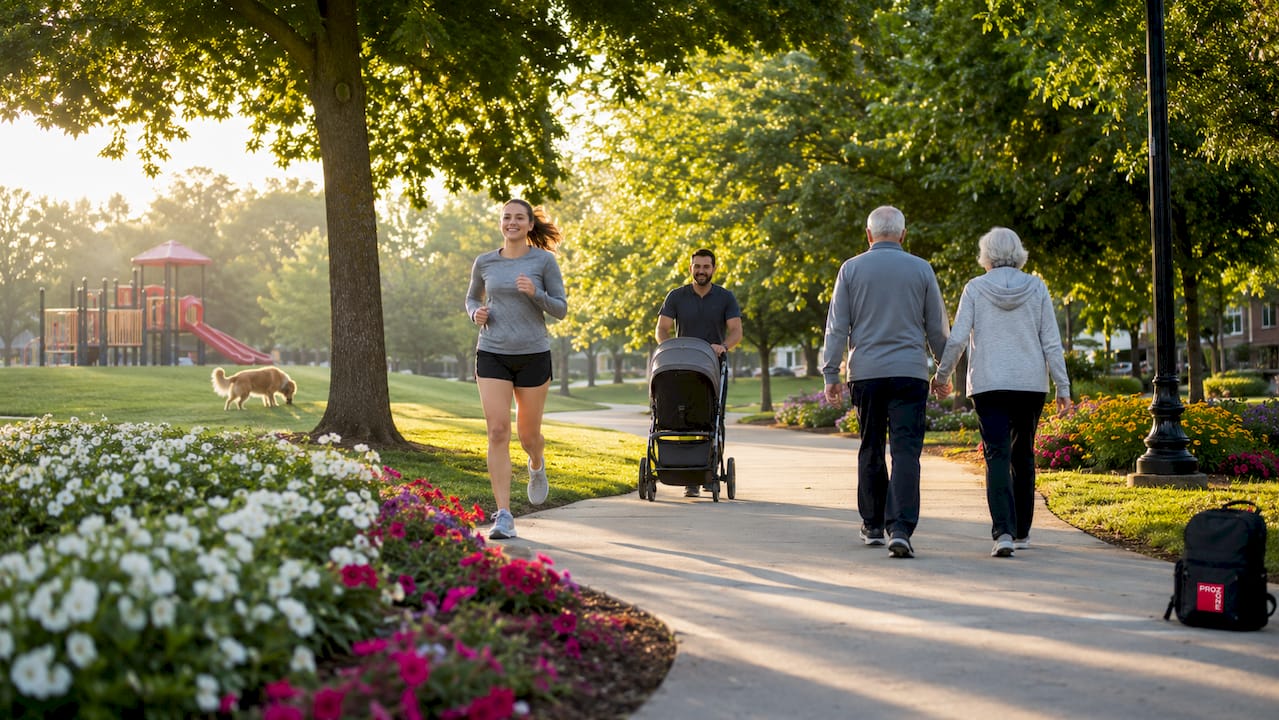
The evidence is consistent across multiple studies. Approximately 20% of all pedestrian fatalities in the United States occur on roads that lack sidewalks or pedestrian facilities. That figure represents a preventable loss concentrated in communities that have simply not built the infrastructure. Separated walkways can prevent up to 88% of pedestrian crashes on affected corridors, according to Federal Highway Administration research.
Vulnerable populations bear the greatest risk on roads without sidewalks. Children walking to school, elderly residents with reduced mobility, and people using mobility aids are all disproportionately represented in pedestrian casualty data. These groups cannot easily adapt to shared-lane conditions the way an able-bodied adult might.
The Safe System Approach, promoted by the CDC and adopted by urban planners across North America, designs environments that tolerate human error. The principle is that infrastructure should prevent a single mistake from becoming a fatal outcome. Sidewalks are the most direct application of this principle at the neighbourhood level.
Pro Tip: When reviewing a corridor for pedestrian risk, prioritise roads with posted speeds above 50 km/h and no physical separation. These locations carry the highest crash probability and should be the first candidates for sidewalk installation.
What are sidewalk design and maintenance best practices?
Good design and consistent maintenance are what convert a sidewalk from a liability into a genuine safety asset. A poorly maintained walkway can introduce its own hazards, including trip hazards, ice accumulation, and drainage failures.
Design principles that reduce risk
Continuous sidewalks on both sides of a street reduce pedestrian crash rates by approximately 50%. Continuity matters because gaps force pedestrians back into the travel lane, recreating the exact risk the sidewalk was built to eliminate. Universal design principles, including kerb cuts, tactile warning strips, and minimum clear widths of 1.5 metres, improve access for people with disabilities and comply with accessibility standards applicable across Alberta.
Drainage is a design element that receives insufficient attention in many projects. Poor drainage design leads to water pooling, concrete degradation, and slip hazards. In Edmonton’s freeze-thaw climate, standing water that penetrates concrete joints expands during freeze cycles and accelerates surface spalling. Specifying air-entrained concrete mixes and positive cross-slopes of 1%–2% toward the road edge addresses this directly.
Maintenance practices that protect users and reduce liability
- Regular condition surveys: Systematic inspection of surface condition, joint integrity, and drainage performance identifies defects before they cause injury. Proactive condition surveys reduce liability and the higher reactive repair costs that follow injury incidents.
- Crack and joint sealing: Sealing longitudinal and transverse cracks before winter prevents water infiltration and freeze-thaw damage that widens defects rapidly.
- Snow and ice removal: In Edmonton, timely clearing within the municipal bylaw window is both a legal obligation and a direct safety measure. Sand and fractured stone aggregates improve traction on icy surfaces without damaging the concrete surface.
- Surface restoration: Grinding trip hazards above 13 mm and applying surface overlays extends service life and eliminates the most common pedestrian fall cause.
Pro Tip: Schedule sidewalk condition surveys in spring, after the freeze-thaw cycle has completed. Winter damage is most visible then, and repair windows before the next freeze are longest.
For Edmonton property managers, a detailed approach to concrete sidewalk maintenance accounts for the specific stresses of Alberta’s climate, including the number of freeze-thaw cycles per season and the use of de-icing salts that accelerate surface scaling.
How do sidewalks contribute to broader community benefits?
The safety case for sidewalks is strong on its own. The economic and social case makes the investment even harder to argue against.
Economic impact on property values and municipal revenue
Properties in neighbourhoods with above-average walkability command higher home values, with increases of $700–$3,000 documented in research on walkable communities. Higher property values translate directly into increased municipal tax revenue, which can partially offset the cost of sidewalk construction and maintenance. The return on investment is measurable and recurring.
The table below summarises the primary community benefits of sidewalk infrastructure compared to corridors without pedestrian facilities.
| Benefit category | Corridors with sidewalks | Corridors without sidewalks |
|---|---|---|
| Pedestrian crash rate | Up to 90% lower | Baseline risk |
| Property values | $700–$3,000 higher | No walkability premium |
| Physical activity levels | Higher; meets CDC recommendations | Lower; discourages walking |
| Social cohesion | Stronger neighbourhood interaction | Reduced street-level engagement |
| Environmental impact | Lower car dependence | Higher vehicle trip generation |
Public health and social cohesion
Neighbourhoods lacking sidewalks discourage walking, leading to reduced physical activity and poorer community health outcomes. CDC research links sidewalk presence with a higher likelihood of residents meeting recommended physical activity levels. The connection is direct: when walking feels safe, people walk more.
Social cohesion follows the same logic. Residents who walk their streets interact with neighbours, observe their surroundings, and develop a sense of shared ownership over public space. This informal surveillance is a recognised community safety measure that supplements formal policing. Sidewalks are the physical infrastructure that makes this possible.
What are practical strategies for improving sidewalk safety?
Urban planners and community advocates have several proven approaches available, ranging from policy frameworks to low-cost tactical interventions.
-
Adopt Complete Streets policies. Complete Streets policies require sidewalks in all new developments and road reconstruction projects. They advance pedestrian safety, equity, and connectivity while supporting diverse users including children, elderly residents, and people with disabilities. Many Canadian municipalities have adopted or are developing Complete Streets frameworks.
-
Use public-private partnerships for funding. Sidewalks deliver outsized safety and economic returns relative to their construction cost, yet they are consistently underfunded in car-centric budget frameworks. Public-private partnership models allow municipalities to leverage developer contributions, business improvement area funding, and provincial grants to close funding gaps.
-
Engage vulnerable community members in planning. Children, elderly residents, and people with disabilities experience sidewalk deficiencies most acutely. Structured engagement with these groups during planning identifies gaps that standard traffic counts miss. Their input should inform both the prioritisation of new construction and the sequencing of maintenance repairs.
-
Deploy tactical, low-cost interventions first. Temporary solutions such as painted walkways and delineator posts cost approximately 25% of traditional construction while providing immediate safety improvements. These staged approaches generate usage data that supports capital investment decisions in cities with constrained budgets.
-
Implement data-driven condition management. Consistent sidewalk condition surveys, scored against a standardised index, allow municipalities to allocate maintenance budgets based on risk rather than complaint volume. This approach reduces legal liability and prevents the accumulation of deferred maintenance that leads to costly reconstruction. Prozoneltd’s municipal sidewalk planning guide outlines how Edmonton-area municipalities can structure this process.
-
Reference Edmonton sidewalk standards. Compliance with Edmonton’s municipal construction standards is not optional for new installations. These standards specify concrete mix design, joint spacing, surface tolerance, and accessibility requirements that directly affect long-term safety performance.
Why sidewalk investment deserves a higher priority in city budgets
Working in Edmonton’s construction and infrastructure sector, the pattern is consistent: sidewalk projects are the first item cut when municipal budgets tighten and the last item restored when funding returns. The reasoning offered is usually that sidewalks are a lower priority than roads or utilities. That reasoning does not hold up against the data.
A road without a sidewalk is not a complete road. It is infrastructure that forces its most vulnerable users into the most dangerous position available. The 50%–90% crash reduction that comes from adding a sidewalk is not a marginal improvement. It is a fundamental change in the safety profile of a corridor.
The moral dimension of sidewalk quality is also worth stating plainly. A city that builds wide arterial roads and neglects pedestrian infrastructure has made a choice about whose mobility it values. That choice is visible in injury statistics and in the daily experience of residents who cannot safely walk to a bus stop or a school.
The good news is that the investment case is strong. Sidewalks are essential public infrastructure that yield better livability, economic returns, and safety compared to equivalent spending on car-centric projects. The data supports prioritising them. The challenge is political will and consistent budget commitment across municipal election cycles.
— Prozoneltd
How Prozoneltd supports safer sidewalk infrastructure in Edmonton
Prozoneltd delivers professional concrete and asphalt sidewalk installation and restoration across Edmonton and the surrounding region, working to Alberta Safety Codes and municipal construction standards on every project. Our team specifies air-entrained concrete mixes suited to Edmonton’s freeze-thaw conditions, designs positive drainage slopes to prevent water infiltration, and applies surface treatments that extend service life. We work with municipalities, property managers, and commercial clients on both new construction and proactive maintenance programmes. For a full picture of our municipal and commercial construction services, visit our services page. Contact Prozoneltd online or by phone for a no-obligation estimate on your next sidewalk project.
FAQ
How much do sidewalks reduce pedestrian crash rates?
Adding sidewalks to roads that currently lack them reduces pedestrian crash rates by 50%–90%, depending on road type and traffic volume. Continuous sidewalks on both sides of a street consistently achieve approximately 50% crash reduction in residential corridors.
What sidewalk design features matter most for safety?
Continuity, adequate width, kerb cuts, and positive drainage are the four most critical design features. Gaps in sidewalk networks force pedestrians into the travel lane, which recreates the primary crash risk the sidewalk was built to eliminate.
How do sidewalks affect property values?
Properties in walkable neighbourhoods with well-maintained sidewalks command home values $700–$3,000 higher than comparable properties in low-walkability areas. This premium reflects both safety and the convenience of pedestrian access to amenities.
What is the Safe System Approach in sidewalk planning?
The Safe System Approach, promoted by the CDC, designs infrastructure to tolerate human error so that a single mistake does not result in a fatal outcome. Sidewalks are a direct application of this principle, removing pedestrians from the path of vehicles before a collision can occur.
How should Edmonton property managers handle sidewalk maintenance in winter?
Timely snow and ice removal within the municipal bylaw window is the first obligation. Beyond that, spring condition surveys after the freeze-thaw cycle identify concrete damage, trip hazards, and drainage issues that require repair before the next winter season.