
TL;DR:
- Sustainable construction methods improve environmental performance by using efficient materials, design, and processes.
- These methods include prefabrication, passive design, sustainable materials, and waste management, which combined, maximize benefits.
Sustainable construction methods are practices that reduce environmental impact and improve building performance by integrating efficient materials, design, and processes across a project’s full lifecycle. For construction professionals working in Edmonton and across Alberta, this means accounting for freeze-thaw cycles, Alberta Safety Codes compliance, and supply chain realities alongside carbon reduction goals. The built environment carries a significant carbon burden globally, and the construction sector is under growing pressure to demonstrate measurable progress. Firms that treat sustainability as a technical discipline rather than a marketing position are the ones winning contracts and building lasting reputations.
What are the main sustainable construction methods?
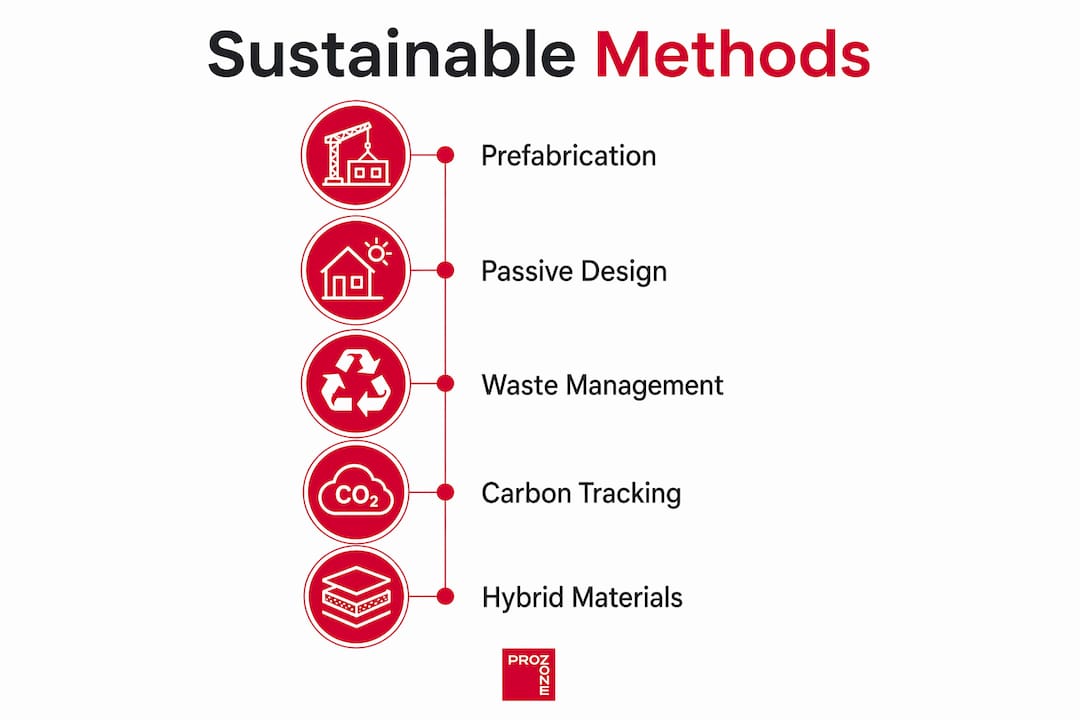
Sustainable construction methods fall into four core categories: prefabrication and modular assembly, passive design, sustainable materials selection, and construction waste management. Each addresses a different phase of the building lifecycle, and the strongest projects combine all four.
Prefabrication and modular construction produce components off-site under controlled conditions. Prefabrication reduces construction waste by 50% and operational energy consumption by 20%, with CO2 mitigation potential ranging from 11% to 96% depending on materials and process efficiency. That range reflects how much design decisions matter before a single component leaves the factory.
Passive design uses building orientation, high-performance insulation, and thermal mass to reduce energy demand without mechanical systems. The built environment accounts for 25% of the UK’s total carbon footprint, a figure that reflects a pattern seen across industrialised nations including Canada. Passive design directly attacks that number by lowering operational energy from day one.
Construction waste management includes source separation on site, material reuse planning, and procurement strategies that match order quantities to actual need. Excess material ordering is one of the most common and avoidable sources of waste on commercial projects.
| Method | Primary benefit | Key constraint |
|---|---|---|
| Prefabrication | 50% waste reduction, 20% energy savings | Higher upfront design investment |
| Passive design | Lower lifetime energy costs | Site orientation limits |
| Sustainable materials | Reduced embodied carbon | Quality variability, testing requirements |
| Waste management | Landfill diversion, cost recovery | Site logistics and sorting discipline |
Pro Tip: Design your prefabrication strategy before finalising the site plan. Changes made after component production begins eliminate most of the cost and waste savings.
How do sustainable construction materials contribute to greener projects?
The role of sustainable materials in construction is to reduce embodied carbon, the emissions locked into a building before it is ever occupied. Embodied carbon is now a primary metric for project assessment, and material selection is where the largest gains are available.
Bio-based materials such as engineered timber, bamboo composites, and hemp-based insulation actively sequester carbon during growth. Engineered timber, including cross-laminated timber (CLT), performs well structurally and is gaining acceptance under the National Building Code of Canada. In Edmonton’s climate, moisture management detailing is non-negotiable with any bio-based system.
Recycled and industrial by-product materials include recycled concrete aggregates and supplementary cementitious materials (SCMs) such as fly ash and ground granulated blast-furnace slag. SCMs replace a portion of Portland cement, which is one of the most carbon-intensive materials in standard construction. Recycled material quality variability remains a major constraint, requiring strict testing rather than assumed performance. Skipping that testing step creates structural and certification risk.
Low-carbon cementitious materials include alkali-activated materials and limestone calcined clay cement (LC3). These are not yet mainstream in Alberta, but procurement teams should be tracking them as regulatory pressure on embodied carbon increases.
Hybridisation strategies that combine bio-based, recycled, and low-carbon cementitious materials offer the most balanced approach. Relying on a single material type to carry all sustainability performance is a fragile strategy.
| Material type | Carbon benefit | Key constraint |
|---|---|---|
| Engineered timber (CLT) | Sequesters carbon, low embodied energy | Moisture detailing critical in cold climates |
| Recycled concrete aggregate | Diverts waste, reduces virgin extraction | Quality variability requires rigorous testing |
| SCMs (fly ash, slag) | Reduces cement content and CO2 | Supply availability varies by region |
| LC3 / alkali-activated | Very low embodied carbon | Limited local supply chains in Alberta |
Pro Tip: Request third-party test certificates for every recycled aggregate batch. Supplier declarations alone do not satisfy Alberta Safety Codes requirements for structural applications.
What role do digital tools play in sustainable construction workflows?
Carbon management is now a project constraint, not an afterthought. High-performing firms treat carbon as a fixed constraint alongside cost and schedule, the same way they treat safety. That shift changes how projects are planned, procured, and reported.

The practical implication is that carbon data must travel with the project from design through procurement and into construction. Breaking the data chain in carbon accounting causes sustainability commitments to fail at the reporting stage, even when the physical work was done correctly. A material specified with a low-carbon profile but procured without its environmental product declaration (EPD) becomes unverifiable.
Digital tools support this in several ways:
- Carbon accounting integration: Connecting carbon tracking to cost and schedule software allows teams to model the carbon impact of procurement decisions before orders are placed.
- Real-time waste visibility: Site management platforms that track material deliveries against actual consumption flag over-ordering before it becomes landfill.
- Early decision support: Digital modelling at the design stage catches conflicts that would otherwise result in rework, which carries both cost and carbon penalties.
- Material data continuity: Maintaining EPDs and test certificates in a shared project environment prevents the data gaps that break reporting chains.
Firms that have not yet integrated carbon tracking into their standard project management workflow are at a growing disadvantage. Clients and municipalities are beginning to require carbon reporting as a condition of contract award.
What challenges affect sustainable construction in Edmonton’s climate?
Edmonton’s climate creates specific technical and logistical challenges that generic sustainability guidance does not address. Freeze-thaw cycling is the most significant. Temperatures in the Edmonton region regularly cross the freezing threshold multiple times in a single season, which accelerates deterioration in materials that absorb moisture. Bio-based and some recycled materials require additional detailing and protective systems to perform reliably under these conditions.
Key challenges for Edmonton-area projects include:
- Freeze-thaw durability: Bio-based materials and porous recycled aggregates need vapour barriers, drainage layers, and protective coatings suited to Alberta winters.
- Alberta Safety Codes compliance: All structural materials, including recycled and alternative cementitious products, must meet Alberta Safety Codes requirements. Non-standard materials require documented testing and, in some cases, engineering review.
- Supply chain fragmentation: Sustainable materials supply chains in Alberta are less developed than in larger markets. Lead times for CLT, SCMs, and EPD-certified products can extend project schedules if not planned early.
- Labour and training gaps: Techniques like poured earth construction or advanced prefabrication assembly require site preparation and crew training that standard subcontractor pools may not provide.
- Industry acceptance: Some clients and municipal procurement teams still treat sustainable methods as experimental. Providing documented performance data from comparable projects accelerates acceptance.
Pro Tip: Specify freeze-thaw resistance ratings explicitly in your material procurement documents. Do not rely on a supplier’s general sustainability claims to cover cold-climate performance.
Poured earth construction is one technique worth understanding in this context. Poured earth requires specialised site management for water content and curing to avoid shrinkage. It is not a direct concrete replacement and should not be specified without an experienced contractor and a clear curing protocol suited to Alberta’s temperature swings.
How can professionals implement sustainable methods practically?
Practical implementation starts at the earliest planning stage. Researchers identified 49 actionable sustainable building practices spanning environmental, economic, and social domains that meet emerging regulatory requirements. The firms that execute these practices well share a common approach: sustainability criteria enter the project brief before design begins, not after.
A structured implementation sequence looks like this:
- Set sustainability targets in the project brief. Define carbon, waste, and energy targets before design starts. Targets set after design is complete are almost always compromised.
- Integrate prefabrication into the design. Prefabrication works best when the structural system is designed around it. Retrofitting prefab into a conventionally designed structure recovers only a fraction of the potential savings.
- Source materials with EPDs early. Environmental product declarations take time to obtain from suppliers. Build EPD requirements into procurement specifications from the outset.
- Coordinate trades to minimise rework. Rework is one of the largest sources of both cost overrun and unnecessary carbon. Detailed coordination meetings before each construction phase reduce conflict and waste.
- Use hybrid material strategies. Combining CLT structure with recycled aggregate foundations and SCM-based concrete flatwork delivers better overall performance than optimising a single material category.
- Document everything. Carbon reporting, waste diversion records, and material test certificates need to be maintained throughout the project. Gaps discovered at handover are expensive to close.
Reviewing construction material options early in the planning phase gives procurement teams the lead time needed to source certified sustainable products without schedule risk.
ProZone’s perspective on sustainable construction in Edmonton
The conversation about sustainable construction in Edmonton has shifted considerably over the past few years. What was once a client preference is now a procurement requirement on a growing number of municipal and commercial projects. The firms that treated carbon tracking as optional are now scrambling to catch up.
The most useful shift in thinking is treating carbon the same way you treat budget. You would not start a project without a cost plan. Starting without a carbon plan is the same category of oversight, and it carries the same consequences when the numbers come in wrong at the end.
Hybrid material strategies are where the real gains are. No single material solves every problem, especially in a climate like Edmonton’s where freeze-thaw performance, structural certification, and supply chain reliability all have to align. Combining CLT, SCMs, and recycled aggregates across different building elements gives you more flexibility and better overall outcomes than betting everything on one approach.
Training is the constraint that does not get enough attention. New materials and methods require crews who know how to handle them correctly. Investing in that training before a project starts is far cheaper than managing defects caused by unfamiliar techniques on a live site.
The firms winning the best work in Alberta right now are the ones who can hand a client a carbon report alongside a cost report. That capability is becoming a baseline expectation, not a differentiator.
— ProZone
ProZone’s construction services for Edmonton projects
ProZone brings certified expertise to construction and infrastructure projects across Edmonton and the surrounding region. All work is executed in compliance with Alberta Safety Codes, using quality-tested materials suited to Alberta’s demanding freeze-thaw conditions. For project managers and property owners looking to apply green building practices without compromising structural performance or schedule, ProZone provides the technical grounding and material sourcing experience to make it work. Explore construction services for Edmonton or contact ProZone directly for a free project estimate. The online inquiry form connects you with a project specialist who can assess your site conditions and sustainability requirements from the first conversation.
FAQ
What is sustainable construction?
Sustainable construction is the practice of designing and building structures that reduce environmental impact, lower energy consumption, and minimise waste across the full project lifecycle. It integrates efficient materials, passive design, and responsible site management from planning through completion.
Why do sustainable construction practices matter for Edmonton builders?
Edmonton’s freeze-thaw climate and Alberta Safety Codes requirements mean that sustainable methods must be selected and detailed for cold-climate performance, not just carbon reduction. Firms that integrate carbon tracking with cost and schedule management are better positioned for municipal contract requirements.
What are the most effective sustainable building materials?
Engineered timber, supplementary cementitious materials such as fly ash and slag, and recycled concrete aggregates offer the strongest combination of carbon reduction and structural performance. Recycled material quality must be verified through rigorous testing before use in structural applications.
How does prefabrication support eco-friendly building?
Prefabrication reduces waste by 50% and cuts operational energy use by 20% compared to conventional site-built construction. The gains are largest when prefabrication is integrated into the structural design from the start of the project.
How does carbon accounting work in construction projects?
Carbon accounting tracks the emissions associated with materials, transport, and site operations throughout a project. Maintaining continuous carbon data from design through procurement and construction is critical. Gaps in that data chain cause sustainability commitments to fail at the reporting stage.