
TL;DR:
- Property maintenance involves regular care of building systems to preserve safety and value. It includes exterior, interior, structural, and safety elements, with clear distinctions from capital improvements. Edmonton’s harsh climate demands proactive seasonal maintenance to prevent costly damage and protect investments.
Property maintenance is defined as the systematic process of preserving a building’s habitability, safety, and long-term value through routine upkeep, preventive servicing, and corrective repairs. The scope covers exterior systems such as roofing, landscaping, and paving, as well as interior systems including HVAC and plumbing. For property managers, homeowners, and real estate investors in Edmonton, understanding this definition is not academic. Alberta’s freeze-thaw climate makes the difference between a well-maintained asset and a costly liability a matter of scheduling, not luck.
What is the definition of property maintenance and what does it cover?
Property maintenance is the ongoing care of building systems and structures to keep them safe, functional, and compliant with applicable codes. It covers four broad domains: exterior elements (roofing, paving, landscaping, drainage), interior systems (HVAC, plumbing, electrical), structural components (foundations, walls, slabs), and safety systems (fire exits, lighting, signage). Each domain requires its own inspection schedule and service response standard.
The industry distinguishes between maintenance and capital improvements. Maintenance preserves existing utility; capital improvements enhance or expand an asset. Confusing the two creates budgeting errors and tax reporting problems. A cracked concrete apron repaired to its original condition is maintenance. Replacing it with a wider, reinforced slab is a capital improvement.
Property upkeep, the informal term most homeowners use, refers to the same concept. The standard industry term is property maintenance, and it carries legal and contractual weight in lease agreements, insurance policies, and Alberta Safety Codes compliance documentation.
What are the main types of property maintenance and their differences?
Maintenance divides into four categories: reactive, preventive, predictive, and routine. Each serves a different operational purpose, and the most effective programmes combine all four.
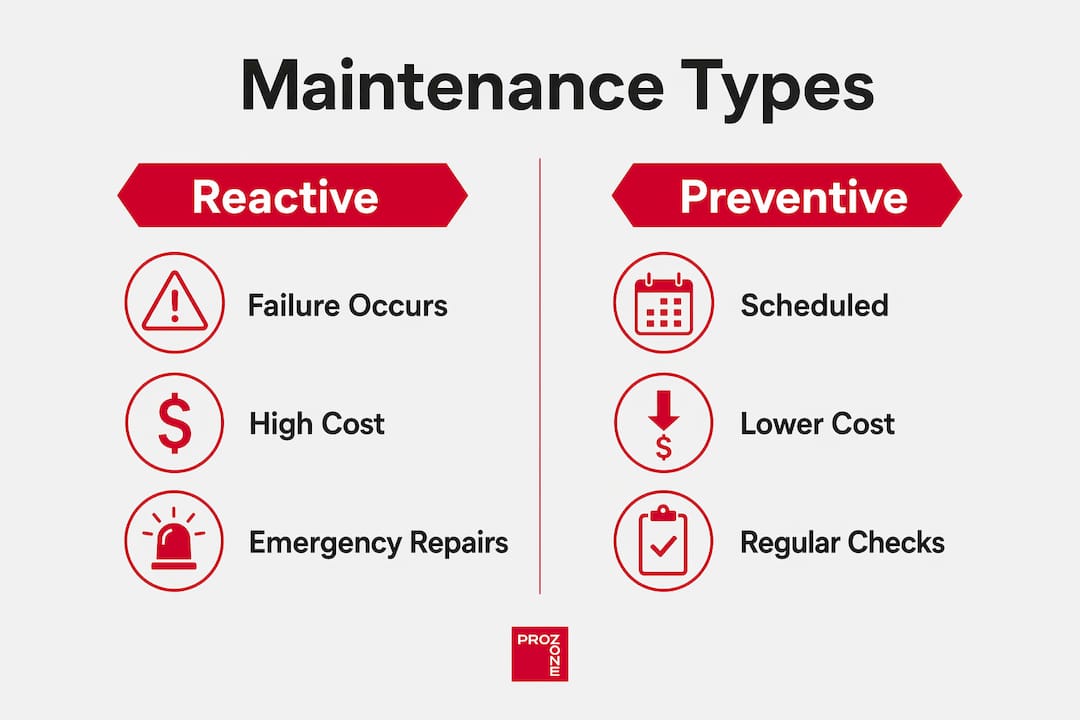
| Type | Trigger | Example | Cost profile |
|---|---|---|---|
| Reactive | Failure occurs | Burst pipe repair | High per incident |
| Preventive | Scheduled interval | Annual roof inspection | Moderate, predictable |
| Predictive | Condition monitoring | Crack mapping on concrete | Low to moderate |
| Routine | Calendar-based | Gutter cleaning each autumn | Low, fixed |
Reactive maintenance addresses failures after they occur. It is the most expensive category per incident because emergency labour rates apply and secondary damage accumulates. Reactive costs run 3–5 times higher than equivalent preventive work. That gap is the financial argument for every other category on this list.
Preventive maintenance follows a fixed schedule regardless of visible condition. Annual roof inspections, seasonal HVAC servicing, and spring concrete assessments all fall here. Preventive programmes extend asset life and reduce breakdown frequency, producing measurable savings on long-term costs.
Predictive maintenance uses condition data to trigger service only when deterioration reaches a defined threshold. Crack mapping on asphalt or concrete is a practical example. You measure, record, and act before failure, not before a calendar date.
Routine maintenance covers recurring, low-skill tasks: gutter cleaning, snow removal, landscaping, and exterior washing. These tasks are calendar-driven and easy to consolidate into a single service contract.
Pro Tip: Lifecycle categorisation separates routine and preventive tasks from capital work in your annual budget. This prevents emergency fatigue and keeps financial forecasting accurate across a full property portfolio.
Why is property maintenance crucial for protecting investment and tenant satisfaction?
Preventive maintenance is a strategic asset management tool, not a line-item expense. Properties with documented maintenance programmes hold value better, attract higher-quality tenants, and face fewer regulatory penalties than those managed reactively.
The safety and compliance argument is equally direct. Alberta Safety Codes set minimum standards for structural integrity, fire egress, and mechanical systems. Failing to meet those standards exposes property owners to fines, insurance voidance, and liability claims. Fire exit maintenance, for example, requires documented inspection records to satisfy both insurer and code requirements.
Tenant retention is a financial metric, not just a satisfaction score. Tenants who experience slow or absent maintenance responses leave at renewal. Replacing a commercial tenant costs months of vacancy plus leasing commissions. The maintenance programme that prevents that outcome pays for itself many times over.
Key benefits of a structured maintenance programme include:
- Preserved property value through documented upkeep history
- Reduced insurance premiums where maintenance records demonstrate risk management
- Regulatory compliance with Alberta Safety Codes and municipal bylaws
- Lower tenant turnover through reliable service responsiveness
- Reduced liability exposure from documented inspections and repairs
“Maintenance should not be viewed as a mere expense but as a strategic investment that directly boosts property values, compliance standing, and tenant retention by avoiding emergencies.” — NAI Global, commercial property maintenance analysis
How does the Edmonton regional climate influence property maintenance strategies?
Edmonton’s climate is one of the most demanding in Canada for built infrastructure. Freeze-thaw cycles cause significant damage to roofing membranes, concrete slabs, asphalt surfaces, and foundation walls. Water infiltrates micro-cracks, freezes, expands, and widens those cracks with each cycle. Without a seasonal maintenance schedule, minor surface defects become structural problems within two to three winters.
The practical implication is that Edmonton property owners need two primary maintenance windows each year. The spring window, typically april through may, is for assessing winter damage: heaved concrete, spalled asphalt, compromised caulking, and roof membrane lifting. The autumn window, september through october, is for sealing, waterproofing, and preparing drainage systems before freeze-up.
| Season | Priority tasks | Materials at risk |
|---|---|---|
| Spring (April–May) | Crack assessment, drainage clearing, roof inspection | Concrete, asphalt, membranes |
| Summer (June–August) | Asphalt sealing, landscaping, exterior painting | Asphalt binder, wood, caulking |
| Autumn (Sept–Oct) | Waterproofing, gutter clearing, snow equipment service | Drainage systems, mechanical |
| Winter (Nov–March) | Snow removal, ice management, emergency response | Walkways, parking surfaces |
Concrete is particularly vulnerable in Edmonton. Proactive concrete repair before freeze-up prevents the exponential damage that occurs when water enters an unsealed crack and expands through multiple freeze-thaw cycles. The cost of sealing a crack in october is a fraction of the cost of replacing a slab in may.
Pro Tip: Schedule your spring assessment before may long weekend. Contractors in Edmonton are fully booked by mid-May as every property manager discovers winter damage at the same time. Early booking secures better pricing and faster response.
What practical steps ensure effective property upkeep?
A structured maintenance programme reduces emergencies, controls costs, and creates the documentation record that protects owners in insurance and liability situations. Digital maintenance records with photo evidence are now a professional standard, not an optional extra. Every site visit should produce a timestamped photo report accessible to the property owner.
The following steps establish a functional maintenance programme for a residential or commercial property:
- Conduct a baseline condition assessment. Walk every system and surface. Document existing defects with photos and measurements. This becomes your benchmark for tracking deterioration.
- Categorise all tasks by maintenance type. Separate routine calendar tasks from preventive scheduled work and capital improvements. Budget each category separately.
- Set service responsiveness standards. Safety issues require inspection within 3 days. Formal repair quotes within 48 hours is the professional benchmark. Emergency response should be available around the clock.
- Consolidate trades into single contracts where possible. Consolidated maintenance contracts reduce administrative overhead, fix your monthly cost, and eliminate the reminder fatigue of managing multiple vendors.
- Implement digital reporting. Require photo documentation for every completed task. This record protects against liability claims and supports insurance applications.
- Review and update the programme annually. After each spring assessment, revise task frequencies based on observed deterioration rates. A programme that does not adapt becomes outdated within two seasons.
Documenting every maintenance visit with photos is a key defence against liability claims and insurance disputes. This single practice separates professional property management from ad hoc repair management.
What experienced property managers know that the textbooks miss
The most common mistake I see in Edmonton property portfolios is treating maintenance as a cost to minimise rather than a programme to manage. Owners cut inspection budgets in slow years, skip the autumn waterproofing round, and then spend three times as much on emergency concrete replacement the following spring. The maths never works in their favour.
The second mistake is blurring the line between maintenance and capital improvements. Confusing these two categories creates inaccurate budgets, incorrect tax filings, and a false picture of property performance. Maintenance preserves what exists. Capital work creates something new or significantly better. Keep them in separate budget lines from day one.
Regional expertise matters more than general contractor experience in Alberta. A contractor who understands Edmonton’s freeze-thaw cycles, the Alberta Safety Codes requirements, and the specific behaviour of asphalt and concrete in sub-zero conditions will prevent problems that a generalist will miss entirely. The role of maintenance in property value is direct and measurable. A documented, consistent programme is one of the strongest signals of asset quality to any future buyer or lender.
— ProZone
How ProZone supports Edmonton property managers with expert maintenance services
ProZone delivers Alberta Safety Codes-compliant property maintenance services for commercial, municipal, and private properties across Edmonton and the surrounding region. The team specialises in concrete repair, asphalt laying, earthworks, snow removal, and drainage, all areas where Edmonton’s freeze-thaw climate creates the highest risk of accelerated deterioration. ProZone uses quality-graded materials and documented reporting on every project, giving property owners the accountability record their insurers and regulators require. For a full picture of available construction and maintenance services tailored to Edmonton’s conditions, contact ProZone directly through the online form for a free estimate.
FAQ
What is the definition of property maintenance?
Property maintenance is the systematic process of preserving a building’s habitability, safety, and long-term value through routine upkeep, preventive servicing, and corrective repairs. It covers both exterior and interior systems across residential, commercial, and municipal properties.
What is the difference between maintenance and a capital improvement?
Maintenance restores an asset to its existing condition and utility. A capital improvement enhances or expands the asset beyond its original state, and the two must be budgeted and reported separately to avoid financial and tax errors.
Why is preventive maintenance more cost-effective than reactive repairs?
Reactive maintenance costs run 3–5 times higher per incident than equivalent preventive work, because emergency labour rates apply and secondary damage accumulates before the repair is made.
How does Edmonton’s climate affect property maintenance schedules?
Freeze-thaw cycles in Edmonton damage roofing, concrete, and asphalt by forcing water into micro-cracks that expand with each freeze. Properties require two primary maintenance windows each year: spring assessment after thaw and autumn waterproofing before freeze-up.
What documentation should a property maintenance programme include?
Every maintenance visit should produce a timestamped photo report documenting completed work and observed conditions. This record is the primary defence against liability claims and insurance disputes, and it meets the professional reporting standard expected by Alberta insurers and regulators.