
TL;DR:
- Using high-quality aggregates improves concrete strength, durability, and lifecycle cost by ensuring proper particle bond and frost resistance. It is essential to verify aggregate cleanliness, gradation, and low absorption through tests conducted by certified laboratories to prevent long-term structural failures. Prioritizing aggregate quality reduces maintenance and rehabilitation costs, especially in Alberta’s freeze-thaw environment.
Use quality aggregates because they directly control concrete strength, durability, and lifecycle cost. Every structural decision downstream — mix design, compressive strength, freeze-thaw resistance — traces back to what you put in the granular skeleton. For Edmonton contractors working through 30-plus freeze-thaw cycles per year, this is not a marginal consideration.
TLDR: Key benefits of quality aggregates
- Higher compressive strength through better particle bond and mechanical interlock
- Frost resistance from low absorption and low porosity stone
- Reduced cement demand with well-graded material, lowering shrinkage and cost
- Predictable workability and compaction on site
- Lower long-term repair risk and reduced lifecycle maintenance cost
Aggregates make up 60–75% of concrete by volume, so their properties set the ceiling on what any mix design can achieve. CSA A23.1 and provincial specifications such as MTO SSP 110S17 exist precisely to enforce a minimum quality floor — but meeting the minimum and specifying for performance are two different things.
Table of Contents
- What does a quality aggregate actually look like on site?
- Quality factors to check before you accept a delivery
- Canadian standards and lab tests you will see on certificates
- How aggregate quality affects lifecycle costs and maintenance
- On-site QA: sampling, frequency, and documentation
- How ProZone manages aggregate quality for Alberta projects
- The case for treating aggregate selection as a risk decision
- ProZone provides material selection, supply, and installation support
- Key references and authoritative resources
- FAQ
What does a quality aggregate actually look like on site?
A quality aggregate is clean, sound, well-graded, durable, and appropriate for its exposure class. That definition becomes practical the moment a delivery arrives on site.
Crushed fractured stone and washed concrete sand are the reference points most Alberta contractors work from. Crushed stone has angular faces that interlock under load, improving bond with cement paste. Rounded river gravel, by contrast, offers less mechanical interlock and typically requires more paste to achieve equivalent strength. Washed sand is free of silt and clay coatings; silt-contaminated sand weakens the cement-aggregate bond and raises water demand.
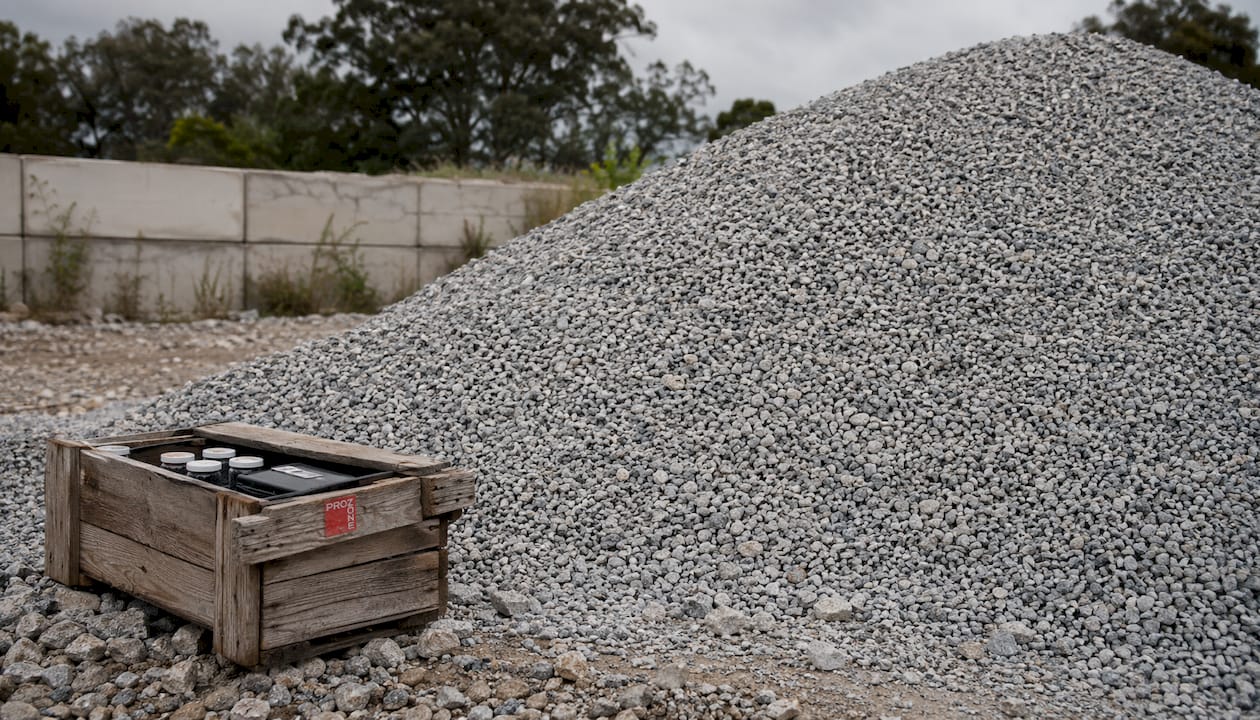
Because aggregates occupy most of the concrete volume, even a modest reduction in aggregate quality propagates through the entire mix. Daily process control testing and source traceability from quarry through crushing, screening, and stockpile blending are what separate a reliable supplier from one who ships inconsistent material between batches.
Key on-site indicators of quality:
- Cleanliness: No visible clay lumps, organic debris, or discolouration
- Gradation: Consistent particle size distribution, no gap-grading or excess fines
- Particle shape: Angular, fractured faces on coarse aggregate
- Moisture uniformity: Consistent surface moisture across the stockpile, no wet pockets
For washed sand and road crush gravel sourced locally in Edmonton, ask the supplier for the current gradation certificate before accepting the load.
Quality factors to check before you accept a delivery
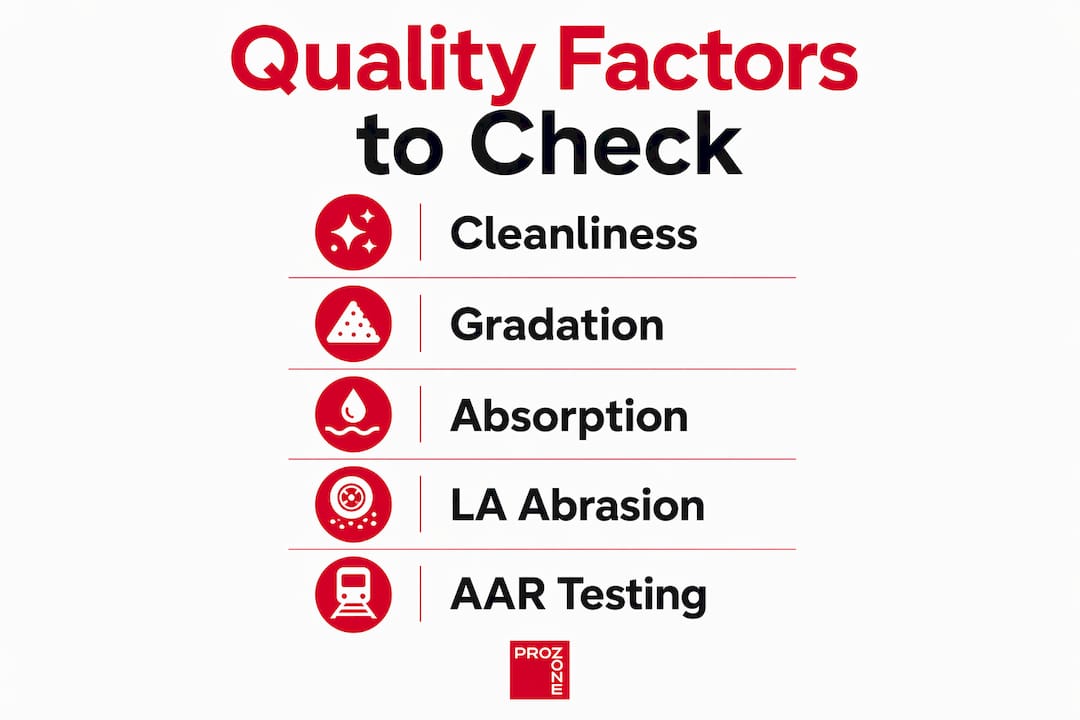
Testing methods contractors should request cover six core dimensions. Each maps to a specific failure mode if it falls outside acceptance limits.
- Gradation (sieve analysis): Controls workability, void ratio, and binder demand. Poor grading raises the void ratio in the granular skeleton, forcing an increase in cement paste, which increases shrinkage, cracking, and long-term permeability. Well-graded aggregates permit tighter packing and lower binder demand.
- Cleanliness and deleterious materials: Clay, organic matter, glass, and wood contaminate the cement-aggregate bond. MTO guidance requires aggregates to be free of these materials because contamination leads to premature cracking and structural failure.
- Particle shape and angularity: Angular, fractured particles improve mechanical interlock and bond. Flat or elongated particles reduce packing efficiency and can cause mix segregation.
- Los Angeles (LA) abrasion: Measures resistance to degradation under impact and abrasion. High LA abrasion loss predicts rapid wear on pavement surfaces and reduced strength in structural concrete.
- Water absorption: Low absorption is critical for freeze-thaw durability. In Alberta’s climate, low porosity and low absorption are the primary selection criteria for aggregates exposed to seasonal cycling and de-icing salts.
- Specific gravity, unit weight, and voids: These values confirm aggregate density and help calculate mix proportions accurately. Unexpected voids indicate contamination or weak particles.
- Alkali-aggregate reactivity (AAR): Certain aggregate mineralogies react with cement alkalis, causing expansion and cracking over time. Require an AAR assessment when the aggregate source or type indicates risk.
Pro Tip: For Edmonton projects subject to freeze-thaw exposure, prioritise absorption and LA abrasion results above all other test data. A stone that passes gradation but shows high absorption will scale within two to three winter seasons under de-icing salt application.
Gradation and cleanliness checks are standard supplier-side QC. Absorption, LA abrasion, and AAR testing should be independently verified through a CCIL-certified laboratory, particularly for municipal or commercial infrastructure contracts.
Canadian standards and lab tests you will see on certificates
Alberta contractors work within a layered standards framework. The primary references are:
| Standard / Specification | Scope | Key Tests Referenced |
|---|---|---|
| CSA A23.1 | Concrete materials and methods of concrete construction | Gradation, absorption, specific gravity, AAR |
| MTO SSP 110S17 | Ontario MTO clean aggregate requirements | Deleterious material limits, field performance acceptance |
| OPSS 1010 / OPSS.MUNI | Ontario provincial standard for aggregates | Sampling frequency, gradation, LA abrasion |
| Municipal TS 1010 | Base, subbase, and backfill for municipal roads | CCIL-certified lab requirements, sampling and acceptance |
Common lab tests and what they predict:
| Test | Failure Mode Predicted | Ask the Supplier If Near Limit |
|---|---|---|
| Sieve analysis (standard certification or equivalent) | Poor workability, excess binder demand | Request gradation history over recent months |
| LA abrasion | Surface wear, strength loss | Request field performance records from similar projects |
| Water absorption | Freeze-thaw scaling, permeability | Require low-absorption source confirmation |
| Percent crushed particles | Reduced bond and interlock | Confirm crushing ratio and production process |
| AAR assessment | Expansion cracking over multiple years | Request petrographic examination report |
MTO allows acceptance based on demonstrated past field performance in addition to lab compliance. When invoking field performance acceptance, require that reference structures are at least 15 years old and were built under equivalent exposure conditions and construction methods.
Reading a test certificate: confirm the lab is CCIL-certified, check that the test date is current (within the contract’s specified validity window), and verify that each result is compared against the applicable specification limit, not just reported as a raw number.
How aggregate quality affects lifecycle costs and maintenance
Poor aggregate selection does not show up on the invoice — it shows up two winters later, which is why understanding the benefits of natural rocks in landscaping is crucial for reducing lifecycle costs. Poorly graded or contaminated aggregates increase water demand and cement paste volume, raising material costs and reducing achieved strength before the slab is even placed.
The failure modes that follow are predictable:
- Freeze-thaw scaling: High-absorption stone saturates, water expands on freezing, and surface paste spalls. De-icing salts accelerate the cycle significantly.
- Increased permeability: Excess paste and poor gradation create a more porous matrix, allowing chloride ingress and reinforcement corrosion.
- Alkali-silica reaction (ASR): Reactive aggregates expand internally over years, producing map cracking and structural compromise.
- Abrasion wear on pavements: Low LA abrasion resistance leads to rapid surface degradation on high-traffic roads and parking areas.
Contractors who prioritise initial cost over durability face hidden lifecycle costs from maintenance and early rehabilitation. For a municipal road or commercial parking lot in Alberta, the marginal premium for specifying low-absorption, well-graded crushed stone is typically recovered within the first maintenance cycle avoided. Selecting quality materials for Alberta construction at the procurement stage is the most cost-effective risk mitigation available to a project manager.
On-site QA: sampling, frequency, and documentation
Sampling is the point where specification intent meets delivered material. Sampling should follow the protocol referenced in the applicable specification (LS-625 for most Ontario and Alberta municipal contracts), and an independent witness should be present for any lot that will be used on a municipal or commercial infrastructure project.
Recommended sampling frequency:
- Standard stockpile: one sample per 500 tonnes or per delivery lot, whichever is more frequent
- Blended or reclaimed aggregates: increased frequency, minimum one sample per 250 tonnes
- Production runs for large pours: daily sampling during active production
Minimum documentation to collect with every delivery:
- Supplier quality certificate with lot identifier and stockpile origin
- Current laboratory test report from a CCIL-certified lab
- Chain of custody record from source quarry to site
- Gradation and absorption results compared against the contract specification limits
Rejection and acceptance workflow: Reject any load immediately if visible deleterious materials are present, if the delivery certificate is missing, or if the lot identifier does not match the approved source. For borderline gradation results, you may negotiate reduced-price acceptance only when the specification permits it and the deviation does not affect the exposure class requirements. When in doubt, invoke referee testing through an independent CCIL-certified laboratory before accepting or rejecting the load.
Pro Tip: Document every rejection with photographs, the delivery ticket, and the specific non-conformance. This record protects you in disputes and supports any warranty or performance claim later in the project lifecycle.
How ProZone manages aggregate quality for Alberta projects
ProZone operates a structured quality control process from supplier vetting through to site delivery, built around the standards and tests described above. For contractors and property managers in Edmonton, this translates into predictable material performance and documented traceability on every project.
ProZone’s aggregate quality controls include:
- Supplier vetting: Only approved sources with current CCIL-certified lab reports and demonstrated field performance records are used. New sources require independent verification before acceptance.
- On-site QA: Sampling and inspection at delivery, with documentation retained for the project file and available for municipal or owner review.
- Lab partnerships: Access to CCIL-certified laboratory testing for gradation, absorption, LA abrasion, and AAR assessment, with results tied to specific lot identifiers.
- Traceability: Chain of custody from source quarry through crushing, screening, and stockpile blending to site delivery, consistent with production-level process control best practices.
ProZone supplies Barkman Concrete products alongside washed aggregates, road crush, and fractured washed rock suited to Alberta’s freeze-thaw exposure. For commercial parking lots, municipal road bases, and concrete flatwork, ProZone’s material selection support helps project teams specify the right gradation and absorption class before tender, avoiding costly substitutions mid-project.
ProZone operates with awareness of CSA A23.1 requirements, municipal specification compliance, and Alberta Safety Codes, and maintains documented field performance records for aggregate sources used on past Edmonton-area projects.
The case for treating aggregate selection as a risk decision
Aggregate specification is where most procurement mistakes happen, and the consequences are deferred long enough that the connection between cause and failure is easy to miss. Specifying tests, demanding traceability, and prioritising low-absorption, well-graded stone for freeze-thaw exposure are not bureaucratic steps. They are the decisions that determine whether a structure performs through its design life or requires rehabilitation within five years.
For municipal and commercial property managers in Alberta, the liability argument is straightforward: a pavement or slab that fails prematurely creates repair costs, service disruption, and potential safety exposure. The aggregate premium that prevents that outcome is almost always smaller than one rehabilitation cycle.
ProZone provides material selection, supply, and installation support
ProZone delivers site-specific aggregate selection, certified test submittals, delivery traceability, and installation support for municipal and commercial road construction projects across Edmonton and the surrounding Alberta region. Whether you need a pre-tender material recommendation, a blended stockpile managed to specification, or a complete supply-and-install contract, ProZone can support the project from first call through final inspection.
Contact ProZone directly for a free estimate: use the online form at prozoneltd.ca or call to speak with a project manager about your material requirements and site conditions.
Key references and authoritative resources
- CSA A23.1 — Primary Canadian standard for concrete materials and methods; governs aggregate quality requirements for structural concrete. Use this when drafting specification clauses and reviewing mix design submittals.
- MTO SSP 110S17 — Ontario Ministry of Transportation special provision for clean aggregates; sets deleterious material limits and provides guidance on field performance acceptance. Use when demanding source history in addition to lab certificates.
- OPSS 1010 / OPSS.MUNI — Ontario provincial standard covering sampling frequency, gradation, and LA abrasion for base and subbase aggregates. Reference for production run testing requirements.
- Municipal TS 1010 — Sets sampling, testing frequency, and CCIL-certified lab requirements for municipal road aggregates. Use when specifying acceptance practices for base and subbase on city contracts.
- Newfoundland and Labrador HDC-930 — Freeze-thaw material selection guidance applicable to cold-climate Canadian projects; useful for absorption and porosity criteria in Alberta exposure conditions.
- NIST Technical Note 1963 — Research on aggregate characteristics and concrete performance; supports understanding of how mineralogy and absorption influence compressive strength and bond.
FAQ
Why is aggregate quality important in concrete construction?
Aggregates make up 60–75% of concrete by volume, so their gradation, cleanliness, absorption, and strength directly control the compressive strength, durability, and long-term performance of the finished structure.
What are the main benefits of using high-quality aggregates?
High-quality aggregates deliver higher compressive strength, better freeze-thaw resistance, reduced cement demand, predictable workability, and lower lifecycle maintenance costs compared to poorly graded or contaminated material.
Which tests should contractors require on aggregate certificates?
Request sieve analysis, LA abrasion, water absorption, percent crushed particles, and an alkali-silica reactivity assessment where the aggregate type indicates risk; all testing should be conducted by a CCIL-certified laboratory for municipal and commercial projects.
How does aggregate selection affect freeze-thaw performance in Alberta?
Low porosity and low absorption are the critical selection criteria for Alberta’s freeze-thaw climate; high-absorption stone saturates, expands on freezing, and causes surface scaling, particularly under de-icing salt application.
Can field performance records substitute for lab test certificates?
MTO guidance permits acceptance based on demonstrated past field performance, but reference structures should be at least 15 years old and built under equivalent exposure conditions to be credible evidence alongside lab results.