
TL;DR:
- Excavation work involves creating cavities or trenches by removing soil, requiring safety planning and regulations.
- Proper site assessment, utility locating, soil classification, and protective systems are essential for safe excavation in Edmonton.
- Professional excavation services ensure compliance, safety, and quality, preventing hazards like cave-ins and utility strikes.
Excavation work sits at the foundation of nearly every construction and landscaping project, yet it’s one of the most underestimated risks on any job site. Property managers and homeowners in Edmonton often assume that digging a trench for drainage or grading a backyard is a simple weekend task. It isn’t. Even small excavation projects need robust safety planning because of risks like cave-ins, underground utility strikes, and ground collapse that can occur at surprisingly shallow depths. Alberta regulations add another layer of obligation that applies to every dig, regardless of scale.
Table of Contents
- What is excavation work? Key elements and project types
- The excavation process: Planning, soil assessment, and regulations
- Safety in excavation: Common hazards and how to prevent them
- Choosing the right excavation method: Factors and equipment
- When to hire professionals: What property managers and homeowners should know
- A contractor’s view: Why professional oversight changes everything
- Need Edmonton excavation work done right? ProZone delivers
- Frequently asked questions
Key Takeaways
| Point | Details |
|---|---|
| Excavation is high-risk | Even small excavation jobs can be dangerous without proper planning, soil assessment, and hazard controls. |
| Alberta regulations matter | Edmonton-area projects must follow strict provincial rules for soil assessment, utility locating, and stabilization. |
| Safety trumps shortcuts | Professional inspections and protective systems make a big difference in preventing injuries and property damage. |
| Right equipment is key | Using methods and tools tailored to soil and site conditions boosts safety and efficiency. |
| Call pros when unsure | For deeper, complex, or utility-near projects, professional excavation teams deliver safe, compliant results. |
What is excavation work? Key elements and project types
Since even shallow or small-diameter projects can pose serious dangers, it’s worth understanding exactly what counts as excavation work and which project types come up most often in Edmonton.
At its core, excavation means creating a cavity or trench by removing soil, using methods adapted to the project scope and soil conditions. That definition covers far more than most people realize. Digging footings for a new garage, cutting a trench for a French drain, grading a backyard for better water runoff, and removing old fill material before laying a concrete pad all qualify. If earth is being cut, moved, or removed in a systematic way, you’re doing excavation work.
Edmonton’s climate and geography make this even more specific. The region’s clay-heavy soils behave unpredictably when wet and can shift dramatically with freeze-thaw cycles. That means the method used to excavate in one neighborhood may not be appropriate three blocks away where soil composition changes.
Common excavation project types in Edmonton include:
- Trenching for gas, water, sewer, or electrical utilities
- Foundation excavation for homes, garages, and additions
- Yard grading to redirect surface water away from structures
- Pool and pond excavation for residential landscaping
- Road base and subgrade preparation for paving projects
- Removal of contaminated or unstable fill material
Understanding which category your project falls into helps determine the right equipment, protective measures, and regulatory requirements. If you’re planning landscape construction in Edmonton, understanding the scope of excavation involved from day one saves time, money, and avoids safety oversights.
Comparison of common excavation project types:
| Project type | Typical depth | Primary risk | Professional required? |
|---|---|---|---|
| Utility trenching | 1.2 to 2.5 m | Utility strike, cave-in | Yes |
| Foundation digging | 2.0 to 3.5 m | Collapse, groundwater | Always |
| Yard grading | 0.1 to 0.5 m | Utility strike | Recommended |
| Drainage installation | 0.5 to 1.5 m | Soil instability | Recommended |
| Pool excavation | 1.8 to 3.0 m | Cave-in, flooding | Always |
The complexity of excavation work grows quickly when geotechnical factors are introduced. Soil bearing capacity, moisture content, and the presence of buried obstructions all influence how a project should proceed. Skipping an engineering or geotechnical review on anything beyond surface-level landscaping is a gamble that professionals simply don’t take.
The excavation process: Planning, soil assessment, and regulations
Now that you know the basics, let’s walk through how safe and compliant excavation unfolds in Edmonton, from the first site visit to the moment ground breaks.
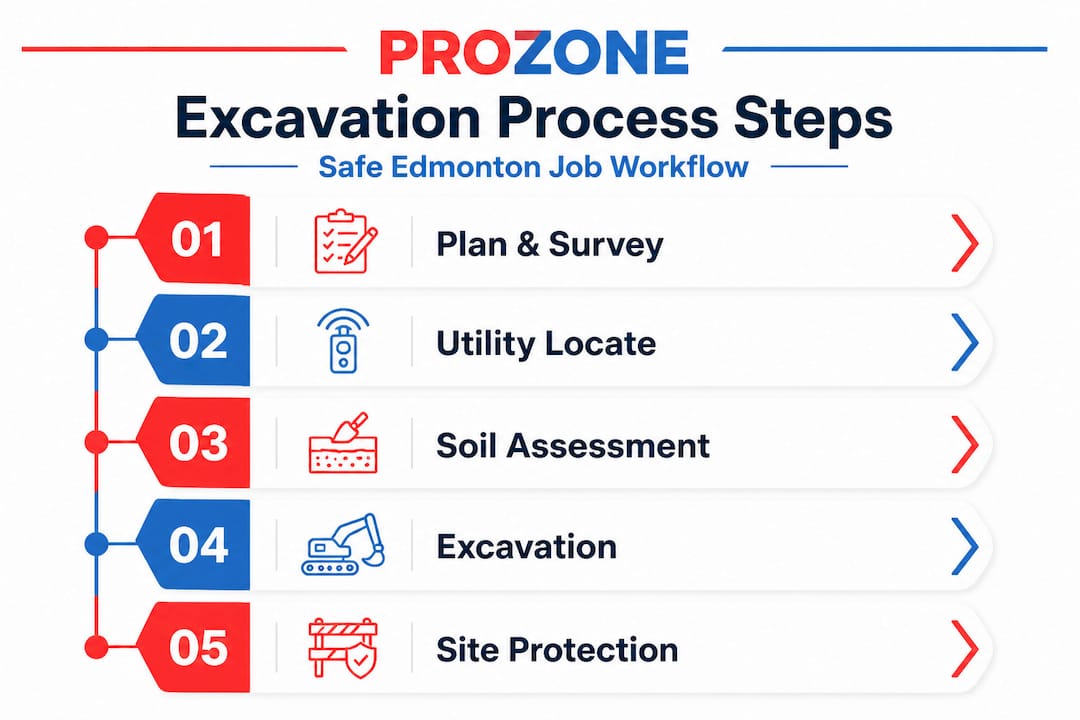
Safe excavation doesn’t begin with a machine. It begins with a detailed assessment of the site, the soil, and the surrounding infrastructure. Excavation jobs must begin with identifying soil type, utility locating, and planning for stabilization and safe entry/exit, as regulated by Alberta OHS Code Part 32. That regulatory foundation shapes every step that follows.
Step-by-step excavation planning in Edmonton:
- Site inspection by a competent person. Before any equipment arrives, a qualified individual must walk the site and assess conditions including ground stability, surface water, nearby structures, and access routes.
- Soil classification. Soil is classified into four types (A through D) based on cohesion, moisture, layering, and prior disturbance. The classification determines which protective system is required.
- Utility locating. Calling Alberta One-Call is legally mandatory before any dig begins. Underground gas lines, water mains, electrical conduits, and telecom cables must be identified and marked.
- Design of the protective system. Based on soil classification and depth, a sloping, shoring, or shielding system is selected and planned. This step cannot be improvised on site.
- Planning for spoil management. Excavated material must be placed at least 1 meter from the trench edge to prevent it from adding load pressure and increasing collapse risk.
- Access and egress planning. Any trench deeper than 1.5 meters requires a safe means of entry and exit, such as a ladder or ramp, positioned within 8 meters of every worker.
- Ongoing inspection during work. Conditions change. A competent person must inspect the site after any rainfall, vibration from nearby equipment, or any sign of ground movement.
Pro Tip: Before calling a single contractor, use Alberta One-Call’s online request system to submit a utility locate request at least three business days before your planned dig date. Doing this late delays the entire project and could put crews at serious risk.
Soil classification and protective requirements:
| Soil type | Characteristics | Required protection |
|---|---|---|
| Type A | Hard, cohesive, undisturbed | Vertical cuts allowed to 1.5 m |
| Type B | Fissured, previously disturbed | Sloping or shoring required |
| Type C | Granular, wet, crumbling | Full shoring or trench box required |
| Type D | Unstable, made fill, soft | Maximum protection always required |
Learning to install landscaping materials safely in Edmonton means understanding that even decorative projects involving minor earthmoving sit within this regulatory framework. If your landscaper is digging more than 0.5 meters to set retaining wall footings or install drainage pipe, soil classification applies. And if you want truly reliable results, working with teams offering proper excavation and removal services means these steps are already built into their workflow.
Safety in excavation: Common hazards and how to prevent them
Understanding the process is one thing, but recognizing and preventing real-world risks makes the difference between a routine job and a disaster.
Cave-ins are the most feared hazard, and rightly so. A cubic yard of soil weighs roughly 1.5 tons. When a trench wall collapses, a worker has almost no chance of escaping. The physics are brutal and fast. Most cave-ins are preventable with protective systems like sloping, shoring, and shielding, combined with competent inspection before and during every shift.
Major excavation hazards and how they’re managed:
- Cave-ins. Prevented through proper soil classification, appropriate protective systems, and immediate inspection after any ground disturbance or weather event.
- Falling material. Tools, equipment, and spoil piles near the edge create falling hazards. Spoil setbacks and exclusion zones around open trenches reduce this risk significantly.
- Utility strikes. Hitting a buried gas line or live electrical cable can be fatal. Mandatory utility locating before any dig is the primary defense, followed by careful hand-digging within the marked tolerance zone.
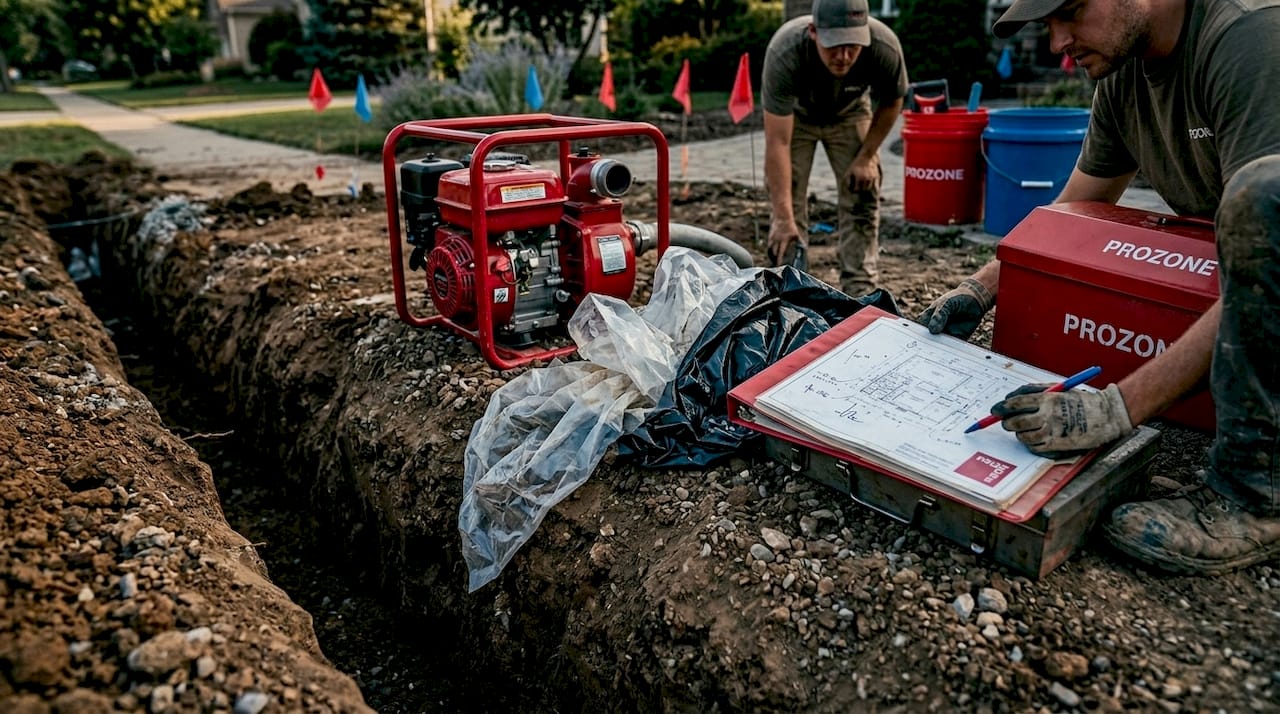
- Flooding and water accumulation. Edmonton’s clay soils and spring snowmelt create real flooding risk in open excavations. Never allow workers into a trench where water is accumulating. Pump out any standing water before entry and monitor continuously.
- Atmospheric hazards. Deep trenches can collect methane or carbon dioxide in low-lying areas. Atmospheric testing is required for trenches near landfill areas, old industrial sites, or anywhere organic decomposition is possible.
- Equipment proximity. Heavy equipment operating near an open excavation creates both vibration risk (which can destabilize walls) and direct strike hazard for workers.
“Any trench can kill. It doesn’t matter whether you’re digging for a backyard garden feature or a major utility corridor. The soil doesn’t know the difference between a landscaping project and an industrial site. Respect the ground.”
Pro Tip: If you notice tension cracks forming parallel to a trench edge, stop all work immediately and have a competent person assess before anyone re-enters. Tension cracks are a visible warning that ground failure may be imminent.
Effective risk mitigation on Edmonton excavation sites requires planning, not just reaction. Teams working with quality commercial landscaping materials in Edmonton know that proper site prep, including safe excavation of the installation area, directly affects the performance and longevity of everything that goes on top. Rushing the dig always costs more later.
Choosing the right excavation method: Factors and equipment
Selecting the right method and tools not only improves productivity but is key to delivering safe, cost-effective results in Edmonton’s specific soil conditions.
Edmonton’s soils are not uniform. The North Saskatchewan River valley has pockets of sand and gravel deposits, while most residential and commercial areas sit on dense lake-bottom clay, technically called lacustrine clay. This clay is notoriously difficult to work with. It’s strong when dry but becomes almost liquid-like when saturated. Matching equipment to soil conditions is therefore not a preference but a technical requirement. Excavation performance depends on matching methods and equipment to soil resistance, project size, and safety needs.
Excavation equipment comparison for Edmonton projects:
| Equipment type | Best application | Depth range | Limitation |
|---|---|---|---|
| Mini excavator | Tight-access residential work | Up to 3.5 m | Limited reach and force |
| Standard excavator | Foundation, utility, deep grading | 3.0 to 7.0 m | Needs adequate access width |
| Backhoe loader | Utility trenching, mixed tasks | Up to 4.5 m | Less efficient than dedicated excavator |
| Skid steer with bucket | Surface grading, cleanup | 0.3 to 1.0 m | Not suitable for trenching |
| Vacuum excavation truck | Utility zone exposure (safe-dig) | Up to 3.0 m | Slow for large volumes |
Key factors that determine method selection:
- Soil resistance and composition. Hard clay requires more powerful equipment and may need ripping attachments. Loose or granular material moves easily but requires faster wall stabilization.
- Site access width. Narrow residential lots in Edmonton’s older neighborhoods often limit equipment size to mini excavators or even hand tools in tight corners.
- Proximity to existing infrastructure. Working near building foundations, buried utilities, or trees with root systems requires precision methods rather than aggressive mechanical digging.
- Water table level. High groundwater, common in lower-lying Edmonton neighborhoods, means dewatering equipment must run continuously alongside excavation.
- Project depth and volume. Moving a few cubic meters for a landscaping feature is a different operation than excavating a full foundation, even if both are called “excavation.”
For projects involving base course construction and paving preparation, the excavation phase must achieve precise subgrade elevations. Even a few centimeters of inconsistency in subgrade depth can cause premature pavement failure. That’s where professional equipment calibration and experienced operators truly earn their value.
Specialty situations call for specialty solutions. Rocky subsurface conditions, common near the river valley, may require hydraulic breaker attachments. Extremely soft or wet sites may need geotextile fabric placed immediately after excavation to prevent subgrade mixing with fill material. These aren’t details you’d know from a quick online search.
When to hire professionals: What property managers and homeowners should know
So, how do you know when a pro is required, and what does a professional excavation experience actually look like in Edmonton?
The honest answer is that most excavation projects in Edmonton benefit from professional involvement. The question isn’t usually “do I need a pro?” but “at what point does going without one become genuinely dangerous or legally non-compliant?”
Decision process for hiring an excavation professional:
- Assess depth. If your project requires digging deeper than 0.5 meters, especially in an unfamiliar soil area, a professional assessment is warranted. Any trench over 1.5 meters requires specific regulatory compliance.
- Check utility proximity. If you know utilities are nearby or you’re unsure of their location, call a professional before touching the ground. Even small-scale landscaping excavations require competent-person inspection, just like larger projects.
- Evaluate complexity. Multiple trench runs, shoring requirements, or work adjacent to building foundations are beyond DIY territory for most property owners.
- Consider regulatory requirements. Alberta OHS Code sets specific standards for stabilization, spoil setbacks, and utility locates on every project. Non-compliance isn’t just risky, it’s a legal liability.
- Get a written scope. When you hire an excavation contractor, ask for a written scope that explicitly covers soil assessment, utility locate confirmation, protective system type, spoil management plan, and site restoration.
What to expect from a professional excavation team in Edmonton:
- Pre-project site visit and written assessment
- Confirmation of utility locate before mobilization
- Proper equipment matched to your project type and soil
- Protective systems installed before any worker enters a trench
- Regular inspection logs maintained throughout the project
- Clear communication on any unexpected underground conditions
- Site cleanup and surface restoration after excavation is complete
The statistic that sticks with most project managers: cave-ins kill multiple workers across North America every year, and the majority of those incidents happen on jobs that were considered routine by the people involved. Routine doesn’t mean safe. It means familiar, and familiarity breeds the kind of complacency that leads to accidents.
Take a look at the project gallery to understand the scale and quality of excavation and earthwork that professional teams deliver in Edmonton. Seeing completed projects gives you a concrete benchmark for what properly executed work actually looks like.
A contractor’s view: Why professional oversight changes everything
Having covered the technical basics, let’s pull back the curtain on what experienced contractors actually observe on Edmonton excavation sites, and why the gap between “following the rules” and “knowing what you’re doing” is wider than most people expect.
The most dangerous moment on any excavation project isn’t when something goes wrong. It’s when everything seems to be going right. Experienced crews know this. When a trench is holding its shape, equipment is moving smoothly, and the job is on schedule, there’s a natural temptation to skip the afternoon inspection or leave a crew member in the trench while the machine repositions. That’s when accidents happen.
Soil classification is another area where common assumptions lead to serious errors. Property owners and even some less experienced operators often look at soil and make a visual guess. Firm-looking clay gets labeled Type A, and suddenly a crew is working without adequate shoring in a trench that should have had a full protective system. The problem is that clay in Edmonton’s freeze-thaw environment can look cohesive on the surface while being completely saturated and unstable a meter down. You cannot reliably classify soil with your eyes alone.
Professional teams carry out penetrometer tests, ribbon tests, and visual clue checks in combination. They look for fissures, layering, seepage, and signs of prior disturbance. That multi-factor approach is what the Alberta OHS Code actually demands, and it’s why a competent person designation isn’t just a title. It represents real, documented training.
Here’s something that often surprises property managers: underground surprises are the norm, not the exception, in Edmonton’s older neighborhoods. Old utility lines that were never decommissioned, buried building debris from demolished structures, unmarked irrigation pipes, and even old septic infrastructure show up regularly. Professional crews treat every site as a potential puzzle. They’re not just digging. They’re interpreting ground conditions in real time and adjusting their approach accordingly.
Decisions around choosing durable landscaping materials for Edmonton projects always connect back to how well the excavation and base preparation were done. The best materials placed on a poorly excavated, inadequately compacted subgrade will fail prematurely. The ground beneath is the foundation of everything else, literally and figuratively.
One more reality worth stating plainly: regulations exist because people died. Every requirement in Alberta OHS Code Part 32 traces back to incidents where workers were killed or seriously injured. Following these rules isn’t bureaucratic box-checking. It’s acknowledging that excavation is one of the most unforgiving environments in construction, and that the people doing this work deserve every protective measure available.
Need Edmonton excavation work done right? ProZone delivers
If you’re planning any kind of excavation project in Edmonton, whether it’s a residential landscaping upgrade, a utility trench for a new build, or major earthworks for a commercial property, you need a team that understands both the technical demands and the regulatory landscape specific to Alberta.
ProZone Ltd handles all aspects of safe, compliant excavation for residential and commercial clients across Edmonton and the surrounding region. From soil assessment and utility coordination through to equipment selection, protective system installation, and site restoration, every project follows a rigorous process built around worker safety and quality outcomes. Explore the full range of Edmonton construction services ProZone offers, or check out the landscaping supplies available for your next outdoor project. Contact ProZone today for a tailored quote and project consultation.
Frequently asked questions
What counts as excavation work on a residential property?
Any project involving earth removal, such as digging for a patio, installing drains, or trenching for utilities, is considered excavation work and falls under safety rules. According to established practice, excavation means creating a cavity or trench by removing soil, using methods adapted to the scope and soil conditions.
Is a soil report always required for a small excavation?
For any significant excavation, soil must be classified to determine safe work methods, but for smaller garden or landscaping digs, basic soil assessment and competent inspection are still strongly recommended. Competent-person inspection and soil classification are core requirements in both US and Alberta-focused guidance, regardless of project size.
How is utility safety addressed before excavation in Edmonton?
Contacting Alberta One-Call to locate utilities is legally required before starting any dig to prevent service strikes and ensure worker safety. Contacting Alberta One-Call for utility locating is a non-negotiable step under Alberta OHS regulations.
What’s the penalty for ignoring excavation regulations in Alberta?
Penalties can range from immediate site shutdowns and substantial fines to full legal liability if injury or damage results from non-compliant excavation work. Repeat violations can result in permanent license suspension for contractors operating in Alberta.
How deep can I dig without shoring?
In Alberta, any trench deeper than 1.5 meters requires a safe means of entry and typically necessitates stabilization like shoring or sloping, depending on soil type. Providing safe means of entry/exit for trenches deeper than 1.5 meters, within 8 meters of all workers, is a direct requirement of Alberta OHS Code Part 32.