
TL;DR:
- Alberta has its own accessibility paving requirements aligned with ADA principles, requiring ongoing maintenance. Proper design, measurement, and routine inspections are essential for legal compliance and safe accessibility. Partnering with experts ensures durable, compliant surfaces that adapt to Alberta’s climate conditions.
Alberta property managers often assume that paving accessibility regulations are a uniquely American concern, that the ADA is someone else’s rulebook. That assumption is costly. Alberta has its own binding accessibility paving requirements embedded in the Alberta Building Code and national accessibility standards, and they mirror ADA principles so closely that understanding both frameworks is not just useful but essential. Whether you manage a commercial parking lot in Edmonton, a multi-tenant retail strip, or a municipal facility, getting your outdoor paved surfaces right protects you legally, reduces liability, and ensures every person on your property can move safely and independently.
Table of Contents
- Understanding ADA compliance paving: Key principles and requirements
- How Alberta’s standards compare: ADA principles versus local codes
- Essential features of compliant paving: Surfaces, slopes, and transitions
- Common mistakes and maintenance blind spots
- The hidden complexity of paving compliance: What most guides leave out
- Partner with Alberta’s paving compliance experts
- Frequently asked questions
Key Takeaways
| Point | Details |
|---|---|
| Compliance is essential | Alberta’s standards require that all outdoor paving routes are accessible, safe, and barrier-free. |
| Know your codes | Property managers must ensure conformity to Canadian and Alberta-specific accessibility rules, not just ADA checklists. |
| Measure and monitor | Meeting width, slope, and surface requirements – and regularly inspecting routes – is vital for ongoing compliance. |
| Avoid common pitfalls | Watch for issues like slope changes after repairs and surfaces that become unstable or slippery. |
| Choose expert help | Partnering with specialists ensures lasting compliance, risk reduction, and accessibility for everyone. |
Understanding ADA compliance paving: Key principles and requirements
To build a strong foundation, let’s first clarify exactly what ADA compliance paving means and why it’s essential for any property manager overseeing outdoor infrastructure.
ADA-compliant paving means designing and constructing outdoor paved “accessible routes,” including sidewalks, paths, parking access paths, and curb ramps, so people with disabilities can travel safely and independently. The entire concept revolves around creating a connected, unbroken path from public transportation stops and accessible parking spaces all the way to a building’s entrance. Break that chain anywhere and you have a compliance failure, regardless of how well every other segment performs.
The core technical requirements apply to surface quality, geometry, and materials. Understanding each one helps you evaluate your property with precision rather than guesswork.
Surface firmness and stability are the baseline. A surface must support the weight and movement of wheelchairs, walkers, and mobility aids without compressing, shifting, or deflecting. Concrete and asphalt both qualify when properly installed and maintained. Loose gravel, crushed stone, bark mulch, and soft soil do not. This is not a judgment call: the guidance is explicit that materials failing the firm and stable test disqualify the entire route.
Slip resistance is a separate but equally critical standard. A surface can be firm and stable while still being dangerously slick when wet. Exposed aggregate finishes, broom-finished concrete, and asphalt with adequate surface texture all contribute to slip resistance. Polished or sealed smooth concrete near building entrances is a frequent compliance problem.
The key technical requirements for accessible routes include:
- Minimum clear width: 36 inches at any point, with 60-inch passing spaces recommended where two wheelchair users might need to pass each other
- Maximum running slope: 5% (1 in 20 ratio) for accessible routes; anything steeper is classified as a ramp and triggers additional requirements
- Maximum cross slope: 2% (1 in 48 ratio), measured perpendicular to the direction of travel
- Surface condition: No vertical changes greater than half an inch without a beveled transition; changes between a quarter inch and half an inch must be beveled at 1:2
- Stable surface materials: Concrete or asphalt in good repair; no loose, shifting, or compressible surfaces anywhere along the route
“The accessible route must be free of surface discontinuities that would impede passage or create tripping hazards. Routine maintenance to eliminate barriers and keep surfaces within tolerances is as important as the initial installation.” – ADA National Network
Proper sidewalk safety and accessibility is not a one-time construction event. It’s an ongoing operational commitment, which is why understanding these principles at a fundamental level matters so much.
How Alberta’s standards compare: ADA principles versus local codes
Now that you know what ADA compliance paving is, let’s see how these requirements actually compare with Alberta’s legal codes, because this is where many property managers make expensive errors.
The ADA is a United States federal law. It does not directly govern Canadian properties. However, Canadian accessibility requirements for paved surfaces and outdoor spaces reference principles that align closely with ADA-style accessible route concepts. In practice, this means most of the technical measurements you encounter in ADA guidance translate almost directly to what Alberta requires.
In Alberta, the primary regulatory instruments are the Alberta Building Code, specifically Section 3.8, which covers barrier-free design requirements for the built environment, and the associated Accessibility Design Guide published alongside Alberta’s Safety Codes Act framework. At the national level, Accessibility Standards Canada has published the CAN-ASC-21 Outdoor Spaces draft standard, which applies to sidewalks, pedestrian crossings, curb ramps, accessible parking areas, and exterior paths of travel.
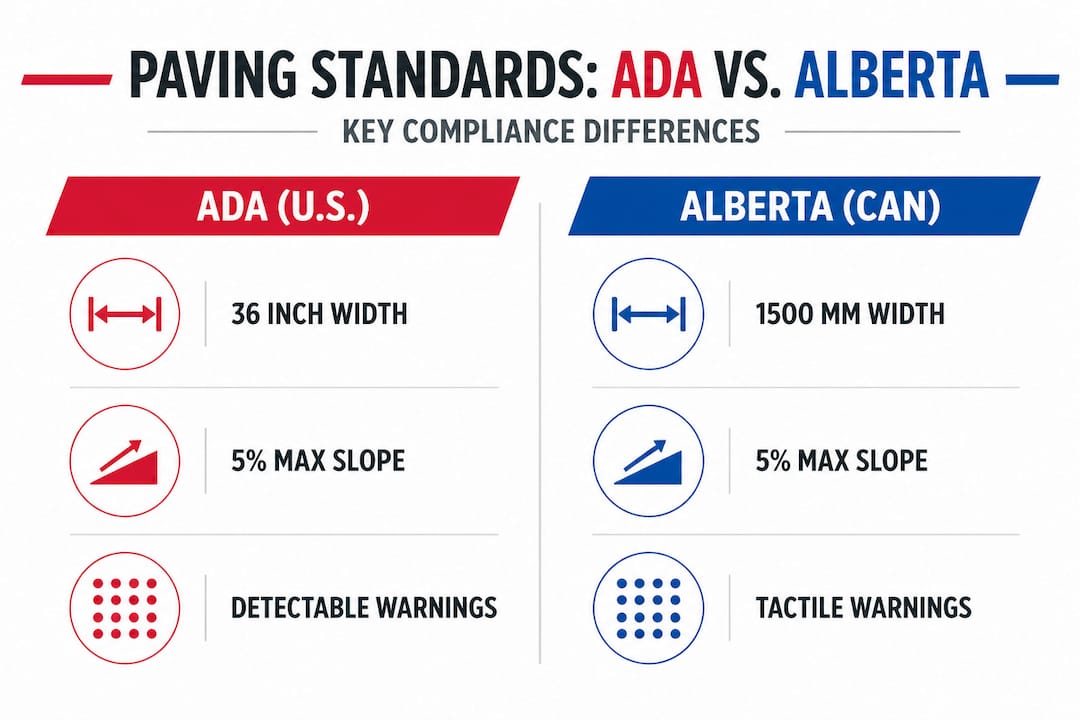
The practical effect for property managers is this: checking against an ADA-style checklist is a reasonable starting point, but Alberta’s local interpretation of slopes, ramp widths, and surface materials may differ in specific details. You need to verify against Edmonton sidewalk standards and the applicable provincial codes, not just rely on generic ADA documentation.
Here is a direct comparison of key standards across frameworks:
| Feature | ADA (U.S.) | CAN-ASC-21 / Alberta |
|---|---|---|
| Minimum route width | 36 inches (915 mm) | 1500 mm (60 inches) preferred; 915 mm minimum |
| Maximum running slope | 5% (1:20) | 5% (1:20) |
| Maximum cross slope | 2% (1:48) | 2% (1:50) |
| Curb ramp maximum slope | 8.3% (1:12) | 8.3% (1:12) |
| Detectable warnings | Required at curb ramps | Required at hazard edges and crossings |
| Surface material | Firm, stable, slip resistant | Firm, stable, slip resistant |
| Vertical transitions | Max 13 mm (half inch) | Max 13 mm with beveling |
The numbers are remarkably similar, which confirms that teams familiar with ADA principles are well positioned to work in Alberta, provided they reference Canadian paving standards and the applicable local code editions for project-specific decisions.
Pro Tip: Keep a physical copy of Alberta’s Accessibility Design Guide on-site during any paving project. When contractors reference “ADA specs,” ask them to map each specification to the Alberta equivalent. A one-page crosswalk document prevents costly misunderstandings before concrete gets poured.
For the latest interpretive guidance and case studies specific to Edmonton and the surrounding region, the ProZone paving compliance insights resource covers practical applications that go beyond what building code language describes.
Essential features of compliant paving: Surfaces, slopes, and transitions
With the regulatory background set, here’s what compliant paving looks like in practical, measurable terms. This is where many well-intentioned projects fall apart because the gap between understanding requirements conceptually and implementing them precisely in the field is significant.
Compliant paving covers specific curb and edge transition elements, including curb ramps and detectable warning surfaces, plus the safe connection of parking to entrances via an accessible route. Maintenance matters too, keeping surfaces within tolerances over time. That last point is critical and we will address it fully in the next section.
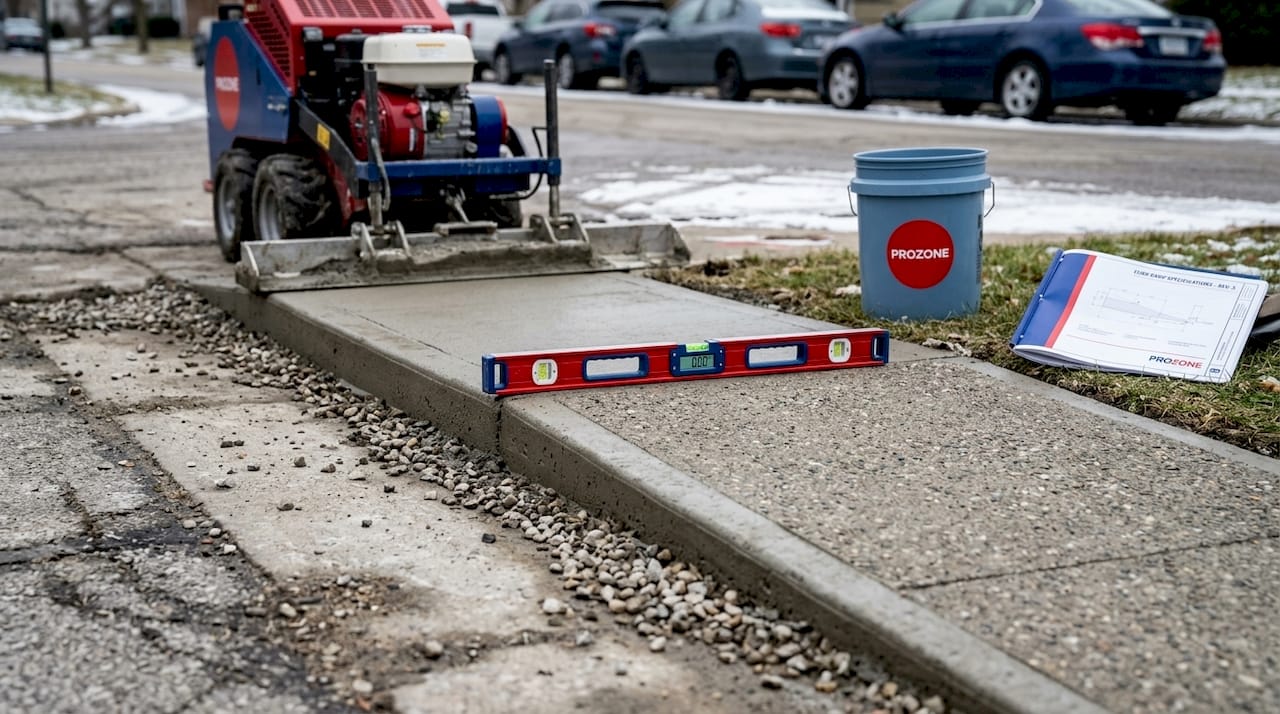
Alberta’s barrier-free requirements under the Safety Codes Act apply to outdoor paved surfaces as part of the broader built environment, meaning every element described below carries legal weight, not just best-practice status.
Here are the measurable features to verify on any compliant paved accessible route:
- Running slope measurement: Use a digital level or slope meter along the direction of travel. Any segment exceeding 5% must be re-evaluated as a ramp with appropriate ramp-specific requirements such as handrails and landings.
- Cross slope measurement: Measure perpendicular to travel direction at multiple points. Slopes exceeding 2% cause wheelchair users to fight lateral drift constantly, creating both fatigue and genuine safety hazards.
- Clear width verification: Measure at the narrowest point, including accounting for any signage, planters, utility boxes, or bollards that encroach on the path. These obstructions are common causes of noncompliance in otherwise well-paved areas.
- Surface condition inspection: Look for cracking, spalling, heaving, or settlement. Document the size and location of any vertical discontinuity exceeding 6 mm (a quarter inch). Between 6 mm and 13 mm requires beveling at 1:2. Anything above 13 mm must be repaired.
- Curb ramp geometry check: Ramp slopes must not exceed 8.3% (1:12), flare slopes at the sides must not exceed 10%, and landings at the top and bottom must be at least 1.2 meters deep and 1.5 meters wide.
- Detectable warning surfaces: Truncated dome tiles or cast-in-place surfaces must be installed at the bottom of curb ramps, at hazardous drop-offs, and at pedestrian crossing points. Color contrast matters too: the domes must contrast visually with the surrounding surface.
| Feature | Minimum/maximum standard | Common failure mode |
|---|---|---|
| Route clear width | 36 in (915 mm) minimum | Encroachment by furniture or signage |
| Running slope | 5% maximum | Drainage design creating excess slope |
| Cross slope | 2% maximum | Crown drainage pushing water to sidewalk edge |
| Vertical transitions | 13 mm maximum | Settlement, frost heave, repair patches |
| Curb ramp slope | 8.3% (1:12) maximum | Contractor using steeper residential standard |
| Detectable warnings | Required at crossings | Omitted during repairs |
| Surface texture | Firm, stable, slip resistant | Smooth sealed concrete near entries |
The connection between driveway paving best practices and accessible parking lot design is more direct than most people realize. Grades in driveways and parking surfaces feed directly into whether the accessible routes connecting parking stalls to building entrances meet slope requirements.
For parking lots specifically, accessible parking lot paving requires that accessible stalls connect to a route that stays within those 5% running and 2% cross-slope limits all the way to the entrance. The path cannot require a person using a wheelchair to travel behind parked vehicles or cross active traffic lanes. Parking lot accessibility also depends on proper line markings and symbol painting, which are as regulated as the pavement itself.
Pro Tip: When commissioning new paving work or major repairs, request a post-construction slope survey from your contractor. A documented slope report with actual measurements gives you a compliance baseline and protects you if questions arise later during an audit or complaint investigation.
Common mistakes and maintenance blind spots
Even with good initial construction, routine maintenance and awareness of common pitfalls are crucial for long-term compliance. Alberta’s freeze-thaw cycle creates conditions that actively work against your investment.
Slope drift, surface texture failure, and abrupt level changes after repairs or settling are the three most common real-world compliance failures practitioners encounter. Loose gravel and dirt surfaces are explicitly identified as failing the firm and stable requirement. These are not edge cases; they represent the majority of noncompliance issues found during accessibility audits of commercial properties across Alberta.
Frost heave is the single biggest maintenance threat in Edmonton and surrounding communities. When water in the subgrade freezes, it expands and can push paved surfaces upward by several centimeters. When it thaws, the surface may settle unevenly. A sidewalk that measured perfectly on installation can develop a 20 mm vertical discontinuity after a single hard winter. That is a compliance failure and a serious trip hazard.
Repair patches introduce their own risks. When a contractor fills a pothole or crack with new asphalt or concrete, the repair material often sits at a slightly different elevation than the surrounding surface. Even a 15 mm step at a patch edge disqualifies that section of the accessible route. The patch must be feathered smoothly or the transition must be beveled at the correct ratio.
Common noncompliance situations to watch for include:
- Gravel or crushed stone paths positioned between accessible parking and building entrances, which do not meet firm and stable requirements under any circumstances
- Drain grates with openings oriented parallel to the direction of wheelchair travel, which can catch small caster wheels and cause falls
- Tree root heaving that creates both slope changes and vertical discontinuities simultaneously
- Winter maintenance damage where snowplow blades chip and abrade surface texture, reducing slip resistance over multiple seasons
- Temporary barriers from construction or maintenance work that narrow the accessible route below 36 inches without providing an alternative compliant path
“The accessible route must be maintained free of ice and snow, obstructions, and surface damage that could impede travel or create hazards. A compliant route on opening day is not a compliant route if maintenance fails to preserve those standards through the operational life of the property.” – ADA Guidance on Outdoor Spaces
Addressing these issues requires year-round maintenance decisions that treat accessible routes as a priority, not an afterthought. The question of whether to repair a section or replace it entirely often hinges on whether the underlying cause of failure has been addressed. Patching over repeated frost heave without improving drainage, for example, is a short-term fix that will require another repair within two to three seasons.
The hidden complexity of paving compliance: What most guides leave out
With the risks and recurring challenges mapped out, it’s worth reflecting on what typical compliance advice often overlooks and what truly works for Alberta property managers who want to stay ahead of this issue.
Most compliance guides hand you a checklist. Check the slope. Check the width. Check the ramp. Tick the boxes and move on. The problem is that a checklist mindset treats compliance as a static state rather than a dynamic condition of your infrastructure. Pavement changes. Ground moves. Alberta winters are relentless. A property that passes every measurement today can fail by spring.
The more effective mental model is treating paving as part of an accessibility system. That means measuring running slope, cross slope, and clear width of the accessible route, confirming surface firmness, stability and slip resistance, verifying curb ramps and landings, checking the full connection from accessible parking to building entrances, and then implementing routine maintenance to keep the route within tolerances over its entire service life. Every element connects to every other element. A compliant parking lot connected to a noncompliant curb ramp connected to a compliant sidewalk is still a noncompliant property.
There is another layer that generic guides miss entirely. Many contractors in Alberta market their work as “ADA-compliant” because ADA is the terminology the market recognizes. But Canadian accessibility compliance for Alberta projects is driven by Canadian accessibility laws and Alberta’s building code requirements, not U.S. federal law. When a contractor says “ADA compliant,” you need to ask specifically which standard they are referencing and how that maps to Alberta’s Safety Codes Act requirements and the CAN-ASC-21 Outdoor Spaces standard. This is not pedantry. A contractor using U.S. ADA slope tables that differ from the Alberta-adopted version by even small margins can create finished work that passes one standard but fails the applicable local one.
The legal exposure from noncompliant paving in Alberta is not theoretical. Human rights complaints, municipal enforcement, and insurance liability claims all follow from accessible route failures. The documentation trail matters enormously. A property manager who can show a dated slope survey, a maintenance inspection log, and repair records is in a fundamentally different legal position than one who cannot.
We advocate for a quarterly visual inspection cycle with an annual professional measurement survey. The quarterly visual check takes 20 minutes and catches obvious problems: new cracks, frost damage, drainage issues, or obstructions. The annual survey uses instrumented measurement to confirm that slopes, widths, and surface conditions remain within tolerance. Together, these create the documented compliance record that protects you and your organization. Reviewing Edmonton best practices can help you structure both inspection types appropriately for local conditions.
The uncomfortable truth is that most accessibility failures on Alberta commercial properties are not design failures. They are maintenance failures. The initial work was done correctly. Nobody followed up. Alberta’s climate did what it always does, and three years later the property has barriers it did not have at construction completion.
Partner with Alberta’s paving compliance experts
If you want to ensure your site is, and stays, compliant without the guesswork and stress, here’s how we can help. ProZone Ltd brings specialized expertise in Alberta barrier-free paving to commercial, municipal, and private property managers across Edmonton and the surrounding region. Our team handles the full compliance scope: accessible sidewalk construction, parking lot grading, curb ramp installation, detectable warning surfaces, repair work, and scheduled maintenance programs. We document our work with slope measurements and project records so you have the compliance evidence you need. Learn more about asphalt paving solutions and how ProZone can keep your outdoor infrastructure safe, barrier-free, and code-compliant through every Alberta season.
Frequently asked questions
What does ADA compliance paving mean for Alberta properties?
It means ensuring paved areas meet Alberta’s accessibility standards for routes, slopes, and barrier-free design. Canadian properties follow Canadian accessibility requirements that align closely with ADA-style accessible route concepts, not the U.S. law itself.
What are the minimum width and slope rules for accessible routes?
Accessible routes require a minimum clear width of 36 inches, a maximum running slope of 5% (1:20), and a maximum cross slope of 2% (1:48). These measurements apply at every point along the route, not just at averages.
Do Canadian codes require curb ramps and tactile warning surfaces?
Yes. Accessibility Standards Canada’s outdoor-spaces standard applies to sidewalks, curb ramps, and accessible parking areas and requires compliant surfaces and tactile warnings at crossings and hazardous edges.
Can gravel or stone surfaces be ADA or Alberta-compliant?
No. Loose gravel or dirt does not meet the firm and stable requirement that is fundamental to any accessible route standard, whether ADA, CAN-ASC-21, or Alberta’s building code requirements.
Is ongoing maintenance required for compliance, even after proper installation?
Yes. Maintenance is required to keep surfaces within tolerances and eliminate new barriers that develop through settling, frost heave, or surface wear. Initial compliance does not guarantee ongoing compliance without documented inspection and repair programs.