
TL;DR:
- Edmonton’s frequent freeze-thaw cycles and heavy precipitation accelerate road damage, leading to numerous potholes. Timely repairs are essential to reduce costs, liability, and safety risks, but weather conditions and resource constraints often cause delays. Data-driven, risk-based maintenance strategies enable more effective planning, longer-lasting fixes, and efficient management of pothole repairs.
Edmonton’s roads take a beating unlike almost anywhere else in Canada. The city’s aggressive freeze-thaw cycles, combined with heavy precipitation and high traffic volumes, produce potholes at a pace that consistently outstrips repair targets set by the city itself. For property managers and municipal authorities, understanding why timely pothole repair matters is not an academic exercise. It directly affects liability, infrastructure longevity, maintenance budgets, and the safety of every driver who uses your roads and parking lots each day.
Table of Contents
- Why timely pothole repair matters in Edmonton’s climate
- Edmonton’s official pothole repair targets and their impact on infrastructure
- The cost of delayed pothole repairs and benefits of swift action
- Operational strategies for achieving timely pothole repair in Edmonton
- Rethinking timely pothole repair: A data-driven, risk-based approach
- Professional solutions for timely pothole repair in Edmonton
- Frequently asked questions
Key Takeaways
| Point | Details |
|---|---|
| Edmonton’s climate accelerates pothole damage | Freeze-thaw cycles and precipitation cause rapid road deterioration requiring swift pothole repairs. |
| City targets vary by priority | High-priority roads must be inspected and repaired faster than alleys to maintain safety and performance. |
| Delays increase costs and risks | Untimely pothole repairs lead to higher expenses, vehicle damage, and accident potential. |
| Data-driven, risk-based approach is key | Combining timely repairs with data analytics improves prioritization and resource allocation. |
| Seasonal planning maximizes repair effectiveness | Scheduling repairs in favorable weather and deploying seasonal crews boosts success and efficiency. |
Why timely pothole repair matters in Edmonton’s climate
Edmonton’s road damage problem starts underground, where you can’t see it. When water seeps into small cracks in asphalt and then freezes, it expands with enough force to fracture the pavement from within. That expansion breaks the bond between asphalt layers, and when the ice melts, it leaves a void. Traffic passing over that void causes the surface to collapse. The result is a pothole.
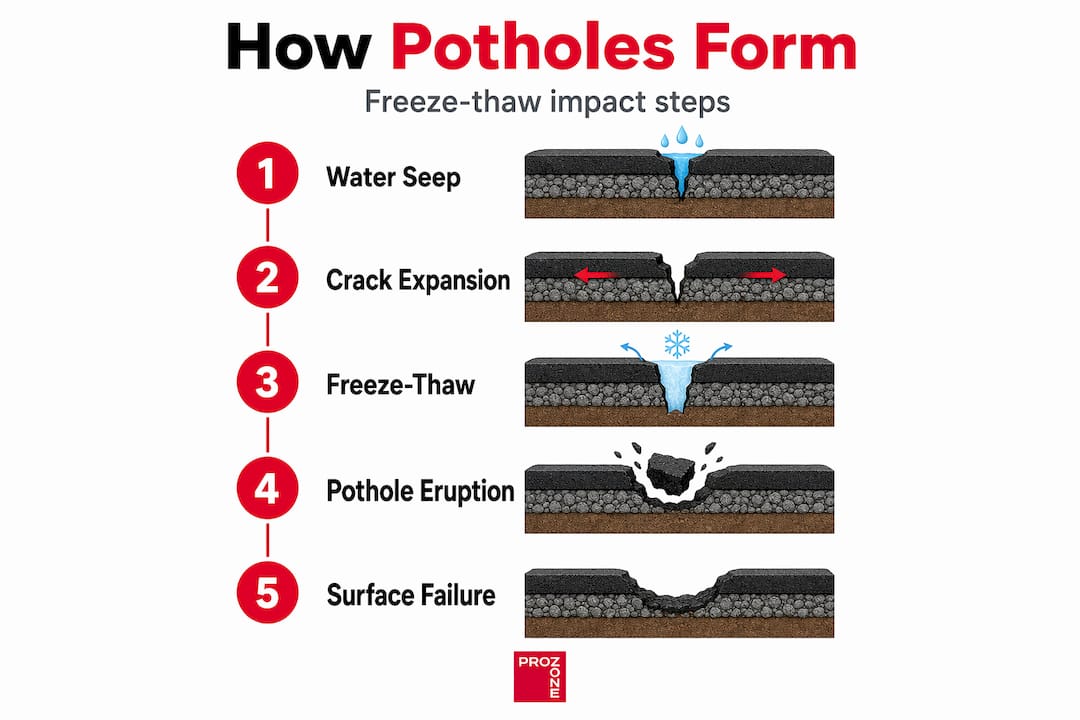
What makes Edmonton especially vulnerable is not just cold temperatures. It is the frequency of temperature swings near zero degrees Celsius. Sustained deep cold is actually less damaging to pavement than repeated cycling above and below freezing. As asphalt research confirms, repeated freeze-thaw cycles near 0°C cause significantly more structural damage than prolonged periods of hard cold, because each cycle reopens and widens existing cracks.
Edmonton’s climate further complicates this by adding heavy precipitation into the mix. Wet conditions prevent fresh asphalt patches from bonding properly, which means repair crews face a narrow window of suitable weather. When that window closes, unrepaired potholes keep deteriorating. The impact of untreated potholes compounds quickly.
Key environmental factors driving Edmonton’s pothole problem:
- Temperature volatility: Edmonton regularly crosses the freeze-thaw threshold dozens of times each winter and spring
- Moisture infiltration: Rain and snowmelt push water deep into existing pavement cracks before freezing sets in
- Traffic load: High vehicle volumes accelerate the collapse of weakened pavement
- Delayed curing windows: Wet or cold weather prevents proper bonding of patching material
“The roads are already telling us something. Every crack that fills with water in fall is a pothole waiting to form in spring.”
Understanding the winter weather impact on asphalt is the first step toward building a repair strategy that actually works in Edmonton’s environment. Knowing how moisture moves through pavement and why certain weather patterns accelerate parking lot damage helps you plan ahead rather than react after the damage is done.
Edmonton’s official pothole repair targets and their impact on infrastructure
The City of Edmonton has formalized its pothole response expectations into a tiered system based on road priority. The intent is solid: focus the fastest response on the highest-traffic, highest-risk roads and apply longer timelines to lower-risk areas like alleys. In practice, however, meeting these targets has proven difficult.
| Road priority | Inspection target | Repair target |
|---|---|---|
| High-priority roads | Within 2 days | Within 10 days |
| Lower-priority roads | Within 5 days | Within 1 month |
| Alleys | Within 2 weeks | Within 1 year |
The numbers reveal a real gap between policy and performance. In Q4 2025, Edmonton met its high-priority repair target only 68% of the time, against an 80% benchmark. That 12-point shortfall means roughly one in eight high-priority potholes stayed unrepaired beyond the target window.
For property managers, this performance data matters directly. If the city is falling short on its own arterial roads, potholes near or accessing your commercial property may not receive timely attention unless you take independent action. The importance of pothole repair extends beyond civic duty. It shapes your legal exposure.
Why the tiered system still represents the right framework, even when imperfectly executed:
- Risk-based allocation: Not every pothole carries the same safety risk. Prioritizing by road type channels resources where they matter most
- Accountability benchmarks: Published targets create measurable performance standards that force transparency
- Maintenance forecasting: Managing inspection and repair timelines becomes easier when you know what response windows apply to your assets
- Liability mapping: Understanding target timeframes helps property managers document inspection records and demonstrate due diligence
Missing a 10-day repair window on a high-priority road is not just a performance statistic. It is additional stress on pavement that was already compromised. Every day past the target, vehicle traffic continues working on that void, widening it, deepening it, and increasing both the cost of repair and the risk to drivers.
The cost of delayed pothole repairs and benefits of swift action
The financial case for timely pothole repair is not complicated, but the scale of the numbers tends to surprise people. Edmonton spent $11.7 million in 2025 repairing more than 650,000 potholes. That figure reflects what happens when a backlog builds. Catching pavement damage early and filling it before it expands costs a fraction of what a full-depth repair or road resurfacing requires.
The costs of delayed repairs fall into three categories that property managers and municipal authorities need to account for separately:
- Direct repair costs: A small surface crack costs almost nothing to seal. A pothole that has widened and deepened requires more material, more labor, and often base-layer work
- Vehicle damage liability: Drivers can and do file claims when vehicle damage is traceable to an unrepaired hazard on a road you manage. Suspension components, tires, and wheel rims are the most common casualties. How potholes affect drivers extends well beyond inconvenience
- Secondary infrastructure damage: Potholes collect water. That water accelerates edge cracking, undermines curbs, and saturates base layers. One unrepaired pothole can initiate a failure zone that spreads across several meters of pavement
Pro Tip: Document every pothole inspection with photos and timestamps. If a claim is ever filed against your property, your inspection record is your first line of defense. A pothole you knew about and didn’t address within a reasonable timeframe is a liability. One you documented and scheduled for repair is a manageable situation.
Better data collection and maintenance practices prevent potholes from escalating into major failures. The cost benefit here is not theoretical. It is the difference between a $50 crack seal and a $2,000 base repair. The benefits of proactive asphalt repair in Edmonton’s climate are measurable and significant. Acting early keeps roads safe and budgets predictable.
Operational strategies for achieving timely pothole repair in Edmonton
Knowing that timely repairs matter is one thing. Building the operational structure to deliver them consistently is another. Edmonton’s municipal approach offers a useful model, even for private property managers working at a smaller scale.
Edmonton’s seasonal repair crews begin mobilizing in March through June, expanding their capacity through summer while balancing the work against competing priorities like street sweeping. That schedule reflects a hard-learned reality: asphalt patching requires specific temperature and moisture conditions to cure properly, and you can not simply accelerate repairs by throwing more crews at the problem when the weather isn’t cooperating.
A practical approach to scheduling timely pothole repair in Edmonton:
- Start inspections in late winter. As snow clears in March and April, new potholes become visible and conditions are approaching workable. Early identification prevents small failures from becoming large ones before repair crews are fully deployed
- Prioritize by traffic volume and risk exposure. A pothole at the entrance to a busy commercial property carries different urgency than one in a rarely used rear parking area. Allocate your repair budget accordingly
- Book contractor capacity before peak season. Repair contractors are in high demand from April through June. Securing agreements in late winter gives you scheduling priority and avoids delays caused by contractor availability
- Use cold-mix asphalt for temporary winter patches. Cold-mix does not perform as well as hot-mix but it can seal a pothole through winter until permanent repairs become feasible. A temporary fix prevents the void from growing
- Schedule permanent repairs during extended dry windows. Asphalt bonding requires dry, warm conditions. Track forecasts and align your repair schedule to maximize curing time
“Failure to meet repair targets often reflects weather conditions and resource constraints. Realistic scheduling that accounts for both is more effective than simply setting more aggressive timelines.”
This kind of adaptive scheduling, driven by conditions rather than calendar dates alone, is what separates an effective maintenance program from one that perpetually chases its own backlog. Optimizing your asphalt repair workflow is as much about timing as it is about technique.
Pro Tip: When coordinating seasonal repair schedules, align pothole patching with your annual line-marking and sealcoating program. Doing surface work in the right sequence, seal first, mark second, can reduce your total downtime and get more out of each weather window.
Rethinking timely pothole repair: A data-driven, risk-based approach
Here is what most road maintenance conversations get wrong. They treat timeliness as the entire solution. Get there faster, fix more potholes, hit the targets. But missed repair targets highlight a structural problem that speed alone won’t solve: without smarter data and risk prioritization, you are simply responding faster to a problem that keeps outpacing you.
Edmonton spent nearly $12 million on pothole repairs in a single year and still missed performance targets. The volume of potholes isn’t the primary driver of that gap. The primary driver is the absence of a predictive maintenance model that identifies which sections of road are likely to fail before they do. Fix those sections early and you dramatically reduce the emergency repair burden in spring.
Our perspective, informed by years of working on Edmonton’s roads and parking lots, is that timely pothole repair must be paired with three things to actually move the needle:
Condition data, collected continuously. Property managers who inspect their asphalt once a year are not working with current information. Roads and parking lots need quarterly assessment. A crack photographed in October that becomes a pothole in March is a preventable expense, but only if someone was looking.
Risk weighting, not just road classification. Edmonton’s tiered system classifies roads by priority type. That is a start. But two roads in the same tier can carry very different risk profiles depending on traffic volume, drainage patterns, and pavement age. A risk-weighted approach routes emergency attention to the highest actual hazard, not just the highest administrative classification.
Adaptive targets that reflect reality. A blanket 10-day repair target sounds reasonable. But in a wet May when crews are stretched thin and asphalt plants are backlogged, that target produces failure statistics rather than repaired roads. Targets need weather-adjusted windows, especially for surface treatments that depend on temperature and dry conditions.
The top road repair methods available today allow for more precise and durable fixes than older patching techniques. But selecting the right method requires knowing the full condition of the pavement, not just the visible pothole. Invest in the data before you invest in the patch.
Professional solutions for timely pothole repair in Edmonton
Translating these strategies into action requires the right contractor partnership. ProZone Ltd provides asphalt repair, road construction, and maintenance services specifically tailored to Edmonton’s climate and the demands of both municipal and commercial properties. Whether you manage a commercial parking lot or oversee a network of municipal roads, the [construction services available for Edmonton property managers](https://prozoneltd.ca/types-construction-services-edmonton-Edmonton managers-2026) cover the full scope of what you need to stay ahead of pothole season.
From strategic road construction for municipalities and commercial properties to targeted patching of individual failures, our teams understand how Edmonton’s freeze-thaw cycle affects repair timing, material selection, and long-term durability. If you’re ready to address existing damage or build a maintenance schedule that keeps your roads in condition year-round, our pothole repair guide walks through the technical options in plain language. Contact ProZone Ltd to discuss a repair plan built for Edmonton’s conditions.
Frequently asked questions
What are Edmonton’s target timeframes for pothole repair?
Edmonton targets inspection within 2 days and repair within 10 days for high-priority roads; lower-priority areas are inspected within 5 days and repaired within a month, while alleys receive inspection within 2 weeks and repair within a year.
Why are freeze-thaw cycles especially damaging to Edmonton’s roads?
Each cycle of freezing and thawing forces water trapped in pavement to expand and contract, widening cracks with every pass. Cycles near 0°C cause more cumulative damage than sustained deep cold because the cycle repeats more frequently, giving cracks less time to stabilize.
How can data collection improve pothole repair efforts?
Detailed road condition data lets maintenance teams identify deteriorating sections before they become potholes, prioritize the highest-risk repairs, and plan seasonal budgets with far greater accuracy than reactive inspection alone.
What strategies does Edmonton use to handle pothole repairs seasonally?
Seasonal crews mobilize in spring, expanding through summer and coordinating repair schedules around street sweeping and weather windows to maximize the time when asphalt can be applied and properly cured.
What are the financial consequences of delayed pothole repairs?
Delays compound damage, increasing both the number of potholes requiring attention and the depth of each repair. Edmonton’s $11.7 million repair bill in 2025 for over 650,000 potholes illustrates the scale of cost that accumulates when preventive and timely action is consistently missed.