
TL;DR:
- Effective project scoping involves defining boundaries, deliverables, constraints, and acceptance criteria to ensure project success. Clear scope statements, a detailed Work Breakdown Structure, and strict change control prevent scope creep and disputes during execution. Accurate scope documentation is especially critical in construction projects in Edmonton due to climate and regulatory considerations.
Project scoping is one of the most consequential steps in any project, yet it is also one of the most frequently misunderstood. Many teams treat it as a formality rather than a governance discipline that defines what will be built, what will not be built, and how success will be measured. Understanding what is project scoping means understanding how projects stay on budget, on schedule, and aligned with stakeholder expectations. This guide covers the core components, the step-by-step process, common pitfalls, and industry-specific nuances that every project manager, business analyst, and stakeholder should know before work begins.
What project scoping actually covers
Project scoping is the formal process of defining the boundaries and deliverables of a project by documenting its goals, tasks, constraints, assumptions, and acceptance criteria. In standard project management vocabulary, this practice is more precisely called scope definition or scope management, terms codified in frameworks like the Project Management Body of Knowledge (PMBOK). The informal phrase “project scoping” describes the broader activity, while the PMBOK uses “Define Scope” as the specific process that produces the official scope baseline.

Two key documents come out of this process. The project scope statement describes what the project will deliver and what it explicitly will not. The scope management plan defines how scope changes are handled, validated, and communicated throughout the project lifecycle. Mixing these two documents creates enforcement gaps, because one describes content while the other governs control.
Key elements of project scope definition
A well-formed project scope definition addresses six core elements:
- Goals and objectives: Specific, measurable outcomes the project must achieve
- Deliverables: Tangible outputs that mark project completion, such as a finished road section, a deployed software module, or a completed site survey
- Work activities: The tasks required to produce each deliverable, typically organized using a Work Breakdown Structure (WBS)
- Constraints: Fixed limits on budget, timeline, resources, or regulatory requirements
- Assumptions: Conditions treated as true for planning purposes that have not been formally verified
- Acceptance criteria: The conditions under which a deliverable is considered complete and approved
The Work Breakdown Structure deserves special attention. WBS traceability to the approved scope statement is a non-negotiable requirement. Every element in the WBS must map back to an approved scope item, and nothing should appear in the WBS that cannot be traced to the scope statement.
Pro Tip: Create a two-column traceability matrix that maps each WBS element to its corresponding scope statement line item. This single document will save hours of dispute resolution during project execution.
| Document | Primary purpose | Who owns it |
|---|---|---|
| Project scope statement | Defines deliverables, exclusions, and acceptance criteria | Project manager and sponsor |
| Scope management plan | Governs how scope changes are processed and approved | Project manager |
| Work Breakdown Structure | Breaks deliverables into trackable work packages | Project manager and team leads |
How to scope a project: a step-by-step process
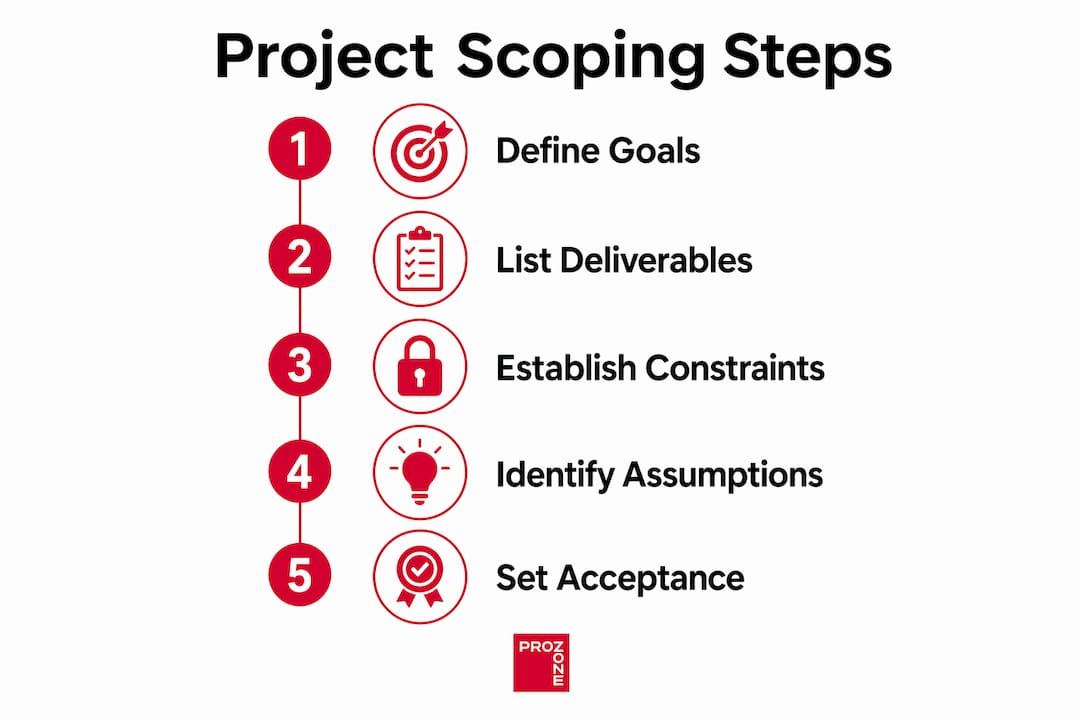
The project scoping process is not a single meeting or a single document. It is a disciplined sequence of activities that builds alignment before resources are committed. Here is a proven approach used across both construction and software environments.
-
Determine project goals and objectives. Start by defining what success looks like in measurable terms. Vague goals produce vague scopes. A goal like “improve site drainage” becomes actionable only when expressed as “install 200 linear meters of French drain to reduce surface runoff by 40% before spring thaw.”
-
Define clear, measurable deliverables. Each deliverable should have an owner, a completion date, and acceptance criteria. Scope statements often serve as the foundation for a Statement of Work when external contractors or vendors are engaged.
-
Build the Work Breakdown Structure. Decompose each deliverable into discrete work packages. This step forces the team to think through execution details that are invisible at the deliverable level, surfacing hidden complexity early.
-
State explicit exclusions. List what the project will not deliver. This is the most underutilized element of scope definition, and it is often the single greatest source of later disputes. If the project covers asphalt resurfacing of a parking lot, state explicitly that line marking is excluded unless a change order is submitted.
-
Document all constraints. Record budget ceilings, regulatory deadlines, material procurement lead times, and resource availability limits. In Edmonton construction projects, environmental constraints such as frost depth and Alberta Safety Codes compliance must appear here.
-
Incorporate stakeholder input and get formal approvals. Stakeholder approval before execution significantly reduces last-minute changes, scope creep, and missed requirements. Approval is not a formality. It is a contractual reference point.
-
Finalize the scope management plan. Define the change control procedure. Who can request a change? Who approves it? What threshold of cost or schedule impact triggers escalation? Without this governance layer, the scope statement is a suggestion rather than a contract.
Pro Tip: Hold a dedicated “exclusions workshop” with your stakeholder group before finalizing the scope statement. Asking stakeholders to name what they do NOT expect the project to deliver surfaces assumptions that would otherwise remain hidden until they cause problems.
Scope creep and how to prevent it
Scope creep is the gradual expansion of project requirements beyond the approved scope baseline, usually without corresponding adjustments to budget or schedule. It is rarely the result of a single large decision. It accumulates through small, informal approvals: a feature added during a demo, a design revision accepted without a change order, an additional deliverable agreed upon verbally.
The consequences are predictable. Budget overruns follow because additional work was never estimated. Schedule slippage follows because resources were reallocated without formal planning. Scope baseline control is the mechanism that prevents this, providing a reference point against which every proposed addition is evaluated before it is accepted.
Three disciplines consistently prevent scope creep in practice:
- Formal change control: Every scope addition, no matter how small, must follow the documented change control procedure. If the procedure requires written approval from the project sponsor for any change over $500, enforce it without exception.
- Acceptance criteria precision: Ambiguous acceptance criteria cause rework and disputes late in delivery. Define what “done” means before work begins, not after a deliverable is submitted.
- Regular scope audits: Compare actual work in progress against the scope baseline at each project milestone. Deviations discovered early cost a fraction of what they cost to unwind in the final weeks of a project.
“Scope is the steering wheel.” Kent Beck’s framing captures the point precisely. Selective scope focus improves time and cost control by aligning teams with realistic delivery goals rather than pursuing all objectives simultaneously.
Scoping nuances in software and construction projects
Project scope definition applies universally, but the specific risks and documents vary significantly between software development and construction.
Software projects
In software, the most dangerous scoping failure is treating a feature list as a scope document. A login screen is not a scope item. The states that screen must handle, including authentication failure, session timeout, permission levels by user role, error recovery paths, and audit logging, represent the actual scope. State and transition behaviors such as edit and view permissions, error recovery, and analytics instrumentation are routinely missed in simple feature lists.
Workflow-first scoping addresses this by mapping operational workflows, approval chains, exception handling, and integrations before any screen design begins. This approach surfaces bottlenecks and hidden cost drivers that a feature list will never reveal.
Construction projects
In construction, scope definition requires precision around material specifications, work phases, site conditions, and regulatory compliance. Edmonton projects face a specific challenge that generic contractors frequently underestimate: freeze-thaw cycle impacts on material performance and long-term durability. A scope document for an Edmonton asphalt or concrete project must specify materials certified for Alberta’s climate conditions, not simply generic grades.
| Scope risk area | Software projects | Construction projects |
|---|---|---|
| Most missed scope element | State/transition behaviors | Material specifications and exclusions |
| Primary cost driver | Workflow complexity | Site conditions and freeze-thaw impacts |
| Governance document | Functional specification | Statement of Work and material schedule |
| Key compliance element | Data security and access control | Alberta Safety Codes and certified materials |
Risk management during design applies equally in both domains. Proactive risk identification at the scoping stage, before resources are committed, prevents the majority of costly mid-project corrections.
Pro Tip: In construction scoping, include a dedicated “site conditions” section in the scope statement. Document soil classifications, existing infrastructure, drainage patterns, and freeze depth. These details prevent disputes over who bears the cost of unforeseen ground conditions.
Clear construction site terminology in scope documents reduces ambiguity between project managers, site supervisors, and subcontractors. A term like “subgrade preparation” means different things to different trades unless the scope document defines it precisely.
My perspective on what teams consistently get wrong
From experience managing projects across both construction and software environments, the single most common failure is treating the scope statement and the scope management plan as the same document. They are not. One describes what will be built. The other describes how decisions about what will be built are made and controlled. Confusing these two produces a project where everyone agrees on the deliverables but no one knows who has authority to approve a change. That ambiguity is where budgets disappear.
The second failure I see repeatedly is weak exclusion lists. Teams spend hours writing detailed deliverable descriptions and almost no time on exclusions. But in my experience, a clear exclusion prevents more disputes than any other scope element. If a stakeholder later claims that a particular deliverable was implied, you can point directly to the exclusion list and close the conversation.
I’ve also watched software teams underestimate workflow complexity every time they scope based on screens rather than processes. A three-screen application can have fifty distinct states once you account for permissions, errors, and edge cases. Scoping screens instead of workflows produces estimates that are off by a factor of two or three. Kent Beck’s observation that scope is a steering mechanism is the most practical framing I have encountered. Use scope to steer toward what matters, not to catalog everything that might possibly be delivered.
My advice to project managers: write the exclusion list first, then write the acceptance criteria, and only then write the deliverable descriptions. You will produce a more honest document, and your stakeholders will understand what they are actually approving.
— ProZone
How ProZone supports scope-defined construction in Edmonton
When project scope definition meets Edmonton’s construction realities, precision matters more than on most projects elsewhere in Canada. ProZone Ltd delivers construction and infrastructure services fully aligned with Alberta Safety Codes, using certified materials rated for freeze-thaw performance, and executing against clearly defined project scope documents from day one. From asphalt laying and concrete screeds to earthworks and municipal road construction, every ProZone project begins with a scope statement that eliminates ambiguity and protects your budget. Explore ProZone’s Edmonton road construction services or submit a project inquiry through the online form to receive a free estimate tailored to your project’s specific scope and site conditions.
FAQ
What is the project scope definition?
Project scope definition is the process of documenting a project’s deliverables, boundaries, constraints, assumptions, and acceptance criteria before work begins. The output is a scope statement that serves as the official reference for all project decisions.
What is scope management in project management?
Scope management is the governance process that controls how scope changes are submitted, reviewed, approved, and communicated throughout the project. It differs from the scope statement because it governs process rather than content.
What are the main elements of project scope?
The core elements are goals, deliverables, work activities, constraints, assumptions, and acceptance criteria. The Work Breakdown Structure links these elements to trackable work packages.
How does scope creep occur and how is it prevented?
Scope creep occurs when work is added to a project without formal approval or corresponding budget and schedule adjustments. It is prevented through a documented change control procedure, precise acceptance criteria, and regular scope baseline audits.
Why is the project scoping process important for construction projects?
In construction, scoping defines material specifications, work phases, and site conditions that directly affect cost and compliance. For Edmonton projects, the scope document must account for freeze-thaw cycle impacts and Alberta Safety Codes requirements to avoid costly mid-project corrections.
| Key takeaway | Details |
|---|---|
| Scope statement vs. management plan | These are two separate documents with different purposes; confusing them undermines change control |
| Exclusions prevent disputes | Listing what the project will not deliver is as important as listing what it will deliver |
| WBS must trace to scope | Every work package must map to an approved scope item to prevent unauthorized work |
| Acceptance criteria reduce rework | Defining what “done” means before work begins eliminates ambiguity at delivery |
| Climate matters in Edmonton scoping | Freeze-thaw cycles and Alberta Safety Codes must be addressed explicitly in construction scope documents |