
TL;DR:
- Retaining walls are engineered structures that prevent erosion, manage water drainage, and create usable outdoor spaces on slopes. Proper design, drainage, and material selection, especially in Edmonton’s freeze-thaw climate, are essential for longevity and performance. Well-constructed retaining walls add significant property value when all system components are integrated and maintained correctly.
Retaining walls are engineered structures that hold back soil to prevent erosion, create usable outdoor spaces, and manage water drainage on sloped properties. In landscaping, their role extends well beyond simple soil containment. A properly designed retaining wall stabilises a hillside, redirects surface runoff, and transforms a steep, unusable grade into terraced garden beds or a level patio. For homeowners and landscape designers working in Edmonton’s climate, understanding how these structures function, what they require structurally, and which materials perform best under freeze-thaw conditions is the difference between a wall that lasts decades and one that fails within a few seasons.
What is the role of retaining walls in landscaping?
Retaining walls serve three core functions in any landscaped property: soil stabilisation, water management, and space creation. Each function is interdependent, and neglecting one compromises the others.
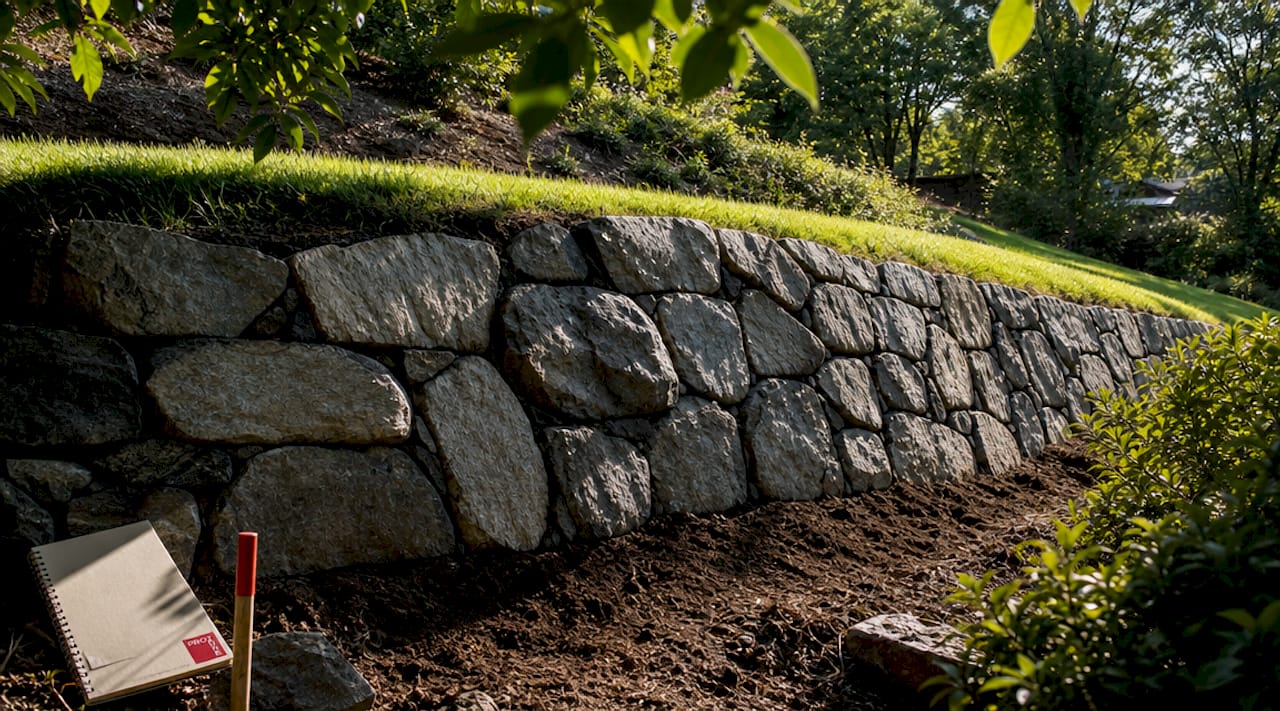
Soil stabilisation and erosion control are the most immediate benefits. On sloped terrain, gravity constantly pulls soil downhill. Without a structural barrier, rain accelerates this process, washing away topsoil, undermining plant roots, and degrading the usable area of a property. A retaining wall interrupts that force, holding the soil mass in place and protecting both the landscape and any structures nearby.
Water management is where many walls succeed or fail. Hydrostatic pressure, the force exerted by water-saturated soil, is the main cause of structural failure within three years of installation. Properly integrated drainage components, including gravel backfill, perforated drain pipes, and weep holes, relieve this pressure before it builds to a damaging level. Prozoneltd consistently specifies drainage system design as a non-negotiable element of every retaining wall project.
Space creation is the benefit homeowners most visibly appreciate. Retaining walls transform unusable sloped land into valuable terraces, with terraced outdoor rooms often becoming the most functional and desirable areas of a yard. Properly installed walls add 75 to 85 percent of their installation cost back to property value when they solve functional problems such as erosion and space limitation. That return makes retaining walls one of the most cost-effective landscape investments available.
Pro Tip: Before planning any retaining wall, assess your property’s drainage patterns during a heavy rain. Where water pools or channels tells you exactly where drainage infrastructure needs to be placed behind the wall.
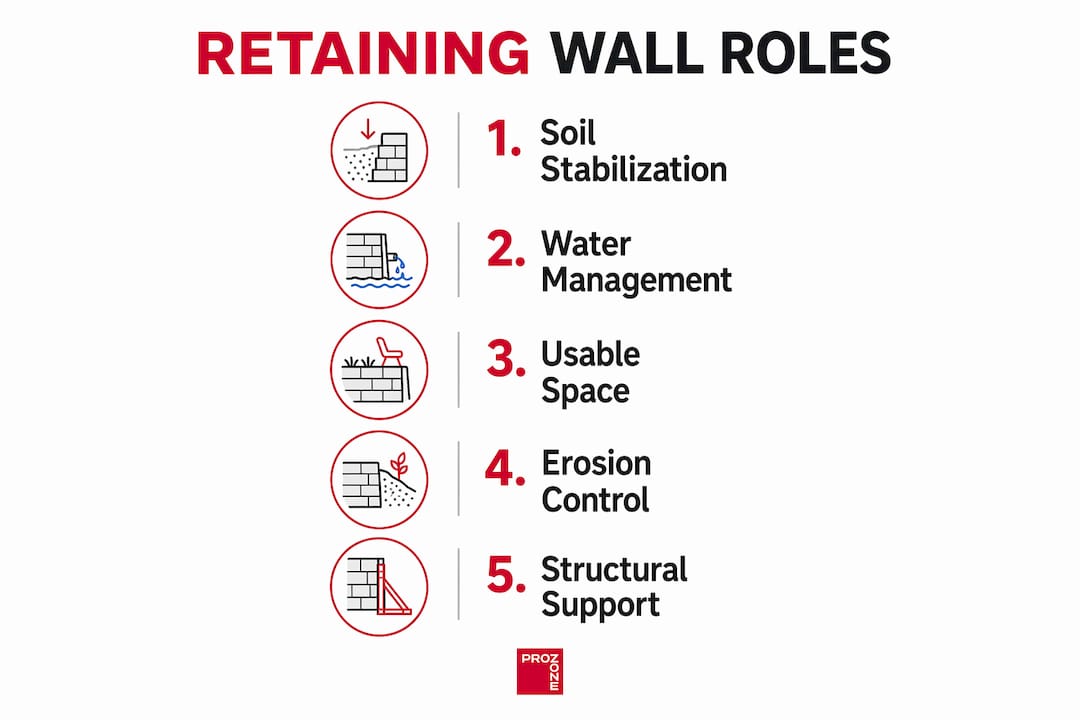
Edmonton’s freeze-thaw cycles add a layer of complexity absent in milder climates. Soil expands when it freezes and contracts when it thaws, exerting lateral pressure on any structure in contact with it. This means material selection, foundation depth, and drainage design must all account for Alberta’s seasonal temperature swings, not just the static weight of the retained soil.
How do retaining walls work structurally?
A retaining wall resists two primary forces: lateral earth pressure from the soil mass behind it, and surcharge loads from anything sitting above that soil, such as a driveway, a deck, or a vehicle. Understanding these forces is what separates a wall that stands for 50 years from one that leans and cracks within a decade.
The structural design process follows a clear sequence:
- Site assessment: Determine soil type, slope angle, wall height, and any surcharge loads. Heavy clay soils exert significantly more lateral force than sandy or loam soils, requiring specific design adaptations such as compaction layers and geogrid reinforcement.
- Foundation excavation: The footing must be dug below the frost line to prevent soil heaving and wall failure caused by freeze-thaw cycles. In Edmonton, this typically means excavating to a minimum depth of 1.2 metres.
- Base preparation: A compacted gravel base provides a stable, free-draining platform. Skipping this step is one of the most common causes of premature wall settlement.
- Wall construction: Courses are laid with a slight backward batter (lean into the slope) to counteract the outward push of retained soil.
- Drainage installation: A 12-inch gravel backfill layer combined with a 4-inch perforated pipe wrapped in geotextile fabric is the recommended drainage setup for most residential walls.
- Geogrid reinforcement: For walls exceeding 3 to 4 feet, geogrid layers anchored into the retained soil mass are often mandatory to achieve structural stability.
The table below summarises how key structural elements interact with Edmonton’s climate conditions:
| Structural element | Function | Edmonton climate consideration |
|---|---|---|
| Foundation depth | Prevents frost heaving | Must reach below frost line (min. 1.2 m) |
| Gravel backfill | Relieves hydrostatic pressure | Free-draining aggregate resists freeze-thaw saturation |
| Perforated drain pipe | Channels water away from wall base | Geotextile wrap prevents pipe blockage from fine soils |
| Weep holes | Outlets for trapped water | Spaced every 1.5 m to prevent pressure buildup |
| Geogrid reinforcement | Anchors wall into soil mass | Required for walls over 3 to 4 ft with surcharge loads |
Pro Tip: Soil type dramatically affects the pressure your wall must resist. If your property has heavy clay soil, consult a structural engineer before finalising wall height or material choice. Clay retains water and expands under frost, compounding lateral pressure significantly.
Weep holes act as vital outlets for trapped water, and their absence is a leading cause of early wall collapse. They should never be treated as optional finishing details.
What are the common types of retaining walls for gardens and slopes?
Retaining wall materials vary considerably in cost, lifespan, aesthetic character, and suitability for different site conditions. The right choice depends on wall height, soil conditions, budget, and the visual character of the surrounding landscape.
| Wall type | Typical lifespan | Approximate cost range | Best application |
|---|---|---|---|
| Segmental concrete block | 40 to 100 years | Moderate | Residential terracing, garden beds |
| Natural stone (dry-stack or mortared) | 50 to 100+ years | Premium | Formal gardens, high-visibility areas |
| Treated timber | 5 to 20 years | Low (from $500 DIY) | Low walls, temporary or budget projects |
| Gabion (wire mesh and stone) | 50 to 75 years | Moderate to high | Steep slopes, naturalistic designs |
| Poured concrete | 50 to 100 years | High | Commercial, high-load applications |
Segmental concrete block walls are the most common choice for residential landscaping in Edmonton. They are modular, relatively straightforward to install, and available in a range of colours and textures that complement most garden styles. Their interlocking design provides good lateral resistance without mortar.
Natural stone walls offer the longest lifespan and the most visually distinctive results, but they require skilled labour to lay correctly. Dry-stack stone walls also provide natural drainage through their gaps, reducing the need for supplementary drainage infrastructure.
Treated timber walls are affordable and accessible for DIY projects, but their lifespan is limited. Timber degrades faster in Edmonton’s wet spring and freeze-thaw conditions, making them a poor choice for permanent landscape features. DIY timber or block walls start at $500, while engineered stone systems can exceed $25,000.
Key considerations when choosing a wall type include:
- Wall height: Walls under 3 feet are suitable for skilled DIYers. Walls taller than 3 to 4 feet, or those supporting heavy surcharge loads, require licensed contractors and, in many Alberta municipalities, building permits.
- Soil conditions: Clay-heavy soils demand stronger, better-drained wall systems.
- Visual integration: The wall material should complement existing hardscape elements such as garden edging and paving to create a cohesive outdoor design.
- Maintenance expectations: Stone and concrete block require minimal ongoing maintenance. Timber requires regular inspection and eventual replacement.
What are best practices for building retaining walls in Edmonton?
Edmonton’s climate imposes specific construction requirements that do not apply in warmer regions. Walls built without accounting for freeze-thaw cycles, clay soils, and spring snowmelt drainage will fail. Common failures stem from lack of expertise in excavation, base preparation below the frost line, and drainage engineering.
The following practices are non-negotiable for walls built to last in Alberta:
- Excavate below the frost line. The critical construction phase occurs below ground. Inadequate footing depth causes wall heaving and failure in freeze-thaw climates. In Edmonton, this means a minimum excavation depth of 1.2 metres for the base course.
- Install a complete drainage system. Gravel backfill, a perforated drain pipe wrapped in geotextile fabric, and weep holes must all be present. Omitting any one component creates a weak point where hydrostatic pressure accumulates. Reviewing drainage and waterproofing principles before construction helps clarify how these elements work together.
- Compact the base thoroughly. A poorly compacted gravel base allows differential settlement, which causes cracking and leaning over time.
- Account for surcharge loads. If a driveway, shed, or deck sits within one wall-height distance behind the wall, the design must factor in those additional loads.
- Select materials rated for freeze-thaw exposure. Concrete block and natural stone perform well in Alberta. Timber and certain decorative materials degrade rapidly under repeated freeze-thaw cycling.
- Inspect annually. Check for leaning, cracking, drainage blockages, and vegetation encroachment. Tree roots can displace wall courses and compromise drainage pipes over time.
Pro Tip: Clear weep holes every spring after snowmelt. Debris and ice can block them over winter, causing water to back up behind the wall during the heaviest drainage period of the year.
For walls over 3 feet or those adjacent to structures, hiring a licensed contractor is not optional. It is the standard required by Alberta Safety Codes. Attempting to engineer a complex wall without professional assessment is the single most common reason retaining walls fail prematurely.
Why retaining walls deserve more credit than they get
Having worked on retaining wall projects across Edmonton and the surrounding region, the pattern that stands out most is how consistently homeowners underestimate what a retaining wall actually is. They see a stack of blocks or stones. What they are looking at is a structural system that must resist tonnes of lateral force, manage seasonal water movement, and survive repeated freeze-thaw cycles, all while looking like a natural part of the garden.
The most expensive mistakes I observe come from treating drainage as an afterthought. A wall built without proper gravel backfill and perforated pipe may look perfect for two or three years. Then a wet spring arrives, hydrostatic pressure builds behind the wall face, and the entire structure shifts or collapses. Rebuilding costs far more than getting it right the first time.
Retaining walls must be treated as integrated systems that adapt to topography and local climate. The walls that perform best over decades are the ones where drainage, foundation depth, material choice, and landscape integration were all considered together from the start, not added as corrections after problems appeared.
The functional value of a well-built retaining wall, turning a steep, eroding slope into a usable garden terrace or level patio, is something that genuinely adds measurable value to a property. That value only holds if the wall is built correctly. Cutting corners on foundation depth or drainage to save a few hundred dollars upfront is a trade-off that rarely pays off.
— Prozoneltd
How Prozoneltd approaches retaining wall projects in Edmonton
Prozoneltd designs and installs retaining walls built to Alberta Safety Codes, with certified project managers overseeing every phase from initial site assessment through to final inspection. Every wall specification accounts for Edmonton’s freeze-thaw conditions, local soil profiles, and drainage requirements. Prozoneltd uses premium concrete block, natural stone, and engineered fill materials sourced for performance in Alberta’s climate, not just for appearance. The process covers excavation, base preparation, drainage system installation, and wall construction as a single coordinated scope of work. If you are planning a retaining wall project in Edmonton or the surrounding area, contact Prozoneltd directly to discuss your site and receive a free estimate. Review the full range of construction services for Edmonton to understand how retaining walls fit within a broader site development plan.
FAQ
What is the main role of retaining walls in landscaping?
Retaining walls stabilise soil on sloped properties, prevent erosion, manage water drainage, and create level, usable outdoor spaces such as garden terraces and patios. Their structural and drainage functions are as important as their visual contribution to a landscape.
How deep should a retaining wall foundation be in Edmonton?
In Edmonton’s freeze-thaw climate, the foundation base course must be excavated to a minimum depth of approximately 1.2 metres to sit below the frost line and prevent seasonal heaving and wall failure.
When do retaining walls require a permit in Alberta?
Walls taller than 3 to 4 feet, or those supporting heavy surcharge loads such as driveways or structures, typically require a building permit and must be designed and installed by a licensed contractor under Alberta Safety Codes.
What causes retaining walls to fail prematurely?
Hydrostatic pressure from water-saturated soil is the leading cause of early failure, typically occurring within three years when drainage components such as gravel backfill, perforated pipe, and weep holes are absent or incorrectly installed.
How long do retaining walls last?
Retaining walls last anywhere from 5 to 100 years depending on materials and engineering quality. Treated timber walls at the lower end of that range contrast sharply with natural stone or poured concrete walls, which can exceed a century with proper drainage and maintenance.