
TL;DR:
- Scheduling snow removal protects Edmonton properties and ensures legal compliance during winter.
- A proactive, documented service prevents fines, liability claims, and costly damage, while improving tenant safety.
Scheduling snow removal is the single most effective step Edmonton property owners and managers can take to protect their properties, tenants, and finances through winter. Edmonton’s Community Standards Bylaw 14600 requires property owners to clear adjacent sidewalks as quickly as possible after snowfall, with fines starting at $100 CAD and the city able to invoice clearance costs directly to your tax account. Alberta’s Occupiers’ Liability Act holds you responsible for reasonable safety on your premises, and victims have two years to file a slip and fall claim with no pre-notice requirement. Understanding why schedule snow removal matters means recognising that reactive, ad-hoc clearing consistently fails both legal and operational standards in Edmonton’s extended winter climate.
Why schedule snow removal: the legal case for Edmonton property owners
Edmonton property owners carry a direct legal duty to keep their sidewalks and walkways clear. Bylaw 14600 requires prompt clearing after every snowfall event, with no fixed hourly deadline but a clear expectation of immediate action. Failure to comply results in a minimum $100 fine, and if the city clears the snow on your behalf, those costs are added to your property tax bill. The financial exposure compounds quickly across a season with multiple storm events.
The legal risk extends well beyond bylaw fines. Alberta’s Occupiers’ Liability Act gives injured parties two years to bring a slip and fall claim against a property owner, with no statutory pre-notice period unlike some other provinces. That two-year window means a single icy walkway incident in january can result in litigation well into the following year. Documented, scheduled clearing is your primary legal defence.
Hiring a contractor does not transfer your liability. Under Alberta law, property owners remain responsible for safe premises even when a contractor is engaged. Your contract must clearly define service triggers, response times, and scope of work. Without those conditions in writing, your legal exposure remains unchanged.
| Risk factor | Consequence of no scheduled clearing |
|---|---|
| Bylaw 14600 non-compliance | Fines from $100 CAD; city invoice added to taxes |
| Slip and fall claim | Two-year limitation period; no pre-notice required |
| Contractor without clear contract | Liability stays with property owner |
| Undocumented service | No legal evidence of reasonable care |
Pro Tip: Keep a copy of every service log, photo, and contractor agreement on file for at least three years. Alberta’s two-year limitation period means you need records that outlast the claim window.
How does scheduling snow removal benefit property operations and tenant relations?
Scheduled snow removal directly improves tenant satisfaction and retention. Consistent, proactive snow clearing signals to tenants that management prioritises their safety and comfort, which is a measurable competitive advantage in Edmonton’s rental market. Properties with reliable winter maintenance attract and keep quality tenants more effectively than those with reactive, inconsistent service. Tenant complaints about icy walkways are among the most common winter grievances in multi-unit residential and commercial properties.

Scheduled services also protect your physical assets. Pre-season site marking, completed before the first snowfall, maps curbs, landscaping features, and underground infrastructure so crews know exactly where to clear and where to stop. Site marking prevents costly damage to pavement edges, irrigation systems, and ornamental plantings that an unfamiliar on-demand crew would never know to avoid. That preparation alone can save thousands of dollars in repair costs over a single season.
Operational benefits of a scheduled service contract include:
- Predictable service windows that align with tenant move-in and move-out times, delivery schedules, and business hours
- Documented site knowledge so crews understand your property layout from day one of the season
- Proactive monitoring during active storm events rather than a single post-storm visit
- Consistent crew familiarity with your site, reducing the risk of equipment damage to property features
- Reduced management burden because you are not making emergency calls during every snowfall
Pro Tip: Schedule a pre-season walkthrough with your snow removal contractor every october. Walk the full perimeter, mark all curbs and landscape features, and confirm trigger depths and response times in writing before the first storm arrives.
Seasonal contracts versus on-demand services: which approach wins?
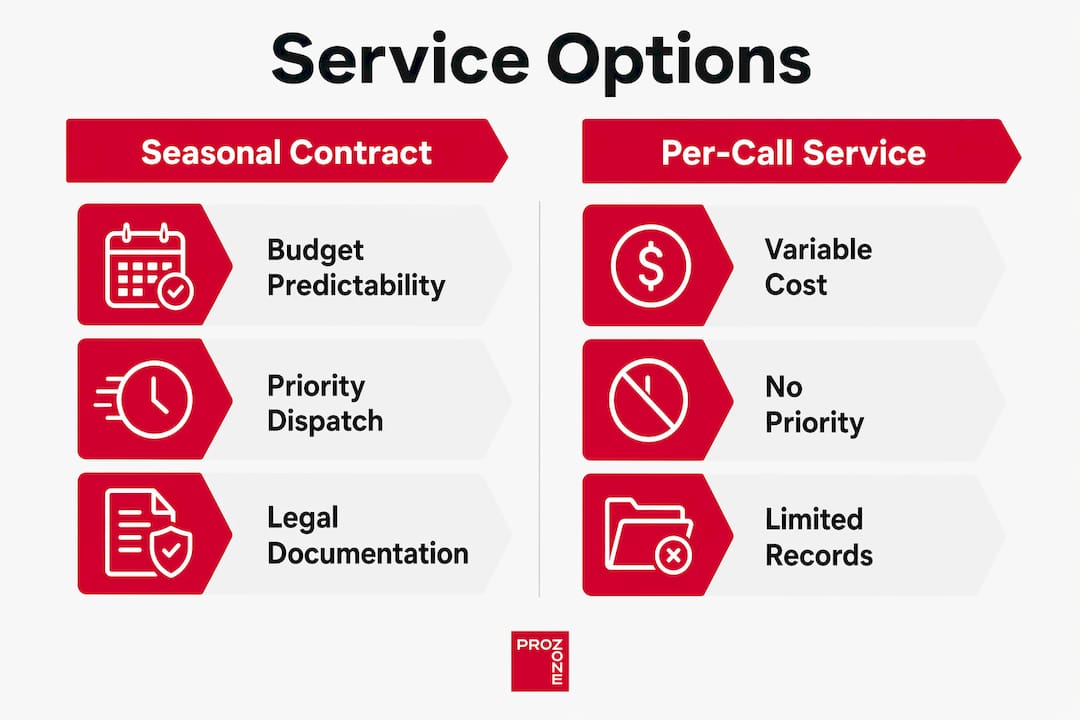
The choice between a seasonal contract and per-call service is fundamentally a question of risk tolerance. Seasonal contracts provide 100% predictable budgeting regardless of how many storms hit Edmonton in a given winter. Per-call services cost less in a mild year but surge dramatically in cost and delay during heavy snowfall periods. Edmonton’s winters are not mild by default, and the freeze-thaw cycles that characterise the region from october through april create repeated clearing events that make per-call pricing unpredictable.
Priority dispatch is the operational advantage that most property managers underestimate. Seasonal contract clients receive priority service during major storms, while per-call clients can wait hours or days when city-wide demand peaks. A commercial property with an inaccessible parking lot or icy entrance during a peak business day faces real revenue and liability consequences. That delay is not a minor inconvenience; it is a documented safety failure.
Professional scheduled crews also begin clearing during active storm events rather than waiting for snowfall to stop. Proactive storm monitoring and site-specific knowledge allow experienced contractors to start work mid-storm, ensuring walkways and lots are passable before peak traffic times. On-demand services, by definition, respond after the fact. That reactive model leaves hazards in place during the highest-risk period.
| Feature | Seasonal contract | Per-call service |
|---|---|---|
| Budget predictability | Fixed seasonal cost | Varies with storm frequency |
| Priority during storms | Guaranteed | Not guaranteed |
| Storm monitoring | Proactive, mid-storm | Reactive, post-storm |
| Service documentation | Included in contract | Varies by provider |
| Site familiarity | Built over season | Starts fresh each call |
| Damage risk from clearing | Low (site marked) | Higher (no site knowledge) |
Service logs and photographs generated through a scheduled contract create a legal record showing reasonable care was taken throughout the season. That documentation is your strongest defence against a slip and fall claim. Per-call services rarely produce consistent records across an entire winter.
When to schedule snow removal and practical tips for Edmonton’s climate
The right time to schedule snow removal is before the season starts, not during the first storm. Edmonton’s winter typically sets in by late october, and property owners who wait until november to arrange service often find that reputable contractors have filled their seasonal capacity. Booking a snow removal contract in august or september gives you access to the best crews and allows time for a proper pre-season site assessment.
Edmonton’s climate presents specific scheduling challenges that generic snow removal advice does not address. The city experiences polar vortex cold snaps that drop temperatures below -30°C, followed by rapid warm-up periods that create freeze-thaw cycles. Those cycles turn compacted snow into ice sheets overnight, making post-thaw inspections as important as post-storm clearing. Your service schedule should include explicit provisions for re-treatment after temperature fluctuations, not just after active snowfall.
Practical snow removal scheduling tips for Edmonton property owners:
- Book your seasonal contract by september to secure priority placement and allow time for pre-season site marking before the ground freezes.
- Define your service trigger depth in writing. Edmonton’s bylaw requires clearing as quickly as possible, so a trigger of 2–5 cm is appropriate for commercial and multi-unit residential properties.
- Schedule pre-season site marking to map all curbs, light standards, fire hydrant access points, and landscaping before the first snowfall covers them.
- Include freeze-thaw re-treatment clauses in your contract. Specify that the contractor will inspect and re-treat surfaces within 24 hours of a temperature swing above 0°C followed by a return to freezing.
- Plan for sand and grit application on high-traffic pedestrian areas. Edmonton’s rock chips and fractured stone provide traction on icy surfaces without the pavement damage caused by excess road salt.
- Review your contract after each major storm. Confirm that service logs and photos were completed and stored, and address any gaps in coverage before the next event.
Pro Tip: Edmonton’s snowpack management differs from other Canadian cities. The city tolerates up to 5 cm of compacted snowpack on residential streets, but your private property has no such tolerance under Bylaw 14600. Your contractor must understand this distinction and clear to bare pavement on all private walkways and lots.
Why property managers who skip scheduled snow removal pay twice
The property managers who resist scheduled contracts almost always cite cost as the reason. What they consistently underestimate is the total cost of reactive management across a full Edmonton winter. A single slip and fall claim, even one that settles without going to trial, carries legal fees, insurance premium increases, and management time that far exceed a full seasonal contract. The math is not close.
Scheduling snow removal is not a maintenance task. It is a risk management decision with legal, financial, and reputational dimensions. Property managers who treat it as an annual line item to minimise are the same ones calling contractors at 6:00 AM during a blizzard and paying surge rates for delayed service. The stress alone is a cost that does not appear on a spreadsheet.
The most effective approach I have seen in Edmonton’s commercial property sector is integrating snow removal planning into the annual property management calendar alongside insurance renewals and capital maintenance reviews. That framing changes the conversation from “how do we spend less on snow” to “how do we protect this asset through winter.” The types of snow removal services available in Edmonton range from basic sidewalk clearing to full-site management with documentation, and the right choice depends on your property type, tenant profile, and liability exposure.
Consistent, documented service also builds a track record that matters when an insurer reviews your claim history. Properties with seasonal contracts and complete service logs are demonstrably lower-risk than those relying on ad-hoc clearing. That record has real value at renewal time.
— ProZone
Prozoneltd’s scheduled snow removal services for Edmonton property owners
Prozoneltd provides professional snow removal in Edmonton tailored to the demands of Bylaw 14600 and Alberta’s occupier liability standards. Seasonal contracts include pre-season site marking, proactive storm monitoring, mid-storm clearing, and complete service documentation with logs and photographs. Every contract defines service triggers, response windows, and scope of work in writing, giving property owners a clear legal record of reasonable care throughout the winter season. Prozoneltd’s crews are familiar with Edmonton’s freeze-thaw cycles and apply the right materials, including fractured stone for traction, to keep surfaces safe between clearing events. Contact Prozoneltd directly through the online estimate form for a custom snow removal plan and free seasonal quote before capacity fills.
FAQ
What does Edmonton’s Bylaw 14600 require for snow removal?
Bylaw 14600 requires property owners to clear adjacent sidewalks as quickly as possible after snowfall, with fines starting at $100 CAD and city clearance costs added to the property tax account.
Does hiring a snow removal contractor remove my liability in Alberta?
Alberta law keeps liability with the property owner even when a contractor is hired. Your contract must define service triggers and responsibilities clearly to support a legal defence.
When is the best time to schedule snow removal in Edmonton?
Book a seasonal contract by august or september to secure priority placement and allow time for pre-season site marking before the ground freezes and the first storm arrives.
Why do seasonal contracts outperform per-call services in Edmonton?
Seasonal contracts provide predictable budgeting and priority dispatch during peak storms, while per-call services surge in cost and delay during high-demand periods common in Edmonton’s extended winter.
What documentation should a snow removal contractor provide?
Service logs and photographs after each clearing event are the minimum standard. This documentation demonstrates reasonable care and serves as legal evidence if a slip and fall claim is filed.