
Subsurface drainage is the removal of excess groundwater from within the soil profile using buried conduits, perforated pipe, and granular bedding to protect foundations, pavements, and load-bearing subgrades. For Edmonton property managers, a properly designed subsurface drainage system directly reduces frost heave risk and extends pavement service life through Alberta’s severe freeze-thaw cycles. ProZone designs and installs these systems in compliance with Alberta Safety Codes, backed by geotechnical site investigation at every project.
Table of Contents
- How does subsurface drainage differ from surface drainage?
- What are the core components of a subsurface drainage system?
- Why does Edmonton’s freeze-thaw climate make subsurface drainage critical?
- What signs tell you that you need subsurface drainage installed?
- What does a professional subsurface drainage installation involve?
- How do you maintain a subsurface drainage system over its lifecycle?
- What permits and standards apply to subsurface drainage in Alberta?
- How ProZone approaches subsurface drainage projects in Edmonton
- A project manager’s perspective on specifying subsurface drainage correctly
- Get a free subsurface drainage assessment from ProZone
- Useful sources and further reading
- FAQ
How does subsurface drainage differ from surface drainage?
Surface drainage moves water overland through grading, swales, and curb and gutter systems. Subsurface drainage intercepts water already within the soil profile, lowering the water table before it saturates the subgrade or migrates toward a foundation. Both systems are necessary; neither replaces the other.
A parking lot perimeter drain handles groundwater migrating laterally beneath the asphalt, while an adjacent landscaped swale handles surface runoff from the same storm event. Relying on surface measures alone is insufficient in Edmonton because saturated subsoils amplify spring thaw damage well beyond what grading can address.
Surface drainage alone is inadequate when you observe:
- Persistent ponding 24–48 hours after snowmelt or rain, even on graded sites
- Pavement pumping (fine material ejecting at joints or cracks under traffic load)
- Repeated frost heave in the same pavement panel or foundation zone
- High measured water table within 1.5 m of the finished subgrade
- Visible salt migration or efflorescence on below-grade concrete walls
What are the core components of a subsurface drainage system?
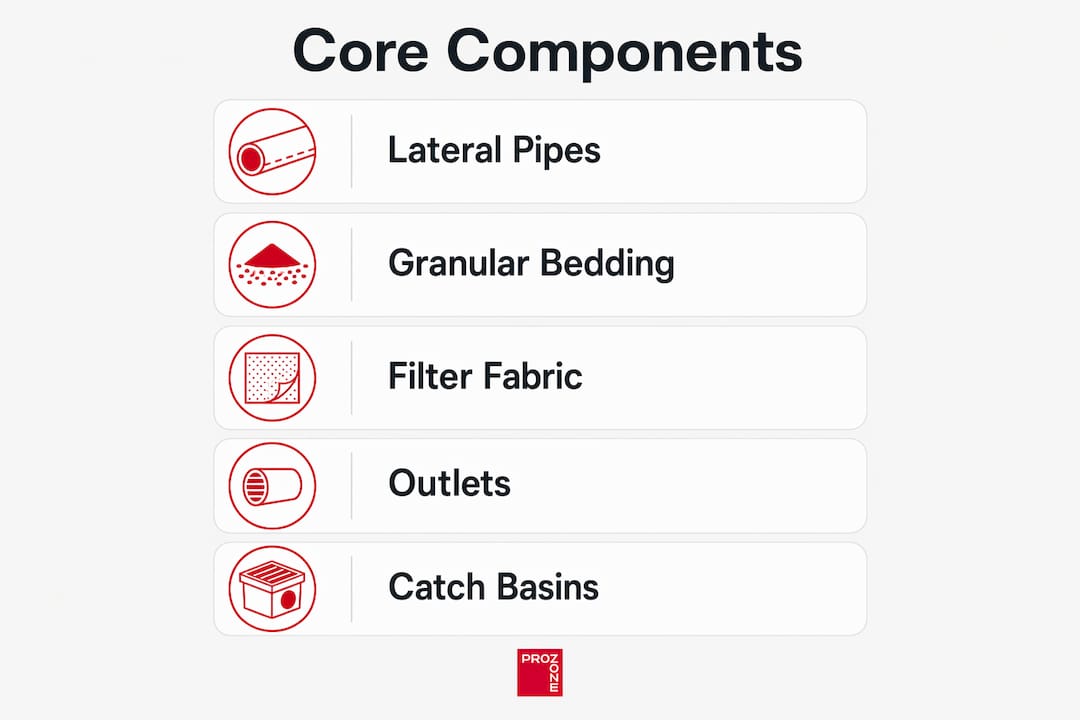
A subsurface drainage system consists of several interdependent parts. Each one must be correctly specified for the system to function through Alberta’s freeze-thaw cycles.
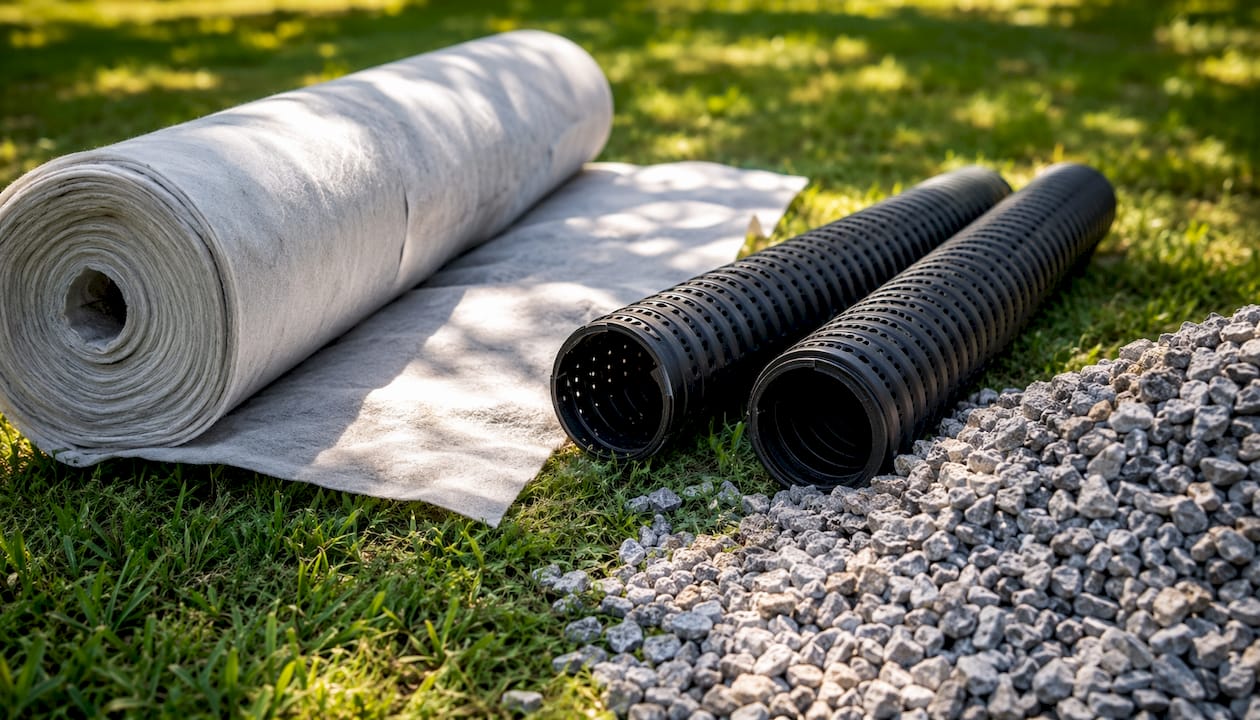
Perforated HDPE pipe forms the collection network. Laterals typically run 75 mm to 125 mm (3 in to 5 in) in diameter, arranged in parallel, herringbone, or double-main layouts documented by Manitoba Agriculture. Mains carry collected flow to the outlet. Crush-resistant pipe specification is critical where frost heave pressure or construction traffic could deform thinner-walled pipe.
Granular bedding and surround holds the pipe at grade, transmits water to perforations, and resists frost pressure. Clean washed stone, free of fines, is the correct material; native soil backfill around drainage pipe is a common substandard practice that accelerates clogging.
Geotextile filter fabric wraps the granular zone to prevent fine soil particles from migrating into the stone and eventually blocking the pipe. The geotextile must be matched to the surrounding soil gradation, not selected generically.
Outlet, catch basins, and sumps complete the system. Where gravity drainage is possible, a frost-protected outlet discharges to a storm sewer, ditch, or watercourse. Where topography prevents gravity flow, a sump and pump are required.
| Component | Typical specification | Function |
|---|---|---|
| Lateral pipe diameter | 75–125 mm (3–5 in) | Collects groundwater from soil |
| Granular bedding depth | — | Transmits flow, resists frost pressure |
| Geotextile | Matched to soil gradation | Prevents fine-particle migration |
| Outlet frost protection | Below local frost depth | Prevents ice blockage at discharge |
Pro Tip: Specify crush-resistant HDPE pipe and clean washed stone rather than native soil backfill. The material upgrade is modest in cost; the reduction in long-term clogging and deformation risk is substantial.
Why does Edmonton’s freeze-thaw climate make subsurface drainage critical?
Frost heave is the primary threat to Edmonton pavements and foundations, and groundwater is its fuel. When saturated soil freezes, water migrates toward the freezing front and forms ice lenses that expand upward, lifting pavement slabs and cracking foundations. Monitoring studies in northern climates recorded maximum frost penetration up to 2.5 m and measured pavement heave reductions of 10–50% at sites where lateral drainage was installed.
Spring thaw compounds the problem. Snowmelt infiltrates partially frozen soil, and soil freezing and thawing in Alberta research at the University of Alberta Breton Plots confirmed that deep frost occurs in years of late snow accumulation and dry fall soil conditions, with significant seasonal variation in subgrade moisture. Seasonal drainage flow can increase from roughly 1 mL/sec/m in winter to 10 mL/sec/m at April thaw, meaning systems must be sized for peak spring conditions, not average annual flow.
Benefits of correct subsurface drainage for Edmonton assets:
- Reduced pavement repair cycles and lower lifecycle costs
- Improved subgrade load-bearing capacity year-round
- Lower risk of foundation settlement and wall cracking
- Reduced salt migration and concrete deterioration
- Fewer emergency repairs following spring thaw events
Statistic: Geocomposite lateral drainage monitoring in northern climates showed heave reductions of 10–50% at instrumented pavement sites after drainage installation.
What signs tell you that you need subsurface drainage installed?
Repeated pavement heave in the same location is the clearest indicator. If a panel has been repaired twice and the subgrade moisture problem has not been addressed, a third repair will produce the same result.
Other triggers include: high water table confirmed by test pits or boreholes, persistent ponding after melt, pavement pumping under traffic, and visible moisture intrusion at building perimeters. New construction on frost-susceptible soils, heavy-traffic parking lots, and low-lying plazas should include subsurface drainage in the base design rather than as a retrofit.
Pro Tip: When budgets are constrained, prioritise the zones with the highest traffic loading and the lowest existing subgrade elevation. Combining drainage installation with a scheduled base course replacement reduces mobilisation costs significantly compared to two separate contracts.
What does a professional subsurface drainage installation involve?
A properly executed installation follows a defined sequence. Skipping steps, particularly geotechnical investigation, is the most common reason systems underperform.
- Site reconnaissance to identify drainage patterns, existing utilities, and outlet options.
- Geotechnical investigation including test pits, boreholes, soil classification, and moisture content testing to determine frost susceptibility and drainage depth.
- Hydraulic sizing and layout design based on soil hydraulic conductivity, catchment area, and peak spring flow requirements.
- Grade and slope verification to confirm gravity drainage is achievable; minimum pipe gradients are confirmed before excavation begins.
- Frost-protected outlet design with discharge point located below the design frost depth or insulated to prevent ice blockage.
- Excavation and bedding installation with granular surround placed and compacted to specification before pipe is laid.
- Pipe installation and backfill with geotextile wrapped correctly and clean washed stone placed to the specified depth.
- Outlet connection and commissioning with flow verification, gradient checks, and as-built drawings issued to the owner.
Acceptance checks for owners include verified pipe gradients, outlet function in cold conditions, and a completed set of as-built drawings. Site inspections at key construction milestones are the practical mechanism for confirming each step before it is buried.
Pro Tip: Require the contractor to confirm outlet elevation and frost protection in writing before backfill begins. Once the trench is closed, verifying outlet depth requires excavation.
How do you maintain a subsurface drainage system over its lifecycle?
A well-installed system with quality materials typically performs for several decades. Systems installed with native soil backfill or thin-walled pipe in high-traffic areas often require intervention within 10–15 years.
The most common failure mode is outlet blockage by ice or sediment. Inspecting discharge points before spring thaw is the single highest-value maintenance task for Alberta properties. Biological clogging and pipe deformation from frost heave are slower-developing failures that camera inspection every 5–10 years will detect before they become critical.
Statistic: Even correctly installed lateral drains can fail if outlet points are obstructed by ice or sediment; proactive pre-thaw inspection is more critical in cold climates than in temperate ones.
Pro Tip: Schedule outlet inspections in late February or early March, before peak thaw flow arrives. A blocked outlet during peak spring drainage can cause rapid subgrade saturation and pavement failure within a single season.
What permits and standards apply to subsurface drainage in Alberta?
Alberta subsurface drainage projects typically require coordination with municipal engineering and, where discharge reaches a waterway, with Alberta Environment and Protected Areas. Alberta Safety Codes govern excavation and utility proximity requirements. A civil or geotechnical engineer is required for projects involving engineered drainage layouts, outlet connections to municipal storm systems, or discharge to natural watercourses.
Documentation owners should expect from a compliant project:
- Geotechnical investigation report with soil classification and frost-depth analysis
- Engineered drainage design drawings with pipe grades, sizes, and outlet details
- Municipal permit for excavation and storm sewer connection (where applicable)
- Environmental review or approval if discharging to a watercourse
- As-built drawings and commissioning record issued at project close
The NRCS Water Management guidance provides a comprehensive technical reference for design principles, outlet requirements, and pumping considerations that complement Alberta-specific regulatory requirements.
How ProZone approaches subsurface drainage projects in Edmonton
ProZone delivers subsurface drainage projects from initial site scoping through to commissioning, coordinating geotechnical input, engineered layouts, and certified installation teams under a single contract. Every project is executed in compliance with Alberta Safety Codes, with documented safety procedures and material specifications on file.
ProZone’s service and quality indicators:
- Geotechnical coordination and soil moisture testing on every project
- Engineered drainage layouts with verified gradients and frost-protected outlets
- Clean washed stone and crush-resistant HDPE pipe as standard specification
- Barkman Concrete products available for associated hardscape and catch basin work
- Certified installers with documented safety procedures
- Project gallery with documented installations available for review at ProZone’s project gallery
- As-built drawings and operation notes issued at project completion
ProZone’s site preparation services include the excavation and subgrade work that typically accompanies drainage installation, reducing the number of contractors a property manager needs to coordinate.
A project manager’s perspective on specifying subsurface drainage correctly
The most expensive drainage project is the one that gets specified twice. Property managers who approve a base course repair without addressing the underlying water table problem will see the same failure within a few seasons, at full mobilisation cost again.
Require geotechnical input before any drainage design is finalised. Specify material and warranty terms in the contract, including pipe crush resistance and bedding gradation. Include inspection milestones so you can verify gradients and outlet protection before the trench is closed. Where budget is limited, staged remediation combining drainage with a scheduled base course rebuild is more cost-effective than treating them as separate projects.
Get a free subsurface drainage assessment from ProZone
ProZone provides on-site assessments and free estimates for subsurface drainage projects across Edmonton and the surrounding Alberta region, from initial investigation through to turnkey installation and commissioning. Whether you are managing a commercial parking lot, a municipal plaza, or a private property with recurring frost damage, ProZone’s team handles the full scope: geotechnical coordination, engineered design, certified installation, and as-built documentation.
For municipal and commercial road drainage tie-ins, ProZone’s road construction capabilities cover the full base and drainage scope. Request your free estimate using the online form at prozoneltd.ca or call ProZone directly to schedule an on-site assessment.
Useful sources and further reading
The following references provide authoritative technical detail for property managers and engineers scoping subsurface drainage projects in Alberta.
| Source | Best used for |
|---|---|
| NRCS Water Management guidance | Design principles, outlet requirements, pumping considerations |
| Manitoba Agriculture: Subsurface Drainage as a Water Management Strategy | Lateral sizing, pipe arrangements, hydraulic performance data |
| SAGE Journals: Efficiency of Geosynthetic Lateral Drainage in Northern Climates | Monitoring data on heave reduction and seasonal flow variation |
| ZALIG Consulting: Frost Depth in Alberta | Alberta-specific frost depth guidance, outlet design, material specifications |
| University of Alberta Breton Plots: Soil Freezing-Thawing in Alberta | Field data on frost penetration depth and snowmelt infiltration in Alberta soils |
Keep these documents accessible when scoping and procuring professional drainage services. They provide the design figures and frost-depth benchmarks that distinguish an engineered specification from a generic contractor quote.
FAQ
What is subsurface drainage in simple terms?
Subsurface drainage removes excess groundwater from within the soil profile using buried perforated pipe, granular bedding, and a protected outlet, preventing waterlogging and frost heave beneath pavements and foundations.
How deep does subsurface drainage need to be in Edmonton?
Pipe depth depends on soil classification and the local frost depth, which can reach 2.5 m in northern Alberta climates. A geotechnical investigation determines the correct installation depth for each site.
How often does a subsurface drainage system need maintenance?
Outlet inspections should occur annually before spring thaw. Camera inspections of the pipe network are recommended every 5–10 years, depending on soil type and clog risk.
What is the difference between a French drain and a subsurface drainage system?
A French drain is one type of subsurface drainage: a trench filled with clean stone and perforated pipe that intercepts and redirects groundwater. Subsurface drainage is the broader category that includes French drains, perimeter drains, geocomposite laterals, and interception drains.
Does ProZone handle both design and installation of subsurface drainage?
ProZone coordinates geotechnical input, engineered drainage layouts, certified installation, and as-built documentation as a turnkey service for Edmonton commercial, municipal, and private property clients.