
TL;DR:
- Properly designed curb and gutter systems are essential for Alberta’s stormwater management, infrastructure longevity, and community safety. They must be constructed with precise grading, alignment, and coordination with sidewalks to prevent costly failures and ensure compliance with municipal standards. Investing in quality curb and gutter installation reduces long-term maintenance costs and enhances property value and community resilience.
Most people glance at a curb and see a tidy edge separating the road from the sidewalk. What they miss is everything happening underneath and alongside it: the engineered channel directing thousands of liters of runoff away from foundations, pavement structures, and community green spaces after every rainstorm. For property managers and municipal authorities in Alberta, curb and gutter systems are not a finishing touch – they are load-bearing infrastructure. This article breaks down exactly what these systems are made of, how they function within Alberta’s drainage network, what construction standards actually demand, and what separates a well-built system from one that will cost you dearly in two or three winters.
Table of Contents
- The anatomy of curb and gutter: What it is and how it works
- Key functions: Why curb and gutter matters for Alberta communities
- Core design and construction standards: Getting curb and gutter right
- Common challenges and expert tips for proper curb and gutter performance
- A practical perspective: Why mastering curb and gutter means mastering long-term property value
- Work with Alberta’s curb and gutter specialists
- Frequently asked questions
Key Takeaways
| Point | Details |
|---|---|
| Essential for drainage | Curb and gutter systems are critical in directing stormwater, preventing property damage and road erosion. |
| Follows strict standards | Proper curb and gutter construction in Alberta must meet municipal standards for grade, drainage, and alignment. |
| Reduces long-term costs | Investing in correct curb and gutter design minimizes costly repairs, rework, and compliance penalties. |
| Prevents ponding problems | Errors in grade or inlets cause water buildup, which is preventable with proper design and construction oversight. |
The anatomy of curb and gutter: What it is and how it works
With the importance of the curb and gutter established, let’s break down exactly what these structures are made of and why every detail matters.
At its most precise, curb and gutter is an engineered roadway feature consisting of a vertical curb and a gutter that together define the road edge and convey stormwater toward drainage inlets. These are not two separate items bolted together – they are cast as a monolithic concrete unit that functions as one structural element. The curb provides the vertical face that resists lateral forces from vehicle tires and prevents pavement from creeping outward. The gutter is the shallow, sloped concrete channel immediately adjacent to the curb that gives water a defined path to travel.
“Curb and gutter is an engineered roadway or parking-edge feature consisting of a vertical curb and a gutter that together define the road edge and convey stormwater along the roadway line toward drainage inlets.” – EPCOR Design Guidelines
Understanding each component helps you ask better questions of contractors and engineers before a project begins. Here is a breakdown of the key structural parts and their roles:
| Component | Description | Primary function |
|---|---|---|
| Curb face | Vertical or near-vertical concrete wall | Resists lateral traffic loads, defines road edge |
| Gutter pan | Sloped channel at pavement edge | Collects and channels surface runoff |
| Flow line | Lowest point of the gutter cross-section | Establishes the direction and speed of drainage |
| Expansion joints | Gaps filled with flexible material at set intervals | Allows thermal movement without cracking |
| Catch basin inlets | Openings at low points in the gutter | Accepts concentrated flow into the storm sewer |
| Curb reveal | Height of the curb face above the gutter pan | Defines vehicle guidance and ponding threshold |
Knowing these components by name matters when you’re reviewing drawings or inspecting finished work. A discrepancy in the flow line elevation of just a few millimeters can redirect water onto private property rather than into an inlet.
For anyone managing Alberta curb installation basics, the primary design objectives are consistent across project types:
- Establish a clear, defined boundary between vehicular and pedestrian zones
- Create a predictable drainage path that intercepts surface runoff before it saturates the subgrade
- Support the structural edge of asphalt or concrete pavement against lateral creep
- Provide a reference elevation for adjacent sidewalk, boulevard, and landscaping grades
- Integrate seamlessly with storm sewer inlets at pre-calculated spacing intervals
If you browse the project gallery at ProZone, you’ll notice that even on straightforward commercial parking lot jobs, the curb and gutter geometry is deliberate. There is no such thing as an approximate slope or a close-enough flow line in a compliant installation.
Key functions: Why curb and gutter matters for Alberta communities
With a basic understanding of the structure, it’s crucial to see why curb and gutter is so central to successful infrastructure and resilient communities in Alberta.
Alberta’s climate presents drainage challenges that milder regions rarely encounter. Freeze-thaw cycles, spring snowmelt events, and intense summer convective storms all place extreme demands on surface drainage infrastructure. A curb and gutter system that merely looks correct but drains poorly will fail quickly under these conditions, and the damage it causes – to pavement, to foundations, to adjacent landscaping – compounds every season.
The stated purposes of curb and gutter include stormwater management via gutter flow toward inlets, defining a clear edge for pavement and traffic containment, and supporting positive drainage away from structures. In practice, this means the gutter pan is doing constant work even during minor rain events, quietly intercepting water that would otherwise saturate the subgrade and accelerate pavement deterioration.
In Alberta, curb and gutter systems are treated as part of the stormwater drainage network, not as isolated roadway furniture. That distinction changes how projects should be designed, budgeted, and inspected. You are not just pouring concrete along a road edge – you are installing a component of a municipal drainage system that has legal performance obligations.
Here are the primary benefits that well-designed curb and gutter delivers to Alberta communities:
- Intercepts surface runoff before it crosses property lines or enters building foundations
- Reduces erosion of boulevard soils and adjacent landscaping
- Provides a stable structural edge that dramatically extends pavement service life
- Creates predictable guidance for drivers, especially in low-visibility conditions
- Supports safe pedestrian zones by clearly separating foot traffic from vehicle lanes
- Simplifies winter maintenance by defining plow paths and melt zones
- Keeps development sites code-compliant with municipal drainage requirements
One statistic that property managers and site engineers need to keep on hand: Alberta municipal drainage guidance sets a maximum ponding depth of 150 mm at sag locations in gutter systems. Exceeding that threshold creates flooding risk, pedestrian hazards, and potential liability exposure for both private developers and municipal authorities.
Effective road maintenance strategies consistently identify curb and gutter condition as a leading indicator of overall pavement health. When the curb and gutter fail, water begins entering the pavement structure laterally, and subgrade saturation follows quickly. For sidewalk restoration guidance, the same principle applies – adjacent walkways degrade far faster when the gutter grades are directing water toward them rather than away.
Pro Tip: Most property managers focus repair budgets on cracked pavement and ignore deteriorating gutter grades. But a gutter that no longer drains toward an inlet will do more pavement damage in two Alberta winters than surface cracking causes in five. Inspect gutter flow lines annually, not just the curb face.
Core design and construction standards: Getting curb and gutter right
Now that we’ve seen curb and gutter’s importance, let’s look at what it takes to build them right and what standards cities demand.
Quality curb and gutter construction is not a matter of skilled hands alone – it demands precise pre-construction planning, rigorous grade control during placement, and systematic inspection before the adjacent pavement goes in. Once asphalt is laid, correcting a gutter elevation error becomes an expensive and disruptive exercise.
Curb and gutter alignment, grade, and jointing are the three factors most directly responsible for drainage performance. If any of these is off, the entire system underperforms regardless of concrete strength or finish quality. The gutter must slope continuously and consistently toward each inlet – even a short flat section creates a ponding point.
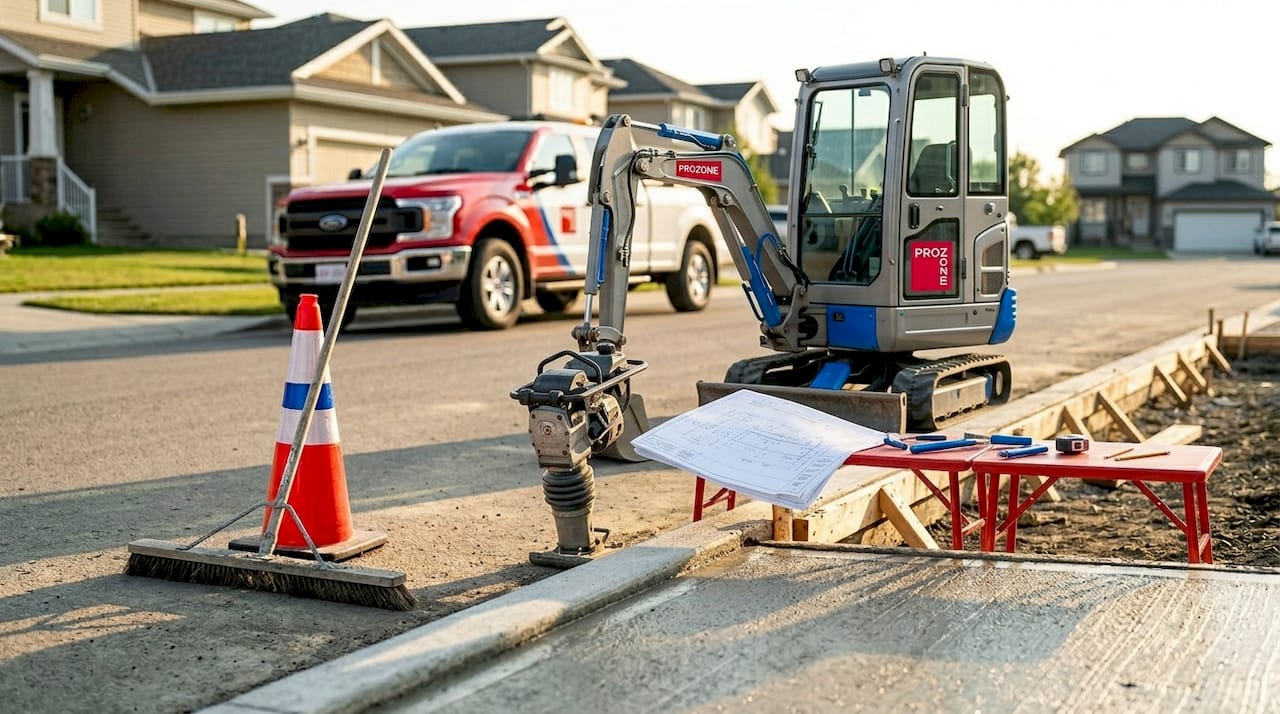
City of Edmonton Design and Construction Standards govern both city-contracted work and private development projects within city limits. Designers and contractors are expected to reference these standards for complete street and drainage requirements. Deviating from them is not a matter of preference – it creates a compliance gap that can delay project approval, trigger corrective work orders, or result in cost-sharing disputes years after project completion.
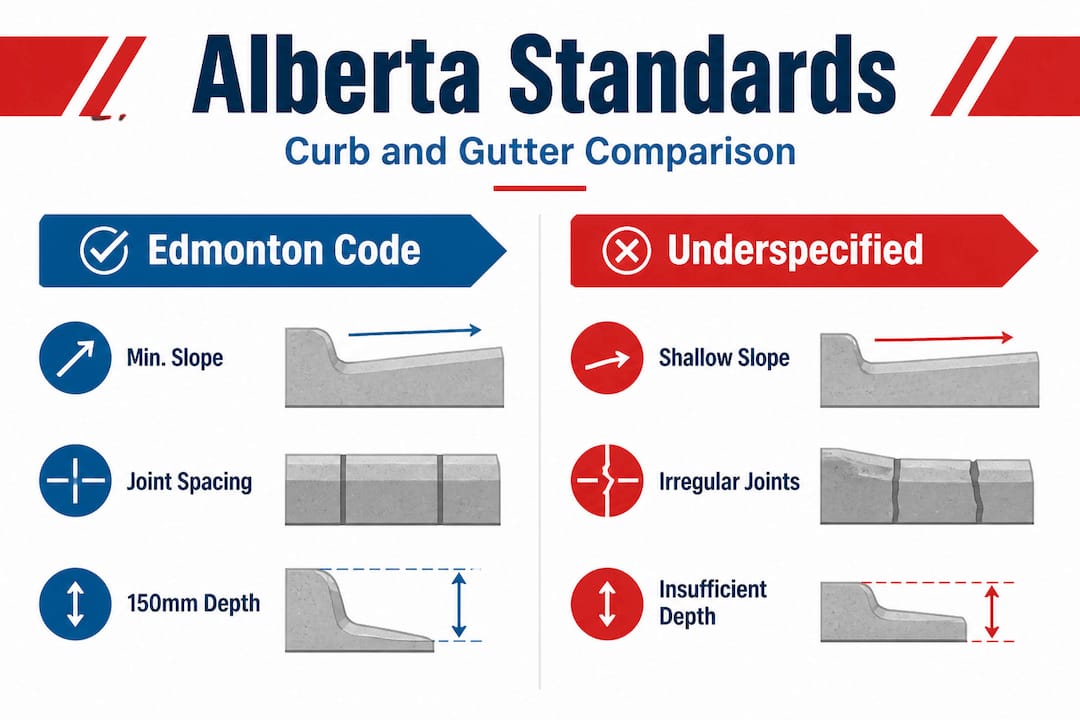
Here is a side-by-side comparison of key Alberta and Edmonton standards versus what generic or lower-specification projects often end up with:
| Design element | Alberta/Edmonton standard | Underspecified approach |
|---|---|---|
| Minimum gutter grade | 0.5% longitudinal slope | Flat or inconsistent grade |
| Maximum ponding at sag | 150 mm depth | No ponding limit defined |
| Inlet spacing | Engineered to flow calculation | Arbitrary or copied from adjacent street |
| Joint spacing | Specified intervals with proper sealant | Irregular or absent joints |
| Curb reveal height | Per road classification | Same height regardless of road type |
| Top-of-curb elevation | Coordinated with sidewalk and boulevard | Set independently of adjacent grades |
For Edmonton sidewalk standards compliance, top-of-curb elevation is not negotiable – it must coordinate with adjacent sidewalk grades and curb ramp landings. Projects that treat these as separate design exercises routinely produce drainage pockets and accessibility failures at transitions. And for sidewalk accessibility standards, the curb-to-sidewalk relationship is specifically scrutinized during municipal inspection.
A numbered sequence for achieving quality curb and gutter on any Alberta project:
- Establish control grades from the drainage design outward. Do not work from the road centerline down – start with the inlet elevations and work back to confirm gutter grades are achievable.
- Set forms precisely to the design grade and alignment. Even small form deflections create permanent flow irregularities. Check every 3 meters during form setting.
- Place concrete continuously within a pour section to avoid cold joints that can crack and separate along the gutter channel.
- Cut or form expansion joints at specified intervals – typically every 6 to 9 meters for standard monolithic curb and gutter, adjusted for temperature at time of placement.
- Finish the gutter pan to a smooth, consistent cross-slope that matches the design drawing. Rough textures in the gutter pan collect sediment and reduce flow capacity over time.
- Inspect the top-of-curb elevation before sidewalk forms are set. This is the last easy opportunity to catch an elevation error before it becomes a costly multi-trade problem.
Pro Tip: Always check the top-of-curb elevation relative to the adjacent ground and planned sidewalk before pouring. A curb set even 20 mm too high creates a drainage trap at the back of the sidewalk that fills with ice every winter and accelerates concrete spalling. It’s a two-minute check that prevents a two-week repair job.
Common challenges and expert tips for proper curb and gutter performance
Even with best practices, many projects run into preventable issues – here’s what to watch for and how to achieve optimal results.
The most frustrating curb and gutter failures are not caused by bad concrete or incompetent crews. They’re caused by coordination gaps between trades, last-minute grade changes in the field, and insufficient inspection at key milestones. Alberta’s construction season is short, and there is constant pressure to move quickly. That pressure is where most mistakes originate.
Curb and gutter projects must coordinate with adjacent sidewalk grades and curb ramps. When this coordination is missing, drainage ponds at transitions, which is exactly the kind of problem that gets worse with every freeze-thaw cycle. Ice formation at a drainage transition point exerts enormous upward pressure on concrete, and a section that looked minor in October can be a fully displaced panel by April.
Inlet spacing and gutter grades must be engineered so that runoff reaches catch basins before ponding exceeds acceptable limits. Alberta guidance sets that ponding threshold at 150 mm at sag points – but many projects never verify inlet performance under actual flow conditions before the street is opened.
“The top-of-curb versus sidewalk and ground-line elevation relationship is explicitly called out as a critical coordination item – getting this wrong creates both drainage and accessibility failures that compound with every season.” – Indiana GIFE Curb and Gutter Guidelines
The most common problems seen on Alberta curb and gutter projects include:
- Reversed gutter grades at transitions between sections poured on different days, creating a low point where none was designed
- Inlet placement that doesn’t match actual low points because the drainage design was not updated after road grade revisions
- Joint misalignment at curb returns and radius points that creates stress concentrations and premature cracking
- Insufficient curb reveal on collector roads, allowing vehicles to ride up on the curb and degrade the edge
- Top-of-curb set above adjacent sidewalk grade, which turns the curb return into a water collector rather than a water shedder
- Poor backfill compaction behind the curb that settles and redirects surface drainage into the back-of-curb zone
The curb and sidewalk installation process at ProZone treats these coordination points as standard checklist items, not afterthoughts. Every project includes a pre-pour grade verification that cross-references the curb forms against the drainage design and the planned sidewalk elevation.
Pro Tip: The single most effective risk-reduction step on any curb and gutter project is a pre-construction coordination meeting between the drainage designer, the curb and gutter contractor, the sidewalk contractor, and the paving contractor. Four people in a room for one hour before work begins can eliminate a month of rework after the street is finished.
A practical perspective: Why mastering curb and gutter means mastering long-term property value
Here is something that rarely makes it into technical specifications but consistently shows up in project post-mortems: the curb and gutter is usually the most accurate predictor of a project’s long-term total cost.
Projects where curb and gutter grades were rushed, where inlet placement was treated as a contractor’s judgment call rather than a design requirement, or where the top-of-curb elevation was set without reference to the sidewalk design – these projects come back for repair within three to five years. In Alberta’s climate, that timeline is almost mechanical. Water intrusion in fall, frost heave in winter, settlement in spring, and cracking through summer. The cycle repeats and amplifies.
The uncomfortable reality is that property managers and municipal authorities who cut scope on curb and gutter to stay within budget almost always spend more over a ten-year horizon than they would have spending correctly the first time. A conservative estimate of the cost difference: a proper curb and gutter installation on a 200-meter commercial frontage might cost 15 to 20 percent more than a minimum-spec installation. But two cycles of repair, resurfacing, and drainage remediation on the same stretch easily exceed the original project cost.
There’s also a community impact dimension that rarely appears on cost spreadsheets. Failing curb and gutter creates nuisance ponding that residents and businesses document and report. It generates accessibility complaints at improperly drained curb ramps. It damages adjacent landscaping and private property in ways that create liability exposure for municipalities and property managers alike.
The paving process insights that our team has developed over years of Alberta projects come back to the same principle: the best investment in pavement is the drainage infrastructure underneath and around it. A well-designed curb and gutter system extends pavement life, reduces maintenance frequency, and protects adjacent property. It is infrastructure that pays returns every season.
Our strong recommendation is to stop treating curb and gutter as a regulatory checkbox that gets value-engineered to the minimum allowable specification. Treat it as a long-term capital investment that determines the maintenance burden of every other infrastructure element it touches. Municipal authorities who build well here spend less everywhere else.
Work with Alberta’s curb and gutter specialists
If you’re looking to eliminate guesswork and guarantee compliant, long-life curb and gutter, ProZone has you covered.
At ProZone Ltd, we deliver curb and gutter solutions built to Edmonton and Alberta municipal standards for property managers, developers, and municipal authorities across the region. Our team coordinates drainage design, grade verification, concrete placement, and inspection into a single managed process – so you’re not stitching together multiple contractors and hoping the grades align. Explore our concrete flatwork solutions for context on how curb and gutter fits into broader site concrete planning, and review our concrete maintenance checklist to understand how to protect your investment after installation. To get started on your next curb and gutter project, visit ProZone Ltd and connect with our team directly.
Frequently asked questions
How does curb and gutter improve drainage during Alberta storms?
Properly designed curb and gutter conveys stormwater toward drainage inlets along the roadway line, preventing ponding and protecting adjacent properties even during intense Alberta rain or snowmelt events.
What is the typical ponding depth limit for gutter systems in Alberta?
Alberta’s municipal drainage guidance specifies a maximum ponding depth of 150 mm at sag locations, a threshold that prevents overflow conditions and minimizes pedestrian and traffic hazards.
Are curbs and gutters required by city standards in Alberta?
Yes. The City of Edmonton’s Design and Construction Standards apply to both municipal contracts and private development projects, making curb and gutter installation a code requirement rather than an option.
What is the main mistake in curb and gutter construction?
The most common and costly mistake is improper alignment or grading. Alignment, grade, and jointing directly determine whether water drains toward inlets or ponds along the gutter, and errors here are expensive to correct after the adjacent pavement is in place.
How does curb design interact with sidewalks and accessibility features?
The top-of-curb versus sidewalk elevation relationship is a critical coordination point – if the curb is set too high relative to the adjacent sidewalk or curb ramp, water collects at the transition and accessibility requirements are not met.