
Adopt a data-driven upkeep programme that pairs an accurate asset register, preventive maintenance schedules, and integrated lifecycle funding — you will spend less, fail less, and satisfy service-level obligations more reliably. The Federation of Canadian Municipalities (FCM) and the Transportation Association of Canada (TAC) both confirm that the shift from reactive patching to integrated asset management is the single highest-leverage change a municipality can make. ProZone supports Alberta municipalities at every stage of that shift, from drainage correction and preventive surfacing to full pavement rehabilitation.
Three priorities to act on now:
- Complete an asset register and condition snapshot for all high-criticality assets, including roads, culverts, storm networks, and public buildings, so you know what you own, what condition it is in, and what it will cost to replace.
- Deploy a preventive work-order programme using a Computerised Maintenance Management System (CMMS) with defined priority rules, so field crews execute the right treatment on the right asset at the right time.
- Integrate lifecycle costs into your annual and multi-year budgets to avoid the deferred-maintenance premium, where a small preventive treatment deferred becomes a substantially higher rehabilitation or replacement cost later.
Contact ProZone for a free estimate or an implementation review of your current upkeep programme.
Table of Contents
- What does public infrastructure upkeep actually cover?
- What challenges derail Canadian municipal upkeep programmes?
- What are the core components of an effective upkeep programme?
- How do you choose and deploy a CMMS for municipal upkeep?
- How do you build lifecycle cost plans that prevent deferred maintenance?
- How do you climate-proof assets in Canadian freeze-thaw environments?
- What should municipal procurement teams require in upkeep contracts?
- Which KPIs and reporting rhythms prove programme performance?
- ProZone in practice: turnkey upkeep delivery in Alberta
- Your 30/90/365-day action checklist
- What training and certification standards apply to upkeep personnel?
- How should you communicate with stakeholders during upkeep projects?
- How do you plan for emergency infrastructure failures?
- How do sustainability practices fit into an upkeep programme?
- Why durable fixes outperform repeated temporary patches in Alberta
- ProZone delivers certified upkeep services across Alberta
- Key Canadian sources for implementation reference
- FAQ
What does public infrastructure upkeep actually cover?
Upkeep is the planned set of inspections, preventive tasks, minor repairs, and small-scale rehabilitation activities that keep assets delivering their intended service level. It sits between routine operations (cleaning, snow clearing) and major capital works (full reconstruction or large-scale rehabilitation). Getting that boundary right matters for budget coding, procurement authority, and council reporting.
Asset classes typically in scope for a municipal upkeep programme:
- Roads and pavements (asphalt and concrete surfaces, granular shoulders)
- Bridges, culverts, and retaining structures
- Storm and sanitary sewer networks
- Public buildings and recreation facilities
- Sidewalks, curbs, and multiuse trails
- Streetlighting and traffic signalling
- Park assets (pathways, structures, irrigation)
The deliverables a manager needs to run this programme are an up-to-date asset register with condition ratings, a live work-order backlog, a lifecycle funding projection, and a tested emergency response plan. Without all four, prioritisation becomes guesswork and council briefings become difficult to defend.
What challenges derail Canadian municipal upkeep programmes?
Most upkeep programmes underperform for a predictable set of reasons, and recognising them early is half the battle.
- Ageing asset stock: A large share of Canadian municipal infrastructure was built in the 1960s and 1970s and is approaching or past its design life simultaneously.
- Siloed data: Road, water, and sewer maintenance kept in separate systems consistently produces suboptimal prioritisation compared with municipalities that integrate data for decision support.
- Constrained operating budgets: Capital grants often fund new assets, while operating budgets for upkeep remain flat or shrink in real terms.
- Labour shortages: Certified equipment operators and pavement technicians are in short supply across Alberta, extending response times and increasing subcontract costs.
- Supply-chain delays: Aggregates, asphalt mix, and drainage materials face lead-time variability that disrupts seasonal scheduling.
Regulatory floor: Ontario’s O. Reg. 239/02 sets minimum maintenance standards for municipal highways, including patrol frequency, pothole repair timelines, and snow and ice response. While Alberta does not have an identical provincial regulation, municipalities across Canada use comparable standards to define local service levels and defend liability positions.
Deferred maintenance is the compounding cost that turns manageable upkeep into unaffordable renewal. A pavement crack left unsealed for one season can require full-depth reclamation within five years. Presenting that lifecycle scenario to finance and council, with numbers, is the most reliable way to secure preventive funding before the damage escalates.
What are the core components of an effective upkeep programme?
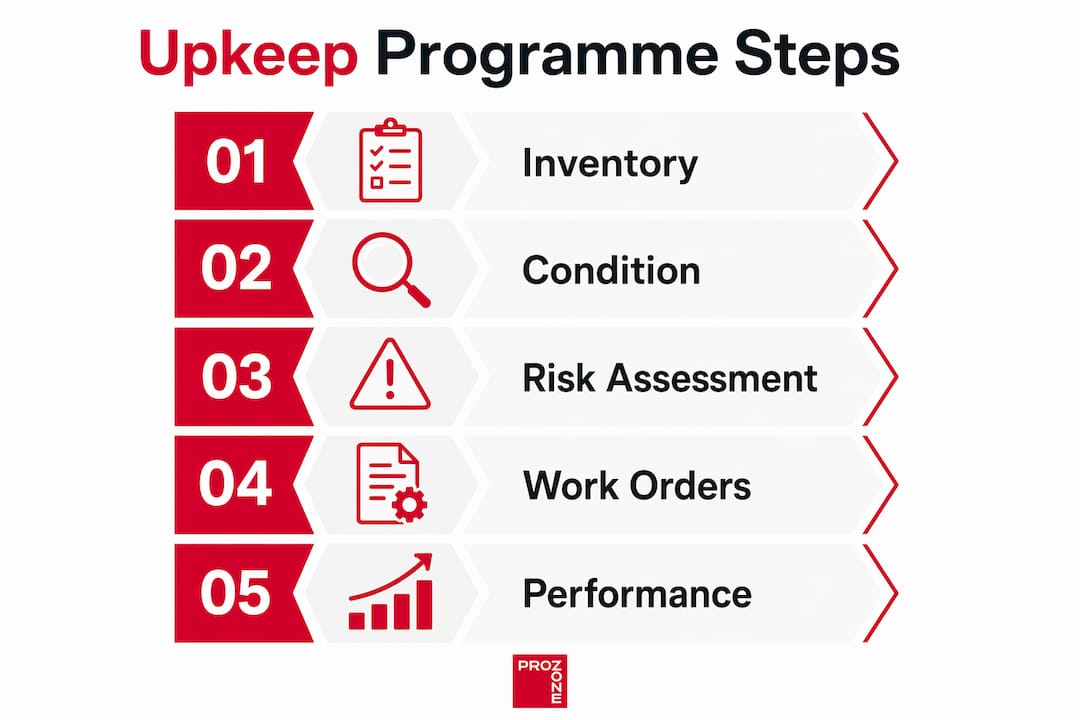
The NRC’s municipal infrastructure management framework sequences five facets that must be completed in order: inventory, performance assessment, service life estimation, lifecycle cost modelling, and criticality ranking. Skipping or shortcutting any facet produces a ranked project list that finance cannot trust.
Minimum asset record attributes
| Attribute | Purpose |
|---|---|
| Asset ID | Unique identifier for work orders and reporting |
| Asset class | Groups assets for treatment scheduling |
| Location (GIS) | Field crew navigation and spatial analysis |
| Replacement value | Lifecycle cost and funding calculations |
| Condition rating | Triggers preventive or rehabilitation treatment |
| Remaining service life | Forecasts replacement timing |
| Maintenance history | Tracks cost per asset and treatment effectiveness |
| Criticality score | Combines failure probability and consequence |
Once the register is populated, a risk-and-criticality matrix combines the probability of failure with the consequence of failure (service disruption, safety, regulatory liability) to triage projects. High-probability, high-consequence assets get treated first regardless of budget pressure. Low-probability, low-consequence assets are scheduled in the next funding window.
The flow from inspection to action runs: condition survey triggers a work order in the CMMS, the CMMS assigns priority based on the criticality matrix, field crews complete the work and record actual costs, and those costs feed the lifecycle model that informs the next council budget submission. FCM’s InfraGuide provides checklists for each asset class to support this cycle.
How do you choose and deploy a CMMS for municipal upkeep?
A CMMS is the operational backbone of any preventive programme. Selection and deployment done poorly wastes budget and demoralises field crews; done well, it reduces reactive spending and produces the audit trail procurement and finance need.
Core functions your CMMS must include:
- Asset inventory with condition records and GIS location
- Scheduled work orders with priority rules and due-date escalation
- Mobile field access for crew assignment, completion, and photo capture
- Parts and materials inventory with reorder triggers
- Cost tracking per asset and per work order
- Reporting dashboards and data export or API for analytics integration
Phased implementation:
- Pilot on one high-criticality asset class (typically pavements or storm drainage) with a defined geographic boundary.
- Migrate existing condition data and historical cost records into the system.
- Train field supervisors and crews on mobile work-order completion before going live.
- Tune priority rules against your criticality matrix for the first 60 days.
- Roll out to additional asset classes once the pilot class shows stable data quality.
KPIs to track from month one:
- Preventive-to-reactive work ratio (target: above 70% preventive)
- Mean time to repair (MTTR) by asset class
- Backlog age (percentage of work orders older than 30 days)
- Percentage of scheduled tasks completed on time
- Maintenance cost as a percentage of asset replacement value
Pro Tip: Start the pilot with your ten highest-criticality pavement sections. Proving ROI on a small, visible set of assets builds the internal credibility you need to secure budget for full data migration.
Many municipalities fail to integrate condition data into their decision-support systems, which is why the CMMS pilot must produce a ranked, fundable project list within 90 days of go-live. If it cannot, the priority rules need adjustment before the programme scales.
How do you build lifecycle cost plans that prevent deferred maintenance?
Lifecycle costing separates three distinct actions: preservation (crack sealing, pothole patching) that maintains existing useful life; rehabilitation (route-and-seal, slurry sealing) that extends life; and replacement, which resets the clock entirely. Each has a different cost profile and a different funding source.
The Township of Ramara’s Asset Management Plan illustrates the financial case clearly: timely preventive interventions can significantly extend pavement useful life well beyond its typical design life. That 14-year extension, applied across a municipal road network, translates into a significant deferral of capital replacement costs.
Lifecycle cost example: A slurry seal applied to a pavement in certain condition bands can extend service life considerably. Deferring that treatment by two seasons typically pushes the pavement below the threshold where rehabilitation is effective, making full-depth reclamation the only viable option at three to five times the cost.
Presenting these scenarios to finance and council requires a simple table: current condition, treatment option, cost per lane-kilometre, life extension, and net present value of deferral. FCM’s Municipal Asset Management Programme (MAMP) guidance provides the framework for structuring these funding requests and aligning them with provincial grant applications.
How do you climate-proof assets in Canadian freeze-thaw environments?
Edmonton and the surrounding Alberta region experience some of the most demanding freeze-thaw conditions in Canada. Spring thaw is the critical failure window for subgrade integrity: saturated subgrades lose bearing capacity rapidly, and surface loads that were safe in February can cause rutting and cracking by April.
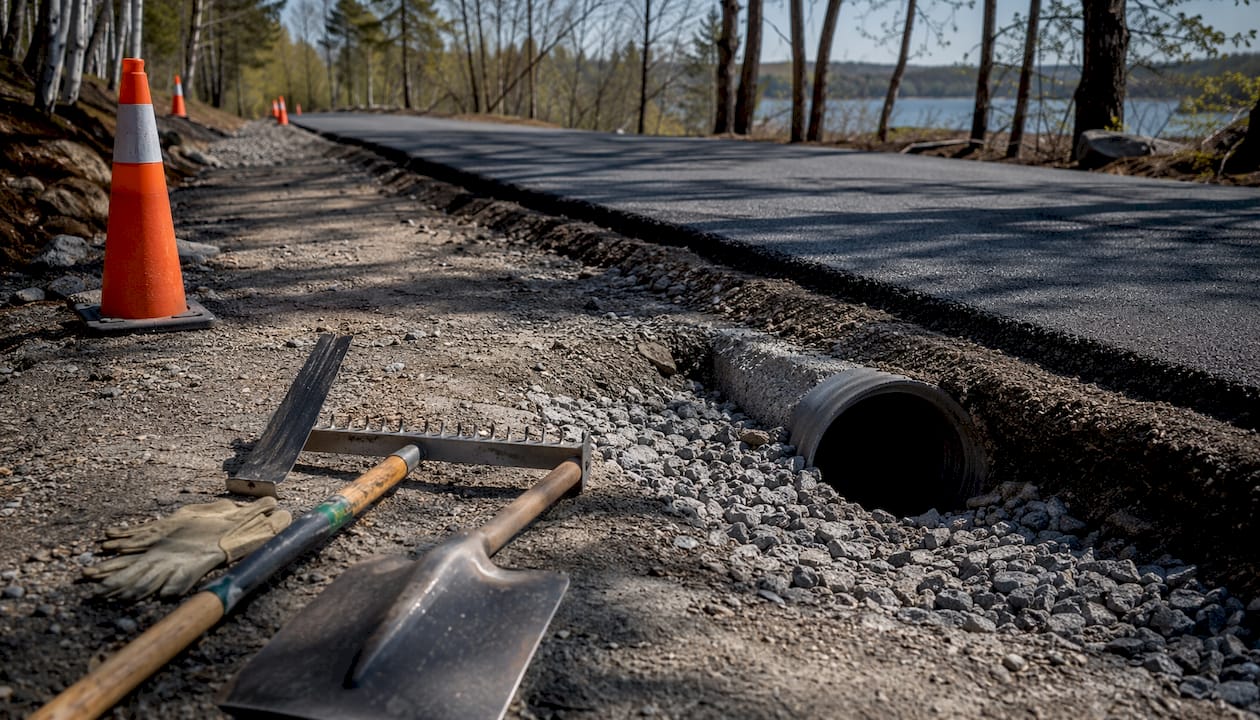
TAC guidance identifies high-quality granular sub-layers and positive drainage as the most effective defences against spring thaw pavement degradation. Surface treatments applied over a failing subgrade are temporary fixes that compound costs.
Key material and design priorities for freeze-thaw climates:
- Use non-frost-susceptible granular materials (well-graded crushed stone) in sub-base layers to prevent ice-lens formation.
- Specify minimum surfacing thickness appropriate to traffic loading and subgrade class; do not reduce thickness to save upfront cost.
- Apply protective infrastructure coatings to exposed structural elements to reduce freeze-thaw spalling and corrosion.
- Trigger crack sealing at PCI 70–79 before cracks admit water; route-and-seal at PCI 60–69; slurry seal at PCI 50–59 to extend life by approximately 10 years.
- Correct drainage deficiencies before any surface treatment; water trapped beneath a new surface will destroy it within one to two freeze-thaw cycles.
Pro Tip: Schedule major surface preservation work in late summer or early autumn, after the hottest paving window and before freeze-up. This gives new treatments a full season to cure before the first freeze-thaw cycle tests them.
For road maintenance in Alberta, the practical sequence is: drainage correction first, granular rehabilitation where subgrade is compromised, then surface treatment matched to the current PCI band. Reversing that order wastes materials and budget.
What should municipal procurement teams require in upkeep contracts?
Procurement quality determines whether the work you specify actually gets delivered. Weak RFP language produces low-quality submissions and expensive disputes.
- Define scope by asset class and condition outcome, not just by activity. Specify the post-work condition rating or PCI band the contractor must achieve, not only the treatment type.
- Require performance-based acceptance criteria: compaction test results (density and lift thickness), materials lab certificates for asphalt mix design, and a post-work condition verification step before final payment.
- Include warranty and holdback clauses appropriate to treatment type: surface seals typically carry a one-season performance warranty; structural works carry longer periods.
- Require as-built data delivery in a format compatible with your CMMS or GIS system, including updated asset condition records and photographic evidence.
- Mandate Alberta Safety Codes compliance and require proof of certifications in the submission package. Contractors unable to demonstrate compliance with Alberta’s construction standards should not pass technical evaluation.
- Mix contract types: use term contracts for routine preventive works (annual or multi-year) and project-based procurement for larger rehabilitation, with KPIs and liquidated damages where service continuity is critical.
Accessibility requirements for sidewalks and curb ramps must also be specified explicitly, including tactile surface standards and cross-slope tolerances, to meet municipal obligations under provincial accessibility legislation.
Which KPIs and reporting rhythms prove programme performance?
| KPI | Calculation | Example target | Frequency | Owner |
|---|---|---|---|---|
| Preventive/reactive ratio | Preventive work orders / total work orders | Above 70% preventive | Monthly | Maintenance manager |
| Maintenance cost / replacement value | Annual maintenance spend / total asset replacement value | 2%–3% | Quarterly | Finance and asset manager |
| Average backlog age | Sum of open work-order ages / count of open orders | — | Weekly | Operations supervisor |
| Scheduled task completion rate | Tasks completed on time / tasks scheduled | Above 90% | Monthly | CMMS administrator |
| Service-level attainment | Service requests resolved within standard / total requests | — | Monthly | Customer service and ops |
Reporting rhythms should match the audience. Field supervisors need daily or weekly dashboards showing open work orders, overdue tasks, and crew utilisation. The maintenance board needs a monthly summary of the preventive/reactive ratio, backlog trends, and budget-to-actual variance. Finance and council need a quarterly reconciliation that connects maintenance spending to lifecycle cost projections and flags any emerging capital needs.
Improving the preventive ratio from 50% to 70% typically reduces unplanned capital requests within two to three budget cycles, because fewer assets reach the failure threshold that triggers emergency replacement. That is the funding case in one sentence.
ProZone in practice: turnkey upkeep delivery in Alberta
ProZone has delivered upkeep projects across Edmonton and the surrounding region, working directly with municipal and commercial clients on pavement rehabilitation, drainage correction, and preventive surfacing programmes.
A representative project scope includes:
- Drainage correction as the first intervention, addressing subgrade saturation before any surface treatment is applied.
- Granular sub-base rehabilitation using non-frost-susceptible crushed stone specified to TAC standards for Alberta climate conditions.
- Asphalt resurfacing matched to the current PCI band, with mix design documentation provided for the client’s asset records.
- Proactive crack sealing and StreetBond surfacing applied within the correct PCI window to maximise treatment life.
- As-built condition records delivered in a format compatible with the client’s CMMS, updating asset history and remaining service life estimates.
Outcomes from this approach include measurable reductions in reactive service calls, improved service-level attainment in the treated area, and a documented ROI that procurement teams can present to finance. ProZone operates under Alberta Safety Codes and provides full materials certification with every project. You can review municipal construction project examples to see the scope and quality of completed work.
Contact ProZone to request a free site review or upkeep programme assessment for your municipality.
Your 30/90/365-day action checklist
30 days:
- Complete a condition snapshot of your ten highest-criticality assets (roads, culverts, storm inlets).
- Identify and prioritise short-term stormwater and drainage repairs before the next freeze-thaw window.
- Draft a CMMS pilot plan covering scope, asset class, data migration requirements, and training needs.
- Confirm budget reallocation authority and procurement delegation for the pilot.
90 days:
- Roll out preventive maintenance schedules for two asset classes using the CMMS pilot data.
- Secure term contracts for routine works (crack sealing, pothole patching, drainage clearing).
- Present lifecycle cost scenarios for the top five deferred-maintenance items to finance.
- Establish the KPI dashboard and reporting cadence for the maintenance board.
365 days:
- Complete a full asset register clean-up with updated condition ratings and replacement values.
- Publish an updated lifecycle funding plan aligned with the next multi-year capital budget cycle.
- Confirm the performance dashboard is in routine use and producing monthly board reports.
- Review the preventive/reactive ratio and adjust priority rules if the target of 70% preventive has not been reached.
What training and certification standards apply to upkeep personnel?
Workforce competency is a direct determinant of treatment quality. A crack seal applied by an untrained crew at the wrong temperature or with the wrong material will fail within one season, negating the entire preventive investment.
For pavement and civil works in Alberta, field supervisors should hold or be working toward certification through the Alberta Construction Safety Association (ACSA) or equivalent provincial body. Equipment operators on compaction and paving work require documented training records that satisfy Alberta Occupational Health and Safety requirements. Construction site safety standards for Alberta specify crew qualifications that procurement teams should require in contract submissions.
For CMMS administration and asset management roles, the Institute of Public Works Engineering Australasia (IPWEA) Asset Management training and the FCM MAMP learning modules provide recognised frameworks that Canadian municipal staff can access. Pairing technical field certification with data management training produces the integrated competency that a preventive programme actually needs.
How should you communicate with stakeholders during upkeep projects?
Upkeep projects disrupt residents, businesses, and commuters. Poor communication turns a well-executed project into a public relations problem and erodes council confidence in the programme.
Notify affected property owners and businesses at least five business days before work begins, with a clear description of the scope, duration, access restrictions, and a contact name for questions. For larger corridor works, a project page on the municipal website with a simple map and FAQ reduces inbound calls significantly. Post-project communication matters too: a brief notice confirming completion and the expected service-life improvement gives residents a tangible outcome to associate with the disruption.
Council briefings should connect upkeep spending to service-level outcomes, not just activity counts. Reporting that “42 km of crack sealing was completed” is less persuasive than “42 km of crack sealing extended pavement life by an average of five years, avoiding $2.3 million in premature rehabilitation.” Quantified outcomes build the political support that sustains preventive funding across budget cycles.
How do you plan for emergency infrastructure failures?
No upkeep programme eliminates failures entirely. A culvert collapse, a sinkhole, or a bridge deck failure requires a response that is faster and more coordinated than routine maintenance. Without a pre-planned response framework, emergency events consume disproportionate budget and expose the municipality to liability.
An effective emergency response plan for infrastructure identifies critical assets by failure consequence, pre-qualifies contractors for emergency call-out (with agreed rates and mobilisation times), and defines the internal authority chain for emergency spending approval. ProZone’s snow removal and winter services capability is one example of a pre-qualified, rapid-response service that municipalities can activate without a full procurement process during weather events.
The plan should also specify the data capture requirements during an emergency: photographs, GPS coordinates, and a condition assessment completed within 24 hours of the event. That documentation supports insurance claims, regulatory reporting, and the post-event update to the asset register and lifecycle cost model.
How do sustainability practices fit into an upkeep programme?
Sustainability in municipal upkeep extends well beyond climate-proofing. Energy efficiency, recycled materials, and reduced waste all reduce whole-life cost and support municipal environmental commitments.
For pavement works, reclaimed asphalt pavement (RAP) incorporated into new mix designs reduces virgin aggregate demand and lowers material cost without compromising performance when specified correctly. LED retrofits for streetlighting reduce energy consumption and maintenance frequency simultaneously, with payback periods that finance committees find straightforward to approve. Environmental considerations in construction for Canadian projects include guidance on material reuse and mitigation measures that align with municipal sustainability policies.
For drainage and stormwater assets, green infrastructure approaches such as bioswales, permeable paving in low-traffic areas, and enhanced inlet filtration reduce peak flows and pollutant loads while extending the service life of downstream pipe networks. These are not premium add-ons; they are cost-effective upkeep tools when applied to the right asset class at the right condition band. The municipal asset painting workflow for structural elements is another area where low-VOC, durable coatings reduce both environmental impact and recoating frequency.
Why durable fixes outperform repeated temporary patches in Alberta
The temptation to patch and move on is understandable when budgets are tight and the work order backlog is long. But in Edmonton’s climate, a temporary patch over a drainage problem is not a cost deferral. It is a cost multiplier. The freeze-thaw cycle will exploit every weakness in a surface treatment that sits on a compromised subgrade, and the repair bill next spring will be larger than the one this year.
The programmes that consistently deliver value are the ones that treat the cause before the symptom: drainage first, subgrade next, surface last. That sequencing requires integrated data, clear procurement specifications, and a contractor who understands Alberta conditions and will not cut corners on granular depth or compaction. Alberta Safety Codes compliance is not a checkbox; it is the minimum standard that separates durable work from repeat work.
ProZone’s experience across Edmonton-region municipal projects confirms that the combination of correct material specification, proper compaction, and timely preventive treatment produces measurable reductions in reactive call-outs within the first full seasonal cycle after intervention.
ProZone delivers certified upkeep services across Alberta
ProZone provides asphalt paving, drainage correction, preventive surfacing, concrete repair, and road construction for municipalities across Edmonton and the surrounding Alberta region. Every project is delivered under Alberta Safety Codes compliance, with full materials certification and as-built condition records provided for integration into your CMMS or asset management system. ProZone also supplies aggregates, granular materials, and landscaping supplies directly, reducing your supply-chain exposure for routine upkeep works.
For municipal managers ready to move from reactive patching to a structured preventive programme, ProZone offers a free estimate and site review. Use the online contact form at prozoneltd.ca or call directly to discuss your programme requirements and get a clear scope and cost for your next upkeep project.
Key Canadian sources for implementation reference
- FCM InfraGuide / MAMP: Best-practice checklists and asset management framework guidance for all municipal asset classes; use for policy justification and council briefing packages.
- FCM Timely Preventive Maintenance Primer: Detailed guidance on pavement preservation treatment selection and timing; use for technical specification of preventive programmes.
- TAC Technical Resources: Granular sub-layer specifications and pavement design guidance for Canadian climate conditions; use for material specification in RFPs and freeze-thaw design.
- O. Reg. 239/02 (Ontario): Minimum maintenance standards for municipal highways; use as a benchmark for setting local service levels and inspection schedules even outside Ontario.
- Township of Ramara AMP: A practical example of a municipal Asset Management Plan with lifecycle cost scenarios and treatment triggers; use as a structural template for your own AMP.
- NRC Municipal Infrastructure Management Framework: The five-facet sequencing model (inventory through criticality) that underpins decision-support system design; use to justify programme architecture to senior leadership.
Attach the FCM and TAC documents to your next council briefing package. They carry the institutional credibility that supports both funding requests and procurement specifications.
FAQ
What is the first step in a municipal upkeep programme?
Complete an asset register and condition snapshot for your highest-criticality assets before scheduling any preventive work. Without accurate condition data, treatment selection and budget allocation are unreliable.
How does preventive maintenance reduce long-term costs?
Timely preventive treatments such as crack sealing and slurry sealing can extend pavement service life significantly, with lifecycle frameworks showing extensions from roughly 20 to over 34 years with well-timed interventions, avoiding far more expensive rehabilitation or replacement.
What CMMS functions are non-negotiable for municipal use?
A municipal CMMS must include asset inventory with condition records, scheduled work orders with priority rules, mobile field access, parts management, cost tracking per asset, and reporting dashboards. Missing any of these functions produces data gaps that undermine the lifecycle cost model.
How should municipalities handle freeze-thaw damage in Alberta?
Correct drainage deficiencies and rehabilitate compromised granular sub-layers before applying any surface treatment. TAC guidance confirms that high-quality granular sub-layers and positive drainage are the most effective defences against spring thaw subgrade failure.
When should a municipality contact ProZone for upkeep support?
Contact ProZone when you need Alberta Safety Codes-compliant delivery of asphalt paving, drainage correction, preventive surfacing, or concrete repair, particularly before the seasonal freeze-thaw window when treatment timing is critical to achieving full service-life extension.