
TL;DR:
- Effective construction site safety relies on collaborative hazard assessments and proactive safety controls.
- Compliance with Alberta regulations mandates thorough documentation, active supervision, and ongoing site management.
Construction site safety tips are actionable measures that prevent workplace hazards before they cause injury, delay, or regulatory penalty. Alberta’s Occupational Health and Safety Act sets strict standards for every active site, and non-compliance carries fines up to $500,000 per offence. That financial exposure alone makes structured safety planning a business priority, not just a legal obligation. Prozoneltd applies these standards on every Edmonton-area project, treating safety as a core deliverable alongside quality and schedule. The tips below reflect current Canadian OHS practice and 2026 enforcement priorities.
1. What are the most critical construction site safety tips?
Personal protective equipment is the last line of defence, not the first. Site managers who rely on hard hats and high-visibility vests as their primary control are already behind. The Hierarchy of Controls places elimination and engineering controls above PPE, meaning you address the hazard at its source before issuing gear.
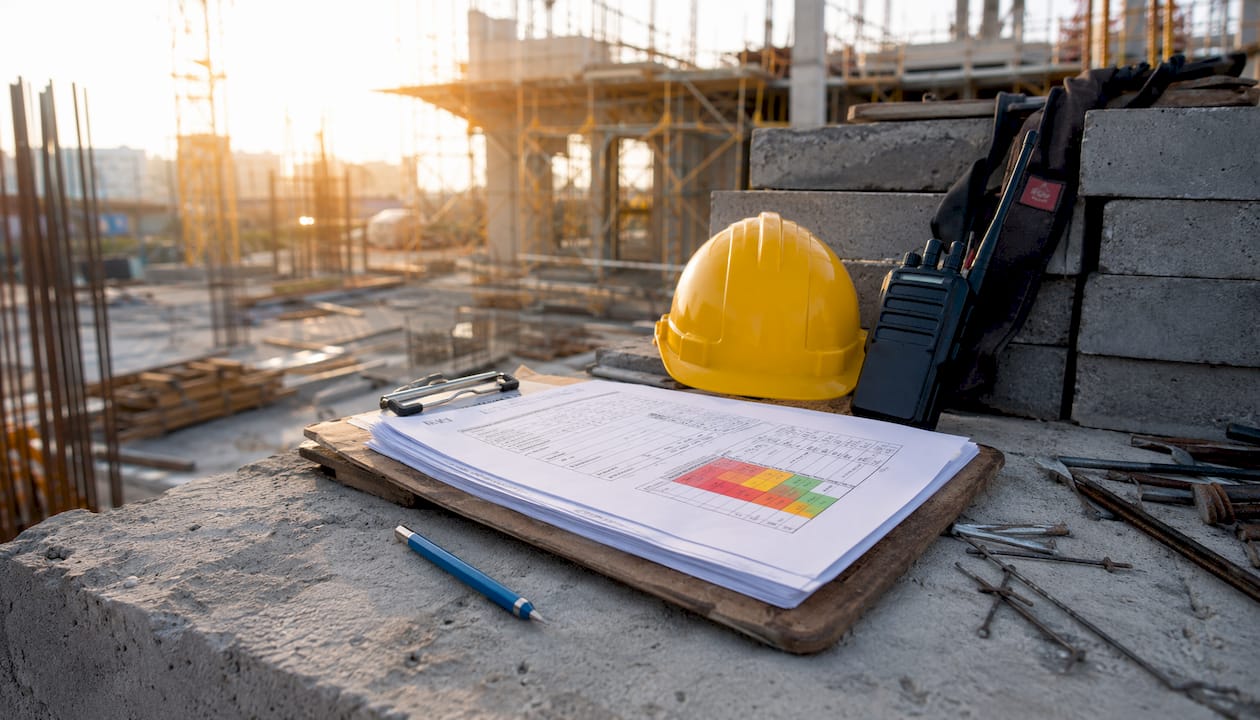
Every worker must receive a site-specific orientation before starting work. A legally defensible orientation includes a physical walk-around of active hazards rather than a video in a trailer. Workers retain far more when they see the actual trench, the live electrical panel, and the crane swing radius in person.
Daily housekeeping is a direct injury-prevention measure. Clear walkways and proper stacking reduce slips, trips, and struck-by incidents, which account for a significant share of routine construction injuries. Assign housekeeping responsibilities by trade and inspect before each shift.
Pro Tip: Post access control points at every site entry and verify orientation records before any worker enters the active zone. This single step closes the most common compliance gap during Alberta OHS inspections.
2. How to conduct effective hazard assessments on construction sites
Three types of hazard assessments apply to Canadian construction sites, and each serves a distinct purpose. A Formal Hazard Assessment covers the full scope of a project before mobilisation. A Job Hazard Analysis (JHA) breaks down a specific task into steps and identifies risks at each stage. A Field-Level Hazard Assessment (FLHA) is completed on-site immediately before work begins and addresses conditions that day.
Collaborative, on-site FLHAs consistently outperform foreman-only paperwork completed in a truck. When the entire crew participates, hazard identification improves and workers take ownership of the controls. The FLHA becomes a genuine safety tool rather than a compliance checkbox.
Risk rating matrices help prioritise which hazards need immediate engineering controls versus administrative measures. Rate each hazard by likelihood and severity, then apply controls starting from the top of the Hierarchy. Falls remain the leading cause of construction fatalities, so guardrails, scaffold inspections, and fall arrest systems are non-negotiable engineering controls, not optional upgrades.
Hazard assessment records must be retained for a minimum of three years. This satisfies both regulatory audit requirements and insurance reviews. Keep records in a format that is accessible on-site and retrievable within minutes.
| Hazard assessment type | When it is completed | Who completes it |
|---|---|---|
| Formal Hazard Assessment | Before project mobilisation | Safety officer and management |
| Job Hazard Analysis (JHA) | Before a specific task begins | Supervisor and crew leads |
| Field-Level Hazard Assessment (FLHA) | Immediately before daily work | Entire crew, on-site |
3. What role does planning and supervision play in site safety?
Pre-task planning is a site-specific, collaborative process. An effective session takes 10–15 minutes on-site with the crew present at the actual work location. That brevity is intentional. A focused, on-location discussion produces better hazard awareness than a lengthy morning meeting in a lunchroom.
Competent supervisors are the most direct safety control on any site. Their role is not to complete paperwork but to monitor work in progress, correct unsafe behaviour immediately, and verify that controls identified in the FLHA are actually in place. A supervisor who reviews the plan but does not walk the site provides limited protection.
Near-miss reporting is an early-warning system that most sites under-use. Near misses provide critical data to identify dangerous trends before they result in injury or fatality. Build a reporting culture by responding to every near miss with a documented review, not a reprimand.
Pro Tip: When multiple trades work in the same zone, hold a brief daily coordination meeting to identify overlapping hazards. A concrete crew and an electrical crew working within five metres of each other create risks that neither FLHA captures independently.
Refer to Prozoneltd’s project planning guide for a structured approach to pre-task coordination on complex multi-trade sites.
4. Key legal compliance requirements for Alberta construction sites
Alberta’s OHS Act sets clear financial consequences for non-compliance. Fines reach $500,000 per offence, with continuing violations attracting $30,000 per day. Serious breaches can result in up to six months of imprisonment for responsible parties. These are not theoretical maximums. Alberta OHS officers issue orders and penalties on active sites.
| Compliance requirement | Regulatory standard | Consequence of non-compliance |
|---|---|---|
| Site-specific safety orientation | Alberta OHS Act, Part 3 | Stop-work order, fine |
| Written hazard assessments | Alberta OHS Regulation 9 | Fine up to $500,000 |
| Hazard assessment record retention | Minimum 3 years | Audit failure, insurance risk |
| Fall protection systems | Alberta OHS Code Part 9 | Stop-work order, fine, imprisonment |
| Daily housekeeping and access control | Alberta OHS Code Part 2 | Fine, incident liability |
COR (Certificate of Recognition) certification is the provincial standard that demonstrates a functioning safety management system. Many municipal and commercial contracts in Alberta require COR as a condition of bidding. Maintaining COR means your safety plans, training records, and hazard assessments must be current and auditable at any time.
Safety plans must function as living documents updated whenever site conditions change, new trades arrive, or a near miss occurs. A static binder on a shelf does not meet Alberta OHS expectations and will not withstand an audit.
5. Practical tips for site managers beyond basic compliance
Orientation is most effective as a dynamic, walk-around process. Showing workers the active hazards in person produces better retention and is more legally defensible than a video presentation. Update the orientation route every time site conditions change significantly.
Seasonal factors in Edmonton demand specific planning. Freeze-thaw cycles between october and april create ground instability, ice accumulation on walking surfaces, and shifting soil conditions near excavations. Prozoneltd’s winter sanding services address surface traction directly, but site managers must also schedule ground assessments after each thaw cycle.
Locate requests to Alberta One-Call require at least three full working days’ notice, with longer delays in spring due to high volume. Missing this step exposes crews to underground utility strikes, which are among the most severe construction incidents. Build locate requests into your project schedule as a fixed milestone, not an afterthought.
Site superintendents should audit safety plan implementation on the ground weekly, not just review documents. The gap between what a safety plan says and what workers actually do is where incidents originate. Effective construction signage at access points, hazard zones, and pedestrian routes reinforces written controls with visual cues that workers see in real time.
Separate pedestrian and vehicle routes wherever cranes, loaders, or heavy trucks operate. Maintaining clear separation between foot traffic and equipment movement reduces struck-by incidents near energised work zones. Mark these routes with physical barriers, not just painted lines.
6. What site preparation steps reduce safety risks before work begins?
Site preparation is where most preventable hazards are either controlled or created. Grading, drainage, and access road placement determine whether workers face unstable ground, standing water, or blind vehicle movements throughout the project. Addressing these conditions before mobilisation is far less costly than managing incidents after work starts.
A thorough site preparation process includes utility locates, soil condition assessments, and access control planning as fixed pre-construction steps. Each of these directly reduces the hazard load that workers face on day one. Sites that skip or rush preparation consistently show higher incident rates during the first two weeks of active work.
In Edmonton’s climate, soil conditions change significantly between seasons. Spring thaw softens ground that appeared stable in winter, creating unexpected subsidence near excavations and heavy equipment paths. Schedule a ground condition review after any extended freeze-thaw period before resuming or starting earthworks.
Prozoneltd’s perspective on safety culture versus safety paperwork
The most persistent problem on Canadian construction sites is the gap between documented safety plans and actual site behaviour. Safety managers spend significant time producing compliant paperwork, yet incidents still occur because the controls described in those documents are not consistently applied in the field.
Frontline workers identify hazards that supervisors and safety officers miss. Involving the crew in FLHAs and pre-task planning is not a procedural nicety. It produces more accurate hazard identification and builds genuine accountability. Workers who help identify a hazard are far more likely to respect the control placed on it.
Checklist compliance is not the same as active site engagement. A foreman who signs an FLHA without walking the work area with the crew has completed a form, not a safety process. The distinction matters because Alberta OHS officers assess actual site conditions, not just documentation quality.
Management commitment is the single factor that separates sites with strong safety cultures from those with strong safety binders. When site managers visibly enforce controls, respond to near misses with action, and treat safety as a production priority, workers follow. When management treats safety as an administrative burden, workers read that signal accurately.
— Prozoneltd
Prozoneltd’s construction safety support for Edmonton site managers
Prozoneltd delivers construction and infrastructure services across Edmonton and the surrounding region with safety and Alberta OHS compliance built into every project scope. From earthworks and concrete screeds to asphalt laying and site preparation, each project follows documented safety plans, site-specific hazard assessments, and trained supervision. Site managers working with Prozoneltd receive a partner who treats compliance as a baseline, not a differentiator. Review Prozoneltd’s full range of construction services for Edmonton managers to see how safety-integrated project delivery works in practice. Contact Prozoneltd directly through the online form or by phone for a free estimate on your next project.
FAQ
What are the most important construction site safety tips?
The most critical tips are completing site-specific hazard assessments collaboratively with the crew, enforcing physical walk-around orientations, applying the Hierarchy of Controls before issuing PPE, and maintaining active housekeeping throughout the project.
How long should a pre-task planning session take?
An effective pre-task planning session takes 10–15 minutes and must be conducted at the actual work location with the full crew present, not in a site office or lunchroom.
What are the penalties for OHS non-compliance in Alberta?
Alberta OHS Act penalties reach $500,000 per offence, $30,000 per day for continuing violations, and up to six months of imprisonment for serious breaches.
How long must hazard assessment records be kept in Alberta?
Hazard assessment records must be retained for a minimum of three years to satisfy regulatory audit and insurance review requirements.
What makes a site safety orientation legally compliant in Alberta?
A legally compliant orientation includes a physical walk-around of active site hazards rather than a video-only presentation, and must be documented with worker sign-off before any work begins.