
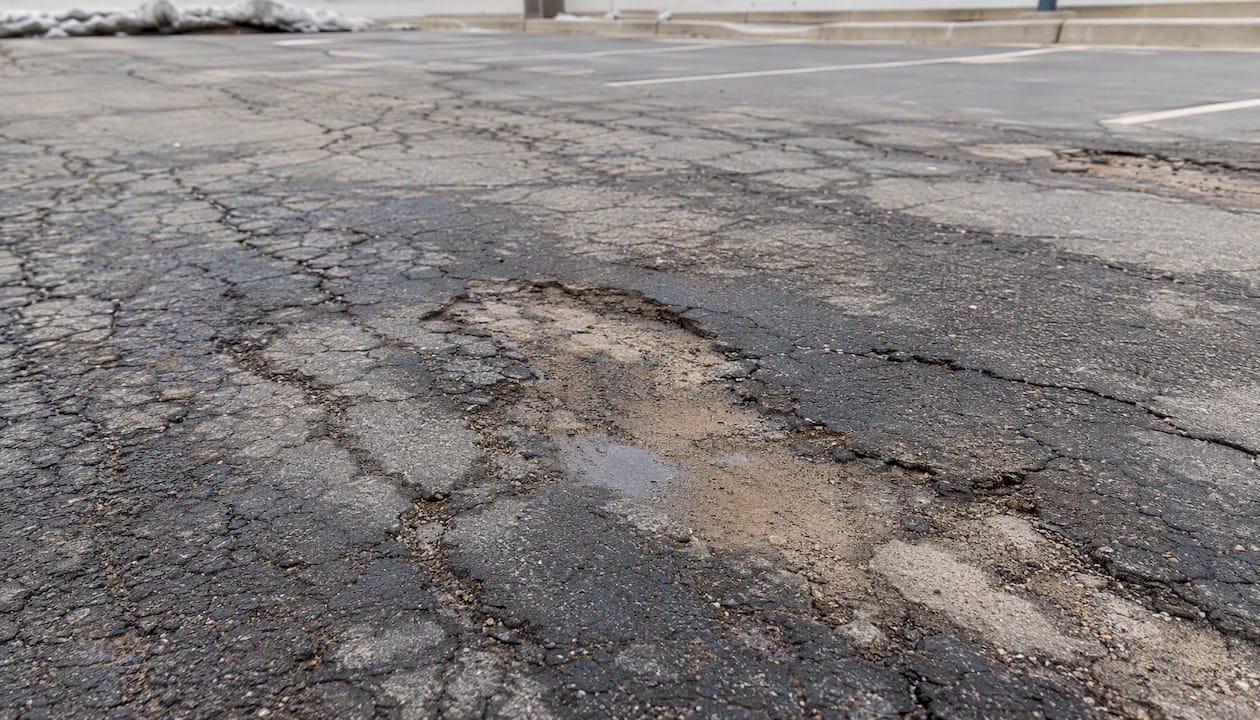
Alligator cracking in asphalt is a structural fatigue failure, not a surface blemish. When you see that interconnected, polygon-shaped crack pattern spreading across a wheel path, the pavement’s base or subbase has typically lost load-bearing capacity. Cosmetic sealing will not fix it.
Two quick checks to run right now:
- Measure the affected area. If the cracked zone covers an area reaching the provincial minimum classification size or more, standards require a formal severity rating and a structural repair plan.
- Check for wheel-path origin and pumping. Cracks that start in the wheel track and show fine material being pushed up through joints indicate active base failure. Arrange a structural assessment immediately.
Table of Contents
- What does alligator cracking in asphalt actually mean?
- How to inspect on site and rate severity quickly
- What causes alligator cracking in asphalt pavement?
- Simple field checks and when to call a professional
- Repair methods and a decision guide for Alberta conditions
- Typical Canadian costs, repair lifespans, and scheduling constraints
- Maintenance routines that reduce the risk of recurrence
- How ProZone assesses and repairs alligator cracking in Alberta
- What ProZone sees most often in the field
- ProZone’s free estimate for alligator cracking repairs in Alberta
- Sources
- FAQ
What does alligator cracking in asphalt actually mean?
The formal term in Canadian pavement management is fatigue cracking, sometimes called crocodile cracking. Provincial pavement condition rating manuals define it as a load-related distress producing multi-sided, interconnected cracks that form a pattern resembling a reptile’s skin. For official classification, the affected area must reach at least a specified minimum size; smaller isolated patches are recorded separately.
Severity is rated in three bands:
- Low: Fine cracks with no spalling, no loose material, and no pumping. Crack widths are narrow and the blocks are still stable.
- Medium: Cracks are wider, some spalling at edges, slight pumping may be visible. Blocks begin to rock under load.
- High: Broken, loose blocks with significant spalling, pumping of fines, and visible surface deformation.
PavementInteractive describes the progression clearly: repeated loading flexes the asphalt layer until tensile cracks initiate at the bottom of the bound layer, then propagate upward and outward into the characteristic polygon pattern. Reflected cracking looks similar but originates from joints or cracks in an underlying layer rather than from fatigue. Distinguishing between the two matters because the repair strategy differs.
Key figure: A minimum area of 1.0 m² is required before a distress qualifies as alligator cracking under provincial pavement management classification.
How to inspect on site and rate severity quickly
A structured field inspection takes less than 30 minutes and gives you the documentation a contractor needs to scope a repair accurately. Follow this sequence:
- Walk the wheel paths first. Alligator cracking almost always originates in the loaded wheel track, not at the pavement edge. Start there.
- Measure the cracked area. Use a measuring tape and sketch the boundary. Record length by width in metres. Note whether multiple patches are connected or isolated.
- Assess crack width and block size. Narrow cracks under 3 mm with large blocks indicate low severity. Cracks over 6 mm with small, irregular blocks indicate high severity.
- Check for spalling. Run your boot along the crack edge. Loose aggregate or broken asphalt pieces signal medium to high severity.
- Test for pumping. Stand near the cracked area while a vehicle drives slowly over it. Fine grey or brown material appearing at the crack surface is pumped subbase fines, a clear structural red flag.
- Photograph systematically. Take one wide shot showing the full extent, one mid-range shot showing crack pattern, and one close-up showing crack width and spalling. Include a measuring tape in at least one frame.
For pavement damage assessment in Alberta, documenting coverage density is equally important. Provincial manuals use three density bands: low (under 10% of the inspected area), medium (10–50%), and high (over 50%).
| Observed signs | Severity rating | Recommended action |
|---|---|---|
| Fine cracks, no spalling, no pumping, blocks stable | Low | Monitor; schedule crack sealing within one season |
| Wider cracks, minor spalling, slight pumping, blocks shift | Medium | Localized full-depth patch; assess drainage |
| Loose blocks, significant spalling, active pumping, deformation | High | Full-depth repair or reconstruction; structural assessment required |
What causes alligator cracking in asphalt pavement?
Most cases trace back to one of three root causes: the pavement was never thick enough for the loads it carries, the base has weakened over time, or water has saturated the subgrade. Often, all three are present together.
Primary structural causes:
- Repeated heavy loading that exceeds the pavement’s fatigue life, particularly in parking lots or access roads used by delivery vehicles heavier than the original design assumed.
- Weak or saturated base and subbase layers that flex excessively under load, transferring tensile stress to the bottom of the asphalt.
- Insufficient asphalt thickness at original construction, which shortens fatigue life dramatically.
- Poor compaction during placement, leaving air voids that collapse under traffic and accelerate cracking.
- Stiff or brittle asphalt mixes that cannot accommodate thermal movement without cracking.
Alberta’s climate adds a compounding factor that milder provinces do not face at the same intensity. Research on climate effects and asphalt performance in Alberta shows that wide diurnal and seasonal temperature swings increase cyclic strains in asphalt, raising fatigue risk so that even moderate traffic volumes can shorten pavement life significantly compared to warmer climates. Edmonton regularly cycles through freeze-thaw events in spring and fall, and each freeze-thaw cycle pumps water through existing cracks, progressively weakening the base.
Secondary contributing factors include blocked or inadequate drainage that keeps the subgrade saturated, overloaded vehicles that exceed posted limits, and original construction deficiencies such as inadequate base depth or poorly graded aggregate. Investigations at flexible pavement sites consistently identify overloading and subbase failure as the two most common drivers, which is why surface-only repairs so often fail within a season or two.
Simple field checks and when to call a professional
Before calling a contractor, a property team can run four low-cost checks that sharpen the repair scope and reduce the risk of being quoted for more work than is needed.
- Sounding: Tap the pavement surface with a hammer or steel rod. A hollow, drum-like sound indicates debonding or voids beneath the surface layer.
- Probing for soft areas: Push a thin steel rod or screwdriver into a crack. If it penetrates easily, the base material has lost density.
- Pumping check under traffic: As noted above, watch for fines appearing at crack surfaces while a vehicle passes. Pumping confirms active base saturation.
- Drainage and ponding audit: Walk the site after a rain event. Standing water within 0.5 metres of the cracked area is a strong indicator that drainage is contributing to the failure.
Red flags requiring immediate professional assessment:
- Pumping of fines visible at any crack surface
- Blocks that rock or shift underfoot
- Cracked area exceeds the minimum classification size or is spreading between inspections.
- Recurring failures within one to two seasons of a previous patch
- Widespread spalling across multiple connected patches
Pro Tip: Before accepting any overlay quote, request that the contractor perform sounding and, where pumping is present, take cores. Pavement inspections that include deflection testing give you the structural data needed to specify overlay thickness correctly rather than guessing.
Repair methods and a decision guide for Alberta conditions
Choosing the wrong repair for alligator cracking is the single most common reason repairs fail prematurely. Alberta crack maintenance guidelines are explicit: crack sealing is ineffective when the base has lost load-bearing capacity, because water will continue to saturate and pump fines through the cracked blocks regardless of what is applied to the surface.
Repair options from least to most invasive:
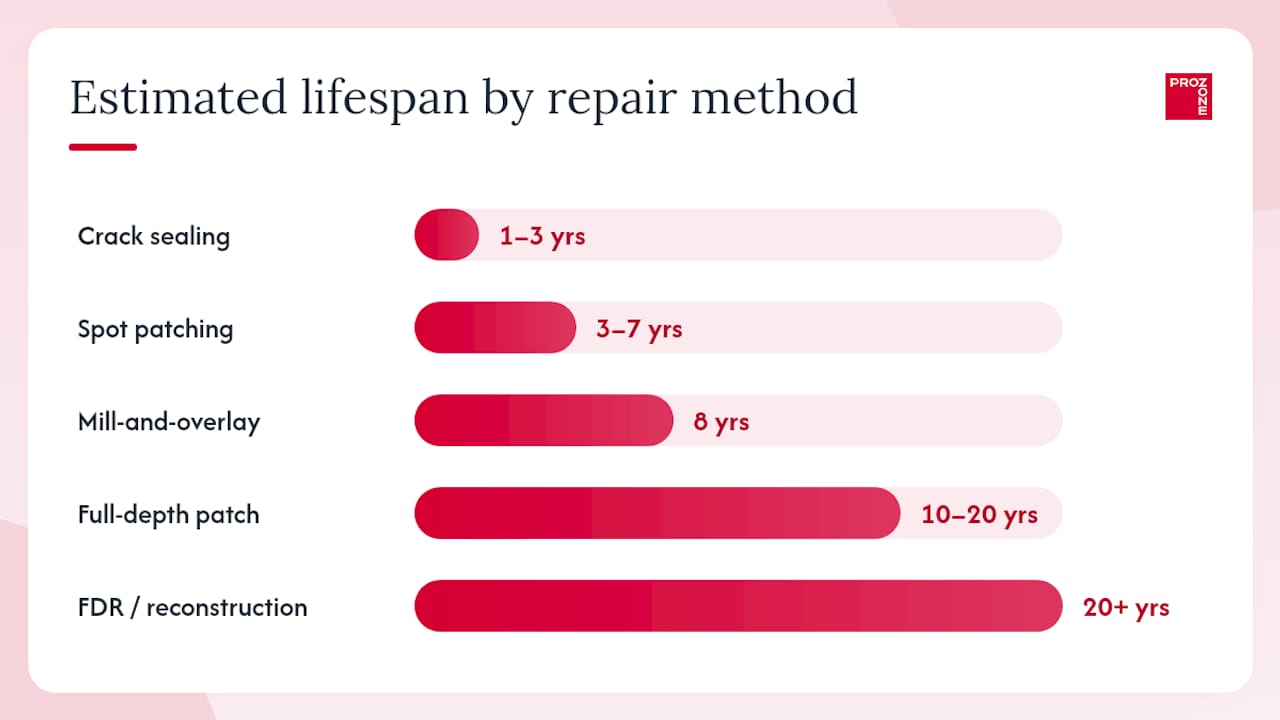
- Crack sealing / rout-and-seal: Appropriate only for low-severity, isolated cracks with no pumping and no base movement. Extends surface life by 1–3 years if applied early. Not a structural fix.
- Localized spot patching: Suitable for medium-severity patches under approximately 2–3 m² where the surrounding pavement is sound. Remove the failed material to firm base, recompact, and replace with hot-mix asphalt. Lifespan of 3–7 years if the root cause is addressed.
- Mill-and-overlay: Appropriate when cracking is widespread but the base is still structurally sound. Milling removes the deteriorated surface layer; a new bound layer is placed to the correct design thickness. Performance evaluations of asphalt overlays in Alberta confirm that overlay thickness is the most statistically significant factor in structural response, so under-designed overlays on a marginal base will reflectively crack within a few years.
- Full-depth patching: The correct choice for high-severity patches where the base is saturated or failed. Excavate to competent subgrade, rebuild the base, and place new asphalt in lifts. Lifespan of 10–20 years when drainage is also corrected.
- Full-depth reclamation (FDR) or reconstruction: Required when cracking is dense and extensive across a large area. FDR pulverises the existing asphalt and base, stabilises the material, and provides a new structural foundation. Most durable long-term solution for widespread structural failure.
| Repair method | Recommended for | Typical cost range (CAD) | Est. lifespan (root cause fixed) | Disruption | Recurrence risk if root cause not fixed |
|---|---|---|---|---|---|
| Crack sealing | Low severity, no pumping, isolated cracks | $2–$8 per linear metre | 1–3 years | Minimal, hours | High |
| Spot patching | Medium severity, under 3 m², sound surrounding pavement | $150 per m² | 3–7 years | Low, 1 day | Moderate to high |
| Mill-and-overlay | Widespread surface fatigue, structurally sound base | $25 per m² | 8 years | Moderate, 1–3 days | Moderate if base marginal |
| Full-depth patch | High severity, failed base, pumping present | $300 per m² | 10–20 years | Moderate, 1–2 days per patch | Low |
| FDR / reconstruction | Extensive cracking, widespread base failure | $80 per m² | 20+ years | High, multi-day | Very low |
Cost ranges are indicative for Alberta conditions and vary with site access, mobilisation distance, and material prices. Obtain site-specific quotes.
Decision flow:
- Cracked area under 1.0 m², no pumping, no block movement: crack sealing or spot patch is acceptable as a short-term measure.
- Cracked area over 1.0 m² with pumping or block movement: structural repair is required. Proceed to coring and base assessment before specifying the method.
Pro Tip: When laying asphalt correctly over a repaired base, MEPDG guidance and ATPD comparisons show that ATPD can underestimate required overlay thickness under poor subgrade conditions. Always verify design thickness against site-specific core data, not just standard tables.
Typical Canadian costs, repair lifespans, and scheduling constraints
The cost ranges in the decision table above reflect Alberta market conditions, but several factors shift them significantly.
- Mobilisation costs for small patches in remote or difficult-access sites can double the effective per-square-metre rate. Grouping multiple repairs into one mobilisation reduces unit cost considerably.
- Seasonal scheduling is critical in Edmonton. Hot-mix asphalt placement requires pavement surface temperatures above approximately 10°C and air temperatures above 5°C. The practical paving window in Edmonton runs from roughly late April through October, though late-season work carries risk if overnight temperatures drop sharply.
- Freeze-thaw timing affects diagnosis too. Spring thaw is the worst time to assess base condition because saturated subgrades are at their weakest. An assessment done in May may show worse conditions than the same site in August, which is useful for scoping repairs but means spring quotes can be conservative.
- Expected service life after each repair type assumes the root cause is corrected. A mill-and-overlay placed over a still-saturated base will reflectively crack within 2–4 years. Full-depth reconstruction with proper drainage correction routinely delivers 20 or more years of service life.
Scheduling note: The Transportation Association of Canada’s Pavement Asset Design and Management Guide recommends proactive preservation over reactive patching. Addressing low-severity cracking before it reaches the pumping stage typically costs 30–50% less than the structural repair required once the base has failed, though that comparison depends on site conditions.
Maintenance routines that reduce the risk of recurrence
The most cost-effective maintenance programme addresses small problems before they become structural ones. TAC’s asset management guidance is consistent on this point: waiting for visible alligator cracking usually means the foundation has already failed, and the shift from maintenance to reconstruction carries a significant cost penalty.
Quarterly and annual actions for property teams:
- Inspect all paved surfaces in spring after thaw and in fall before freeze-up. Document new cracking, measure areas, and photograph.
- Seal isolated cracks under 6 mm width promptly, before water infiltration begins. Early crack sealing is the highest-return maintenance action available.
- Clear and flush all drainage channels, catch basins, and edge drains at least twice per year. Blocked drainage is a leading contributor to base saturation.
- Apply sealcoating on sound pavement surfaces every 3–5 years to reduce oxidation and surface water infiltration. Sealcoating does not repair structural damage but extends the life of sound pavement.
- Schedule a professional pavement condition survey every 3–5 years to update your asset records and plan overlays before cracking reaches structural severity.
For a full asphalt maintenance checklist tailored to Edmonton, including seasonal timing and material selection guidance, ProZone’s published resources cover the complete annual cycle.
Pro Tip: Load management matters as much as surface maintenance. Posting load restrictions during spring thaw, when subgrade bearing capacity is at its lowest, can extend pavement life by several years on routes used by heavy delivery or service vehicles. Coordinate with tenants or contractors who regularly access the site.
How ProZone assesses and repairs alligator cracking in Alberta
ProZone’s assessment process follows a structured sequence before any repair method is specified. Visual mapping of crack patterns and severity is the starting point, followed by sounding across the affected area to identify debonded zones. Where pumping or high-severity cracking is present, cores are taken to confirm base thickness, material condition, and moisture content. Drainage conditions are assessed at the same time, because a structurally correct repair placed over a drainage problem will fail again.
Standards and design references ProZone applies:
- TAC Pavement Asset Design and Management Guide for classification and preservation planning
- Provincial pavement condition rating manuals for severity documentation
- MEPDG and ATPD references when specifying overlay thickness, particularly on sites with poor subgrade or high traffic volumes, where ATPD tables alone may underestimate required thickness
- Alberta Safety Codes and provincial construction standards for all placement and compaction work
Quality and certification signals:
- All asphalt work is carried out under Alberta Safety Codes requirements
- Mix designs and compaction are verified against specification before and during placement
- ProZone provides post-repair documentation including core results, compaction records, and drainage confirmation
- Site-specific warranties are provided on structural repairs
ProZone serves Edmonton and the surrounding Alberta region. To arrange a free site assessment and repair estimate, contact the team directly through the ProZone contact page.
What ProZone sees most often in the field
The most common mistake on alligator-cracked pavements is applying crack filler or a thin overlay without investigating the base. It looks resolved for one season. By the following spring, the same pattern reappears, often larger, because the freeze-thaw cycle has continued to pump fines and widen the voids beneath the surface. The repair budget has been spent twice, and the structural problem is worse than before.
The second most common error is under-designed overlays. A 40 mm overlay placed on a marginal base without coring to verify thickness requirements will reflectively crack within a few years. Specifying overlay thickness from a standard table rather than from site-specific deflection data is a shortcut that consistently produces early failures, particularly in Edmonton’s climate where thermal cycling adds fatigue demand on top of traffic loading.
Practical guidance from ProZone’s field work: prioritise drainage correction and coring before committing to any repair method above spot patching. When a base is saturated, even a correctly designed overlay will underperform until the water source is eliminated. Communicating load restrictions to tenants during the repair period also protects the new surface during the critical early curing phase.
ProZone’s free estimate for alligator cracking repairs in Alberta
ProZone handles the full repair sequence for alligator-cracked pavements in Edmonton and surrounding Alberta: site assessment, coring, drainage evaluation, structural patching, mill-and-overlay, and full-depth reconstruction, all carried out to Alberta Safety Codes and TAC standards. You get a single point of contact from assessment through to post-repair documentation, with no subcontracting of core structural work.
For facility managers and property owners who need a clear repair scope and a firm price, the right first step is a free on-site estimate. ProZone’s team will assess severity, measure coverage, check drainage, and provide a written recommendation with cost options before any work begins. You can also review ProZone’s asphalt paving services overview to understand the full scope of what is available.
Book your free site assessment through the ProZone contact page or call directly. Repairs scheduled for the correct seasonal window, with the base work done properly, are the ones that last.
Sources
The following resources were referenced in this article and are recommended for deeper technical detail:
- Pavement surface condition rating manual
- Pavement Asset Design and Management Guide (2013) | Transportation Association of Canada (TAC)
- Crack maintenance guidelines
- Study on climate effects and asphalt performance in Alberta
- Performance evaluation of asphalt overlays in Alberta
- Investigation of the reasons for alligator cracks at flexible pavement sites
FAQ
What is alligator cracking in asphalt pavement?
Alligator cracking is a load-related fatigue distress that produces interconnected, multi-sided cracks resembling a reptile’s skin. It typically originates at the bottom of the asphalt layer under repeated loading and propagates upward, indicating that the pavement’s structural capacity has been exceeded.
What causes alligator cracking in asphalt?
The primary causes are repeated loading beyond the pavement’s design capacity, a weak or saturated base or subbase, and insufficient asphalt thickness. In Alberta, freeze-thaw cycling compounds these factors by pumping water through existing cracks and progressively weakening the base layer.
How do you fix alligator cracks in asphalt?
The correct repair depends on severity and root cause. Low-severity, isolated cracks with no pumping can be crack-sealed as a short-term measure. Medium to high-severity cracking with pumping or base movement requires full-depth patching or reconstruction; surface sealing alone will not restore structural integrity.
Can you pave over alligator cracks?
A mill-and-overlay is appropriate only when the underlying base is still structurally sound. Placing an overlay directly over active alligator cracking without addressing the base will result in reflective cracking within a few seasons, particularly in Alberta’s freeze-thaw climate. Coring to verify base condition before specifying overlay thickness is strongly recommended.
When should you call a professional for asphalt cracking?
Arrange a professional structural assessment when the cracked area reaches 1.0 square metre or more, when pumping of fines is visible, when blocks shift underfoot, or when a previous patch has failed within one to two seasons. ProZone provides free on-site assessments for property owners and facility managers across the Edmonton region.