
TL;DR:
- Asphalt paving is a precise, multi-stage process vital for durability and long-term performance.
- Proper surface preparation, mix design, compaction, and quality joints are essential for lasting asphalt.
- Hiring experienced contractors who follow industry standards and conduct thorough testing ensures pavement longevity.
Most property owners assume asphalt paving is straightforward: show up, pour the black stuff, roll it flat, and you’re done. That assumption costs thousands of dollars every year in premature failures, crumbling edges, and surfaces that crack after the first Edmonton winter. The reality is that asphalt paving is a precise, multi-stage process where every decision, from mix design to compaction temperature, directly affects how long your pavement lasts. Whether you’re managing a commercial parking lot, a residential driveway, or a private road, understanding what actually goes into a quality paving job gives you the power to hire smarter, ask better questions, and protect your investment for decades.
Table of Contents
- Defining asphalt paving: More than just a black surface
- The asphalt paving process: Step-by-step for lasting results
- Edge cases and real-world challenges in asphalt paving
- Quality control and best practices: Getting the most from your investment
- Perspective: What most property owners get wrong about asphalt paving
- Get expert help with your next Edmonton paving project
- Frequently asked questions
Key Takeaways
| Point | Details |
|---|---|
| Asphalt paving definition | Asphalt paving involves precisely blended materials and a multi-step process for lasting pavement. |
| Key process stages | Each stage – from surface prep to compaction – directly affects the performance and lifespan of your surface. |
| Special scenarios matter | Edge cases like overlays and complex commercial sites need expert handling to avoid premature failure. |
| Quality control essentials | Hire contractors who follow best practices, test for density, and adapt to Edmonton’s climate for best results. |
Defining asphalt paving: More than just a black surface
Now that we’ve set the stage, let’s clarify what asphalt paving truly is, beyond first impressions.
Asphalt paving is not a single material or a single action. It is a structured construction process. As the Asphalt Paving Handbook NAPA defines it, “asphalt paving is the process of constructing pavements using asphalt mixtures, precisely blended for durability.” That word “precisely” carries a lot of weight. The mix is engineered, not guessed.
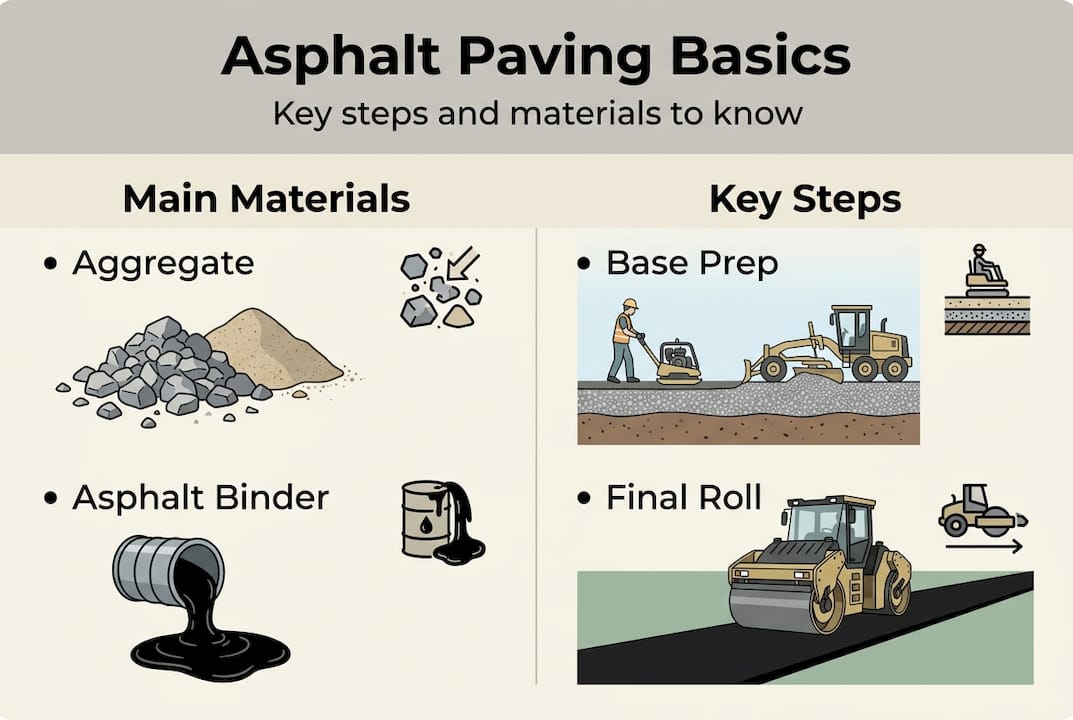
At its core, asphalt pavement is made of two main components: aggregate and asphalt binder. Aggregate refers to crushed stone, gravel, and sand, which form the structural skeleton of the pavement. The asphalt binder, a petroleum-derived product, coats and holds those particles together. The ratio, particle size distribution, and binder grade are all calculated based on the expected load, climate, and traffic volume. You can learn more about asphalt road facts to see how these components come together in real applications.
Here is where the misconceptions start piling up. Many people confuse asphalt with concrete and assume they perform the same way. Concrete is a rigid pavement. Asphalt is flexible, which makes it better suited to Edmonton’s freeze-thaw cycles. When the ground shifts in winter, a flexible pavement can move slightly without cracking the way rigid concrete does. That flexibility is a design feature, not a weakness.
Another common myth is that any contractor with a paver machine can deliver a lasting result. In practice, the blend of the mix matters enormously. Edmonton’s climate demands specific binder grades that remain stable in both extreme cold and summer heat. A mix designed for a mild coastal climate will fail faster here. Understanding modern paving explained helps clarify why local expertise in mix selection is non-negotiable.
Here are the core features that make asphalt paving durable when done correctly:
- Engineered mix design matched to traffic load and local climate conditions
- Proper base preparation with adequate compacted granular sub-base depth
- Correct binder grade selected for Edmonton’s temperature range
- Controlled placement temperature to ensure proper workability and compaction
- Adequate pavement thickness based on expected vehicle weight and frequency
- Quality joint construction to prevent water infiltration at seams
“The performance of an asphalt pavement is directly tied to the quality of materials, the precision of the mix design, and the skill applied during construction. Shortcuts in any of these areas will show up as failures, often sooner than expected.”
For Edmonton property managers, this means the conversation with your contractor should start well before the crew arrives on site. The mix design, the base work, and the compaction plan are where the real decisions get made.
The asphalt paving process: Step-by-step for lasting results
Understanding the components is key, but it’s the process that truly makes or breaks a paving project.
The key stages of paving include surface preparation, mix production, transportation, placement with pavers, compaction, and joint construction. Each stage depends on the one before it. Skip or rush any step, and you introduce a weakness that will grow over time.
Here is how each stage works in practice:
- Surface preparation. The existing base is graded, cleaned, and compacted. Any soft spots or unstable areas are addressed. This is the most undervalued step. A perfectly laid asphalt surface on a weak base will fail within a few seasons.
- Mix production. The asphalt plant heats and blends aggregate with binder at precise temperatures, typically between 275°F and 325°F. The mix must meet the specified design before it leaves the plant.
- Transportation. Mix is hauled in insulated trucks. Timing matters because the material must arrive at the right temperature for placement. Long hauls in cold weather can cause the mix to cool too quickly.
- Placement with pavers. A mechanical paver spreads the mix at a uniform thickness and temperature. Operator skill directly affects smoothness and consistency.
- Compaction. Rollers compact the hot mix to achieve the required density. This is where the pavement gains its strength. Rolling patterns and timing are critical.
- Joint construction. Where two paving passes meet, the joint must be properly sealed and compacted to prevent water from entering and causing premature failure.
Pro Tip: Ask your contractor what temperature they plan to stop paving operations. In Edmonton, ambient temperatures below 50°F (10°C) significantly increase the risk of poor compaction. A good contractor has a clear cutoff and won’t push through marginal conditions just to finish the job.
Here is a quick comparison to help you understand the difference between professional and non-professional paving results:
| Factor | Professional paving | Non-professional paving |
|---|---|---|
| Mix design | Engineered for local climate | Generic or unknown blend |
| Base preparation | Fully graded and compacted | Minimal or skipped |
| Compaction testing | Density tested on-site | Visual check only |
| Joint quality | Sealed and compacted properly | Rough, often open |
| Expected lifespan | 15 to 20+ years | 5 to 10 years |
| Warranty offered | Typically yes | Rarely |
For a deeper look at how these stages apply to Edmonton properties, the paving processes explained resource breaks down contractor responsibilities in plain terms. If you want to know how to extend asphalt lifespan after installation, maintenance scheduling plays a major role alongside quality construction.
Edge cases and real-world challenges in asphalt paving
The basic process covers most jobs, but real-world conditions demand flexibility and extra skill.
Not every paving project is a clean, flat, open lot. Some of the most common jobs in Edmonton involve conditions that push beyond standard procedures. Edge cases in paving include airfields with higher precision requirements, segmentation hazards, overlays, steep grades, and cold-mix asphalt for specific uses. Each of these scenarios requires a different approach, different materials, and often more experienced crews.
Here are the most common complex scenarios Edmonton property owners encounter:
- Overlays on failing pavement. Paving over an existing surface sounds simple, but if the base has failed, an overlay will crack and separate within a few years. A proper assessment of the existing pavement structure is essential before any overlay work begins.
- Steep grades and slopes. Asphalt mix on a steep grade can shift during compaction if the temperature is not managed carefully. Specialized rolling techniques and mix adjustments are required.
- Commercial parking lots with heavy traffic. Delivery trucks and heavy vehicles create concentrated load points. Standard residential mix designs are not adequate. Thicker lifts and stiffer binder grades are needed.
- Cold-mix applications. For patching or remote locations without access to a hot-mix plant, cold-mix asphalt is used. It is less durable and should be treated as a temporary solution in most cases.
Here is a data table showing common edge case scenarios and their additional requirements:
| Scenario | Additional requirement | Risk if ignored |
|---|---|---|
| Overlay on failed base | Full base assessment or removal | Delamination within 2 to 3 years |
| Steep grade paving | Adjusted mix and rolling pattern | Surface rutting or sliding |
| Heavy commercial traffic | Thicker lifts, stiffer binder grade | Early rutting and cracking |
| Cold weather paving | Cold-mix or heated logistics plan | Poor compaction, surface failure |
| High-precision areas | Tight tolerances and density testing | Uneven drainage, structural failure |
Projects with improper joint construction in commercial settings can fail years earlier than expected, reducing pavement life by 30 to 40 percent in high-traffic zones. That is not a minor issue. It is a budget problem that compounds over time.
Edmonton’s winter asphalt challenges are a real factor in project planning. Freeze-thaw cycles, snow removal equipment, and road salt all accelerate wear on surfaces that were not built to handle them. Recognizing when your project falls into a more complex category is the first step toward getting the right contractor for the job.
Quality control and best practices: Getting the most from your investment
Knowing when a project needs extra skill is helpful, but ensuring quality is essential for your investment.
Quality control in asphalt paving is not just about watching the crew work. It involves measurable standards, documented testing, and a contractor who takes accountability seriously. As the Asphalt Paving Handbook NAPA confirms, “compaction is critical; factors like temperature windows, roller patterns affect durability.” If your contractor cannot explain how they manage these factors, that is a red flag.
Here is a practical checklist of questions to ask before hiring a paving contractor:
- What binder grade are you specifying for this project, and why?
- How will you test compaction density on-site?
- What is your minimum placement temperature cutoff?
- Can you provide references from similar Edmonton projects completed in the last two years?
- Do you follow NAPA guidelines for mix design and placement?
- What is your joint construction method, and how do you seal them?
- What warranty do you offer on your workmanship?
Pro Tip: Request a nuclear density gauge test or a core sample after compaction is complete. This is the most reliable way to verify that the pavement was compacted to the required density. Contractors who resist this request are often the ones who cut corners on roller passes.
“A pavement that looks smooth on the surface can still be under-compacted underneath. The only way to know for certain is to test it. Visual inspection is not enough.”
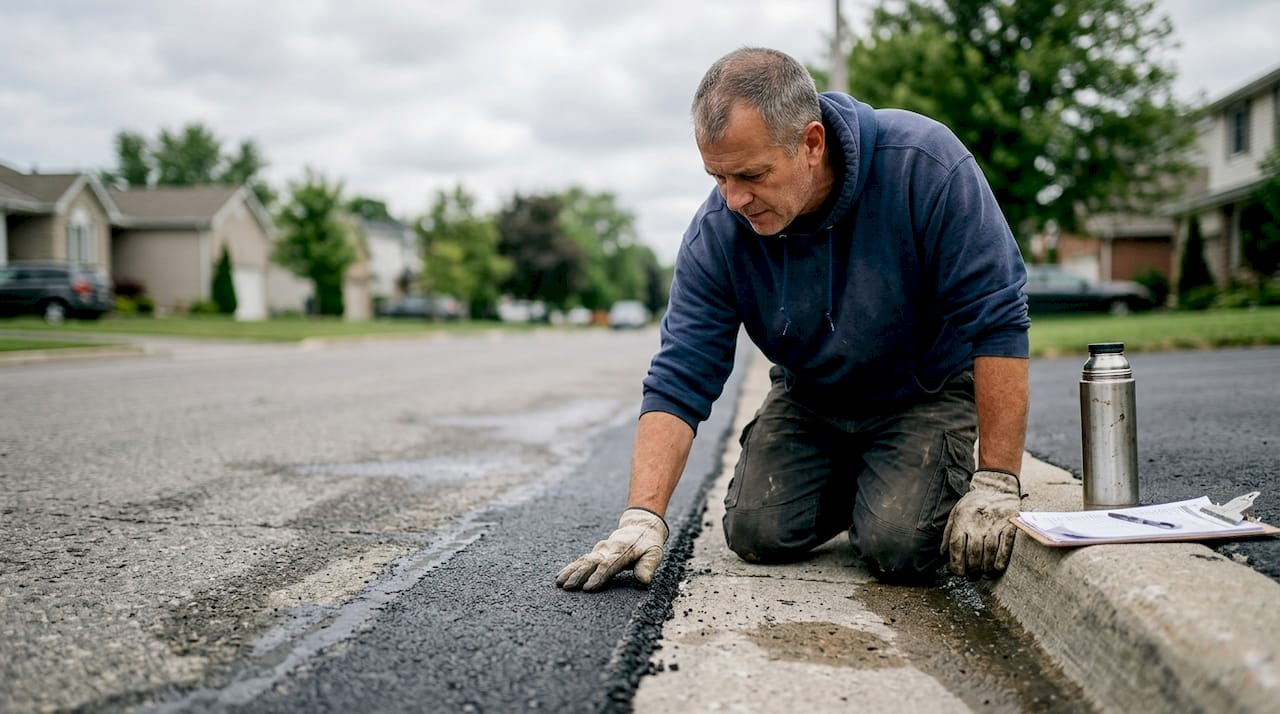
Evaluating joint work is also something you can do visually. Run your hand across a longitudinal joint (the seam between two paving passes). It should be flush and smooth, with no visible gap or ridge. A rough or raised joint is a sign of poor technique and a future entry point for water.
For Edmonton property owners thinking about asphalt project budgeting, quality control is where you protect your investment. A lower bid that skips density testing and uses a generic mix design will cost more in repairs within five years than a properly executed job costs upfront. The math is not complicated once you factor in patching, overlays, and disruption to your property or tenants.
Perspective: What most property owners get wrong about asphalt paving
Armed with best-practice knowledge, let’s zoom out to a veteran’s perspective on what really matters.
After working on paving projects across Edmonton and the surrounding region, the pattern we see most often is this: property owners focus on price and timeline while ignoring the factors that actually determine whether a pavement lasts. The cheapest bid almost never accounts for proper base preparation, density testing, or climate-appropriate mix design. Those line items get trimmed to win the job, and the owner pays for it later.
The uncomfortable truth is that most surface failures do not start at the surface. They start with rushed prep work, the wrong mix for the conditions, or under-compacted lifts that look fine on day one but begin to ravel and crack within two or three winters. By the time the failure is visible, the root cause is buried under the pavement.
Another blind spot we see regularly is owners who check references for a contractor’s aesthetics but never ask about compaction data or mix design records. A smooth-looking job can still be a poor-quality job. The data tells the real story.
What actually works is straightforward: hire contractors who document their process, test their results, and have verifiable Edmonton experience. Be proactive about maintaining paved surfaces with crack sealing and sealcoating on a regular schedule. Do not wait for visible failure before acting. Reactive maintenance always costs more than preventive care, and in Edmonton’s climate, the window between “minor crack” and “major repair” is shorter than most people expect.
Get expert help with your next Edmonton paving project
With real-world wisdom in mind, here’s how you can take the next step toward a durable, expertly paved surface.
At ProZone Ltd, we bring the technical depth and local Edmonton experience that quality asphalt paving demands. We follow industry-standard processes for mix design, compaction testing, and joint construction, so you get a surface built to last through Alberta’s demanding seasons. Whether you need a new commercial lot, a residential driveway, or a full pavement rehabilitation, our team applies the same rigorous standards to every project.
If you want to understand more about what goes into a quality surface, our asphalt road info page covers the fundamentals in detail. For a broader look at what we offer property managers and commercial clients, explore our Edmonton construction services page. When you’re ready to talk about your project, our team is available to assess your site, recommend the right approach, and give you a clear, honest proposal.
Frequently asked questions
How long does asphalt paving typically last in Edmonton?
Under proper installation and routine maintenance, asphalt pavements in Edmonton can last 15 to 20 years. Precisely constructed mixtures maintained over time hold up well against environmental stress, though heavy traffic and harsh winters can shorten that range without regular upkeep.
What factors make asphalt paving different from concrete paving?
Asphalt uses flexible mixtures that handle freeze-thaw cycles better and can be opened to traffic faster after installation. Aggregate and binder in asphalt require precise construction steps, while concrete is rigid and takes longer to cure and repair when damaged.
Can asphalt paving be done in cold months?
Yes, but it requires careful planning. Cold-mix asphalt and overlays require specific handling and timing to ensure the material compacts properly before it loses heat, which is especially challenging in Edmonton’s shoulder seasons.
What should I look for when hiring an asphalt paving contractor?
Prioritize contractors who follow NAPA guidelines and can demonstrate on-site compaction and density testing. Local Edmonton references from completed commercial or residential projects are equally important.