
Hire a licensed, Alberta OHS Code–aware excavation and hauling contractor for any Edmonton job that breaks ground. That single decision determines whether your project clears permits on schedule or stalls at the first municipal inspection. ProZone offers Edmonton excavation services across the full project lifecycle. Request a free estimate through the online form at prozoneltd.ca or call the team directly.
Core services to expect from a qualified contractor:
- Site preparation, stripping, and rough grading
- Foundation and basement excavation
- Trenching for utilities and drainage
- Hydrovac and hand-expose work near buried facilities
- Demolition and material salvage
- Hauling and disposal of clean fill and contaminated material
- Clean fill supply and delivery
Table of Contents
- What does excavation and haul in Edmonton typically include?
- What Alberta OHS and City of Edmonton rules apply to excavation work?
- How must buried facilities be located and exposed safely in Alberta?
- What drives excavation and hauling prices in Edmonton?
- What is the typical process and timeline for an Edmonton excavation job?
- What should you ask for in quotes and how do you compare bids?
- What equipment and hauling capacity do Edmonton contractors typically use?
- Representative project summaries showing excavation and hauling outcomes
- Why choose ProZone for Edmonton excavation and hauling projects?
- What contractual terms should you expect from an Edmonton excavation contractor?
- What payment terms and financing options do Edmonton excavation contractors typically offer?
- How do you verify a contractor’s compliance beyond insurance and WCB?
- How do you assess a contractor’s safety record beyond credentials?
- How should you handle unexpected issues or delays during an Edmonton excavation project?
- What project managers often get wrong about Edmonton excavation projects
- ProZone handles your excavation and hauling project from permit to restoration
- Sources
- FAQ
What does excavation and haul in Edmonton typically include?
Edmonton projects range from a single-family basement to a multi-block civil corridor, and the service scope shifts accordingly. Site preparation covers topsoil stripping, rough grading, and establishing subgrade elevations before any structure goes in. Foundation and basement excavation requires precise cut depths and often engineered shoring when walls exceed standard slope angles.
Trenching for water, sewer, gas, and electrical runs through nearly every project. Hydrovac work handles the hand-expose zone around buried utilities, where mechanical equipment is prohibited by Alberta OHS rules. Demolition adds a salvage and sorting step before hauling begins.
Hauling and disposal splits into two streams: clean fill, which can go to approved clean fill disposal sites in Edmonton, and contaminated or regulated material, which requires documented disposal at a licensed facility. Dirt removal cost in Edmonton rises sharply when material is classified as contaminated, so early soil testing matters. Seasonal access is a real constraint; frozen ground in January can limit equipment reach, while spring thaw softens subgrade and increases the risk of equipment rutting and slope instability.
What Alberta OHS and City of Edmonton rules apply to excavation work?
Two regulatory layers govern every dig in Alberta: the provincial OHS Code and the City of Edmonton’s zoning and permit framework.
Alberta OHS Code thresholds:
- Excavations deeper than 1.5 m trigger mandatory worker-protection measures under Part 32 Excavating and Tunnelling.
- For excavations up to 3 m, protective structures must be strong enough to prevent cave-ins.
- Excavations over 3 m require a professional engineer design and certification for temporary protective structures (RPEng sign-off is mandatory, not optional).
- When no formal soil classification is provided, the OHS Code requires assuming the least stable soil type, which imposes the strictest slope angles and support requirements and may increase both cost and schedule.
City of Edmonton permit requirements:
The City’s zoning rules for excavation, stripping and grading require a development permit before work begins. Applications must demonstrate drainage control, erosion management, dust suppression, and a final site restoration plan. The Development Officer will not issue a permit unless satisfied that operations will leave the site in an acceptable condition.
For larger or more complex projects, the Project Implementation Plan (PIP) guide sets out what the city expects: site assessments, neighbourhood notifications, and, where required, an authenticated site-specific engineered excavation plan. When excavation occurs adjacent to existing foundations or within the minimum side-yard setback, temporary excavation support or amended foundation plans are frequently required to protect adjoining properties.
Pro Tip: Require the contractor to confirm soil classification in writing before finalising the bid. Without it, the OHS Code defaults to the weakest soil type, which can add significant shoring cost and delay.
How must buried facilities be located and exposed safely in Alberta?
Before any ground disturbance, employers must contact owners of all buried facilities to have locations marked. That is a statutory obligation, not a courtesy. Once locate marks are in place, mechanical excavation is prohibited within 1 metre of those marks until the facility is visually exposed by hand digging or an approved non-destructive method. Hydrovac is the most widely used approved method in Edmonton; it removes soil with pressurised water and vacuum suction without risking a pipe or conduit strike. High-pressure pipelines may require an even larger hand-expose zone and owner supervision on site.
Safety checklist to expect from a competent contractor:
- Confirmed locate request submitted before mobilisation
- Written record of all buried facility marks and their depths
- Hydrovac or hand-expose procedure documented in the project plan
- Mechanical equipment exclusion zone clearly marked on site
- Contingency procedure for an unexpected utility strike
Pro Tip: Ask for the locate confirmation number and the contractor’s hand-expose procedure at the pre-construction meeting. A contractor who cannot produce both immediately is a compliance risk.
What drives excavation and hauling prices in Edmonton?
Excavation cost in Edmonton varies more than most property owners expect. Volume is the starting point, but it is rarely the dominant variable on a constrained urban site.
Primary cost drivers:
- Excavation volume: calculated in cubic metres (length x width x depth x swell factor for loose material).
- Soil type and classification: rock, clay, or contaminated fill each carry different equipment requirements and disposal costs.
- Site access and constraints: narrow lots, overhead utilities, and proximity to existing structures add mobilisation time and may require smaller equipment at higher hourly rates.
- Seasonality: freeze-thaw cycles in Edmonton can require frost ripping, additional shoring, or schedule delays; spring thaw is the highest-risk window for slope instability.
- Disposal classification: clean fill disposal in Edmonton costs less than regulated or contaminated material, which must go to a licensed facility with documented tipping fees.
- Hauling distance and construction waste dump fees: longer haul routes and higher tipping fees at receiving facilities add directly to the per-load cost.
- Engineered shoring and RPEng fees: mandatory for excavations over 3 m; budget this as a fixed line item, not a contingency.
- Traffic control: required on most Edmonton urban sites and billed separately by many contractors.
A rough volume estimate uses: length (m) x width (m) x depth (m) x 1.25 swell factor = loose cubic metres to haul. That figure gives you a starting point for comparing bids, but true quotes must be verified on site. Low-ball bids that omit disposal fees, traffic control, or RPEng costs are a common source of budget overruns. Under the City of Edmonton’s design and construction standards, developers are responsible for supplying, hauling, and installing municipal improvement materials to city specifications, which adds another layer of cost accountability on subdivision and infill projects.
What is the typical process and timeline for an Edmonton excavation job?
- Scope and site visit: Contractor reviews drawings, confirms access, and identifies constraints. Duration: 1–3 days.
- Buried facility locates: Locate request submitted; marks confirmed on site. Allow 3–5 business days minimum.
- Permit and PIP submission: Development permit application and PIP submitted to the City of Edmonton. Residential permits: 2–4 weeks. Commercial or civil: 4–10 weeks depending on complexity.
- Engineering and shoring design: RPEng engaged for excavations over 3 m or where site conditions require it. Add 1–2 weeks for design and certification.
- Excavation and material haul: Active dig and soil removal. Small residential (under 200 m³): 2–5 days. Medium commercial (200–1,000 m³): 1–3 weeks. Larger civil projects: 4–12 weeks or more.
- Backfill and compaction: Utility backfill requires compaction certificates; lot grading plans must align with municipal drainage requirements.
- Final grading and site restoration: Topsoil replacement, erosion control, and municipal inspection sign-off.
Municipal inspections and weather delays most commonly add time at steps 3, 6, and 7. Spring thaw in April and May is the highest-risk period for compaction failures and drainage disputes. Building a two-week weather buffer into any schedule that spans that window is standard practice on well-managed Edmonton projects.
What should you ask for in quotes and how do you compare bids?
A compliant quote for site preparation work in Edmonton should contain every item below. Missing elements are not minor oversights; they are signals of how the contractor manages risk.
Required quote elements:
- Detailed scope with cut depths, volumes, and disposal classification
- Unit rates for excavation (per m³) and hauling (per load or per m³)
- Estimated volumes with swell factor stated
- Disposal and tipping fees itemised separately
- Traffic control plan and cost
- WCB clearance certificate and liability insurance certificate
- RPEng sign-off confirmation when excavation exceeds 3 m
- Payment schedule and warranty terms
Red flags to watch for:
- Vague lump-sum pricing with no unit rates
- No locate or hand-expose procedure in the safety plan
- Missing or expired WCB and insurance documents
- No project gallery or verifiable references
- RPEng “available if needed” language rather than a confirmed engagement
Five questions to put to every bidder:
- What soil classification are you assuming, and is that based on a geotechnical report?
- Who is your registered professional engineer for shoring design, and can you provide their stamp?
- How do you handle unexpected contaminated material discovered mid-excavation?
- What is your locate and hand-expose procedure, and who supervises it on site?
- What does your warranty cover for backfill settlement and compaction?
What equipment and hauling capacity do Edmonton contractors typically use?
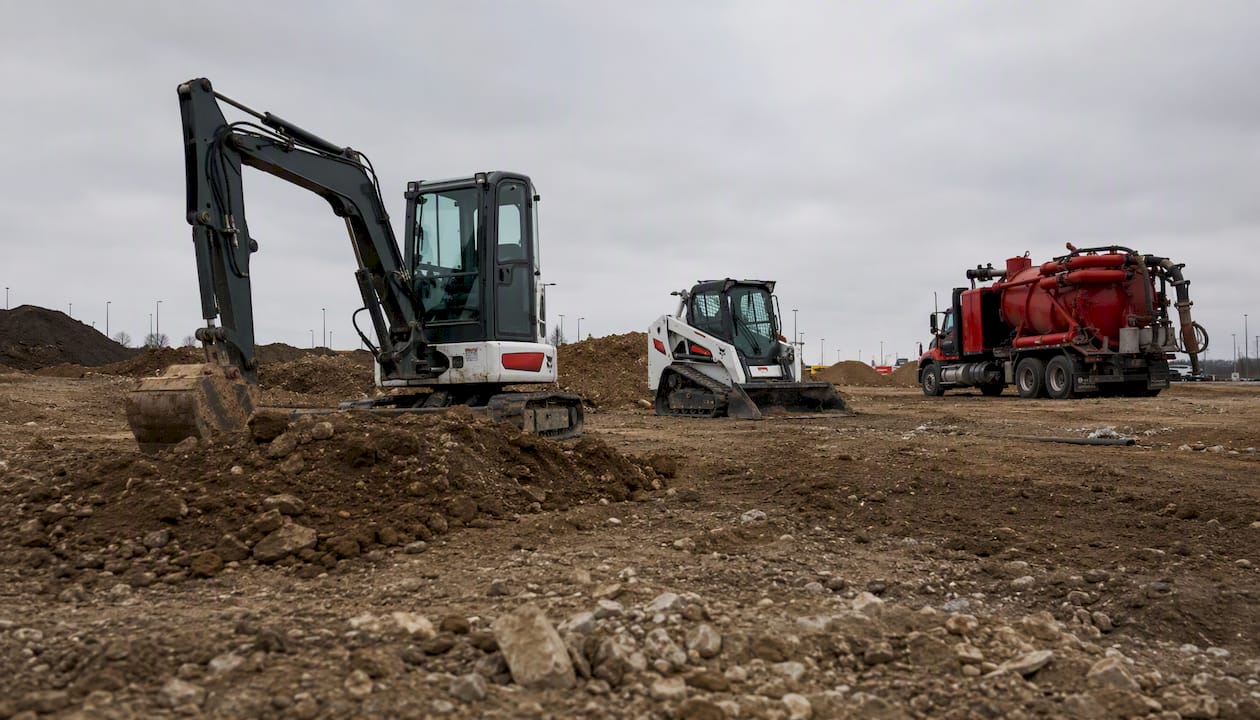
Equipment selection depends on project scale, site access, and material type. The table below maps common equipment to typical use cases and key logistical notes for Edmonton conditions.
| Equipment type | Typical use | Logistical notes for Edmonton |
|---|---|---|
| Mini excavator (1–5 t) | Tight residential lots, utility trenching | Low ground pressure; useful during spring thaw |
| Standard excavator (20–30 tonne) | Basement and foundation digs, bulk earthworks | Requires adequate site access width |
| Backhoe loader | Utility trenching, backfill, grading | Versatile; common on mid-size infill projects |
| Skid steer | Material handling, tight spaces, cleanup | Pairs with attachments for frost ripping |
| Hydrovac unit | Hand-expose zones, utility locates | Reduces strike risk; adds a line item to early estimates |
| End dump truck (20 tonne payload) | Bulk soil removal, clean fill delivery | Route permits needed for overweight loads |
| Roll-off bin truck | Demolition debris, smaller volumes | Flexible scheduling; common for residential jobs |
| Lowbed mover | Equipment mobilisation | Permit required for wide or heavy loads on city streets |
Payload planning matters as much as equipment selection. A 20-tonne end dump carries roughly 12–14 m³ of compacted clay per load; loose sandy material runs higher. Underestimating load counts inflates hauling costs and extends project duration. Winter logistics add another layer: frozen haul roads can actually improve load capacity, but early spring weight restrictions on Edmonton roads limit truck payloads and require route planning well in advance.
Representative project summaries showing excavation and hauling outcomes
Residential basement excavation, inner-city infill lot: A tight 7.5 m wide lot required a mini excavator and hydrovac pre-expose on three utility crossings before the main dig could begin. Approximately 180 m³ of clay was removed over four days. Engineered shoring was not required at the final cut depth, but the contractor confirmed soil classification with a geotechnical report to avoid defaulting to the weakest OHS soil type. Municipal permit and locate clearance added eight days to the front end of the schedule.
Commercial parking lot re-grade and soil removal: A 2,400 m² commercial site required stripping 0.4 m of mixed fill and clay, totalling approximately 960 m³. Contaminated material in one quadrant required segregation and disposal at a licensed facility, which added a separate tipping fee stream. RPEng certification was not triggered at this depth, but a PIP was submitted to the City with a drainage restoration plan. Total active haul duration was nine working days.
Municipal utility corridor trenching: A 320 m trench for a combined utility run required coordinated locates across four buried facility owners, hydrovac pre-expose at 14 crossing points, and engineered shoring for a 3.4 m section adjacent to an existing water main. The PIP included neighbourhood notifications and a contingency procedure for unexpected conditions. The project completed within the contracted timeline, with compaction certificates submitted for municipal sign-off.
Why choose ProZone for Edmonton excavation and hauling projects?
ProZone brings together the credentials and operational capacity that compliant Edmonton projects require. Key trust signals include:
- Alberta OHS Code–aware procedures on every project, including documented locate and hand-expose protocols
- WCB coverage and liability insurance available for review at quote stage
- Established relationships with registered professional engineers for shoring design and certification on excavations over 3 m
- Hydrovac capability for hand-expose zones and utility locates
- Project gallery demonstrating completed residential, commercial, and municipal work in Edmonton
- Experience navigating City of Edmonton development permits, PIP submissions, and municipal inspection sign-off
- Integrated service capacity covering excavation, grading, backfill, and surface restoration under one contract
That last point reduces the coordination risk that comes with managing separate subcontractors for dig, haul, and restoration. When the same team handles earthworks and site preparation, the permit documentation, compaction certificates, and drainage restoration plans stay aligned from start to finish.
What contractual terms should you expect from an Edmonton excavation contractor?
A well-drafted excavation contract covers scope, liability, and warranty clearly. Scope of work should define cut depths, volumes, disposal classification, and what constitutes a change order. Liability clauses typically assign responsibility for damage to buried facilities to the contractor when proper locates were completed, and to the owner when locate information was incomplete or withheld.
Warranty terms on backfill and compaction usually run 12 months for settlement defects, though this varies. Force majeure clauses covering weather delays are standard in Alberta given freeze-thaw variability; confirm that the clause defines what constitutes a weather delay and how schedule extensions are documented.
Change order procedures matter as much as the base contract. Unexpected contaminated material, rock, or groundwater are common mid-excavation surprises in Edmonton. A contract without a clear change order process leaves both parties exposed when the scope shifts.
What payment terms and financing options do Edmonton excavation contractors typically offer?
Alberta’s Builders’ Lien Act entitles contractors to register a lien against the property if payment is withheld without cause, so understanding the lien period and holdback obligations before signing protects both parties.
Financing through the contractor is uncommon for excavation work; most property owners arrange project financing independently through their lender before tendering. For commercial and municipal clients, net-30 or net-45 payment terms on progress invoices are standard. Always confirm whether the quoted price is fixed or subject to unit-rate adjustment if actual volumes differ from estimates; a unit-rate contract is more transparent on variable-volume jobs.
How do you verify a contractor’s compliance beyond insurance and WCB?
Insurance certificates and WCB clearance letters are the minimum threshold, not a complete compliance check. To go further, request the contractor’s Alberta Safety Codes Officer registration or confirmation that their safety programme has been reviewed by a qualified safety professional. Ask for their most recent OHS programme documentation, including their excavation-specific safe work procedures.

For municipal work, confirm the contractor is listed or pre-qualified on the City of Edmonton’s approved contractor registry where applicable. Check that their RPEng relationships are current by requesting the engineer’s APEGA registration number and confirming it is in good standing through the APEGA public registry. A contractor who resists any of these requests is signalling that their compliance posture is weaker than their marketing suggests.
How do you assess a contractor’s safety record beyond credentials?
Credentials confirm that a contractor has met a threshold; safety record shows how they perform under real conditions. Request the contractor’s WCB experience rating (also called the industry rate modifier or IRM) for the past three years. A rate below 1.0 indicates a claims history better than the industry average; above 1.0 suggests more frequent or more costly incidents than peers.
Ask directly for their lost-time incident rate and any stop-work orders received in the past two years. Reputable contractors will provide this without hesitation. Check Alberta’s OHS compliance database for any orders or penalties issued against the company. References from past municipal or commercial clients are also a direct line to real performance data; ask specifically about how the contractor handled unexpected conditions and whether the project finished within the agreed safety parameters.
How should you handle unexpected issues or delays during an Edmonton excavation project?
Unexpected conditions are common enough in Edmonton that a competent contractor treats them as a planned-for risk, not a surprise. The most frequent mid-project issues are undocumented buried facilities, contaminated soil, groundwater intrusion, and frost deeper than anticipated.
When an unexpected condition arises, the first step is to stop mechanical work in the affected area and notify all relevant parties: the owner, the engineer of record if one is engaged, and the buried facility owner if a utility is involved. Document the condition with photographs and written notes before any remediation begins. This documentation protects everyone if a change order or insurance claim follows.
The PIP should already include a contingency procedure for unexpected conditions; if it does not, that gap needs to be addressed before work resumes. Agree on the change order scope and cost in writing before the contractor proceeds. Verbal agreements on scope changes are a leading cause of payment disputes on Edmonton construction sites. Weather delays follow a similar protocol: document the conditions, notify the owner, and issue a written schedule extension notice within the timeframe specified in the contract.
What project managers often get wrong about Edmonton excavation projects
The freeze-thaw cycle in Edmonton is not just a scheduling inconvenience; it is a structural risk that changes the engineering calculus on any excavation that spans late autumn through early spring. Walls that are stable in August can become unstable by November as moisture content shifts and frost penetrates. Contractors who skip a site-specific engineered plan on the assumption that the cut depth is “just under” the RPEng threshold are taking a risk that belongs to the owner once the contract is signed.
The other underestimated cost is the default soil classification rule. Without a geotechnical report, the OHS Code requires assuming the weakest soil type, which drives up shoring requirements and can add weeks to the schedule. A geotechnical investigation costs a fraction of the shoring it can eliminate.
Pro Tip: Require soil classification documentation and RPEng confirmation at the bid stage, not after award. Contractors who cannot commit to these at the proposal stage will cost you more later.
ProZone handles your excavation and hauling project from permit to restoration
ProZone manages the full scope of Edmonton excavation and hauling work: permit submissions, PIP preparation, engineered shoring coordination, hydrovac utility locates, bulk soil removal, clean fill disposal, and final grading. You get one point of contact from the first site visit through municipal sign-off, which keeps documentation aligned and reduces the risk of gaps between subcontractors.
Quotes from ProZone include itemised scope, estimated volumes with swell factors, disposal classification, and RPEng confirmation when the project requires it. For property owners, contractors, and project managers who need a compliant, experienced team on an Edmonton site, the next step is straightforward. Visit the site preparation and construction services page for a detailed overview of what ProZone delivers, or go directly to Prozoneltd to submit your project details and receive a free estimate.
Sources
- Part 32 Excavating and Tunnelling
- Excavations: Temporary protective structures (EXCV002)
- 56. Excavation, Stripping and Grading
- Design and Constructions Standards – Volume 1: General (July 2020 edition)
FAQ
How much does excavation and hauling cost per cubic metre in Edmonton?
Excavation cost in Alberta varies by soil type, access, and disposal classification. Clean fill removal typically costs less per cubic metre than contaminated or regulated material, which requires licensed disposal and documented tipping fees; always request itemised unit rates in any quote.
How do you calculate excavation volume for a project estimate?
Multiply the length, width, and depth of the excavation in metres, then apply a swell factor of approximately 1.25 to convert bank measure to loose cubic metres for hauling. This gives a working estimate; a contractor must verify actual volumes on site before issuing a firm price.
When is a professional engineer required for an Edmonton excavation?
A registered professional engineer must design and certify temporary protective structures for any excavation deeper than 3 m under the Alberta OHS Code. RPEng sign-off may also be required by the City of Edmonton’s PIP process for excavations adjacent to existing foundations or within minimum setbacks.
What is clean fill disposal and how does it differ from contaminated material disposal?
Clean fill is uncontaminated soil, gravel, or rock that can be accepted at approved clean fill sites in Edmonton at standard tipping fees. Contaminated material contains regulated substances and must go to a licensed disposal facility with documented chain of custody, which raises both hauling cost and disposal fees significantly.
How long does a typical residential excavation project take in Edmonton?
A small residential excavation under 200 m³ typically takes 2–5 active working days once locates are confirmed and permits are in hand. Front-end permit and locate clearance commonly adds 2–4 weeks to the overall schedule, and spring thaw conditions can extend that further.