
Most Edmonton homeowners pay between $300 and $2,500 for common curb and sidewalk repairs, depending on the method and panel count, with larger replacement jobs running higher per linear foot. Polyurethane foam lifting sits at the efficient end for single-panel settlement, mudjacking costs less upfront but trades off on longevity, and full replacement anchors the top of the range. The fastest way to know your exact number is a free on-site estimate, since slab thickness, access, and depth of settlement swing quotes more than any other factor.
Table of Contents
- How much does curb repair cost in Edmonton by method?
- What affects curb and sidewalk repair cost in Edmonton?
- Repair versus replace: which saves you more money?
- Municipal rules, reporting and cost responsibility in Edmonton
- How to hire the right contractor in Edmonton
- ProZone perspective: freeze-thaw failure and site staging
- Get a free on-site estimate from ProZone
- Authoritative local resources and reading
- Sources
- FAQ
How much does curb repair cost in Edmonton by method?
The cost of curb repair in Edmonton depends heavily on which repair method fits your slab’s condition. A single sunken sidewalk panel and a fully deteriorated curb line call for entirely different solutions, and the price gap between them is significant.
Polyurethane foam lifting (poly lift) is the fastest-curing option on this list. Expect $5 to $25 per square foot, with cure times measured in minutes to a few hours rather than days. Because the foam is lightweight and hydrophobic, it adds minimal load to a weak subgrade and resists the freeze-thaw cycling that undermines slower-curing materials. For a typical 4 foot by 4 foot sunken panel, that translates to a job in the low hundreds of dollars, plus any applicable minimum visit fee.
Traditional mudjacking (slurry) costs less per square foot upfront but comes with trade-offs. The slurry mix is heavier, cures over a longer window, and in Edmonton’s freeze-thaw environment it can resettle sooner than foam, especially where drainage is poor. It remains a reasonable choice for larger, less climate-exposed areas where budget matters more than long-term stability.
Grinding or shaving a raised or uneven panel edge is the cheapest fix per job, often billed as a flat service call. It addresses trip hazards without touching the underlying settlement, so treat it as a stopgap rather than a structural fix.
Full panel replacement becomes necessary once cracking, spalling, or multiple void areas rule out lifting. A standard residential panel (roughly 2.5 feet by 32 feet of sidewalk run) commonly falls in the $4,000 to $8,000 range for full replacement, based on local specialist pricing. Broader concrete flatwork pricing across the Edmonton market generally lands around $8 to $12 per square foot, with labour complexity pushing some jobs higher.
Curb replacement per linear foot carries its own pricing structure separate from flatwork. Standard curb runs commonly price in the $9 to $21 per linear foot range depending on finish, reinforcement, and site prep. Decorative or reinforced curb options sit at the premium end of that band.
Statistic Callout: Lifting a sunken panel with polyurethane foam typically costs 50 to 70 percent less than tearing it out and pouring new concrete, provided the slab itself hasn’t cracked or crumbled.
Most contractors also charge a minimum visit or mobilization fee, commonly $300 to $700, because the truck, pump, and crew cost the same whether you’re fixing one panel or five. If you have more than one problem spot on your property, bundling them into a single visit is the single easiest way to reduce your per-panel cost.
- Poly lift: $5 to $25 per square foot, cures in hours
- Mudjacking: lower per square foot, cures over days, higher resettling risk
- Grinding: flat fee, cosmetic fix only
- Full replacement: $4,000 to $8,000 for a standard panel run
- Curb replacement: $9 to $21 per linear foot
What affects curb and sidewalk repair cost in Edmonton?
A quote for identical-looking damage can vary by hundreds of dollars between two properties, and the reason is almost always one of these line items.
- Site access. A backyard panel reachable only through a narrow gate costs more to service than a driveway apron a truck can pull straight up to.
- Slab thickness and depth of settlement. Thicker structural slabs and deeper voids need more material and more pump time, which raises the per-square-foot rate.
- Voids beneath the slab. Undetected voids from erosion or poor original compaction can require additional foam or slurry volume beyond the initial estimate.
- Tree roots and reinforcement. Root intrusion sometimes requires cutting and disposal before any lifting or replacement can begin, and rebar-reinforced sections take longer to break out.
- Tie-ins to adjacent curb or asphalt. Where your sidewalk meets a curb or driveway apron, matching grades and joints adds labour that a standalone panel wouldn’t need.
- Labour, mobilization, disposal, and permits. Labour rates are consistently the largest single driver of final quotes, ahead of material cost itself.
- Seasonality. Concrete pours need above-freezing conditions to cure properly, which compresses the practical work window and can raise demand-driven pricing in peak months.
Edmonton’s freeze-thaw cycling deserves its own line in this discussion. Water that seeps under a slab, freezes, expands, and thaws repeatedly is the single biggest reason panels sink or heave in the first place, and it’s why material choice matters as much as initial price.
Pro Tip: Ask any contractor whether their lifting material is hydrophobic. A material that absorbs groundwater will freeze, expand, and undo your repair within a season or two, no matter how good the installation looked on day one.
Repair versus replace: which saves you more money?
The decision usually comes down to one question: is the concrete itself still sound, or is the slab damaged beyond its settlement problem?
Choose lifting when:
- Only one or two panels have sunk, and the surface is free of major cracks or spalling
- The trip hazard is caused by settlement, not by the concrete breaking apart
- You want the shortest possible downtime, since foam lifting can return a walkway to service within hours
Choose replacement when:
- Multiple adjacent panels show cracking, pitting, or crumbling edges
- Reinforcement steel is exposed or corroded
- The settlement has caused the slab to fracture rather than simply tilt
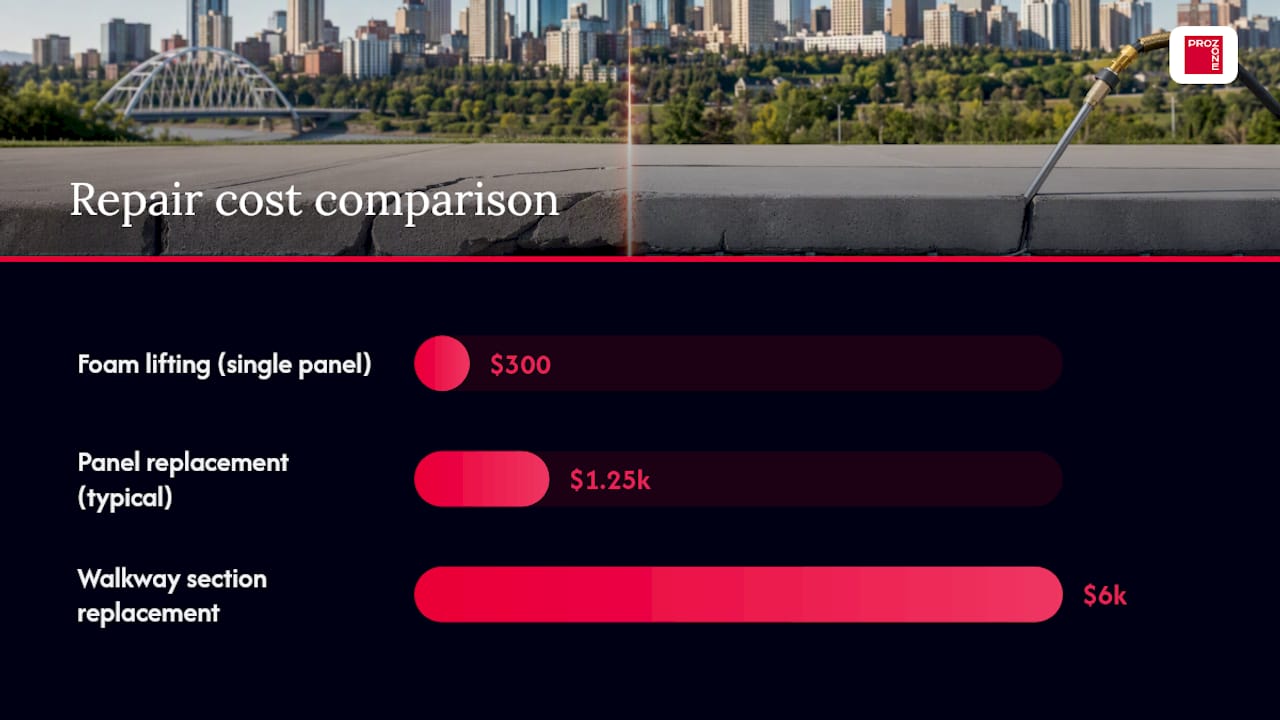
Run the math on a typical case: lifting a single 4 foot by 4 foot sunken panel with polyurethane foam might cost a few hundred dollars including the minimum visit fee. Replacing that same panel, once you factor in demolition, disposal, forming, and new concrete, often lands closer to $1,000 to $1,500 for a comparable area, scaling up toward the $4,000 to $8,000 range for a full walkway section. Lifting wins decisively when the concrete itself is still structurally sound.
Grinding sits in its own category. It’s the cheapest option per job, but it only shaves a lip down to grade, it does nothing for the settlement underneath, and in a freeze-thaw climate the same spot often re-heaves within a year or two. Treat grinding as a temporary hazard fix, not a repair.
Municipal rules, reporting and cost responsibility in Edmonton
Not every damaged sidewalk or curb is your bill to pay. The City of Edmonton maintains and repairs sections of public sidewalk and roadway infrastructure, and residents are expected to report hazards through 311 rather than repairing city-owned sections themselves. Once reported, the city inspects and schedules repairs based on severity and its maintenance program.
Larger reconstruction projects work differently. The city can apply local improvement levies to property owners for reconstruction adjacent to their property, though it typically offers amortization options that spread the cost across property tax instalments rather than requiring a lump sum.
A few practical points worth knowing before you book private repair work:
- Confirm whether your damaged section is city-owned infrastructure or falls under private property responsibility before hiring a contractor.
- Check whether your neighbourhood is scheduled for a renewal program in the next one to five years, since paying for private repair right before a city reconstruction means paying twice.
- If reconstruction is imminent, a lower-cost temporary fix like lifting may make more financial sense than a full private replacement.
How to hire the right contractor in Edmonton
A written quote tells you almost everything about whether a contractor is cutting corners. Here’s how to vet one properly.
- Ask about warranty length and materials. A contractor confident in their work will put a specific warranty period in writing, tied to the material used, not a vague verbal promise.
- Confirm cure times and site staging. Get the actual timeline for when the area will be safe to walk or drive on, not just “a few days.”
- Verify insurance and Alberta Safety Codes compliance. Any contractor working on public-facing infrastructure in Alberta should carry liability insurance and follow the Alberta Safety Codes Act requirements for concrete work, not operate on a handshake basis.
- Require a detailed written quote. It should separate materials, labour, mobilization, disposal, and permit fees line by line, so bundled surprise charges can’t appear later.
- Ask for references and photos of comparable Edmonton work. A contractor with real local project history will have this ready without hesitation.
Watch for red flags: quotes with no start or end date, pressure to add unrelated upsells (decorative stamping, unnecessary full-driveway replacement), or a refusal to itemize disposal and permit costs separately from labour.
Pro Tip: If two quotes for the same job differ by more than 30 percent, ask both contractors for their labour rate and material specification in writing. The gap usually comes down to one skipping proper base prep, not one simply charging less for the same work.
ProZone perspective: freeze-thaw failure and site staging
Edmonton’s repeated freeze-thaw cycling is behind most of the settlement and cracking we see on residential and commercial sites. Water infiltration under a slab, followed by expansion and contraction through winter, gradually erodes the base material until the panel tilts or heaves.
We favour polyurethane lifting on single-panel settlement where the concrete itself remains structurally sound, since the material is hydrophobic and doesn’t add the load that slurry does to an already weakened subgrade. Where cracking or reinforcement failure has already occurred, replacement is the only durable answer.
Our estimating process starts with an on-site measure and a written, itemized quote, so property managers get documentation that matches Alberta Safety Codes requirements before any work begins.
— ProZone
Get a free on-site estimate from ProZone
Generic contractors often quote curb and sidewalk repairs over the phone using rough averages, which is exactly why so many Edmonton property owners end up with surprise costs once the crew shows up. ProZone works differently: every estimate starts with an actual on-site measure, a method recommendation based on your slab’s condition and Edmonton’s freeze-thaw exposure, and a fixed-price written quote with a realistic timeline, not a ballpark.
Free on-site consultations may be available within 100 km of Edmonton. Whether you’re dealing with a single sunken panel or a full curb and sidewalk replacement across a commercial property, our team can walk the site and give you options at every price point, backed by Alberta Safety Codes compliant work.
Ready for a real number instead of a guess? Visit the curb and sidewalk repair service page to request your free estimate online, or call ProZone directly to book a site visit this week.
Authoritative local resources and reading
For official municipal process details, see the City of Edmonton’s roadway repair types page and its sidewalk reconstruction guidance. For deeper budgeting benchmarks specific to Edmonton properties, review ProZone’s concrete repair cost breakdown.
Sources
- Types of Roadway Repairs | City of Edmonton
- Mudjacking Edmonton: Cost, Process, and Foam vs Traditional
- Concrete contractor cost guide for Edmonton
FAQ
How much does curb repair cost in Edmonton?
Most single-panel repairs cost between $300 and $2,500 depending on method, with polyurethane foam lifting priced at $5 to $25 per square foot and full replacement running higher. Get an on-site estimate for an exact number, since access, slab thickness, and settlement depth all affect the final price.
How much does it cost to install a concrete sidewalk in Edmonton?
New sidewalk installation or full panel replacement typically costs $8 to $12 per square foot for standard flatwork, with a full residential panel run often landing between $4,000 and $8,000. Labour complexity and site access are the main variables that push a quote toward the higher end.
How much does it cost to hire a handyman in Edmonton for concrete work?
General handyman rates aren’t a reliable guide for structural concrete repair, since curb and sidewalk work involves specialized equipment, base prep, and Alberta Safety Codes compliance that a general handyman typically doesn’t carry insurance or certification for. A dedicated concrete contractor quote, itemized by material, labour, and disposal, gives a far more accurate number for this type of work.
Does the City of Edmonton pay for sidewalk repairs?
The city maintains and repairs sections of public sidewalk reported through 311, but larger reconstruction projects can be billed to adjacent property owners through local improvement levies, often with amortized payment options on property tax. Damage on private property sections remains the owner’s responsibility.
Is polyurethane foam lifting better than mudjacking for Edmonton’s climate?
Foam lifting generally holds up better against Edmonton’s freeze-thaw cycling because it’s lightweight and hydrophobic, which reduces the water absorption that causes traditional slurry to resettle. Mudjacking remains a lower upfront-cost option, but expect a shorter service life in exposed, moisture-prone areas.