
Resurfacing suits concrete that is structurally sound with only surface-level damage, while replacement is the right call when the base or subgrade has failed or when more than about 15 to 20 percent of the slab needs patching, according to Cement Association of Canada guidance. Resurfacing costs less upfront and returns the surface to service faster. Replacement costs more and takes longer but restores full structural capacity and extends service life well beyond what an overlay can offer.
Table of Contents
- What each option fixes and what you can expect
- Signs your concrete is a good candidate for resurfacing
- Signs that point to full replacement instead
- How to weigh cost against expected service life
- Why freeze-thaw cycling and material choice decide success
- Maintenance steps that protect your investment either way
- Resurfacing techniques: how overlay types differ
- What the replacement process involves, step by step
- Environmental considerations for each option
- How long each project typically takes
- Decision outcomes we see across Edmonton-area properties
- Downtime and usability during each project type
- How we approach diagnosis and specification
- Get a free on-site assessment from ProZone
- FAQ
- Sources
What each option fixes and what you can expect
Resurfacing and replacement solve different problems, and confusing them leads to premature repeat failures. Resurfacing addresses cosmetic and shallow surface defects. Replacement addresses problems rooted in the base, the subgrade, or the structural integrity of the slab itself.
- Resurfacing fixes surface-level wear such as scaling, minor cracking, and discoloration while leaving the existing base in place.
- Replacement fixes structural failure, including subgrade settlement, pumping, and cracks that run through the full depth of the slab.
- Service life runs shorter for resurfacing and considerably longer for a correctly specified new pour.
- Downtime is lower for resurfacing since there is no demolition or base rework; replacement requires longer closures to allow excavation, compaction, and curing.
Signs your concrete is a good candidate for resurfacing
Resurfacing works when the underlying structure is intact and the damage sits on the surface. We look for scaling, hairline cracking, staining, and general wear that has not compromised the slab’s load-bearing capacity.
- Surface defects are cosmetic: scaling, crazing, minor cracks, and staining with no vertical displacement.
- No pumping or significant settlement is visible when the slab is loaded or walked.
- Patch repair is needed on less than roughly 15 to 20 percent of the total surface area, per Cement Association of Canada guidance.
- A test patch confirms bond potential before committing to a full overlay.
Material compatibility between the overlay and the existing slab matters as much as the visible damage. An overlay with mismatched stiffness or thermal movement can debond during freeze-thaw cycling.
Pro Tip: Ask your contractor to run a moisture check on the slab before resurfacing, especially where freeze-thaw exposure is heavy; trapped moisture under a new overlay is one of the most common causes of early bond failure.
Signs that point to full replacement instead
Some damage patterns cannot be resolved with a surface treatment, no matter how good the overlay material is. These are the conditions where replacement protects your budget over the medium term rather than draining it through repeated repairs.
- Widespread spalling, structural cracks running through the slab, or failed joints indicate the concrete itself has lost integrity.
- Pumping, voids, or visible settlement point to base or subgrade failure that no overlay can correct.
- Patch repair already covers more than about 15 to 20 percent of the surface, or a previous overlay has failed, a pattern Cement Association of Canada flags as a replacement trigger.
- Traffic loads or usage have changed since the original pour, exceeding what the existing slab and base were designed to carry.
When the base has shifted, resurfacing only hides the problem temporarily. The new surface will crack along the same lines as the damage underneath, often recurring under freeze-thaw cycling.
How to weigh cost against expected service life
Resurfacing lowers your initial spend and gets the surface back in service quickly, but it typically shortens the interval before the next major intervention is needed. Replacement costs more upfront and takes longer to complete, but it resets the service clock and reduces maintenance demands for years afterward.
Lifecycle cost analysis guidance for pavement decisions recommends using a multi-decade analysis window rather than comparing upfront price alone, since a long period is needed to capture full rehabilitation cycles for each option, per the LCCA standard practice guideline. A resurfacing project that looks cheaper in year one can cost more than a correctly specified replacement once you account for future repair cycles it will need.
Concrete is more resilient against spring thaw stress than asphalt, which supports specifying durable concrete solutions where seasonal freeze-thaw shifts are severe, according to the sustainable benefits of concrete pavement report.
Budget for these cost drivers regardless of which path you choose:
- Site preparation, including demolition or localized base repair.
- Overlay material and thickness, or new concrete mix design and reinforcement.
- Finishing, curing time, and weather protection during the pour or application.
- Traffic control and access restrictions during the work.
- Follow-up sealing or patching in the years after installation.
Why freeze-thaw cycling and material choice decide success
Edmonton’s seasonal swings put concrete through repeated freeze-thaw cycles, and that cycling is the primary stress test for any resurfacing job. Water enters pores in the concrete, freezes, expands, and gradually breaks the material apart from the inside unless the mix resists it.
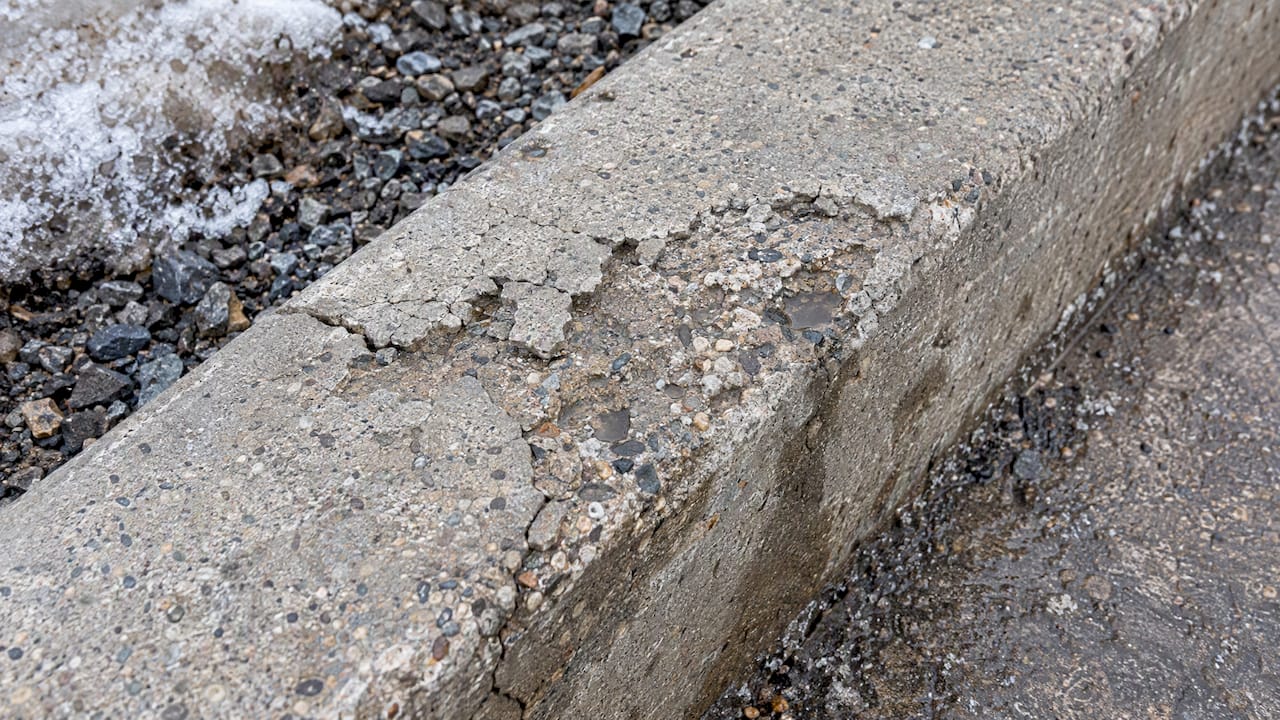
Air-entrainment, proper curing, and good drainage are the measures that reduce frost damage and extend durability under winter exposure, based on NRC research on concrete and winter conditions. Skipping any one of these steps leaves the slab vulnerable even if the mix design looks correct on paper.
Bond failure between an overlay and the existing substrate is most often traced to mismatched stiffness or differing thermal expansion rates, which NRC guidance on overlay compatibility identifies as a leading cause of premature failure under freeze-thaw cycling or dynamic loading.
- Confirm the overlay’s durability class matches CSA A23.1 Class C-2 requirements for exterior flatwork exposed to chlorides and freezing, per CSA A23.1 guidance.
- Require drainage correction before any resurfacing work begins, since standing water accelerates frost damage.
- Ask whether the contractor has tested bond strength or chloride content on the existing slab.
Pro Tip: If your slab has a history of repeated patch failures, request a core sample and a bond pull test before approving another resurfacing attempt; the test cost is small compared to redoing a failed overlay.
Maintenance steps that protect your investment either way
Whether you resurface or replace, a short list of maintenance habits determines how long the result actually lasts. Skipping these steps can cause an installation to underperform its expected service life.
- Seal exterior flatwork periodically, a schedule Cement Association of Canada commonly recommends for exposed concrete.
- Patch small cracks or chips promptly, before winter moisture can enter and expand them.
- Correct drainage issues as soon as ponding appears, since trapped water drives frost damage.
- Moderate de-icing salt use where possible, and favour salt types that are less aggressive on concrete surfaces.
Our concrete maintenance checklist breaks these steps into a schedule your facility staff can follow without specialized training.
Resurfacing techniques: how overlay types differ
Not all resurfacing is the same, and the overlay type you choose should match the wear pattern and traffic load on the slab. Thin overlays work well for cosmetic resurfacing where the main concern is appearance or light surface wear.
Thicker overlays are used where the surface needs to withstand heavier foot or vehicle traffic, or where minor surface irregularities need levelling before a new finish is applied. Polymer-modified overlays bond more aggressively to the substrate and tend to handle thermal movement better than straight cementitious mixes, which matters directly for freeze-thaw performance.
Micro-topping products create a thin decorative or protective layer and suit interior or lightly trafficked exterior areas rather than driveways or parking lots exposed to de-icing salt. Self-leveling overlays correct minor grade issues across a slab before a final wear layer goes down, which is useful on older driveways or walkways that have settled unevenly without failing structurally.
The thickness and material choice should follow a site-specific assessment rather than a standard default. A parking lot bearing regular vehicle loads through an Edmonton winter needs a different overlay specification than a backyard patio, even if both slabs show similar surface wear on first inspection. Matching the overlay type to the actual loading and exposure conditions is what separates a resurfacing job that lasts from one that fails prematurely.
What the replacement process involves, step by step
Full replacement follows a defined sequence, and skipping steps or rushing the base work is where most premature failures start. Understanding the stages helps you plan around the downtime involved.
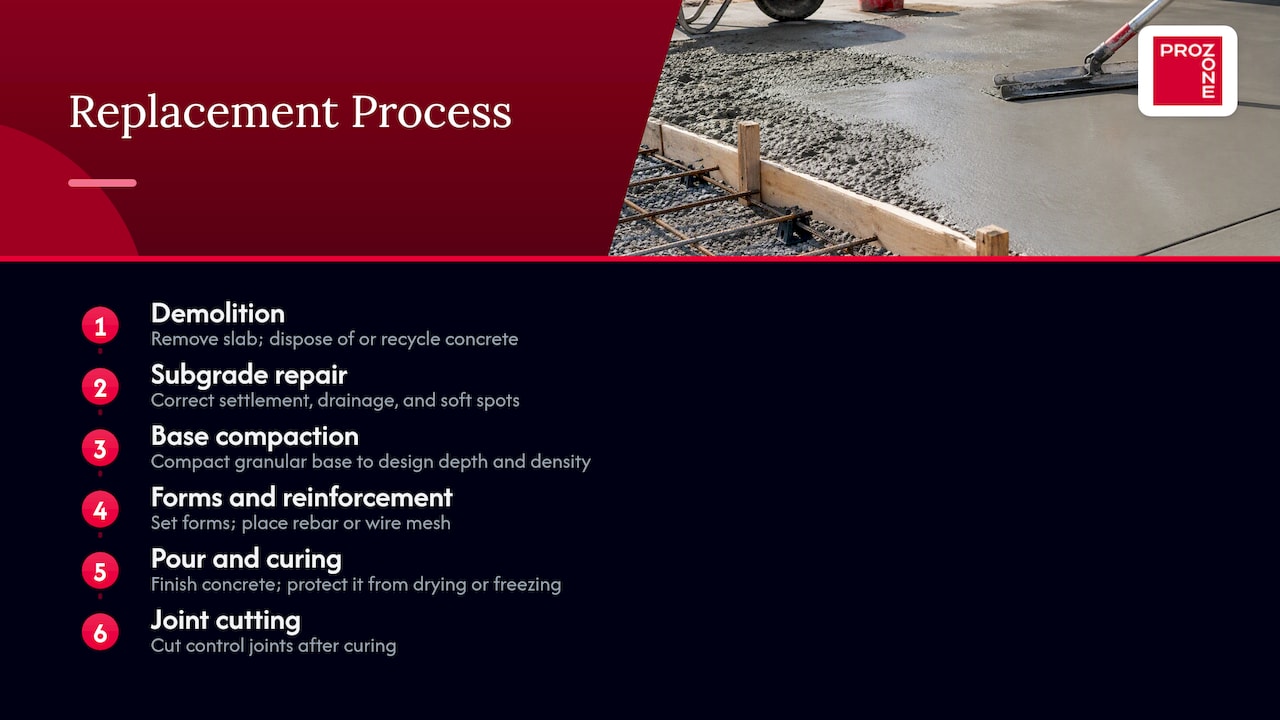
The process begins with demolition: breaking out and removing the existing slab, along with proper disposal or recycling of the removed concrete. Next comes subgrade inspection and repair, correcting any settlement, poor drainage, or soft spots that caused the original failure, since pouring new concrete over an uncorrected base simply repeats the same problem.
Base compaction follows, placing and compacting granular base material to the depth and density the design calls for. Formwork and reinforcement come next, setting the forms that shape the new slab and placing rebar or wire mesh as specified for the expected load.
The pour itself requires correct mix design, placement, and finishing technique, followed by a curing period during which the concrete gains strength and the surface is protected from premature drying or freezing. Joint cutting follows curing, creating control joints that manage where the slab will crack as it shrinks and moves with temperature changes.
Each stage depends on the one before it. A well-compacted base with correct drainage is often the difference between a replacement slab that lasts for the long term and one that develops the same pumping or settlement issues prematurely.
Environmental considerations for each option
Resurfacing generally uses less raw material and generates less demolition waste than full replacement, since the existing slab stays in place and only a thin layer of new material is added. That reduces the volume of concrete that needs to be produced, transported, and eventually disposed of.
Replacement requires removing and disposing of the old slab, though much of that material can be crushed and reused as aggregate or base fill rather than sent to a landfill. The new concrete poured for a replacement also carries the embodied carbon of fresh cement production, which is higher per project than a thin overlay.
Over a longer timeline, however, the calculation shifts. A slab that fails and needs resurfacing repeatedly because the underlying problem was never fixed consumes more material in total than a single, correctly specified replacement that lasts for decades. Concrete’s resilience against seasonal freeze-thaw stress compared with asphalt also supports its use as a durable choice for reducing long-term material turnover in exposed applications, as the sustainability analysis of concrete pavement notes.
The environmentally sound choice depends on which option actually solves the underlying problem. Resurfacing a structurally sound slab is the lower-impact option. Resurfacing a failing base simply defers the larger material cost to a near-future replacement, often with added demolition work to remove the failed overlay first.
How long each project typically takes
Resurfacing projects move through preparation, surface cleaning and profiling, material application, and curing, with timing depending on project size and weather conditions. Smaller residential driveways or walkways typically finish faster than larger commercial parking areas, where access and traffic control add time.
Replacement takes considerably longer because of the additional stages involved. Demolition and disposal, subgrade correction, base compaction, forming, pouring, and a full curing period before the surface can bear traffic all add time compared with resurfacing. A typical commercial replacement project runs from initial assessment and permitting through the final cure, with curing alone requiring a period before the area can return to normal use, longer in cold weather when concrete gains strength more slowly.
Weather plays a larger role in replacement timelines than in resurfacing, since pouring and curing fresh concrete in freezing or near-freezing conditions requires cold-weather protection measures that extend the schedule. Planning either project for warmer months, where your timeline allows it, reduces curing delays and the risk of frost affecting fresh concrete before it reaches adequate strength.
Decision outcomes we see across Edmonton-area properties
Commercial parking lots and municipal sidewalks in the Edmonton area show a consistent pattern: surface-only damage with a sound base responds well to resurfacing, while slabs with a history of pumping or repeated patch failures need replacement to stop the cycle.
Properties with heavy winter salt exposure and years of freeze-thaw cycling often show overlay bond failure when a previous resurfacing job skipped proper moisture checks or used a mismatched material. Practitioner guidance on restoring serviceability points to moisture entrapment and freeze-thaw cycling as primary drivers of these recurring failures in the Alberta climate, and diagnosing that root cause before any repair is essential.
Facility managers who commission a full diagnostic assessment before choosing a path, rather than defaulting to the cheaper resurfacing option, more often end up with a solution matched to the actual condition of the slab rather than its surface appearance. That diagnostic step, more than the choice itself, tends to determine whether the next few winters go smoothly or bring the same cracks back.
Downtime and usability during each project type
Resurfacing keeps disruption low because there is no demolition and no extended cure-to-traffic waiting period beyond the overlay material’s own set time. A driveway or parking area can often return to light use after the overlay material has set, depending on the product used and weather conditions.
Replacement takes the area out of service for longer. Demolition, base work, forming, pouring, and curing all need to happen in sequence, and new concrete needs time to reach sufficient strength before it can bear vehicle traffic safely. For a commercial lot or municipal walkway, that means planning around an extended closure and, often, phasing the work across sections so part of the property stays usable.
Phasing is worth discussing directly with your contractor if full closure is not workable. Splitting a parking lot or sidewalk network into zones lets replacement happen in stages, keeping some areas open while others are under construction, at the cost of a longer overall project timeline.
How we approach diagnosis and specification
We start every resurfacing or replacement decision with a visual assessment, followed by substrate checks for pumping, settlement, and moisture, and bond or load testing where the history warrants it. That sequence follows the same diagnostic logic NRC and Cement Association of Canada guidance recommend before committing to a repair method.
We specify materials and durability classes consistent with CSA A23.1 and NRC best practice for exposed flatwork. That specification discipline is what separates a repair that lasts from one that needs redoing after a single winter.
— ProZone
Get a free on-site assessment from ProZone
We run the same diagnostic checklist described above on every concrete evaluation: visual inspection, substrate and moisture checks, and a load review where traffic patterns matter. You get an estimate based on what your slab actually needs, not a default recommendation.
- Free on-site consultations are available in the Edmonton area, with flexible and after-hours scheduling.
- Recommendations are developed with applicable Alberta Safety Codes and CSA specifications for exterior flatwork in mind.
- Our concrete services team handles everything from targeted resurfacing to full replacement and base reconstruction.
Request your free estimate through our online contact form or call us directly to schedule an on-site visit before the next freeze-thaw season puts more stress on your slab.
FAQ
Does concrete resurfacing really work?
Resurfacing works well when the underlying slab is structurally sound and the damage is limited to the surface, such as scaling or minor cracking. It fails when applied over a slab with base or subgrade problems, since the new surface will crack along the same lines within one or two winters.
What is the average cost to resurface a concrete driveway?
Published pricing for resurfacing varies by region, overlay thickness, and material choice, and no single figure applies across projects. Budget for site preparation, overlay material, finishing, and curing time, and request a written estimate based on your specific slab condition.
What are the downsides of using a concrete overlay?
An overlay can debond if its stiffness or thermal movement does not match the existing slab, a failure mode NRC guidance on overlay compatibility identifies as common under freeze-thaw cycling. A test patch and moisture check before installation can help assess that risk.
Is resurfacing a driveway worth it?
Resurfacing is worth it when patch repair covers less than roughly 15 to 20 percent of the surface and no pumping or settlement is present, per Cement Association of Canada guidance. When damage exceeds that threshold or the base has failed, replacement delivers better long-term value despite the higher upfront cost.