
For standard commercial stalls, compacted asphalt thickness generally ranges in the medium band, while low-traffic areas use thinner sections and truck routes or loading zones require thicker asphalt to accommodate heavy loads. These figures assume a properly engineered granular base, adequate drainage and a subgrade matched to expected traffic. Final depths should always be confirmed through a site assessment rather than a generic rule of thumb.
Table of Contents
- Recommended thickness ranges and sample layer constructions
- How traffic loading and soil type change the thickness decision
- Minimum granular base and subbase requirements and when to order geotechnical testing
- Asphalt mix and construction quality: binder grades, lift thickness and compaction targets
- Drainage and frost protection: the details that actually drive longevity
- Quick estimating: how to turn area and thickness into asphalt tonnage and cost discussion points
- Maintenance schedule and interventions to preserve structural life
- Our approach to site assessment and build-to-spec paving
- Get a free site estimate
- FAQ
- Sources
Recommended thickness ranges and sample layer constructions
Asphalt thickness is never a single number. It changes with how the area gets used, what sits underneath it and how water moves through the site.
Low-use zones, such as overflow parking or pedestrian-adjacent areas, generally perform well with a thin to moderate compacted asphalt layer over an adequate granular base. Standard commercial parking stalls, drive aisles, and visitor parking require a medium thickness range. Truck routes, loading docks, and fire lanes experiencing heavy axle loads need a thicker asphalt mat combined with a more robust granular base.
A typical layered build for a standard commercial lot looks like this:
- Surface (wearing) lift: 40 mm to 50 mm compacted
- Binder lift: 50 mm to 60 mm compacted
- Crushed granular base course (CBC): a moderate compacted thickness range
- Select granular subbase (SGSB): a variable compacted thickness dependent on subgrade quality
Each asphalt lift is placed and compacted separately rather than as one thick mat. Limiting each compacted lift keeps density consistent through its full depth, since a paver and roller train cannot achieve uniform compaction on an overly thick single pour. This lift sequencing matters as much as the total thickness number on a drawing.
How traffic loading and soil type change the thickness decision
The single biggest driver of required thickness is traffic, expressed technically as Equivalent Single Axle Loads (ESALs), a way of converting a mix of vehicle types and frequencies into one standardized loading value for pavement design.
A lot serving mostly passenger vehicles with an occasional delivery van generates a low ESAL count and supports a thinner section. A site with daily waste collection, delivery trucks or forklift traffic accumulates ESALs quickly and needs a design built around that load, not the average car.
- Request an ESAL-based design whenever more than occasional heavy vehicle traffic is expected.
- Coarse-grained subgrades (sands, gravels) generally need less base thickness because they drain and bear load well.
- Fine-grained subgrades (silts, clays) typically require thicker granular base and subbase layers to control deflection and frost susceptibility.
Soil type and traffic together, not asphalt thickness alone, decide whether a lot lasts 10 years or 25.
Minimum granular base and subbase requirements and when to order geotechnical testing
Asphalt performs only as well as what sits beneath it. Granular base and subbase layers distribute load and control moisture, and skipping or undersizing them is one of the most common causes of premature cracking and potholing.
As starting points, coarse-grained subgrades commonly need a minimum 150 mm granular subbase, while fine-grained subgrades often require closer to 300 mm before asphalt is placed, with the exact figure confirmed on site rather than assumed from a table. Never place asphalt directly on native soil or dirt; without an engineered base, frost heave and point-load failure follow quickly in freeze-thaw climates.
- Order geotechnical testing when subgrade conditions are unknown, mixed or visibly soft.
- Use cores or ground-penetrating radar (GPR) on existing lots to confirm current layer depths before resurfacing.
- Treat borderline soil reports as a trigger for thicker, not thinner, granular sections.
For a deeper look at how this layer gets built correctly, our guide to sub-base preparation covers compaction sequencing in more detail.
Asphalt mix and construction quality: binder grades, lift thickness and compaction targets
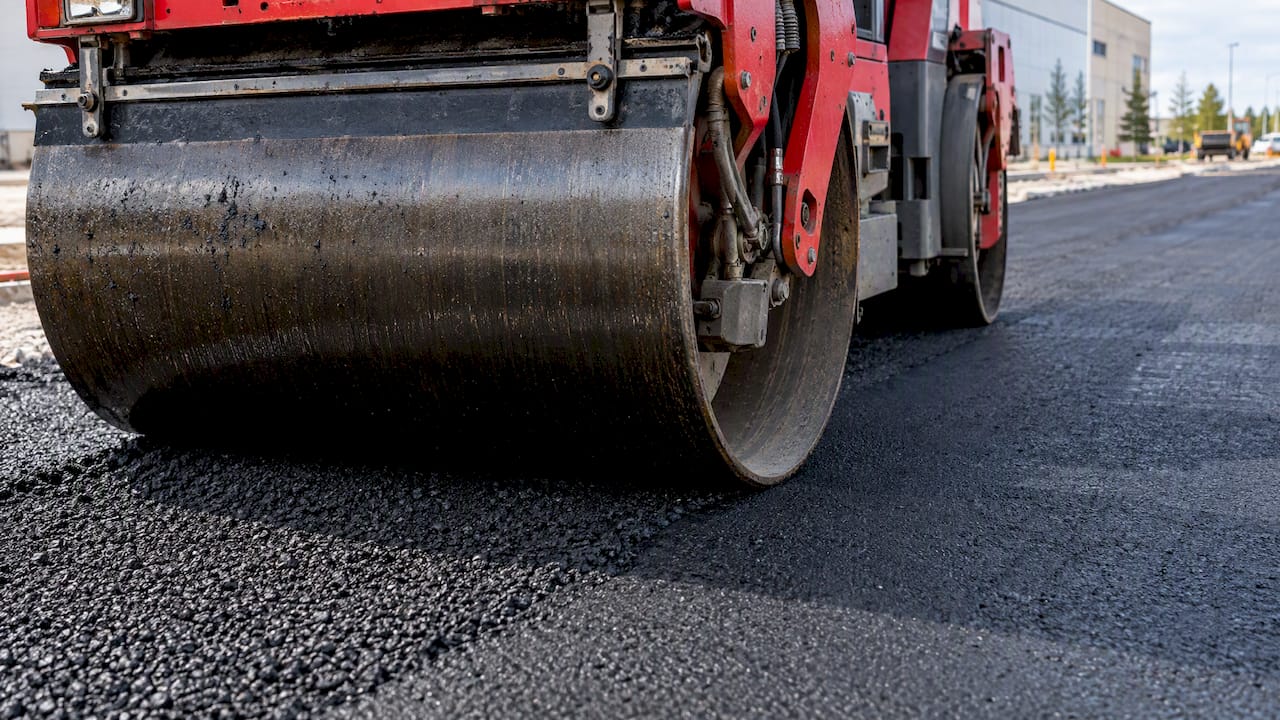
Thickness specifications mean little if the mix and compaction are wrong. Binder selection, often written as a Performance Grade (PG) such as PG 58-28, is chosen to resist both summer softening and winter cracking in regions with wide seasonal temperature swings and involves understanding various bituminous materials like BUR and Modified Bitumen Roofing Material.
Shifting to a stiffer binder grade has a measurable effect on rutting resistance. NRC testing found that moving from PG 52-34 to PG 58-28 reduced rutting by roughly 271 percent in lab conditions, a meaningful gain for any lot carrying sustained heavy traffic.
Alberta’s design bulletin DB13 sets out nominal maximum aggregate size (NMAS) and mix-type guidance by lift, along with recommended compacted lift thickness limits. Keeping each compacted lift in the 50 mm to 60 mm range helps avoid segregation and supports consistent density through the mat.
- Specify the PG binder grade in writing rather than accepting a generic “hot mix” description.
- Require minimum density targets, typically expressed as a percentage of maximum theoretical density, in the contract.
- Ask for recycled asphalt pavement (RAP) content limits so the mix retains predictable performance.
Pro Tip: Ask your contractor to state compacted lift thickness and density targets on the quote itself, not just the final surface depth.
Drainage and frost protection: the details that actually drive longevity
In freeze-thaw climates, drainage often matters more than an extra 25 mm of asphalt. Water trapped under or within the pavement structure is what actually destroys load-bearing capacity.
Surface grading should maintain positive slope, generally a minimum of 1 to 2 percent, so water sheds toward catch basins rather than pooling on the mat. On sites with naturally high moisture or fine-grained soils, subsurface drainage, geotextile separators between soil and granular layers, or underdrains help keep the base dry year-round.
- Confirm positive drainage slope exists across the full lot, not just near entrances.
- Add geotextile fabric where fine-grained subgrade meets granular base to prevent intermixing.
- Route roof and site runoff away from pavement edges rather than across the surface.
Spring thaw is the riskiest period: saturated subgrade loses strength exactly when frost is leaving the ground, which is why drainage design deserves as much attention as thickness. Our cold weather asphalt paving article covers seasonal controls specific to this climate pattern in more depth.
Quick estimating: how to turn area and thickness into asphalt tonnage and cost discussion points
A simple formula lets you sanity-check a contractor’s quantity estimate before signing.
- Calculate area in square metres (length times width).
- Multiply area by compacted thickness in metres to get volume in cubic metres.
- Multiply volume by the asphalt density (roughly 2.4 tonnes per cubic metre) to estimate tonnage.
- For example, a 1,000 square metre lot at 0.125 m (125 mm) compacted thickness needs about 300 cubic metres, or roughly 720 tonnes of asphalt.
- Compare bids line by line across prep work, binder grade, hauling distance, compaction equipment and traffic control.
Request itemized breakdowns rather than a single lump sum, and confirm whether site allowances for unexpected soil conditions are included. Our asphalt parking lot cost breakdown walks through typical regional cost drivers in more detail.
Maintenance schedule and interventions to preserve structural life
Thickness gives a lot its structural ceiling, but maintenance determines whether it actually reaches that lifespan.
- Seal cracks annually or biannually before water can infiltrate the base.
- Patch localized failures quickly rather than letting them spread into the surrounding mat.
- Sealcoat on a multi-year cycle to slow oxidation and surface raveling.
- Consider an overlay when distress is mostly surface-level and the base remains sound; move to full-depth reconstruction when base failure or widespread cracking is evident.
- Fix drainage issues as soon as they appear, since standing water accelerates every other form of deterioration.
Proactive drainage and crack repairs typically cost far less than the structural reconstruction that follows when water damage is left unaddressed.
Our approach to site assessment and build-to-spec paving
We apply this same logic on every parking lot project: assess the site, confirm the subgrade, then design the pavement structure to match actual traffic and climate exposure rather than a generic template.
We follow Alberta design bulletin guidance and recognized workmanship standards, with geotechnical coordination brought in whenever soil conditions are uncertain during project assessment. During a site assessment, expect a review of existing pavement condition, soil observations, drainage patterns and traffic patterns before the proposal of layer structure and thickness. That assessment, not a flat per-square-metre number, determines a durable design.
— ProZone
Get a free site estimate
Getting the thickness and base structure right starts with a proper look at your site, not a phone-quote guess. Free on-site consultations within 100 km are offered to review subgrade, drainage and traffic patterns before recommending a design.
Have a site plan and photos of any current cracking, rutting or ponding ready; it speeds up the estimate and helps us scope the project accurately. Review our asphalt paving and repair services or browse our full range of services, then request a free estimate or call us directly to book your on-site survey.
FAQ
What is 12.5 mm asphalt used for?
A nominal maximum aggregate size (NMAS) mix is a finer-graded asphalt typically used as a surface or wearing lift. It suits standard parking stalls and lighter traffic areas where a smoother, tighter surface texture is preferred over the coarser mixes used in binder or base lifts.
How much weight can 5 inches of asphalt hold?
Roughly 125 mm (5 inches) of compacted asphalt over an adequate granular base generally falls within the range used for standard commercial parking lots and light truck traffic, as outlined in Alberta’s design bulletin. Actual load capacity depends on the supporting base thickness and subgrade strength, not asphalt depth alone, so a site-specific design is needed for heavy or repeated truck loading.
Can you lay asphalt directly on dirt?
No, asphalt should never be placed directly on native soil or dirt. Without an engineered granular base and subbase, the pavement structure lacks the support needed to resist frost heave and traffic loading, leading to early cracking and failure.
How far will 1 ton of asphalt go?
One tonne of asphalt covers roughly 8 to 9 square metres at a 125 mm compacted thickness, using an approximate density of 2.4 tonnes per cubic metre. Coverage shrinks as thickness increases, so a thicker truck-route section will need proportionally more material per square metre than a standard stall area.