
TL;DR:
- Commercial snow removal involves proactive, contract-based services to clear snow and prevent ice hazards on commercial properties. It includes snow plowing, de-icing, walkway clearing, and roof load management, with service dispatch triggered by specific accumulation thresholds. Proper contracts prioritize safety, documentation, and equipment capacity to reduce liability and ensure effective winter operation.
Commercial snow removal is the proactive, structured process of clearing snow and managing ice on commercial properties to maintain safety, regulatory compliance, and uninterrupted operations throughout winter. Unlike residential clearing, it is a risk management service governed by service agreements, trigger thresholds, and documented maintenance protocols. In Edmonton and across Alberta, freeze-thaw cycles create conditions where a single unmanaged snowfall can generate serious liability exposure. Structured management programs reduce slip-and-fall claims by 60–80% through consistent, documented maintenance. This guide covers commercial snow removal explained in full, from service scope and pricing to contractor selection and equipment.
What does commercial snow removal cover?
Commercial snow removal is defined by scope and precision, not just the act of plowing. Services include snow plowing, de-icing, walkway clearing, and snow hauling to designated stockpile areas to prevent hazards from accumulation. Each of these components addresses a distinct risk category on your property.
Service dispatch is typically automatic, not reactive. Contracts often trigger service at 2 inches of accumulation on parking areas and 1 inch on pedestrian walkways. That threshold system removes ambiguity and prevents the ice formation that follows delayed response.
De-icing is one of the most misunderstood components. Applying liquid brine or solid agents before a storm, rather than after, can cut de-icer use by 50–70% by preventing ice from bonding to the surface. Pre-treatment must be applied within 24 hours of a storm’s onset and remains effective above approximately 15°F (around -9°C).
Roof snow load management is a separate, high-risk service. Removal is recommended when snow reaches approximately 75% of a structure’s design load, and it requires certified fall-protection protocols. Property managers who overlook roof loads expose themselves to structural damage claims that dwarf typical slip-and-fall settlements.
Pro Tip: Before the first snowfall, stake-mark all site hazards including fire hydrants, drainage grates, and curb edges. Unmarked hazards cause equipment damage and mid-season disputes with contractors.
- Snow plowing of parking lots, access roads, and loading bays
- De-icing and anti-icing of driving and pedestrian surfaces
- Walkway and entrance clearing, including ADA-accessible routes
- Snow hauling to off-site or designated on-site stockpile zones
- Roof snow load monitoring and removal with fall-protection protocols
How are commercial snow removal contracts structured and priced?
Commercial contracts follow three primary pricing models, and choosing the wrong one for your property type can cost significantly more than the service itself.

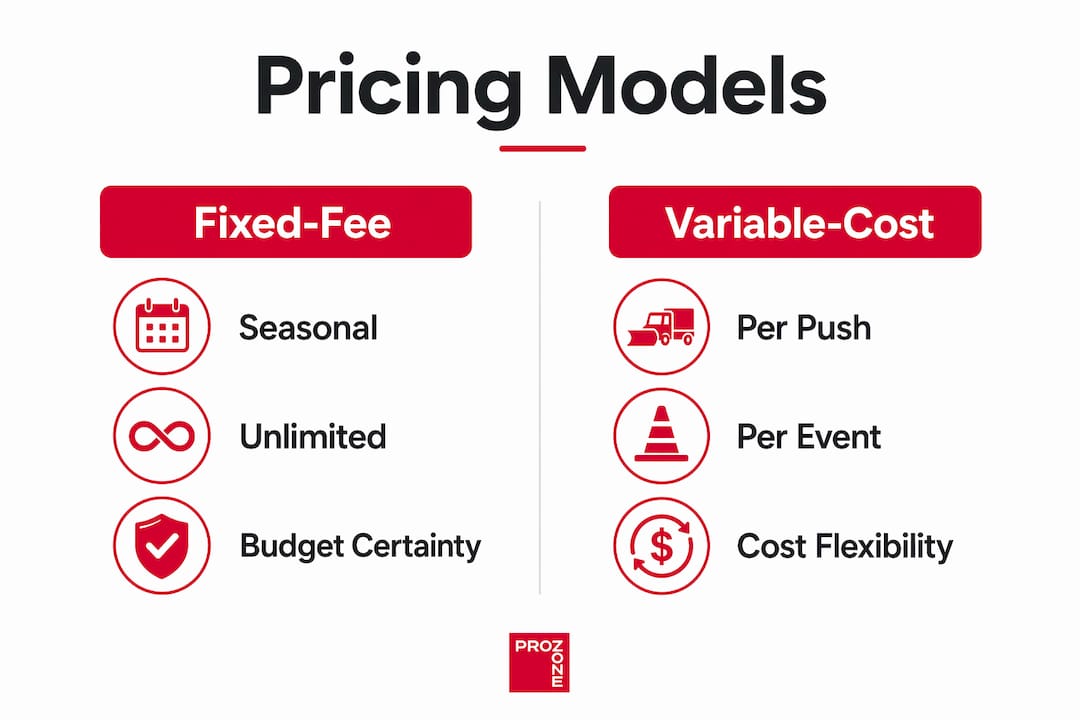
Per-push pricing charges a flat rate each time a crew attends your site. Rates typically range from $150 to over $500 per push, depending on property size and scope. This model suits properties in regions with light or unpredictable snowfall, where paying per event avoids overpaying for a mild winter.
Seasonal contracts offer fixed-fee unlimited service, commonly structured from november 15 to april 15 in Alberta. That fixed cost provides budget certainty and incentivises the contractor to work efficiently. The trade-off is that you pay the full seasonal rate regardless of how much snow actually falls.
Per-event pricing sits between the two, billing for each measurable weather event rather than each individual site visit. This model works well for properties with moderate traffic and predictable storm patterns.
| Pricing model | Best for | Budget certainty | Risk to property manager |
|---|---|---|---|
| Per push | Light or variable snowfall | Low | High in heavy winters |
| Seasonal flat fee | High-snowfall regions | High | Low |
| Per event | Moderate traffic properties | Medium | Medium |
Contract clarity on three points protects you from disputes: priority zones (which areas get cleared first), trigger depths (the accumulation level that activates service), and liability protections (who bears responsibility for documented incidents). Commercial contracts require higher insurance coverage and more detailed service agreements than residential arrangements. Verify that your contractor carries general liability and commercial auto coverage before signing.
Pro Tip: Review your snow removal contract before october ends. Contractors in Edmonton book up quickly, and late-season agreements often carry premium pricing or reduced service priority.
What equipment do professional snow removal contractors use?
Professional commercial snow removal relies on a fleet of specialised equipment, not pickup trucks with aftermarket blades. The machinery used determines how quickly and completely a site can be cleared after a significant snowfall event.
- Plow trucks handle large open areas such as parking lots and access roads. Modern units carry hydraulic blades that adjust angle and pitch, allowing operators to windrow snow efficiently toward designated stockpile zones.
- Skid-steers manoeuvre in tight spaces where trucks cannot operate, including loading docks, narrow laneways, and areas adjacent to building entrances.
- Front-end loaders move high volumes of accumulated snow and are used for hauling operations when stockpile zones reach capacity.
- Ice control spreaders apply granular or liquid de-icing agents at calibrated rates, preventing over-application that damages pavement and surrounding vegetation.
Technology now plays a direct role in liability protection. GPS tracking on service vehicles creates a timestamped record of every site visit. Photographic documentation, captured before and after each service, provides critical evidence for liability defence in slip-and-fall litigation. Settlements in winter slip-and-fall cases can average from $50,000 to $250,000 per incident. A contractor without documentation systems exposes your property to that full range of risk.
Contractors typically operate overnight or early morning to keep business operations uninterrupted during weather events. That timing requires reliable dispatch systems and equipment that is maintained and ready before the season begins, not sourced reactively when a storm hits.
How to choose the right commercial snow removal contractor
Selecting a contractor is a risk management decision, not a price comparison exercise. The lowest bid rarely accounts for the insurance coverage, equipment capacity, and documentation practices that protect your property through a full Alberta winter.
Use the following criteria to qualify any contractor before signing:
- Insurance and liability coverage: Confirm general liability insurance at commercial-grade limits. Reactive will-call approaches fail to prevent ice formation and leave property managers exposed to claims. A contractor without adequate coverage transfers that risk directly to you.
- Alberta Safety Codes compliance: Contractors working on commercial sites in Alberta must operate within provincial safety standards. Ask for documentation of compliance, particularly for roof snow removal and fall-protection protocols.
- Equipment capacity: Verify that the contractor owns or has guaranteed access to the machinery required for your site. Subcontracted crews with undersized equipment are a common source of service failures during peak storm events.
- Documentation practices: GPS logs, timestamped photos, and service reports are non-negotiable. Clear documentation of every snow removal event provides the strongest defence in slip-and-fall litigation.
- Priority zone planning: The best commercial programmes pre-define priority zones such as emergency access lanes and accessible entrances before the season begins. Contractors who ask about your site layout before quoting are demonstrating the right approach.
- Communication protocols: Confirm how the contractor notifies you of service completion, weather delays, and scope changes. Proactive communication prevents disputes and keeps your operations running on schedule.
A professional parking lot service also brings site-specific knowledge that generic providers lack. In Edmonton, freeze-thaw cycles between november and march can refreeze cleared surfaces within hours of a service visit. Contractors who account for that in their scheduling and de-icing protocols deliver materially better outcomes than those who treat every market the same.
What property managers often get wrong about winter contracts
The most common mistake property managers make is treating snow removal as a reactive expense rather than a proactive programme. Waiting until the first major snowfall to call contractors results in limited availability, higher per-push rates, and service agreements that lack the priority-zone and trigger-depth language that protects you legally.
Edmonton’s climate makes this particularly consequential. Temperatures can swing from -25°C to above freezing within a single week in january or february. That freeze-thaw pattern turns cleared pavement into black ice within hours, and a contractor without a pre-treatment protocol will miss that window entirely. The financial exposure from a single unmanaged icing event, measured against the cost of a seasonal contract, makes the calculus straightforward.
Documentation is the second area where property managers consistently underinvest. Many assume that hiring a contractor transfers all liability. It does not. If your contract lacks clear language on service triggers, response times, and documentation requirements, a court may find shared liability regardless of who held the shovel. Treat your snow removal agreement the same way you treat your property insurance policy: read every clause before winter arrives.
The contractors worth retaining are those who treat the relationship as a partnership in risk management, not a transactional service call. That distinction shows up in how they plan your site before the season, how they communicate during storms, and how thoroughly they document every visit.
— ProZone
Prozoneltd commercial snow removal services for Edmonton properties
Prozoneltd provides certified commercial snow removal services across Edmonton and the surrounding region, built around Alberta Safety Codes compliance and documented winter maintenance programmes. Every contract includes pre-defined priority zones, automatic dispatch triggers, and GPS-tracked service records that protect your property through the full winter season. Prozoneltd’s Edmonton infrastructure solutions cover snow clearing, de-icing, snow hauling, and roof load monitoring, all delivered by crews operating with commercial-grade equipment and verified insurance coverage. Contact Prozoneltd directly through the online form or by phone to receive a free estimate tailored to your site’s scope and risk profile.
FAQ
What is commercial snow removal?
Commercial snow removal is a structured, contract-based service that clears snow and manages ice on commercial properties to maintain safety and operational continuity. It differs from residential clearing through its focus on liability risk management, documented maintenance, and compliance with safety standards.
How much does commercial snow removal cost in 2026?
Per-push rates typically range from $150 to over $500, depending on property size and service scope. Seasonal flat-fee contracts covering november 15 to april 15 provide fixed-cost certainty for high-snowfall regions like Edmonton.
What trigger depth activates commercial snow removal service?
Most commercial contracts dispatch crews automatically at 2 inches of accumulation on parking areas and 1 inch on pedestrian walkways. These thresholds prevent ice formation that follows delayed response.
Why does documentation matter in commercial snow removal?
Slip-and-fall litigation settlements can range from $50,000 to $250,000 per incident. Timestamped GPS logs and photographic records from each service visit provide the primary legal defence for property managers.
What should a commercial snow removal contract include?
A complete contract defines priority service zones, accumulation trigger depths, response time commitments, insurance coverage requirements, and documentation protocols. Contracts lacking these elements leave property managers exposed to disputed liability during winter incidents.