
Reinforced commercial concrete parking lots in Edmonton typically run $6.00 to $12.00 per square foot, or roughly $3,000 to $6,000 per stall once drive aisles and circulation space are factored in. The spread comes down to three things: subgrade condition, drainage design, and reinforcement specification. Before you lock in a budget, commission a geotechnical report and collect at least three comparable bids built from that same soil data.
Table of Contents
- What does a concrete parking lot cost per square foot and per stall in Edmonton?
- What drives the total cost on every commercial concrete bid?
- What Edmonton bylaws and accessibility rules affect parking lot design?
- Asphalt or concrete: which actually costs less over 15 years?
- How do you get an accurate, comparable concrete parking lot quote?
- What should you budget for concrete parking lot maintenance over 15 to 30 years?
- Why procurement discipline matters more than the per-square-foot number
- Get a firm, code-compliant estimate from ProZone
- Sources
- FAQ
What does a concrete parking lot cost per square foot and per stall in Edmonton?
Start with the per-square-foot number, because every quote you receive should trace back to it. Reinforced commercial concrete in Edmonton typically lands between $6.00 and $12.00 per square foot, according to industry benchmarking from Winsparking. Lots with poor native soils, tight urban access, or heavy structural reinforcement sit at the top of that range. Straightforward greenfield sites with good drainage and simple geometry land closer to the bottom.
Converting square footage to stalls requires a circulation factor. Most commercial lots need 300 to 350 square feet per stall once you account for drive aisles, turning radii, and landscaped islands. That factor turns the per-square-foot number into a working budget figure.
Pro Tip: Ask every bidder for their assumed square feet per stall before comparing dollar figures. A contractor using 260 square feet per stall looks cheaper on paper but may be under-designing your circulation space.
At that ratio, per-stall costs for concrete typically run $3,000 to $6,000 per stall, compared with $1,500 to $3,000 per stall for asphalt, per the same Winsparking data. Here’s how that plays out across common Edmonton commercial projects:
- 25-stall lot (roughly 8,750 square feet): expect $52,500 to $150,000 depending on site prep and drainage complexity. Small retail pads and clinic lots typically sit at the lower end unless soil conditions force deeper excavation.
- 75-stall lot (roughly 26,250 square feet): expect $157,500 to $450,000. Multi-tenant office and light industrial sites often fall in the middle third once accessible stalls and landscaped islands are added.
- 200-stall lot (roughly 70,000 square feet): expect $420,000 to $1,200,000. Large retail centres and municipal facilities push toward the high end when stormwater detention or heavy-duty truck aprons are required.
Add-ons shift these numbers further. EV charging conduit trenched during construction typically adds a modest per-stall allowance rather than the far higher cost of retrofitting after paving, a point Winsparking’s cost guide makes explicitly. Underground stormwater detention and LED pole lighting are the two other line items that most often surprise owners who budgeted from a bare per-square-foot number without asking what’s included.
What drives the total cost on every commercial concrete bid?
Every line item on a bid ties back to one of seven cost drivers; for guidance on construction authorization and regulatory processes, see comment construire son garage. Understanding them lets you compare quotes that look wildly different on the surface but are actually pricing the same scope.
A geotechnical report comes first, and it’s the single highest-leverage dollar you’ll spend. Expect to pay $3,000 to $8,000 for a report that tells your engineer the bearing capacity, frost depth, and drainage characteristics of your soil. Skip it, and you’re asking contractors to guess at subgrade thickness, which is exactly where change orders come from.
Excavation volumes follow directly from that report. Haul distance to disposal or import sites, and whether spoil needs to be trucked off-site or can be reused as fill, both swing the excavation line by thousands of dollars on a mid-size lot.
The aggregate base underneath the slab needs to meet a compaction standard, usually verified with proctor density testing. A thin or poorly compacted base is the most common cause of premature cracking in Edmonton, where seasonal frost heave punishes any weak spot in the subgrade.
Concrete mix design, slab thickness, and reinforcement together determine structural performance:
- Specified compressive strength for commercial parking areas generally runs higher than residential flatwork, and your engineer sets this based on traffic loads, not guesswork.
- Slab thickness typically increases in truck aprons, loading zones, and turning lanes versus standard stall fields.
- Reinforcement (rebar or synthetic fibre) and jointing strategy (control joints, expansion joints) both affect long-term crack control.
Formwork, finishing, and curing practices matter more in Edmonton than almost anywhere else in Canada. Cold-weather concreting protocols, including insulated blankets and adjusted cure times, are mandatory once overnight temperatures approach freezing, and a contractor who skips them is setting you up for surface scaling within two winters.
Stormwater management, whether it’s a simple sheet-drain design or a full detention pond with a quality treatment device, adds a distinct unit cost that should appear as its own line item. Finally, temporary traffic control and phasing plans protect your business access during construction and deserve their own budget line rather than getting buried in “general conditions.”
What Edmonton bylaws and accessibility rules affect parking lot design?
Municipal and provincial rules aren’t optional line items. They set the minimum paved area, the number of accessible stalls, and the landscaping you must build into the site plan before a permit gets issued.
City of Edmonton zoning bylaw 54.8 requires landscaped open space at a rate of 2.0 square metres per vehicle parking space for any lot with 30 or more stalls. On a 75-stall lot, that’s 150 square metres of landscaped area you must design into the site, plus the island minima the bylaw sets for how that space gets distributed. Owners who treat landscaping as an afterthought routinely discover it adds both paved area and a planting allowance they hadn’t budgeted for.
Accessible stall requirements come from the National Building Code 2023 Alberta edition and Alberta’s barrier-free design guidance. The Safety Codes Council of Alberta recommends a minimum accessible stall width of 2.4 metres paired with a 2.4 metre access aisle, plus a continuous barrier-free path of travel to building entrances. The number of accessible stalls required scales with total lot size, so a 200-stall facility needs meaningfully more accessible capacity than a 25-stall pad.
Permit and inspection fees, along with municipal hard-surfacing standards that may require concrete rather than gravel or asphalt in specific zones, round out the regulatory cost picture. Landscaping islands and accessibility requirements together reshape striping layout and vehicle circulation, and that redesign work adds real per-stall cost that a generic contractor estimate often misses entirely.
Key figure: Any Edmonton lot crossing the 30-stall threshold triggers the 2.0 m² per space landscaping requirement under bylaw 54.8, a rule that catches many first-time commercial developers off guard during permitting.
Asphalt or concrete: which actually costs less over 15 years?
Concrete costs more upfront. Asphalt wins on lifecycle cost only in low-traffic applications. That’s the honest tradeoff, and it’s worth stating plainly before the marketing language from either camp clouds the decision.
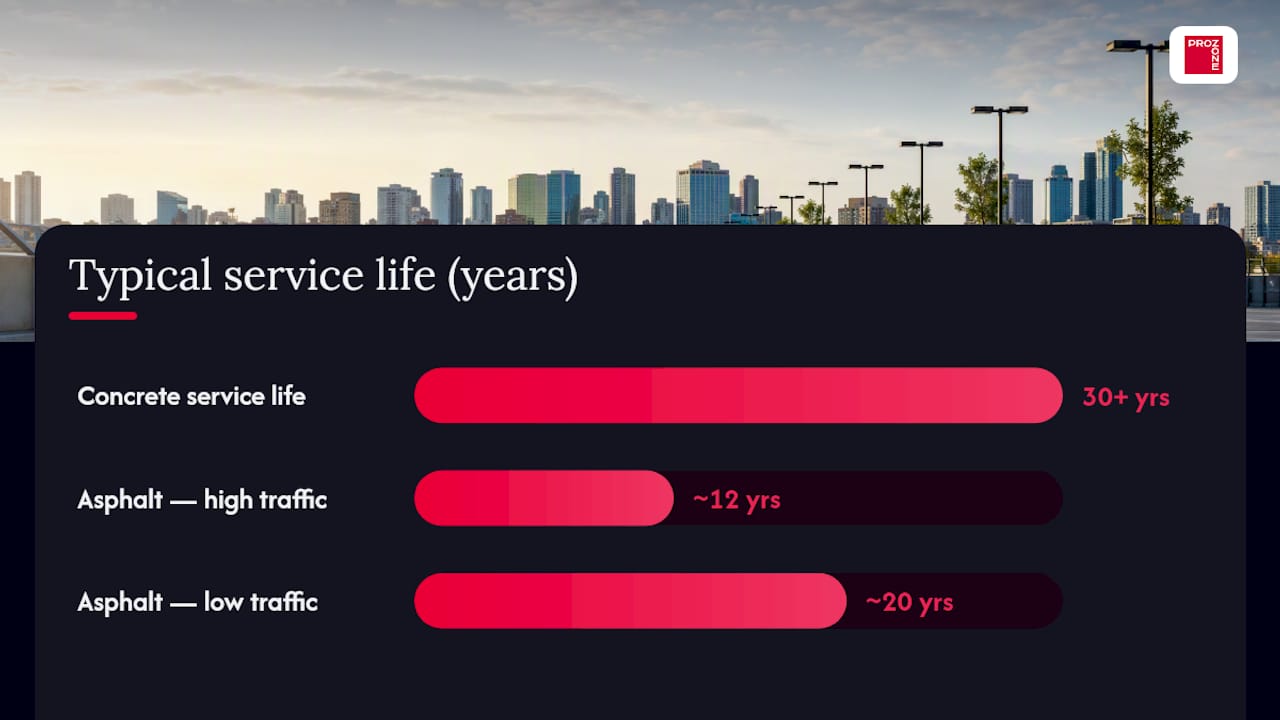
Concrete typically runs 20% to 50% higher in initial installation cost compared with asphalt, according to The Owner Builder Network’s comparison of the two materials. That premium buys a material that commonly lasts 30 or more years with proper joint maintenance, versus an asphalt surface that needs a full overlay roughly every 12 to 20 years depending on traffic loads and Edmonton’s freeze-thaw exposure.
The decision usually comes down to how the lot gets used:
- Concrete wins where heavy trucks turn repeatedly, where bus lanes or loading docks concentrate point loads, and anywhere de-icing salt exposure is constant. Concrete resists salt-driven surface deterioration far better than asphalt over a multi-decade horizon.
- Asphalt wins on rapid installation timelines and lower first cost, which matters for owners financing construction against a tight opening date or a limited capital budget.
- Hybrid layouts split the difference. Many Edmonton commercial sites pour concrete at entry aprons, turning lanes, and dumpster pads, then use asphalt across the bulk of the stall field. That combination captures concrete’s durability where wear concentrates without paying the full premium across the entire site, a point echoed in Winsparking’s own material guidance.
If your project is weighing surfacing options in more depth, ProZone’s asphalt versus concrete comparison guide breaks down the durability side of that decision further. For sites leaning toward asphalt for cost reasons, a dedicated Edmonton asphalt cost breakdown is worth reviewing alongside your concrete numbers before you finalize a material choice.
How do you get an accurate, comparable concrete parking lot quote?
Bids that look nothing alike usually aren’t pricing the same scope. The fix is a written RFP that forces every contractor to quote against the identical set of assumptions.
Your RFP should specify:
- Geotechnical data: attach the actual soil report rather than asking bidders to assume conditions.
- Pavement section: state the required base thickness and slab depth so nobody is guessing at your engineer’s design.
- Compaction QA requirements: specify what proctor density testing you expect and who pays for it.
- Concrete mix design: state the specified compressive strength, not just “commercial grade.”
- Reinforcement type: rebar size and spacing, or fibre dosage, spelled out explicitly.
- Curing method: particularly your cold-weather protocol for shoulder-season pours.
- Drainage scope: sheet drain, catch basins, or detention, defined as its own line item.
- EV conduit allowance: even if you’re not installing chargers today, price the trenching now.
Require bidders to return a construction schedule, QA testing results from prior comparable projects, warranty terms in writing, proof of liability insurance, and documented compliance with Alberta Safety Codes. References from municipal or commercial clients of similar scale tell you more than a glossy brochure ever will.
Pro Tip: Read the unit rates, not just the bottom line. A bid that’s 10% lower but omits a defined unit cost for unsuitable soil removal is the one most likely to hand you a change order mid-project.
Watch for low bids that exclude geotechnical allowances, use vague “per contractor standard” language instead of a specified mix design, or leave winter concreting protocols unaddressed. Contract language that defines a soil contingency allowance, locks in unit costs for common change scenarios, and requires acceptance testing before final payment is the single best defence against budget creep on a project this size.
What should you budget for concrete parking lot maintenance over 15 to 30 years?
Construction cost is only the entry price. What you spend keeping the lot healthy over its service life often rivals the original build cost, especially in a climate that cycles through freeze and thaw as often as Edmonton’s does.
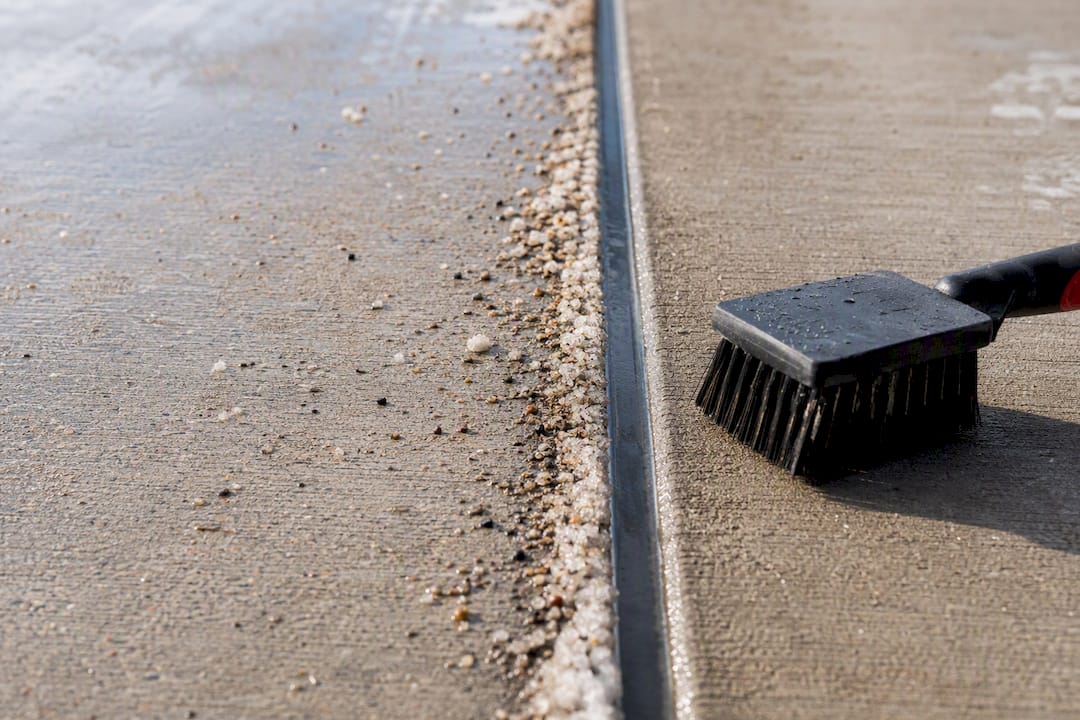
Concrete parking surfaces need routine joint cleaning to keep grit and de-icing salt from working into control joints, plus targeted sealing on high-exposure areas and periodic slab repairs where distress appears. A reasonable annual reserve allocation, expressed as a fraction of a dollar per square foot, keeps pace with these needs without requiring large lump-sum outlays every few years.
Over a 15-year horizon, that reserve strategy typically favours concrete in heavy-traffic zones. Asphalt requires a full-depth overlay roughly every 12 to 20 years, according to The Owner Builder Network’s lifecycle analysis, which represents a major capital event rather than a routine reserve draw. Concrete’s maintenance profile is steadier: smaller, more predictable expenses spread across the same period.
Edmonton’s freeze-thaw cycle is the variable that changes everything. Water that infiltrates a poorly sealed joint, then freezes and expands, is the primary mechanism behind spalling and joint deterioration across the region. Proper joint detailing at the time of construction, paired with consistent de-icing salt management, meaningfully reduces this risk over the lot’s service life.
Watch for these early warning signs, since catching them early keeps repair costs modest:
- Hairline surface cracking in year one to three, often a sign of curing or jointing issues that a repair contractor can address before it spreads.
- Joint spalling after several winters, typically tied to salt penetration and inadequate sealant maintenance.
- Ponding or birdbath areas indicating a drainage grade problem rather than a slab defect, best addressed through targeted drainage correction before it undermines the base.
Why procurement discipline matters more than the per-square-foot number
The number everyone fixates on, the per-square-foot rate, is the least useful figure in this whole process if it isn’t backed by a defined scope. We’ve seen the same $9.00 per square foot quoted for a lot with proper geotechnical design and one with none at all. Only one of those numbers survives contact with an Edmonton winter.
Conventional advice tells owners to “get three quotes and compare.” That’s incomplete. Three quotes built from three different assumptions about subgrade thickness, reinforcement, and curing protocol aren’t comparable at all, they’re just three unrelated guesses wearing the same dollar sign.
What actually protects your budget is sequencing: commission the geotechnical report first, write the RFP around its findings, then collect bids. That order turns a vague per-square-foot range into a firm, defensible number your finance team can actually approve. Skipping the geotech step to save a few thousand dollars is the single most expensive mistake we see repeated across Edmonton commercial projects, because it shows up later as a change order with no leverage to negotiate it down.
— ProZone
Get a firm, code-compliant estimate from ProZone
ProZone is the premium standard for commercial concrete work in Edmonton, built on Alberta Safety Codes compliance, and quality materials, rather than the shortcuts that generic contractors rely on to win on price alone. We handle the full scope this article covers: structural concrete flatwork, stormwater drainage design, EV conduit coordination, and ongoing maintenance agreements paired with commercial snow removal once your lot is built.
Before your free estimate, have your site plan, target stall count, and desired design life ready. We’ll walk the site, build a scope checklist against your zoning and accessibility requirements, and hand you real cost ranges instead of a single guessed number. Call ProZone directly or use our online contact form to book a free consultation within 100 km of Edmonton, and get a bid you can actually take to your board.
Sources
- National Building Code 2023 Alberta edition
- City of Edmonton zoning bylaw 54.8 — Parking facilities
- Parking Lot Construction Cost 2026 | Asphalt, Concrete, ADA — Winsparking
- Asphalt vs concrete: which is best for your commercial parking lot? — The Owner Builder Network
FAQ
How much does it cost to build a concrete parking lot in Edmonton?
Reinforced commercial concrete typically costs $6.00 to $12.00 per square foot, or $3,000 to $6,000 per stall once circulation space is included, with the final figure depending on soil conditions, drainage, and reinforcement specification.
How much is concrete per square foot in Edmonton?
Commercial-grade concrete parking construction generally runs $6.00 to $12.00 per square foot in Edmonton, according to industry benchmarking, though sites with poor subgrade or complex drainage push toward the top of that range.
How much does a 12×12 concrete slab cost in Canada?
A residential concrete slab is a different scope than a commercial parking lot, typically priced separately by residential contractors; ProZone’s Edmonton concrete driveway cost breakdown covers this smaller-scale pricing directly.
How much does it cost to pave a 1,000 square foot area?
At Edmonton’s typical $6.00 to $12.00 per square foot range for commercial concrete, total costs depend on area size and site-specific factors like excavation depth or drainage tie-ins.
Should I get a geotechnical report before requesting quotes?
Yes. A geotechnical report, typically $3,000 to $8,000, gives every bidder the same soil data to price against, which is the only way to receive genuinely comparable quotes rather than estimates built on differing assumptions.