
TL;DR:
- Decorative concrete offers Edmonton homeowners a wide range of aesthetically pleasing, textured, and colored surfaces that surpass basic gray cement. Proper installation, climate-appropriate finishes, and regular maintenance are essential to ensure durability and curb appeal in Edmonton’s harsh winters. Choosing the right finish and working with experienced contractors maximizes the longevity and resale value of decorative concrete surfaces.
Plenty of Edmonton homeowners picture decorative concrete as little more than gray cement tinted a different shade, maybe pressed with a leaf stamp before it dries. That picture barely scratches the surface. Decorative concrete covers an entire family of intentionally finished, colored, textured, or patterned surfaces designed to achieve real aesthetic goals, not just fill a gap between the grass and your front door. This guide cuts through the confusion, walks you through every major finish type, explains the installation process honestly, and gives you the maintenance knowledge to protect your investment through Edmonton’s punishing winters.
Table of Contents
- What is decorative concrete? Foundation, finishes, and forms
- Types of decorative concrete finishes for Edmonton landscapes
- How decorative concrete is made: Steps, materials, and techniques
- Common pitfalls and how to ensure lasting results with decorative concrete
- Maintaining the look: Top care tips for decorative concrete
- What most Edmonton homeowners miss about decorative concrete
- Ready to enhance your landscape? Explore decorative concrete solutions
- Frequently asked questions
Key Takeaways
| Point | Details |
|---|---|
| Definition clarified | Decorative concrete uses texture, patterns, and color so your exterior is more than just gray flatwork. |
| Finish selection matters | Choose finishes like exposed aggregate or broom styles for safety and longevity in Edmonton. |
| Quality installation, | Proper prep, curing, and sealing are essential for attractive, durable results. |
| Prevent common pitfalls | Avoid surface delamination, cracking, and slipperiness by understanding and managing local risks. |
| Maintenance extends life | Routine cleaning and resealing protect curb appeal and add value to your property. |
What is decorative concrete? Foundation, finishes, and forms
Most people assume concrete is concrete. You pour it, it hardens, it’s done. Decorative concrete works on an entirely different level because every decision, from the mix design to the final sealer coat, is made with appearance and function in mind equally.
The technical definition is precise:
“Decorative concrete is concrete or cementitious overlay systems that are intentionally finished, colored, textured, or patterned to achieve aesthetic outcomes beyond standard gray flatwork.” (Decorative Concrete Applications)
That word “intentionally” matters. A smooth trowel finish on a garage floor is functional. A polished concrete patio with integral color and a saw-cut geometric pattern is decorative. The difference is in the planning, the materials chosen, and the skill applied at every stage.
The main categories you’ll encounter include:
- Specialty castings and formed finishes: Think board-formed concrete walls, glass fiber reinforced concrete (GFRC) panels, and custom cast garden edging. These are made in molds and placed rather than poured in place.
- Overlay and topping systems: Thin polymer-modified layers applied over existing concrete to refresh a dull surface, add color, or create a micro-topping with a smooth modern look.
- Texture and pattern systems: Stamped concrete is the most recognized here, but exposed aggregate and broom finishes also fall in this group.
- Surface coloring methods: Integral pigments mixed into the concrete before placement, acid staining that reacts chemically with the surface, or water-based stains applied after curing.
The range of visual results is genuinely wide. You can achieve a patio that reads like natural limestone, a pathway that mimics aged brick, a driveway with a clean linear scored pattern, or a garden border with a rough stone texture. None of these require the natural material itself. That flexibility is exactly why decorative concrete has become a go-to choice for Edmonton homeowners who want lasting curb appeal without the cost and fragility of real stone or brick.
Types of decorative concrete finishes for Edmonton landscapes
Once you understand the basics of decorative concrete, it’s essential to consider which finish best serves your specific needs and local conditions. Edmonton’s climate is not forgiving. Freeze-thaw cycles, road salt spray, and snow removal traffic put pressure on any outdoor surface. The finish you choose has a direct impact on how your concrete holds up over five, ten, or twenty years.
Principal categories include specialty casting and formed finishes, overlay systems, texture and pattern systems, and surface coloring. Each category carries different performance characteristics outdoors.
Here’s how the most common Edmonton landscape finishes compare:
| Finish type | Visual appeal | Slip resistance | Maintenance level | Cold climate suitability |
|---|---|---|---|---|
| Stamped concrete | High, mimics stone or brick | Low to medium (needs non-slip additive) | Medium (reseal every 2-3 years) | Moderate (can trap moisture in joints) |
| Broom finish | Clean, understated | High | Low | Excellent |
| Exposed aggregate | Textured, natural look | High | Low to medium | Very good |
| Acid stained | Unique, variegated color | Medium (depends on sealer) | Medium to high | Good with proper sealer |
| Overlay/micro-topping | Modern, seamless | Medium | Medium | Fair (depends on bond strength) |
For most Edmonton driveways, walkways, and patio surrounds, broom and exposed aggregate finishes deliver the best balance of looks and practicality. They drain well, grip foot traffic naturally, and resist the kind of surface chipping that stamped concrete can develop when freeze-thaw cycles are extreme.
When it comes to choosing the right finish for Alberta projects, the local climate really does narrow the field. Stamped concrete is beautiful, but it requires a non-slip additive in the sealer and more frequent resealing to stay safe and vibrant through Edmonton winters.
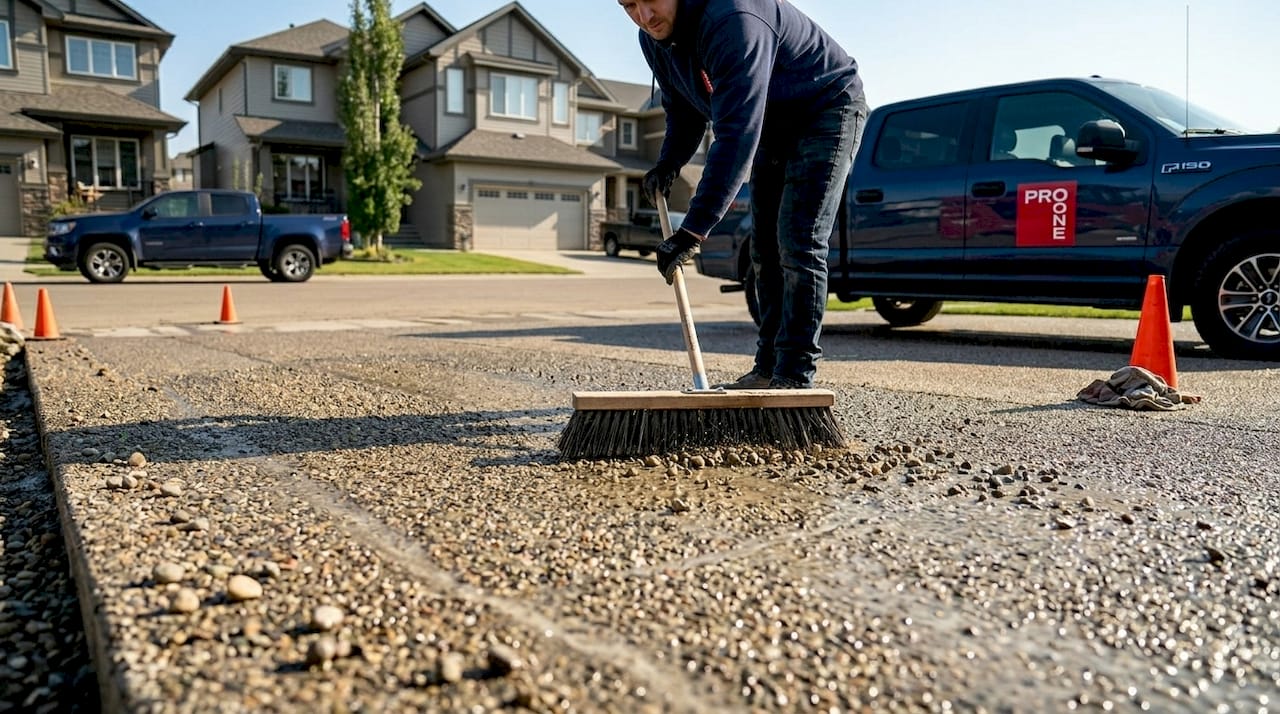
Pro Tip: The American Concrete Institute’s ACI 310R guide recommends finishes matching climate, specifically broom and exposed aggregate over heavy stamped patterns in harsh winters, to minimize slip and fade risks. If you want stamped concrete, ask your contractor about broadcast non-slip aggregates applied to the sealer coat, not just a standard topcoat.
Not all decorative concrete products are made equal, either. A low-cost pigment system will fade noticeably after two or three Edmonton summers. High-quality iron oxide pigments hold their color far longer and resist UV degradation. The same principle applies to sealers: penetrating sealers protect from within, while film-forming sealers add gloss but require more frequent reapplication.
How decorative concrete is made: Steps, materials, and techniques
Now that you know the options, let’s look at how decorative concrete comes to life under Edmonton conditions. The installation process involves far more than pouring and waiting, and understanding each step helps you ask the right questions when hiring a contractor.
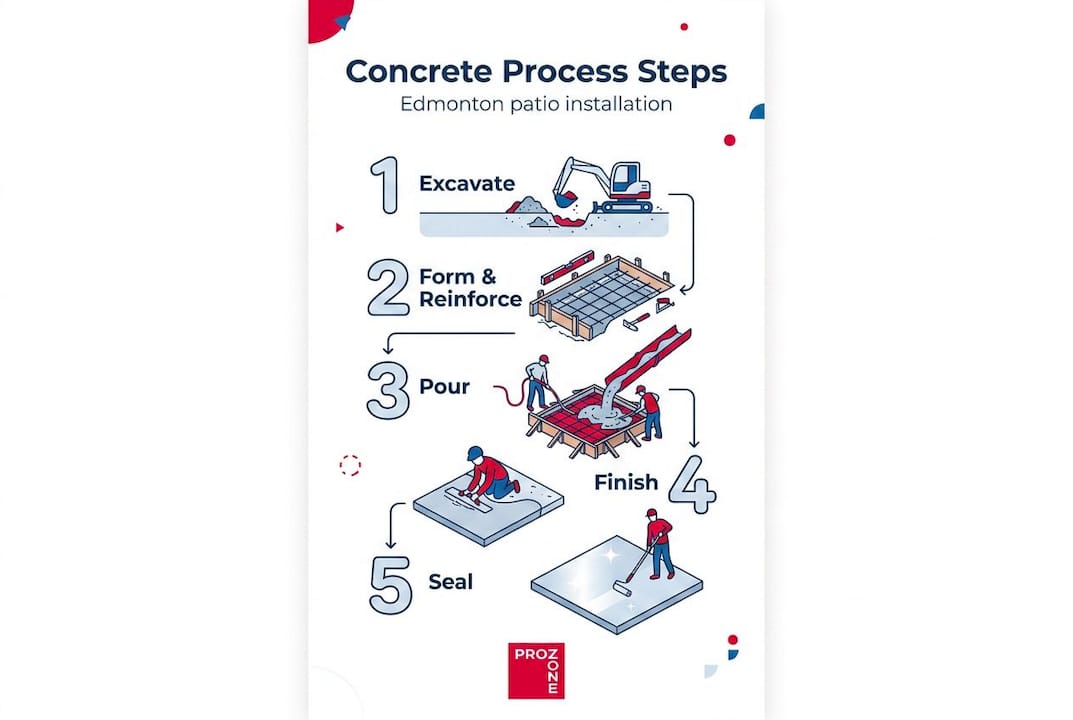
Here’s a straightforward overview of a typical decorative concrete patio or pathway installation:
- Site preparation and base work: The ground is excavated to the correct depth, usually 4 to 6 inches for a residential patio, and a compacted granular base is laid. Proper drainage is planned at this stage.
- Forming and reinforcement: Wood or metal forms shape the slab. Rebar or wire mesh is placed inside to control cracking.
- Mix design with integral color: If color is going into the mix, iron oxide pigments are added at 0.5 to 7% of the cement weight. This produces consistent color throughout the slab, not just at the surface.
- Placement and consolidation: Concrete is poured, screeded level, and consolidated to remove air pockets.
- Stamping or surface treatment: Stamping must happen in the plastic state, typically within a 2 to 4 hour window depending on temperature. Release agents prevent stamps from sticking. Broom or exposed aggregate finishes are applied during this stage as well.
- Curing: Proper curing is critical. Concrete needs adequate moisture and temperature to reach its design strength.
- Cutting and joint placement: Control joints are saw-cut to manage where any cracking occurs, typically within 24 to 48 hours.
- Polishing (if applicable): Polished concrete requires 4 to 8 grinding passes, starting at 30-grit and finishing up to 800-grit for a high sheen.
- Sealing: Applied after the 28-day cure, sealing locks in color, protects the surface, and adds slip resistance when the right product is chosen.
The materials involved are more specialized than most people realize. Here’s a breakdown:
| Material | Purpose | Key spec |
|---|---|---|
| Iron oxide pigments | Integral color | 0.5 to 7% of cement weight |
| Polymer-modified overlay | Thin surface refresh | Min. 3,000 psi bond strength |
| Penetrating sealer | Moisture and salt protection | Low VOC for indoor/outdoor use |
| Film-forming sealer | Surface gloss and color enhancement | Reapply every 2 to 3 years |
| Non-slip aggregate broadcast | Improve traction on sealed surfaces | Applied to wet sealer coat |
| Release agent | Prevent stamp adhesion | Powder or liquid form |
Substrate preparation for overlays deserves special attention. The surface profile must meet ICRI CSP 3 to 5 standards, which means it needs a slightly rough texture so the overlay bonds correctly. The minimum 3,000 psi compressive strength requirement for the existing slab is non-negotiable. Skipping this check is one of the most common reasons overlays fail within the first two years.
For an average Edmonton patio measuring roughly 400 square feet, the full process from excavation to final sealing typically takes 5 to 8 days, depending on weather, cure time, and the complexity of the finish chosen. Cold weather slows curing significantly and may require insulated blankets or heated enclosures during the pour.
Common pitfalls and how to ensure lasting results with decorative concrete
Understanding the process means you can better ensure long-term beauty and avoid common headaches. Decorative concrete fails for predictable reasons, and most of those reasons come down to shortcuts taken during installation.
Here are the most frequent mistakes Edmonton homeowners encounter:
- Poor substrate preparation: Overlays applied to contaminated or weak concrete will delaminate. This is the leading cause of overlay failure.
- Skipping non-slip treatment: Smooth sealed surfaces become dangerously slick in wet conditions. Many stamped concrete surfaces look beautiful and perform terribly in rain.
- Using the wrong sealer: Some sealers are incompatible with acid stains or integral pigments, causing blotching or color stripping.
- Inadequate curing time before sealing: Sealing too early traps moisture and causes clouding or blistering.
- Ignoring base compaction: A poorly compacted base leads to settling and cracking, no matter how perfect the surface finish looks.
Moisture is a particular concern. Delamination in overlays occurs when moisture vapor transmission exceeds 3 pounds per 1,000 square feet per 24 hours, as measured by ASTM F1869 testing. This is an issue even in Edmonton’s drier climate, especially in spring when ground moisture is high.
Cracking is the other major concern. Concrete cracks. That’s simply the nature of the material. The goal is to manage where and how cracking occurs through proper joint placement and base work. If you want to understand why concrete cracks in the first place, the causes are usually moisture movement, temperature change, or load stress, all of which Edmonton surfaces deal with regularly.
When cracking does appear, addressing it promptly prevents water infiltration and freeze-thaw damage from turning a small issue into a large repair. Repairing concrete cracks on decorative surfaces requires color-matched materials and compatible products, so don’t attempt it with hardware store gray patching compound.
Pro Tip: Before accepting any decorative concrete job as complete, test the sealed surface with a water spray and walk on it. If it feels slippery even with shoes on, ask the contractor to apply a non-slip broadcast aggregate to a fresh sealer coat. This is a simple fix done properly while the project is still active.
Maintaining the look: Top care tips for decorative concrete
With installation complete, smart maintenance preserves value and curb appeal season to season. Decorative concrete is not maintenance-free, but it is low-maintenance when you follow a consistent routine. Edmonton’s winters add some specific considerations that warmer-climate guides often skip.
Here are the core maintenance steps for decorative concrete surfaces:
- Clean regularly: Sweep or blow debris off the surface weekly during active seasons. Organic material left sitting can stain through sealers over time.
- Wash seasonally: Use a garden hose or low-pressure power washer with a pH-neutral cleaner at least twice a year, once in spring after winter, and once in fall before freeze-up.
- Inspect the sealer annually: Look for dull patches, peeling, or areas where water no longer beads. These are signs the sealer is thinning and needs reapplication.
- Reseal every 2 to 3 years: After the 28-day cure period following initial installation, maintain the protective coating on schedule. Skipping resealing leads to color fading, surface erosion, and moisture intrusion.
- Handle snow and ice carefully: Use plastic snow shovels rather than metal-edged tools that can scratch sealed surfaces. Sand is the preferred traction aid. Chemical deicers are damaging.
- Address stains promptly: Oil, rust, and organic stains penetrate sealers faster than you’d expect. Treat them within days, not weeks.
For a full breakdown of seasonal tasks, a concrete maintenance checklist makes it easy to stay on schedule without missing anything critical.
Pro Tip: Never use rock salt or calcium chloride deicers on decorative concrete surfaces. These chemicals accelerate freeze-thaw damage and strip sealers quickly. Magnesium chloride at low concentrations is the least harmful chemical deicer if sand is not sufficient, but even that should be used sparingly. A more detailed breakdown of seasonal care is available in a concrete surfaces pro guide that covers year-round maintenance for Edmonton properties.
The investment in decorative concrete only pays off if the surface is protected. A stamped patio that looked great at year one but was never resealed will look faded, worn, and potentially slippery by year five. Proper sealing and cleaning are not optional extras. They’re part of the product.
What most Edmonton homeowners miss about decorative concrete
We’ve covered the essentials, but here’s a perspective most guides skip over: what really makes decorative concrete work for local homeowners goes beyond picking a nice finish from a catalog.
Edmonton homeowners frequently make the mistake of copying trends from Vancouver, Calgary, or American design magazines without adjusting for climate. A heavily stamped pool deck finish that looks incredible in Phoenix or even Vancouver will underperform here. The joint lines in stamped patterns collect water, that water freezes, and within a few cycles you’re dealing with surface deterioration that requires costly repair. This isn’t a flaw in decorative concrete itself. It’s a flaw in applying the wrong solution to the wrong climate.
The honest truth is that exposed aggregate and broom finishes are not the boring, practical option. They’re the sophisticated choice when you understand how they perform in Alberta winters. A well-executed exposed aggregate driveway with a custom color blend looks genuinely striking, holds up to snow removal and freeze-thaw without complaint, and requires far less maintenance than its stamped counterpart. The homeowners who invest in understanding their climate before chasing aesthetics end up with surfaces they’re still proud of fifteen years later.
Skilled installation is non-negotiable here. We’ve seen plenty of decorative concrete projects in Edmonton where the finish looked acceptable at completion but failed within two winters because the base wasn’t compacted correctly or the sealer was applied too early. Decorative concrete rewards good craftsmanship and punishes shortcuts faster than plain concrete does because every imperfection shows. Protecting your concrete through Edmonton winters starts with getting the installation right the first time.
There’s also a missed opportunity most homeowners don’t consider: resale value. Thoughtfully designed decorative concrete, a cohesive stamped pathway connecting the driveway to the front entry, a colored patio that flows into the yard, or exposed aggregate garden edging that ties the landscaping together, adds measurable curb appeal. Real estate professionals consistently note that outdoor living spaces drive buyer interest. A well-executed decorative concrete project signals quality and care to prospective buyers in a way that cracked, stained standard concrete never can.
The homeowners who get the most value from decorative concrete are the ones who treat it as a long-term infrastructure investment, not a cosmetic upgrade. That shift in thinking changes every decision, from which finish to select to which contractor to hire to how seriously you take annual maintenance.
Ready to enhance your landscape? Explore decorative concrete solutions
Armed with knowledge, you’re ready to consider how decorative concrete could upgrade your own home. If you’re weighing materials and want to understand what holds up best in Edmonton’s seasons, browsing landscaping material options gives you a solid starting point for comparing durability and aesthetics side by side.
When you’re ready to move from planning to action, working with an experienced Edmonton concrete contractor ensures your decorative concrete is installed to the standards that actually last through Alberta winters, with the right mix design, proper base preparation, and climate-appropriate finishes. For specific projects like walkways or street-facing areas, exploring sidewalk and curb solutions can help you see how decorative treatments integrate with the broader outdoor environment. ProZone Ltd brings local expertise and hands-on experience to every project in the Edmonton region, so your investment looks great and performs reliably from year one.
Frequently asked questions
Can decorative concrete be installed in winter in Edmonton?
It is possible, but contractors must use cold-weather admixtures, heated water, and insulated blankets to ensure proper curing and prevent surface damage during freezing temperatures.
How long does decorative concrete last outdoors?
With correct installation and regular maintenance including resealing every two to three years, decorative concrete surfaces typically last 20 to 30 years in Edmonton’s climate.
Is decorative concrete slippery when wet?
Stamped surfaces when wet can be very slippery without non-slip additives in the sealer, so always confirm your contractor includes this treatment on sealed decorative finishes.
What’s the ideal finish to minimize slips and fading in Edmonton?
Broom and exposed aggregate finishes are the strongest choice because, as industry guidance confirms, broom/exposed aggregate outperforms heavy stamping in harsh winters for both slip resistance and color retention.
How do you clean and maintain decorative concrete?
Use a pH-neutral cleaner and low-pressure rinsing for routine washing, reseal the surface every two to three years, and avoid chemical deicers that strip protective coatings and accelerate surface wear.