
TL;DR:
- Permeable pavement allows rainwater and snowmelt to infiltrate, significantly reducing urban runoff and improving groundwater recharge. It employs a layered structure, with options like porous asphalt, pervious concrete, and permeable pavers, each suited to different applications in Edmonton’s climate. Proper installation, site assessment, and maintenance are critical to maximize performance and sustainability benefits.
Permeable pavement is defined as a paving system engineered to allow rainwater and snowmelt to infiltrate through its surface layer rather than sheet across it as runoff. Unlike conventional asphalt or concrete, which shed water into storm drains, permeable pavement directs water downward through a structured multi-layer base, where it is filtered, temporarily stored, and gradually released into the ground. Studies in Guelph, Ontario have documented runoff reductions as high as 90%, making this technology one of the most measurable tools available for urban stormwater management. For property owners and developers in Edmonton, where spring thaw and summer cloudbursts regularly stress municipal drainage infrastructure, understanding this system is both a practical and regulatory priority.
How does permeable pavement work to manage stormwater?
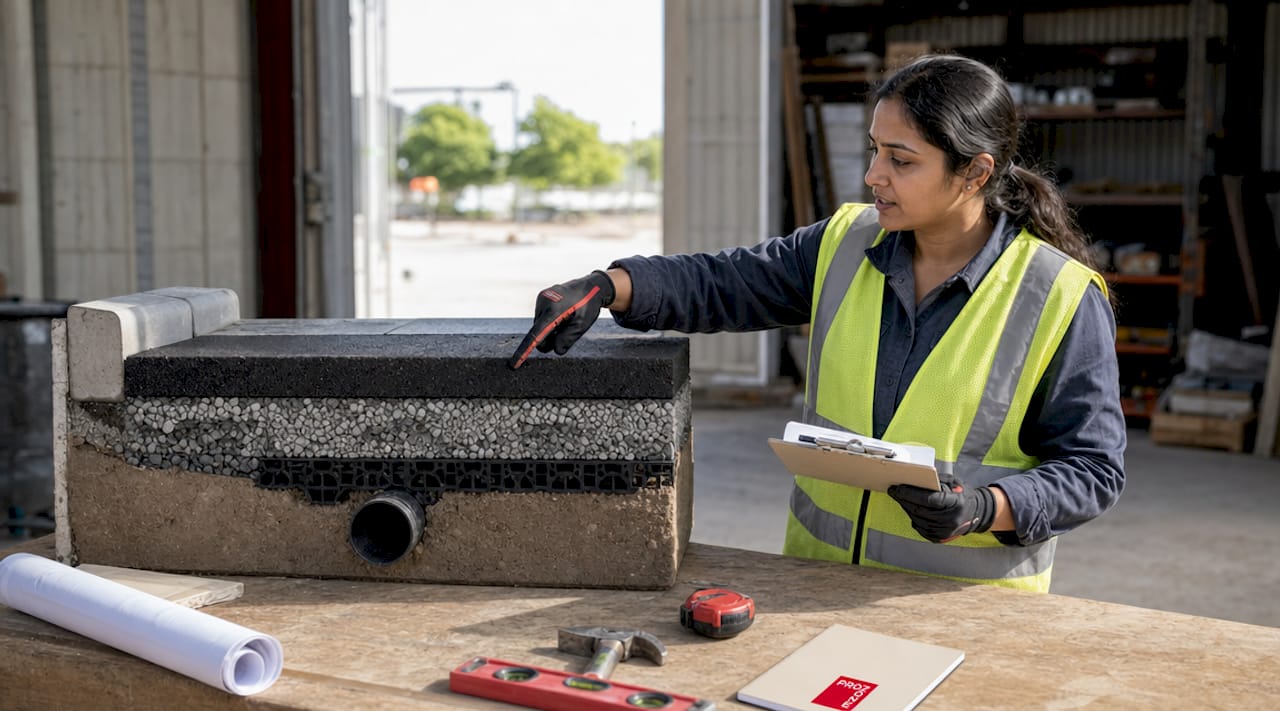
Permeable pavement functions through a layered engineering system, not simply a porous surface. The structure typically consists of four components: a permeable surface layer, a bedding course of clean aggregate, a 6 to 12 inch stone storage reservoir, and an infiltration layer that interfaces with native soil. Water passes through each layer in sequence, slowing its movement and allowing fine particles and pollutants to be filtered out before the water reaches the water table.
The comparison with traditional impervious pavement is stark. Impervious surfaces increase runoff by as much as 50% compared to permeable alternatives, placing significant stress on storm drain capacity during peak events. A 350-square-foot permeable driveway can capture over 5,600 gallons of rainwater annually, diverting it from overloaded storm drains into groundwater recharge. That volume represents a meaningful reduction in the load placed on Edmonton’s municipal stormwater network.
Underdrains are sometimes incorporated into the base layer when native soils have low permeability. In these cases, the system shifts from pure infiltration to a detention and filtration function, holding water temporarily and releasing it at a controlled rate. The Green Municipal Fund describes permeable pavement as a critical component of a broader stormwater strategy, not merely a surface material choice. This distinction matters when specifying systems for commercial sites subject to municipal stormwater bylaws.
Key performance characteristics of a well-designed permeable pavement system include:
- Runoff volume reduction of 60 to 95%, with peak flow reductions of 30 to 70%
- Pollutant filtration through physical and biological processes within the aggregate layers
- Groundwater recharge by directing clean infiltrate toward the water table
- Reduced peak stress on downstream drainage infrastructure during storm events
What types of permeable pavement are available?
Three primary materials dominate the permeable pavement market: porous asphalt, pervious concrete, and permeable interlocking concrete pavers (PICP). Each has distinct performance characteristics, cost profiles, and ideal applications.
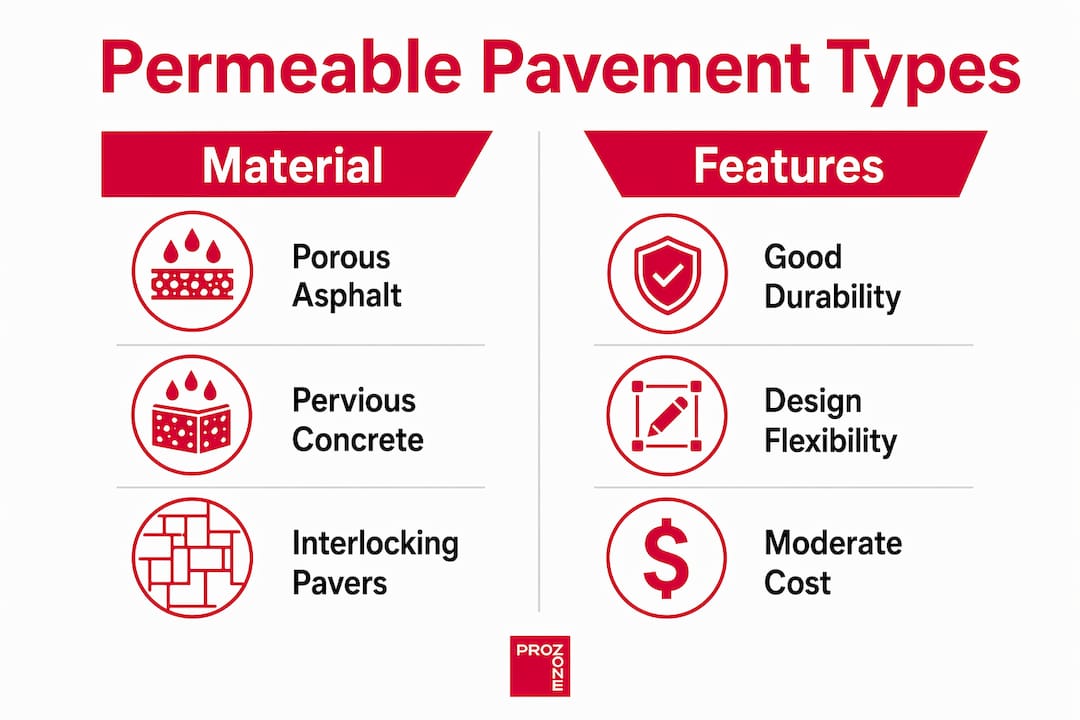
| Type | Best application | Durability | Relative cost | Maintenance |
|---|---|---|---|---|
| Porous asphalt | Parking lots, driveways | 20+ years with upkeep | Moderate | Vacuum sweeping required |
| Pervious concrete | Walkways, low-traffic areas | 20–30 years | Moderate to high | Pressure washing, sweeping |
| Permeable pavers (PICP) | Residential driveways, plazas | 25+ years | Higher upfront | Individual unit replacement |
Porous asphalt uses an open-graded mix that omits fine aggregates, creating a network of interconnected voids. It performs well in parking lots and is familiar to contractors already working with conventional asphalt. Pervious concrete achieves a similar void structure through a low water-to-cement ratio and is often preferred for pedestrian paths and light-traffic zones where a harder surface finish is desirable.
Permeable pavers offer the greatest design flexibility, available in a range of colours and patterns to complement residential or commercial aesthetics. Critically, individual units can be replaced without disturbing the surrounding installation, which simplifies repairs and reduces long-term maintenance costs. This makes PICP a popular choice for residential driveways and commercial plazas in Edmonton where freeze-thaw cycling causes periodic surface movement.
Pro Tip: Some Alberta municipalities offer stormwater fee reductions or rebate programmes for properties that install qualifying permeable pavement systems. Confirm eligibility with your local authority before finalising your material selection, as the rebate structure can influence the cost comparison between porous asphalt and PICP.
What are the benefits of permeable pavement for property owners?
The benefits of permeable pavement extend well beyond stormwater volume reduction. For property owners and developers, the system addresses several interconnected concerns: flood risk, foundation integrity, urban heat, and long-term operating costs.
Permeable pavement prevents soil subsidence in clay-rich soils by allowing moisture to infiltrate evenly beneath the surface rather than pooling at the perimeter. Uneven moisture distribution under impervious surfaces causes clay to shrink and swell cyclically, which can lead to foundation movement and cracking over time. Edmonton’s glacial till soils contain significant clay fractions, making this benefit particularly relevant for local property owners.
Urban cooling is a secondary but measurable advantage. Water evaporating from permeable surfaces cools the surrounding area, reducing the heat island effect that dark impervious pavements intensify. For commercial properties with large paved footprints, this can translate into lower cooling loads for adjacent buildings during summer months.
Permeable pavement is not just a surface material. It is a key component of a broader stormwater management strategy that balances infiltration, detention, and filtration to protect both property and public infrastructure. — Green Municipal Fund
Additional property-level benefits include:
- Reduced stormwater fees in municipalities that charge based on impervious surface area
- Compliance support for developments subject to stormwater management requirements under Alberta Environment and Protected Areas guidelines
- Improved water quality in adjacent watercourses by filtering hydrocarbons, heavy metals, and sediment before they reach the drainage network
- Lower flood risk for below-grade structures such as parkades and mechanical rooms
What should you consider during permeable pavement installation?
Installation quality determines long-term system performance more than material choice alone. Several site-specific factors must be assessed before construction begins.
- Conduct a soil permeability test. Clay soils often require underdrains to prevent waterlogging and maintain system function. Skipping this step is the most common cause of premature system failure.
- Verify site slope. Slopes between 1% and 5% are optimal for permeable pavement, balancing infiltration capacity with erosion control. Steeper grades require additional engineering measures.
- Excavate to the correct depth. The stone storage reservoir must be sized to handle the design storm event for your site. Undersized reservoirs overflow during peak events, defeating the system’s purpose.
- Install geotextile fabric correctly. Fabric placed between the storage layer and native soil prevents fine particles from migrating upward and clogging the aggregate over time.
- Specify the right surface mix. Porous asphalt and pervious concrete mixes differ from standard pavement mixes. Using a conventional mix by mistake eliminates the void structure entirely.
| Installation factor | Requirement | Consequence if ignored |
|---|---|---|
| Soil analysis | Permeability test before design | Waterlogging, system failure |
| Site slope | 1% to 5% gradient | Erosion or ponding |
| Storage reservoir depth | Sized to design storm | Overflow during peak events |
| Geotextile placement | Between aggregate and subgrade | Clogging within 3 to 5 years |
| Surface mix specification | Open-graded or pervious mix | Loss of infiltration capacity |
Maintenance is not optional once the system is installed. Routine vacuum sweeping removes sediment and debris that gradually block surface pores, and neglecting this task is the primary cause of reduced infiltration rates in ageing systems. For Edmonton properties, post-winter sweeping is particularly important because sand applied for winter traction accumulates in surface voids over the cold season.
Pro Tip: Schedule vacuum sweeping at minimum twice per year: once in spring after sand and grit from winter maintenance has accumulated, and once in autumn before freeze-up. Properties adjacent to unpaved areas or with heavy tree canopy may require quarterly service to maintain full infiltration capacity.
For a broader overview of paving processes in Edmonton, including layer specifications and material selection, ProZone’s technical resources provide region-specific guidance.
Where is permeable pavement most effectively applied?
Permeable pavement performs best in specific site contexts. Matching the system to the right application maximises both performance and return on investment.
Residential applications are the most common entry point for property owners. Driveways and walkways benefit from PICP’s aesthetic flexibility and the ability to replace individual units without full-surface reconstruction. A residential driveway in Edmonton also represents a meaningful contribution to lot-level stormwater management, particularly in older neighbourhoods where storm and sanitary sewers are combined.
Commercial parking lots represent the highest-volume application. Large impervious parking areas generate substantial runoff during rain events, and many commercial developments in Alberta are now subject to stormwater management requirements that specify maximum allowable runoff rates. Permeable parking surfaces can satisfy these requirements without the cost of constructing a separate detention pond. For guidance on commercial parking lot maintenance, including drainage-related repair considerations, ProZone’s resources address common challenges specific to Alberta conditions.
Public spaces including parks, pedestrian plazas, and trail surfaces are well-suited to pervious concrete and PICP. These surfaces handle foot traffic and light vehicle loads effectively while contributing to municipal green infrastructure targets.
Edmonton’s freeze-thaw climate introduces one additional consideration. Permeable pavement systems must be designed with frost depth in mind, as the aggregate base must extend below the frost line to prevent heave from disrupting the surface layer. Properly designed systems in Alberta have demonstrated reliable performance through multiple freeze-thaw cycles when base depths and drainage are specified correctly.
ProZone’s perspective on permeable pavement in Alberta
From ProZone’s experience working on infrastructure projects across the Edmonton region, the most consistent challenge we observe is not the technology itself but the site preparation discipline that precedes it. Permeable pavement systems are specified correctly on paper far more often than they are installed correctly in the field. The difference almost always comes down to whether a proper geotechnical assessment was completed and whether the contractor followed the layer specifications without substitution.
Regulatory pressure for sustainable stormwater solutions is increasing across Alberta municipalities, and property developers who address this proactively gain a measurable advantage in project approvals and long-term operating costs. The upfront investment in a properly designed permeable system is consistently recovered through reduced stormwater fees, lower flood remediation costs, and extended pavement service life when maintenance is maintained.
The maintenance discipline point deserves emphasis. We have assessed permeable systems less than five years old that had lost most of their infiltration capacity simply because vacuum sweeping was never scheduled. A system that costs more to install than conventional pavement and then performs no better because of neglected maintenance is a poor outcome for everyone involved. Partnering with a contractor who builds maintenance requirements into the handover documentation, and who adheres to Alberta Safety Codes throughout installation, is the most reliable way to protect that investment.
— ProZone
Work with ProZone on your permeable pavement project
ProZone Ltd. delivers permeable pavement installations across Edmonton and the surrounding region, with full adherence to Alberta Safety Codes and a multi-layer construction approach calibrated to local soil and climate conditions. Our team conducts site-specific geotechnical assessments before any design is finalised, specifying underdrain configurations, storage reservoir depths, and surface materials appropriate for Edmonton’s freeze-thaw environment. We use quality-graded aggregates and open-graded surface mixes, not standard materials substituted to reduce cost. For municipal clients and commercial developers, ProZone’s road construction services include permeable pavement as part of a complete stormwater management solution. Contact ProZone directly for a free estimate or to discuss your site requirements.
FAQ
What is permeable pavement?
Permeable pavement is a paving system designed to allow water to infiltrate through its surface into a structured aggregate base, reducing stormwater runoff and supporting groundwater recharge. It differs from conventional pavement, which sheds water as surface runoff into storm drains.
How much runoff does permeable pavement reduce?
Permeable pavement systems can reduce surface runoff by 60 to 95% and peak flows by 30 to 70%, depending on design and site conditions. Systems without underdrains in well-draining soils achieve the highest reduction rates.
What types of permeable pavement are best for Edmonton?
Permeable interlocking concrete pavers (PICP) and porous asphalt are both well-suited to Edmonton’s freeze-thaw climate when the base is designed to extend below the frost line. PICP offers additional flexibility because individual units can be replaced without full-surface reconstruction.
How often does permeable pavement need maintenance?
Vacuum sweeping at least twice per year is the minimum maintenance requirement to prevent pore clogging from sediment and debris. In Edmonton, post-winter sweeping is particularly important to remove sand and grit deposited during winter traction maintenance.
Does permeable pavement work in clay soils?
Permeable pavement can function in clay soils, but underdrains are required to prevent waterlogging and convert the system from a pure infiltration design to a detention and filtration function. A soil permeability test before design is non-negotiable on clay-heavy sites.