
TL;DR:
- Selecting landscape materials that match Alberta’s freeze-thaw climate, project needs, and installation methods ensures long-term durability. Proper base and soil specifications are critical; failure to specify these correctly often leads to costly repairs and premature failure. Using low water absorption, flexible, and well-drained materials like interlocking pavers and engineered retaining wall blocks enhances resilience against frost damage.
Correct landscape material selection is defined as matching each material’s physical properties to the project’s function, Alberta’s freeze-thaw climate, and the installation method required for long-term performance. Choosing the wrong product — even a visually appealing one — leads to base failures, frost heave, and costly repairs within two to three seasons. This guide covers how to identify project needs, specify soils and aggregates, choose winter-proof hardscape products, and incorporate permeable materials for drainage. Property managers, contractors, and homeowners across Edmonton and the surrounding region will find concrete specifications and ordering guidance throughout.
How to use a landscape material selection guide for your project type
Material requirements vary significantly depending on whether you are building a driveway, a garden bed, a patio, or a drainage feature. Treating all projects as interchangeable leads to under-specified bases and premature surface failures. The first step is to distinguish between softscape needs (planting areas, lawn, garden beds) and hardscape needs (driveways, patios, retaining walls, pathways).
Common project types and their primary material requirements break down as follows:
- Garden beds and planting areas: Screened topsoil or garden mix soil, free of stones and roots, with adequate organic content for root development.
- Driveways and pathways: 25mm road crush gravel as the compacted base layer, with a finished surface of asphalt, concrete, or compacted gravel.
- Patios and paver installations: 5mm washed sand as the bedding layer, set over a compacted 25mm road crush base.
- Play areas: 10mm washed round rock or rubber mulch for impact absorption and drainage.
- Dry riverbeds and drainage features: 40mm washed round rock or Class 1M limestone for water flow and visual appeal.
Project-specific material matching is the foundation of every successful Alberta landscape installation. Skipping this step and ordering generic fill or unscreened soil creates problems that are expensive to correct after installation.
Accurate measurement is equally critical. Calculate the volume of each zone in cubic metres, then add 10 to 15 percent to account for compaction and settling. Ordering short means a second delivery charge and potential delays; ordering excess by a small margin is far more cost-effective.
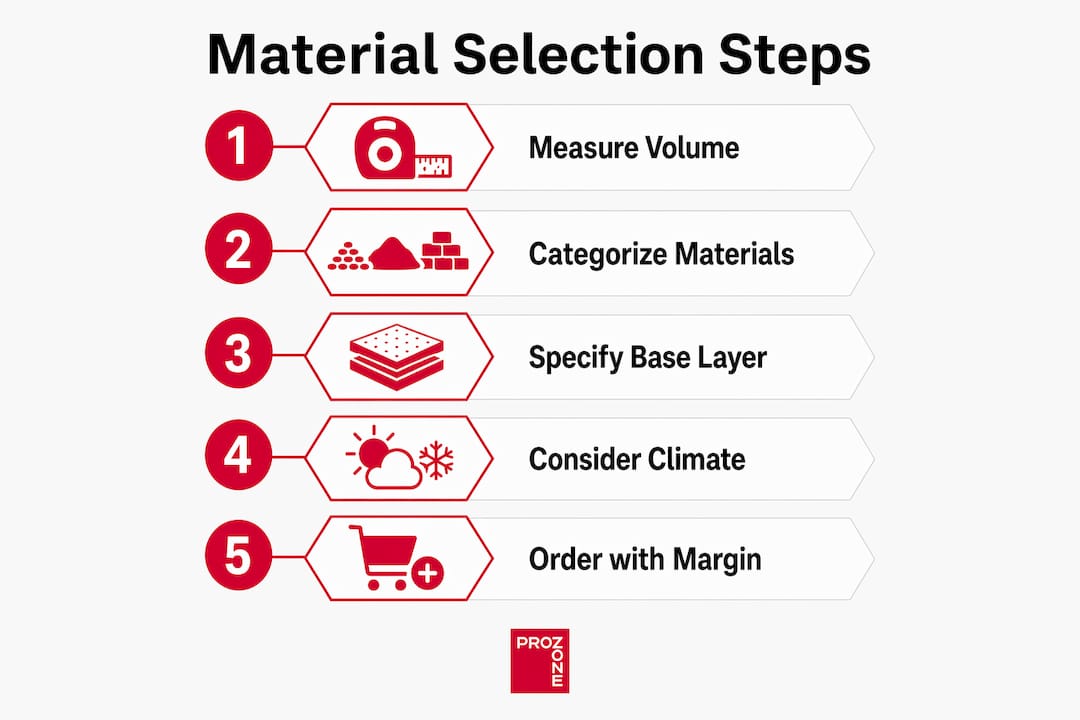
Pro Tip: When ordering multiple material types for a single project, group your measurements by material category and confirm each specification in writing with your supplier before delivery. This prevents substitutions that compromise performance.
What makes a landscape material suitable for Alberta’s freeze-thaw climate?
Alberta’s climate subjects outdoor surfaces to repeated freeze-thaw cycles, with Edmonton averaging temperatures that swing well below zero in winter and above 25°C in summer. Materials that absorb water and lack structural flexibility crack, heave, and delaminate under these conditions. Winter-proof materials for Alberta projects share three characteristics: low water absorption, structural integrity under load, and compatibility with a properly drained base system.
The most reliable choices for Alberta hardscape installations include:
- Interlocking concrete pavers: Individual units flex slightly with ground movement, reducing cracking compared to monolithic poured concrete slabs.
- Engineered retaining wall blocks: Manufactured to precise tolerances, these resist freeze-thaw degradation better than natural fieldstone stacked without mortar.
- Crushed gravel bases (25mm road crush): Compacted gravel drains freely and resists frost heave by preventing water accumulation beneath surfaces.
- Decorative rock for ground cover: Angular crushed stone or river rock outperforms bark mulch in Alberta winters. Bark mulch retains moisture, compresses under snow loads, and decomposes, requiring annual top-up. Decorative rock is permanent and does not harbour the moisture that accelerates frost damage.
The base system beneath any surface is as important as the surface material itself. Inadequate drainage and base layers cause the majority of hardscape failures in Alberta, not the surface product. A minimum 150mm compacted gravel base under patios and driveways, combined with a geotextile separation layer, prevents fine soil particles from migrating upward into the aggregate and compromising drainage.
Selecting only the visible surface material without specifying the base system is the single most common and costly mistake in Alberta landscape projects. The surface is what you see; the base is what determines whether it lasts five years or twenty-five.
Pro Tip: Specify the base layer depth and material in your project documentation before ordering surface materials. A 150mm compacted road crush base under pavers is not optional in Edmonton’s climate. It is the minimum standard for a surface that will not heave within two winters.
How to select soils and aggregates for planting and hardscape foundations
Soil and aggregate specifications directly determine plant health and structural durability. Vague ordering language like “topsoil” or “fill” produces inconsistent results because suppliers interpret these terms differently. Precise specification language prevents substitutions that lead to poor root establishment, uneven settling, and failed installations.
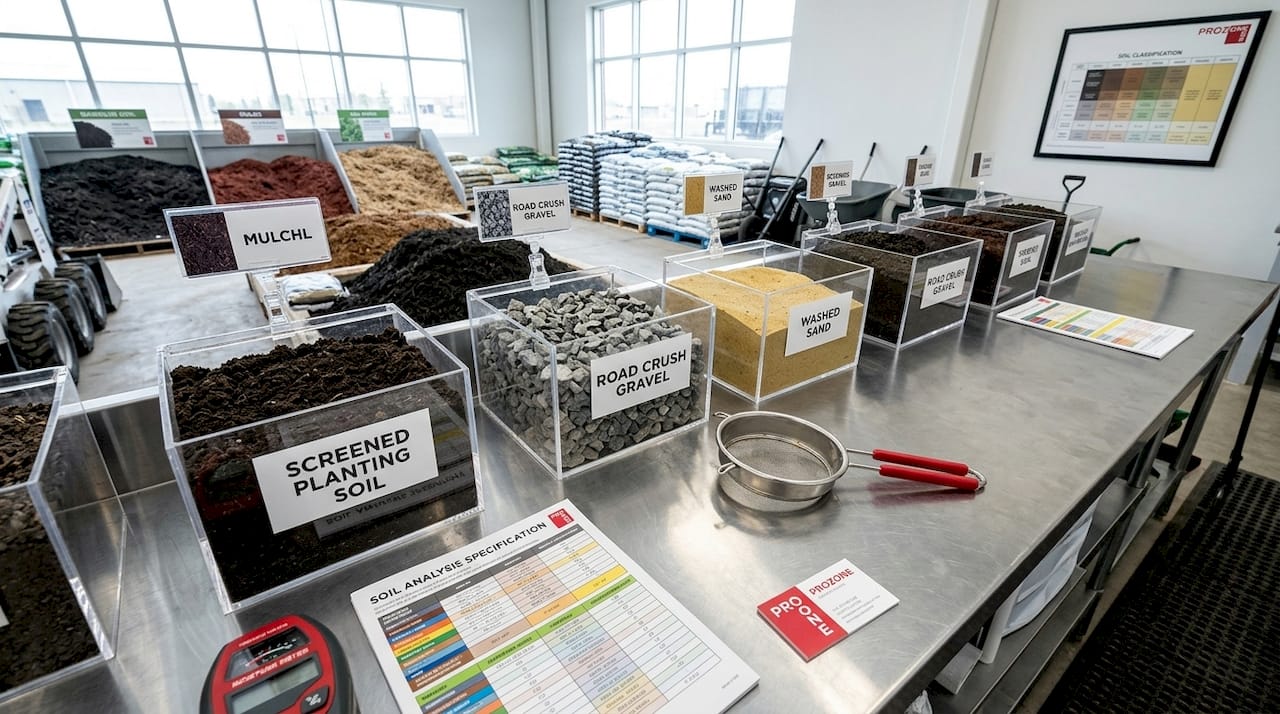
The University of Toronto’s landscape design standard defines acceptable planting soil as screened, triple mix, weed-free, friable natural loam, free of stones, roots, lumps, and other solid material. This standard applies directly to Alberta planting projects. Using screened topsoil that meets this specification reduces the risk of compaction, drainage failure, and weed pressure in garden beds and sod installations.
The table below compares the most common aggregates used in Alberta landscape projects:
| Material | Typical application | Key specification | Notes |
|---|---|---|---|
| 25mm road crush gravel | Driveways, pathway bases, paver sub-base | Angular, compactable | Drains freely; resists frost heave |
| 5mm washed sand | Bedding layer under pavers | Clean, free of fines | Levels surface; allows minor adjustment |
| 10mm washed round rock | Play areas, paver joints | Rounded, washed | Comfortable underfoot; good drainage |
| 40mm washed round rock | Dry riverbeds, drainage swales | Rounded, washed | Handles high water flow |
| Class 1M limestone | Drainage features, decorative edging | Angular, durable | Long-lasting; low maintenance |
| Decorative crushed stone | Ground cover, garden borders | Various colours | Permanent; no annual replacement |
Balancing aesthetics with function is straightforward when you start with the functional requirement and then select the most visually appealing product within that category. Washed sand and road crush gravel serve structural roles; decorative rock and limestone serve both structural and visual roles depending on placement.
Pro Tip: Order aggregate volumes in cubic metres and add 15 percent for compaction loss. A 100mm compacted base layer requires approximately 120mm of loose material before compaction. Suppliers who quote in tonnes rather than cubic metres should provide a conversion factor specific to the material’s bulk density.
How to incorporate permeable and engineered materials for drainage
Permeable materials manage stormwater at the source by allowing water to infiltrate through the surface rather than running off into municipal drainage systems. For Alberta properties subject to heavy spring melt and summer storm events, this is a practical performance advantage, not just an environmental preference.
Pervious concrete is a porous pavement option that allows water to pass through the surface into a gravel storage bed below. It performs well in Alberta when installed correctly, with a properly designed sub-base that accounts for freeze-thaw cycling. The critical difference between pervious concrete and traditional concrete is that pervious concrete relies on void space for drainage. That void space must be protected from sediment accumulation through regular maintenance.
Geotextile fabrics are a separate category from weed barrier fabric, and the distinction matters. Geotextile fabric provides mechanical strength, soil separation, and controlled filtration drainage. Weed fabric is a thin, low-strength product designed only to suppress plant growth. Using weed fabric in place of geotextile under a gravel driveway or paver base will result in fabric breakdown and soil migration within a few seasons.
Key considerations when specifying permeable and engineered materials:
- Pervious concrete requires a minimum 300mm granular sub-base in Alberta to buffer freeze-thaw movement.
- Geotextile fabric should be specified by weight (grams per square metre) and filtration rating, not by brand or generic description.
- Maintenance plans for permeable surfaces must be documented at the design stage. Sediment accumulation in pervious concrete voids reduces infiltration capacity and can render the surface functionally equivalent to standard concrete within three to five years without regular vacuuming or pressure washing.
- Locally sourced gravel and stone reduce transport emissions and are generally well-matched to Alberta’s geological conditions. Local material sourcing also simplifies reordering for repairs or extensions.
The combination of a correctly specified geotextile layer, a well-graded aggregate base, and a permeable or semi-permeable surface creates a drainage system that manages both stormwater and frost pressure simultaneously.
Why material sustainability means more than low-carbon claims
After working on landscape projects across Edmonton and the surrounding region, the clearest lesson is that material sustainability is not a single-variable decision. A low-carbon material installed incorrectly, by a contractor without the skills to compact it properly or comply with Alberta Safety Codes, will fail faster than a conventional product installed by a qualified team.
The most durable projects ProZone has observed share a consistent pattern: the material specification, the installation method, and the contractor’s capability were all aligned from the start. When one of those three elements is mismatched, the material takes the blame, but the real failure is in the planning. Specifying interlocking pavers without specifying the correct base depth, or ordering screened topsoil without confirming it meets friable loam standards, produces the same outcome as ordering the wrong product entirely.
Local sourcing is worth prioritising where it makes sense. Alberta-sourced aggregates are generally well-suited to Alberta conditions, and shorter supply chains reduce the risk of substitutions during delivery. Reclaimed materials can work well in low-traffic decorative applications, but they require more careful maintenance planning, particularly for surfaces that need periodic pressure washing.
The practical takeaway is this: choose materials that match your climate, your project type, and your maintenance capacity. A material that performs well for twenty years with minimal upkeep is more sustainable than a low-emission product that requires replacement in five.
How ProZone supports Alberta landscape material projects
ProZone supplies and installs premium landscape materials across Edmonton and the surrounding Alberta region, working with property managers, contractors, and homeowners on projects that range from residential garden installations to large-scale commercial hardscape builds. Every material ProZone supplies meets Alberta Safety Codes standards, and the team provides specification guidance to help clients order correctly the first time.
For commercial landscaping materials and residential supply, ProZone offers screened topsoil, road crush gravel, washed aggregates, decorative rock, and installation support tailored to Alberta’s freeze-thaw conditions. Clients can request a free estimate through the online form at prozoneltd.ca/contact or call directly to discuss project specifications. ProZone’s team reviews each project’s material requirements before delivery to confirm specifications match the intended application, reducing the risk of costly substitutions or under-specified bases.
FAQ
What is the best base material for patios in Alberta?
25mm road crush gravel, compacted to a minimum depth of 150mm, is the standard base for patio and paver installations in Alberta. This depth accommodates freeze-thaw movement and provides free drainage that prevents frost heave.
How do I specify landscape soil to avoid poor results?
Order soil described as screened, triple mix, weed-free, friable natural loam, free of stones and roots. This specification language, aligned with the University of Toronto landscape standard, prevents suppliers from substituting unscreened fill or compacted clay.
Is pervious concrete suitable for Alberta driveways?
Pervious concrete works in Alberta when installed with a minimum 300mm granular sub-base and a documented maintenance plan. Without regular sediment removal, void spaces fill and the surface loses its drainage function within a few years.
What is the difference between geotextile fabric and weed barrier?
Geotextile fabric provides mechanical strength, soil separation, and controlled filtration drainage. Weed barrier is a thin, low-strength product designed only for plant suppression and is not suitable for use under driveways, patios, or gravel bases.
Which ground cover material performs best through Alberta winters?
Decorative rock and crushed stone outperform bark mulch in Alberta winters. Bark mulch retains moisture, compresses under snow, and decomposes annually. Decorative landscape stones are permanent, drain freely, and require no seasonal replacement.