
TL;DR:
- Preventative property maintenance involves scheduled inspections and servicing to preempt failures, reducing repair costs. Edmonton’s climate necessitates tailored schedules addressing freeze-thaw damage, extended heating, and heavy snow loads, with detailed records essential for effective management. ProZone offers certified services supporting these strategies, emphasizing the importance of disciplined record-keeping and seasonal adjustment.
Preventative maintenance for properties is a scheduled programme of planned inspections and servicing designed to identify and address potential failures before they occur. In property management, this practice is also called planned preventive maintenance (PPM), and the two terms are used interchangeably throughout this guide. Active maintenance programmes reduce repair spending by 40–60% over ten years by eliminating emergency repairs and deferred damage. For Edmonton property owners and managers, where freeze-thaw cycles and extended heating seasons place extraordinary stress on building systems, a structured approach to preventative property care is not optional. It is the foundation of responsible asset management.
How to build a preventative maintenance schedule for your property
A planned calendar of recurring tasks is the operational core of any preventive maintenance programme. The schedule replaces reactive repairs with planned work orders, so your team addresses wear before it becomes failure. Building one correctly starts with two steps: a complete asset inventory and a condition assessment of each system.
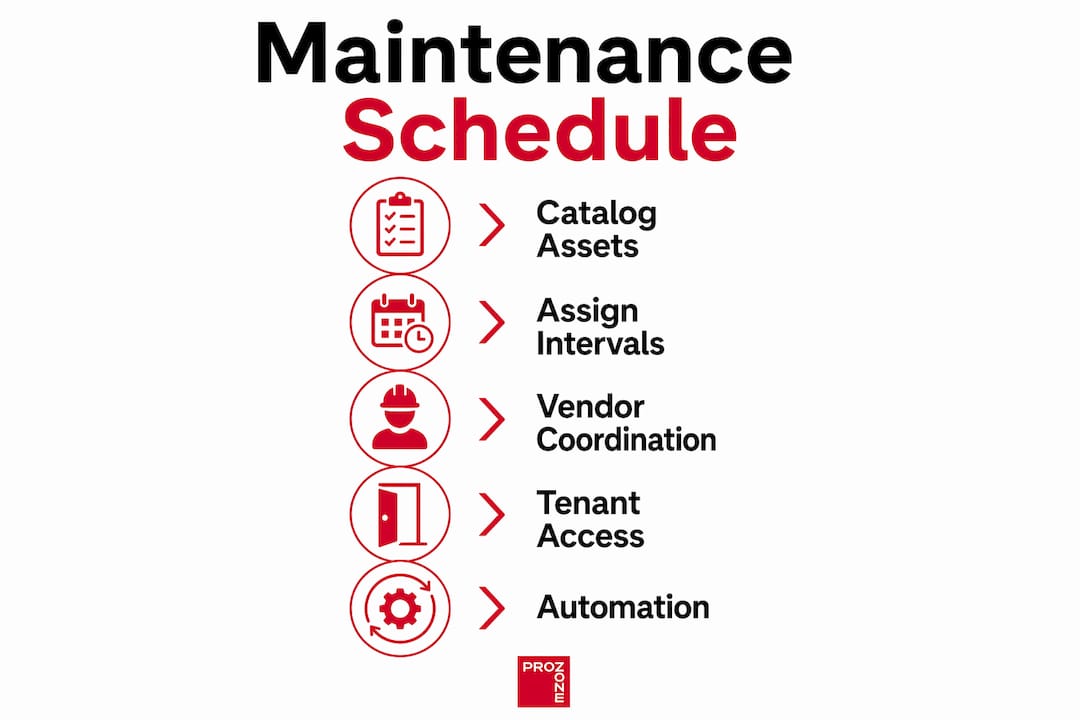
Begin by cataloguing every major system in your property: HVAC equipment, plumbing, electrical panels, roofing, building envelope, safety devices, and exterior surfaces. Record the age, last service date, and known condition of each asset. This data determines your inspection intervals. A ten-year-old furnace in an Edmonton property running through a nine-month heating season needs more frequent attention than a two-year-old unit in a mild climate.
Once your inventory is complete, assign maintenance intervals based on three factors: asset age, manufacturer recommendations, and local climate demands. Tailoring schedules to system condition and local weather produces far better results than applying a generic national template. For Edmonton properties specifically, furnace filter changes every one to three months during heating season and CO detector testing every six months are standard intervals, not optional extras.
Vendor coordination and tenant access protocols belong in the schedule from the start. Unplanned access requests delay work and create friction with tenants. Build access windows into your recurring work orders and communicate them in advance.
Pro Tip: Automate your recurring work orders using a maintenance management platform. Automated recurring tasks reduce missed deadlines and remove the reliance on individual memory or manual reminders.
What belongs on a property maintenance checklist for Edmonton?
A property maintenance checklist organises tasks by system and season, making it practical to assign, track, and verify completion. The table below outlines the core systems, recommended tasks, and suggested frequencies for Edmonton properties.
| System | Key tasks | Frequency |
|---|---|---|
| HVAC | Filter replacement, furnace tune-up, AC prep, ventilation checks | Filters: 1–3 months; tune-up: annually |
| Plumbing | Leak inspections, water heater flushing, sump pump testing | Quarterly to annually |
| Safety equipment | Smoke and CO detector testing, fire alarm inspections | Every 6 months minimum |
| Building envelope | Caulking, window and door seal checks, gutter cleaning | Seasonally (spring and fall) |
| Exterior and landscaping | Concrete and asphalt inspection, drainage checks, snow removal | Seasonally and after major weather events |
Beyond the table, several tasks deserve specific attention for Edmonton’s conditions:
- HVAC: Schedule furnace start-up inspections every fall before the first hard frost. Many costly HVAC failures occur at seasonal restart points when systems are pushed back into full operation after summer dormancy.
- Plumbing: Test sump pumps each spring before snowmelt peaks. Flush water heaters annually to remove sediment that reduces efficiency and shortens equipment life.
- Safety equipment: Alberta’s Residential Tenancies Act requires landlords to maintain heating, plumbing, electrical, and safety systems. Smoke and CO detector testing is both a legal obligation and a life-safety requirement.
- Building envelope: Inspect caulking around windows, doors, and penetrations each fall. Failed seals allow moisture intrusion that accelerates interior damage through the freeze-thaw cycle.
- Exterior surfaces: Concrete walkways, asphalt parking areas, and retaining structures require post-winter inspection. Refer to ProZone’s guide on maintaining concrete surfaces for a detailed approach to managing freeze-thaw deterioration.
How to monitor, document, and adjust your maintenance programme
Maintenance records are the operational memory of your property. Good maintenance history improves troubleshooting speed, supports service prioritisation, and reduces the cost of emergency response by giving contractors prior context before they arrive on site. Without records, every service call starts from zero.
A structured monitoring approach follows four steps:
- Assign and document every task. Each work order should record the asset, task performed, technician, date, and any findings. Standardised documentation makes records searchable and auditable.
- Track completion rates. Review open and overdue work orders weekly. Persistent gaps in a specific system signal either an interval that is too long or an asset approaching end of life.
- Analyse emergency repair trends. If a system generates repeated emergency calls between scheduled services, shorten the inspection interval. Shifting repair timing to earlier intervention prevents compounding damage and reduces total lifecycle costs.
- Coordinate with certified contractors. Professional service providers like ProZone supply written service reports that integrate directly into your maintenance records. This documentation also supports compliance with Alberta Safety Codes and habitability standards under the Residential Tenancies Act.
Pro Tip: Review your maintenance programme annually. Compare emergency repair costs year over year. A well-calibrated programme should show a measurable decline in unplanned repair spending within the first two years.
Digital platforms such as Buildium, AppFolio, or Yardi Voyager all offer work order modules that support centralised preventative scheduling with standardised asset documentation. The specific platform matters less than consistent use of whichever system you choose.
How Edmonton’s climate shapes your maintenance strategy
Edmonton’s climate is one of the most demanding in Canada for property assets. The city experiences temperature swings of more than 60°C between summer highs and winter lows, and the freeze-thaw transition periods in spring and fall are particularly destructive to building materials.
Freeze-thaw damage is a leading cause of façade and concrete deterioration in Edmonton. Water penetrates micro-cracks in masonry, concrete, and caulking, then expands as it freezes, widening the crack with each cycle. Neglected façade deterioration can cost five to ten times more to repair than early intervention. Seasonal inspections in October and April are the minimum standard for any multi-storey or commercial property.
The extended heating season, which runs from roughly September through April, places sustained demand on HVAC systems. Edmonton-specific HVAC maintenance requires filter changes every one to three months during this period, not the standard three-to-six-month interval recommended for milder climates. A clogged filter forces the furnace to work harder, increasing energy consumption and accelerating component wear.
Snow accumulation creates two distinct risks: roof load stress and blocked drainage. Flat or low-slope roofs on commercial and multifamily properties require snow removal after significant accumulation events. Gutters and downspouts must be clear before spring melt to prevent ice damming and water intrusion at the roofline.
Edmonton property managers who treat their maintenance schedule as a seasonal engineering exercise, rather than a generic annual checklist, consistently outperform those who apply national templates. The city’s climate demands that fall and spring be treated as critical system transition points, not just calendar markers.
Pipe freeze prevention is a specific winter risk. Hose bibs (exterior water taps) must be shut off and drained before the first frost. Pipes in unheated spaces such as parkades, crawl spaces, and exterior walls require insulation checks each fall. A single burst pipe in a commercial property can cause tens of thousands of dollars in water damage within hours.
What experience with Edmonton properties has taught us about preventative care
The most common failure mode in property maintenance programmes is not neglect. It is inconsistency. Property managers who conduct thorough spring and fall inspections but skip the quarterly mechanical checks accumulate deferred maintenance that surfaces as expensive failures in the worst possible season, typically mid-January when HVAC demand peaks.
The second most common failure is poor documentation. Without service records, contractors repeat diagnostic work that was already completed, tenants report the same issues multiple times, and compliance audits become stressful exercises in reconstruction. Detailed records are not administrative overhead. They are a direct cost-reduction tool.
ProZone’s experience working with Edmonton commercial and municipal properties confirms that the properties with the lowest emergency repair rates share two characteristics: they use certified contractors who follow Alberta Safety Codes, and they maintain written service histories for every asset. The combination of professional standards and disciplined record-keeping produces measurably better outcomes than either practice alone.
The long-term return on investment from preventative property care is well-documented. Shifting from reactive to planned maintenance does not eliminate maintenance costs. It changes their timing, making them predictable, budgetable, and significantly lower in total value over a ten-year horizon.
— ProZone
How ProZone supports Edmonton property maintenance programmes
ProZone provides certified construction and infrastructure maintenance services across Edmonton and the surrounding Alberta region, with direct relevance to the exterior and structural components of any preventative maintenance programme. Services include concrete and asphalt inspection and repair, earthworks, snow removal, and exterior landscaping supply, all delivered in compliance with Alberta Safety Codes and quality standards. ProZone’s service documentation integrates directly into your maintenance records, supporting both compliance and cost tracking. For a full overview of available services, visit ProZone’s construction services for Edmonton property managers. Contact ProZone through the online form at prozoneltd.ca or call directly to request a free maintenance programme estimate tailored to your property portfolio.
FAQ
What is preventative maintenance for properties?
Preventative maintenance for properties is a planned programme of scheduled inspections and servicing tasks designed to address wear and potential failures before they occur. It replaces reactive repairs with recurring work orders tied to specific assets, intervals, and compliance requirements.
How often should property maintenance tasks be completed?
Frequency depends on the system and asset age. A three-layer cadence of monthly tenant-facing checks, quarterly mechanical servicing, and annual life-safety evaluations covers most multifamily and commercial properties effectively.
What are the legal maintenance obligations for Alberta landlords?
Alberta’s Residential Tenancies Act requires landlords to maintain heating, plumbing, electrical, and safety systems in habitable condition. Failure to comply exposes landlords to tenant remedies and regulatory penalties.
Why does Edmonton’s climate require a different maintenance approach?
Edmonton’s freeze-thaw cycles, extended heating season, and heavy snow loads place greater stress on HVAC systems, building envelopes, and exterior surfaces than most Canadian cities. Seasonal engineering of maintenance schedules at fall and spring transition points is the standard practice for properties in this region.
How do maintenance records reduce repair costs?
Detailed service records give contractors prior context before each visit, reducing diagnostic time and repeat inspections. They also allow managers to identify recurring failure patterns and adjust maintenance intervals before emergency repairs occur.