
TL;DR:
- Choosing the right landscaping service is essential to enhance property value, reduce long-term costs, and meet specific outdoor goals in Edmonton. Full-service landscaping offers comprehensive design and installation, while maintenance-only preserves established landscapes, and specialty services target specific improvements; understanding your property’s needs guides the best choice. Strategic investments in landscaping can simplify maintenance and increase appeal, emphasizing the importance of tailored solutions and expert guidance in property management.
Choosing the wrong landscaping service doesn’t just hurt curb appeal. It wastes budget, creates ongoing headaches, and can leave your property looking neglected through Edmonton’s short but demanding outdoor season. Whether you manage a commercial complex, own a retail property, or simply want your home’s exterior to work harder for you, the landscaping decisions you make now will shape the experience, value, and maintenance load for years ahead. This guide walks through every major service category, compares your options clearly, and helps you match the right solution to your specific property goals.
Table of Contents
- How to evaluate landscaping service needs
- Overview of full-service landscaping
- Maintenance-only landscaping services
- Landscape enhancement and specialty services
- Comparing landscaping service options
- What most property managers miss about landscaping decisions
- Discover trusted landscaping and construction solutions in Edmonton
- Frequently asked questions
Key Takeaways
| Point | Details |
|---|---|
| Match service to property | Choosing between full-service, maintenance-only, or specialty landscaping depends on your property’s goals and conditions. |
| Maintenance contracts rising | Edmonton landscaping maintenance contracts have increased in value, reflecting strong demand. |
| Enhancements add value | Specialty and enhancement services can boost property aesthetics, function, and long-term savings. |
| Upfront vs. ongoing costs | Full-service redesign requires higher initial investment, while maintenance-only keeps ongoing costs predictable. |
| Strategic investment pays off | Combine thoughtful selection with professional support for maximum landscape ROI. |
How to evaluate landscaping service needs
Let’s start by clarifying how to match landscaping services to your property requirements.
Before you call a single provider, it pays to do a quick internal audit of what your property actually needs. The single biggest mistake property managers make is calling landscapers without a clear idea of what success looks like. Are you trying to improve first impressions? Reduce safety hazards from overgrown plants? Add usable outdoor space? Each goal points to a different type of service.
Start by looking at four core factors:
- Property goals: Do you want to improve curb appeal, create usable outdoor space, address safety concerns like poor visibility or trip hazards, or simply maintain what already exists?
- Maintenance frequency: How often does your property need attention? Weekly mowing and trimming? Monthly seasonal cleanups? One-time redesign followed by minimal upkeep?
- Budget and timeline: Are you planning a multi-phase transformation over two or three seasons, or do you need results fast on a fixed budget?
- Existing landscape conditions: Is your current landscape in good shape, partially outdated, or completely undeveloped?
The answers to these questions determine whether you need full-service landscaping, a basic maintenance contract, or targeted specialty enhancements. Understanding the difference between these categories is the foundation of any smart landscaping decision.
As the distinction is clearly framed in industry resources, full-service vs. maintenance landscaping involves entirely different scopes: full-service encompasses design through installation and ongoing care, while maintenance-only focuses strictly on upkeep of existing landscapes without design changes or major construction.
Pro Tip: Before contacting any provider, walk your property and write down exactly what bothers you and what you wish existed. A five-minute notes list can save hours of back-and-forth with contractors and helps you compare quotes accurately.
For commercial properties specifically, reviewing commercial landscaping tips before starting your search gives you a benchmark for what professional results look like in the Edmonton market.
Overview of full-service landscaping
Once you’ve assessed your needs, the first major option is full-service landscaping.
Full-service landscaping is the most involved option. Think of it as a complete outdoor renovation. It typically covers everything from initial design and site preparation through hardscape installation, planting, irrigation setup, and ongoing seasonal care. It’s the right choice when a property needs significant visual or functional improvement, not just routine upkeep.
Here’s what full-service typically includes:
- Landscape design: Site analysis, plant selection, layout planning, and visual renders of the final result
- Hardscape installation: Pathways, patios, retaining walls, edging, and other structural outdoor elements
- Irrigation systems: Installation or upgrade of sprinkler and drip systems to support plant health
- Planting and grading: Installation of trees, shrubs, ground cover, and lawn, including soil grading and drainage work
- Ongoing maintenance: Seasonal cleanup, fertilization, and care programs once the landscape is established
This approach makes the most sense for new builds, major property upgrades, commercial spaces making a brand impression, or any situation where the existing outdoor area is either bare or significantly run down. As noted in resources on garden design approaches, thoughtful plant placement and structural elements work together to create outdoor spaces that function and look intentional year-round.
Full-service landscaping requires an upfront investment, and that’s where many property managers hesitate. But it’s worth understanding what you’re buying. A well-designed landscape reduces long-term maintenance costs, improves drainage, supports plant health from day one, and often increases assessed property value. You’re not just paying for plants. You’re paying for a system.
When planning a full-service project, sourcing quality materials matters as much as skilled labor. Reviewing landscaping materials options gives you a realistic sense of what goes into high-quality installations in Alberta’s climate.
Full-service landscaping offers comprehensive transformation but comes with higher upfront cost. The investment pays off best when tied to clear goals, a structured timeline, and a provider experienced with Edmonton’s climate.
The providers that deliver full-service landscaping are project managers as much as they are horticulturalists. Expect project timelines, phased billing, and ongoing communication. If a provider can’t explain their design rationale or material choices, that’s a red flag.
Maintenance-only landscaping services
For properties with mature landscapes, maintenance-only services may be the practical choice.
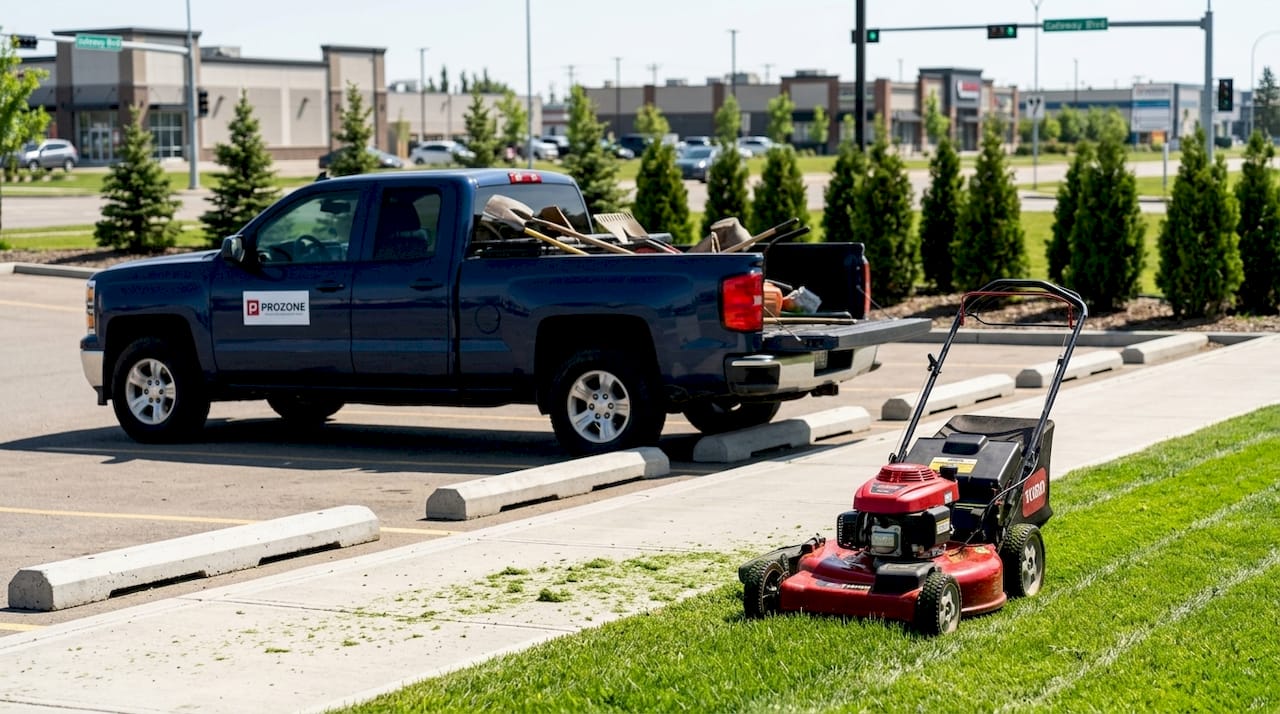
Maintenance-only landscaping is exactly what it sounds like. You already have a functioning, established outdoor space, and the goal is to keep it looking that way. There’s no design phase, no major construction, and no significant plant installation. This type of contract focuses entirely on recurring tasks that preserve the existing landscape.
Typical services covered under a maintenance-only contract include:
- Mowing and trimming: Regular lawn cutting and edging along walkways and beds
- Fertilization and weed control: Scheduled applications to keep lawns dense and healthy
- Seasonal cleanups: Spring and fall services to clear debris, cut back perennials, and prep for the next season
- Pruning and deadheading: Ongoing care for shrubs, hedges, and flowering plants
- Irrigation checks: Monitoring sprinkler systems for leaks or coverage issues
These contracts are usually structured around a fixed service schedule, weekly or biweekly in the growing season, with reduced frequency during shoulder months. For property managers overseeing multiple sites, the predictability of a maintenance contract simplifies budgeting and reduces the need for constant vendor coordination.
The landscaping industry has seen growing demand for these contracts. Maintenance contract values increased 9% from 2023 to 2024, signaling that property owners are increasingly recognizing the long-term value of regular professional care over reactive fixes.
Maintenance-only service is also where Edmonton’s seasonal rhythms matter most. The window for active landscaping work runs roughly from late April to October. Getting locked into a peak-season contract late often means reduced availability and higher rates, especially for commercial properties that need consistent service across the full season.
Understanding how a maintenance workflow operates helps property managers set realistic expectations and communicate clearly with providers. The best maintenance contracts define response times, escalation procedures for issues, and end-of-season deliverables.
Pro Tip: Book your maintenance contract in late winter. Providers are more flexible on scheduling and pricing before the spring rush starts, and you’ll secure the time slots that work best for your property’s visibility and usage patterns.
For properties across Edmonton that need year-round attention, pairing landscaping care with a broader property maintenance strategy ensures no gaps between seasons.
Full-service vs. maintenance landscaping represents a genuine fork in the road. One transforms, the other preserves. Knowing which your property needs prevents costly mismatches.
Landscape enhancement and specialty services
Beyond core services, many properties benefit from select enhancement or specialty offerings.
Enhancement and specialty services sit between full redesign and basic maintenance. These are targeted upgrades or specialized treatments that address specific needs without requiring a full landscape overhaul. For property managers who want to add meaningful value without committing to a major project, this category is worth exploring carefully.
Here are the most common enhancement and specialty services worth considering in Edmonton:
- Landscape lighting: Low-voltage LED systems for pathways, accent lighting on trees and architecture, and safety lighting near entrances improve security and extend the usable hours of outdoor spaces.
- Water features: Small fountains, decorative ponds, or rain garden systems add visual interest and can support drainage management on properties with standing water issues.
- Eco-friendly upgrades: Native plant installation, xeriscaping (low-water landscaping), and organic fertilization programs reduce resource use and lower long-term maintenance costs significantly.
- Pest and disease management: Targeted treatments for common Edmonton landscape threats including aphids, grubs, and fungal issues protect plant investments before damage spreads.
- Seasonal color programs: Rotating annual flower installations managed by a provider keep commercial properties looking fresh and intentional through each season.
- Winter-durability upgrades: Mulching, anti-desiccant sprays for evergreens, and strategic windbreak plantings protect landscape investments through Alberta’s harsh winters.
- Wildlife-friendly features: Bird-friendly shrubs, pollinator gardens, and bat boxes are increasingly popular in residential and municipal properties looking to support biodiversity.
According to industry benchmark data, residential landscaping accounts for over 60% of market share, and properties investing in specialty enhancements often generate stronger returns on that investment compared to standard maintenance contracts alone.
For Edmonton properties specifically, the combination of extreme temperature swings, clay-heavy soils, and short growing seasons makes specialty solutions more valuable than in milder climates. A drought-tolerant native planting, for example, doesn’t just look good in July. It survives August heat stress, holds up through October frosts, and requires significantly less irrigation than conventional plantings.
When evaluating which enhancements fit your property, start with the elements that address real problems first. Lighting near hazardous walkways, drainage improvements in low-lying areas, or pest management on high-visibility hedges deliver measurable value. Decorative features come second.
Pro Tip: Ask your landscaping provider specifically about sustainable solutions suited to Alberta’s climate. Providers experienced with local conditions can recommend species and systems that reduce watering costs, fertilizer use, and annual replacement costs over time.
For projects involving physical installation of specialty materials, reviewing material installation guidance helps you understand quality standards and what to expect from a professional install.
Comparing landscaping service options
To simplify decisions, here’s a direct comparison of the main service categories.
Choosing between service types comes down to scope, budget, and what your property’s outdoor space currently looks like. The table below makes the key trade-offs visible at a glance.
| Service type | Scope | Typical cost range | Best suited for | Ongoing needs |
|---|---|---|---|---|
| Full-service landscaping | Design, installation, construction, ongoing care | High upfront, moderate ongoing | New builds, major upgrades, commercial rebrands | Seasonal maintenance included or add-on |
| Maintenance-only | Mowing, trimming, fertilization, seasonal cleanup | Low to moderate, contract-based | Established landscapes, budget-conscious owners | Regular recurring visits required |
| Enhancement or specialty | Targeted upgrades, lighting, eco-features, pest control | Varies widely by feature | Properties adding value or addressing specific issues | Minimal to moderate, depends on feature |
As summarized in a broad review of the landscaping services landscape, full-service offers comprehensive transformation but higher upfront cost, while maintenance-only suits budget-conscious owners with existing landscapes but can miss design opportunities that would add real value.
The most important column in that table is “best suited for.” Many property managers choose based on cost alone and end up with the wrong service type entirely. A maintenance-only contract on a poorly designed landscape just preserves the problem indefinitely. A full-service redesign on an already well-maintained property may deliver marginal return compared to targeted enhancements.
A few practical scenarios to illustrate the right match:
Scenario 1: You manage a 20-unit apartment complex with a 10-year-old landscape that’s overgrown but structurally sound. Maintenance-only service, possibly combined with one or two enhancement additions like lighting or fresh mulch, will restore the look without the cost of a redesign.
Scenario 2: You own a commercial retail strip that’s been neglected for years, with dead plants, crumbling pathways, and no cohesive design. Full-service landscaping is the right starting point. The investment will show immediate returns in tenant satisfaction and customer foot traffic.
Scenario 3: You have a well-kept residential property but want to reduce watering costs and improve year-round interest. Specialty enhancements, native plant additions, and a lighting upgrade deliver targeted value without the disruption of a full redesign.
Using a landscaping supply guide alongside your service selection helps ensure materials and workmanship align with the final vision.
What most property managers miss about landscaping decisions
Now, let’s go beyond the basics and challenge some typical decision patterns.
Here’s something we’ve observed repeatedly in the Edmonton market: property managers default to maintenance contracts because they feel safe. They’re predictable, low-friction, and easy to approve in a budget meeting. But “safe” and “smart” aren’t always the same thing.
Maintenance-only contracts preserve the status quo. If your landscape’s current state is just functional, you’re paying indefinitely to keep something mediocre looking mediocre. That’s not a landscaping strategy. It’s avoidance.
The uncomfortable truth is that maintenance-only often leaves potential value untapped. A modest investment in enhancement or redesign can dramatically improve return on a property while actually reducing long-term maintenance complexity.
The financial logic behind this perspective has real data behind it. High-profit landscaping firms achieve their advantage through lower operating costs, with direct labor typically representing the largest single expense. What this means for property owners is that labor efficiency drives value, and a well-designed landscape reduces labor time dramatically compared to a poorly designed one that requires constant workarounds.
A thoughtful full-service redesign can eliminate the awkward mowing angles, reduce the number of plant varieties requiring special care, introduce low-maintenance native species, and create a layout that actually gets cleaner and easier to maintain every year. The upfront cost pays for itself in reduced maintenance hours over time.
The other thing managers miss is the compounding effect of small enhancements. Adding a proper lighting system doesn’t just improve safety. It extends evening use of the space, improves perceived security, and makes the property more attractive to tenants, buyers, and customers. Adding drought-tolerant plantings isn’t just an environmental decision. It reduces the irrigation portion of your maintenance bill every single season going forward.
We’ve seen this pattern play out consistently. The properties that look the best and cost the least to maintain long-term are almost never the ones that took the cheapest path early on. They’re the ones where someone made a strategic investment, built a solid foundation, and then let a lean maintenance contract preserve what’s already working well.
If you want to understand how smart investment in outdoor infrastructure pays off across property categories, looking at how commercial parking lot maintenance generates long-term savings offers a parallel lesson. The same principle applies to landscaping: proactive investment beats reactive spending every time.
The most successful property managers we work with treat landscaping the same way they treat roofing or HVAC. They plan for it strategically, invest at the right points in the property’s lifecycle, and then maintain consistently. The ones who struggle treat it as an afterthought and wonder why their landscaping bills keep growing without the results to show for it.
Discover trusted landscaping and construction solutions in Edmonton
For Edmonton property owners ready to act, here’s where to start your landscaping journey.
ProZone Ltd. works with commercial property owners, managers, and homeowners across the Edmonton region to deliver outdoor solutions that match both budget and ambition. Whether you need materials for a landscaping project, expert guidance on installation, or a construction partner for site preparation and hardscaping, our team brings deep local knowledge to every project. Explore the full range of landscaping and construction services available for Alberta properties, or browse specific solutions for commercial property maintenance to support your ongoing management needs. Reach out directly to discuss your property’s requirements and get clear, practical recommendations from a team that understands Edmonton’s outdoor challenges from the ground up.
Frequently asked questions
What’s the difference between full-service and maintenance-only landscaping?
Full-service landscaping covers design, installation, and ongoing care, while maintenance-only focuses strictly on regular upkeep of existing landscapes without design or construction work.
How often should landscaping maintenance be scheduled in Edmonton?
Most Edmonton properties schedule maintenance weekly during the growing season (May through September) and monthly during shoulder months, with adjustments based on the specific property layout and plant types involved.
Are specialty landscaping services worth the investment?
Specialty enhancements typically increase property value, reduce long-term maintenance complexity, and address specific climate challenges. For Edmonton properties, eco-friendly upgrades and winter-durability features offer some of the strongest returns according to landscaping service comparisons.
What is the typical cost structure for landscaping contracts?
Direct labor is the single largest cost driver in landscaping, and contract values have risen roughly 9% year over year, reflecting increased labor and material costs across the industry.
How do I choose the right landscaping service for my property?
Start by identifying your property goals and current landscape condition, use a comparison framework like the table in this guide to match service type to your needs, and consult a local provider for a site-specific assessment before committing to any contract.