
TL;DR:
- Effective material supply management is essential, accounting for 25-35% of project costs.
- Alberta projects require compliance with SML and PPL licenses, with strict annual reporting deadlines.
- Strategic sourcing and strong supplier relationships reduce risks, delays, andcost overruns in construction.
Materials sitting on a truck aren’t just logistics – they’re roughly 25-35% of your total project costs, and every delay or compliance gap hits your bottom line directly. For property managers, municipal authorities, and commercial owners across Alberta, material supply isn’t a background task. It’s one of the highest-leverage decisions on any project. Get it right, and you control your budget, your schedule, and your risk exposure. Get it wrong, and you’re scrambling for replacements, facing fines, or absorbing cost overruns that no contingency fund fully covers. This article breaks down exactly what material supply involves, how to manage it strategically, what Alberta’s rules require, and how to source smarter in a volatile market.
Table of Contents
- What does material supply in construction mean?
- Key methodologies and best practices for material supply
- Material supply compliance: Alberta rules and responsibilities
- Costs, supply chain risks, and strategic sourcing in Alberta
- How material supply shapes success for Alberta projects
- Why material supply is the silent driver of project success in Alberta
- Partner with experts for material supply and construction success
- Frequently asked questions
Key Takeaways
| Point | Details |
|---|---|
| Material supply defined | Material supply means sourcing, procurement, and delivery – distinct from physical installation. |
| Best practices save costs | Strategies like just-in-time supply and strategic supplier partnerships can lower costs and reduce storage needs. |
| Alberta compliance is essential | Following Alberta’s PLAR rules and deadlines is required to avoid penalties, especially for sand, gravel, and clay. |
| Plan for risks and inflation | Be proactive about tariffs, inflation, and long-lead times by prioritizing local suppliers and early procurement. |
| Think long-term, not just lowest bid | Prioritizing strategic supplier relationships improves security and long-term value over cost alone. |
What does material supply in construction mean?
Most people assume material supply just means ordering stuff and having it show up. It’s a lot more structured than that. According to the Construction Specifications Canada, material supply covers procurement, delivery, and management of building materials but does not include installation. That’s a meaningful legal and contractual distinction that matters in every scope-of-work agreement you sign.
So what exactly falls under material supply? Think of it as three sequential stages:
- Needs assessment: Calculating quantities, specs, and timing based on project drawings and schedules.
- Procurement: Sourcing from suppliers, negotiating terms, placing orders, and confirming lead times.
- Delivery and handling: Coordinating logistics to site, managing staging areas, and tracking inventory to prevent shortages or waste.
Installation, meaning the actual incorporation of materials into the physical structure, is a separate scope item. That separation matters when you’re reviewing contracts or assigning accountability for defects. If a subgrade fails because wrong-spec gravel was delivered, was that a supply problem or an installation problem? Knowing where supply ends and installation begins protects you legally and financially.
In Alberta, the most commonly managed materials for infrastructure and landscaping projects include gravel, sand, clay, concrete, and various aggregates. Each comes with its own sourcing constraints, transport requirements, and compliance considerations. Crushed limestone behaves differently in freeze-thaw cycles than round river gravel, and those differences affect both procurement specs and delivery schedules.
Key insight: When supply and installation responsibilities overlap without clear contract language, disputes follow. Always define the handoff point in writing before work begins.
For Alberta property managers and municipalities, accuracy in the supply stage is the single biggest factor preventing downstream delays. An understocked site stalls crews. An overstocked site creates storage problems and ties up capital. The right quantity, at the right spec, delivered at the right moment, is the actual goal. For guidance on what happens after materials arrive, the installation guide for Alberta covers the practical steps from delivery to finished grade.
Key methodologies and best practices for material supply
Knowing what material supply includes is only half the equation. Applying the right methods is where managers actually save money and protect timelines. Two frameworks dominate the conversation: Material Requirements Planning (MRP) and Just-in-Time (JIT) delivery.
MRP is a structured approach to anticipating what materials you need, when you need them, and in what quantities, based on your project schedule and bill of materials. It’s essentially demand-driven purchasing. You work backward from your project milestones to set procurement windows, which prevents both panic buying and over-ordering.
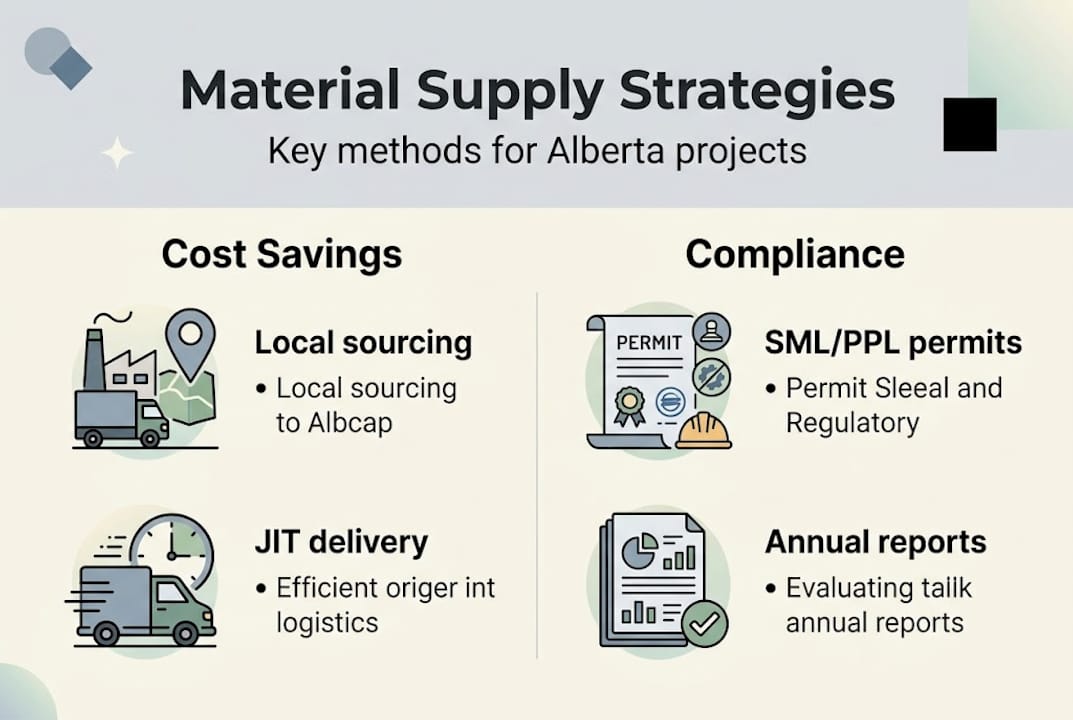
JIT takes a leaner approach. Instead of pre-staging large volumes on site, you schedule deliveries to arrive just as they’re needed. JIT delivery reduces on-site storage needs by 50-70%, which is significant on constrained urban sites where laydown space is limited. Strategic procurement overall can save 5-15% compared to ad hoc purchasing.
Here’s a quick comparison of the two approaches:
| Factor | MRP | Just-in-Time |
|---|---|---|
| Storage requirements | Moderate to high | Minimal |
| Supplier reliability needed | Medium | Very high (95%+) |
| Risk of stockout | Lower | Higher |
| Best suited for | Large, complex projects | Repetitive or urban projects |
| Cost savings potential | Moderate | High, if supplier is reliable |
Procurement strategies have a direct effect on cost, quality, and timeline, which is why the lowest-bidder approach so often backfires. Transactional buying, where you chase the cheapest quote each cycle, leaves you exposed when supply tightens. Strategic supplier partnerships, by contrast, give you preferential scheduling, early warning on price changes, and flexibility when your project needs shift.
Here’s a practical sequence for stronger procurement outcomes:
- Identify critical materials early and flag anything with long lead times.
- Shortlist 2-3 qualified suppliers for each major material category.
- Negotiate multi-year or volume-based contracts to lock in pricing and availability.
- Include escalation clauses that define how price changes are handled rather than leaving them open.
- Build in buffer stock for high-volatility items like aggregates and concrete.
For managers sourcing landscaping materials for Alberta commercial or municipal sites, the supplier relationship piece is especially important. When aggregate demand spikes in a short Alberta construction season, the clients with strong supplier relationships get priority. Everyone else waits. See aggregate pro tips for guidance on selecting the right material type for your specific application.

Pro Tip: Don’t wait for a shortage to start building supplier relationships. Check in with your key suppliers even during off-season months. That ongoing communication is what gets your orders prioritized when competition for materials peaks in spring and summer.
Material supply compliance: Alberta rules and responsibilities
Alberta has specific legal requirements for sourcing surface materials like sand, gravel, and clay from Crown land. Ignoring these rules doesn’t just create paperwork problems. It can result in fines, project shutdowns, and reputational damage with municipal clients.
The two key instruments are the Surface Material Lease (SML) and the Public Pit License (PPL). Here’s when each applies:
| Instrument | When required | Who applies |
|---|---|---|
| Surface Material Lease (SML) | Long-term or large-volume extraction | Private contractors, developers |
| Public Pit License (PPL) | Short-term or smaller-scale extraction | Contractors on public land |
| Borrow Pit Exemption | Government/municipal infrastructure only | Crown agencies, municipalities |
Under the Public Lands Act and PLAR, anyone removing surface materials from Crown land must hold the appropriate authorization, pay royalties based on volume removed, and file annual reports by January 31 each year. That deadline is firm. Late reporting triggers compliance flags that can affect your ability to renew or obtain future licenses.
Here’s what annual reporting typically requires:
- Volume of material removed (in cubic meters)
- Location of the pit or extraction site
- Royalty calculation and payment
- Site condition summary
Municipal authorities should note that borrow pit exemptions exist for government-sponsored infrastructure projects, but the exemption must be documented and approved before extraction begins. Assuming you’re exempt and acting on that assumption without authorization is where projects run into trouble.
Pro Tip: Add your SML/PPL annual reporting deadline (January 31) to your project calendar as a recurring reminder. Better yet, assign it to a specific team member so it never falls through the cracks during busy winter planning cycles.
Non-compliance consequences can include stop-work orders, royalty penalties, and restrictions on future licensing. For projects on public land, those delays are especially damaging because they affect community timelines and contract deliverables. Review the Alberta installation compliance guide alongside regulatory requirements. Choosing best materials for Alberta projects from compliant sources from the start avoids most of these headaches entirely.
Costs, supply chain risks, and strategic sourcing in Alberta
Material costs don’t move in a straight line. In 2026, annual construction inflation sits at 0-3% for most categories, but specific subsystems like mechanical, electrical, and specialty structural components are seeing 5-10% increases. And when U.S. tariffs factor in, the pressure climbs further: tariff exposure adds approximately 8.1% to the cost of affected imports.
Reality check: If you’re budgeting for materials using last year’s prices without accounting for tariff and inflation adjustments, your contingency isn’t a safety net – it’s already spent.
For Alberta specifically, supply chain disruptions from cross-border trade hit harder because of regional dependency on U.S.-sourced products. Steel, lumber, and certain polymer-based materials are all tariff-sensitive. Engineered timber accounts for 42% of framing in Alberta projects, which means any disruption in that category ripples fast.
Here are the main cost inflators to track:
- Raw material price volatility driven by global commodity markets
- Freight and fuel surcharges that vary by season and distance
- Tariff exposure on U.S.-sourced steel, lumber, and specialty products
- Short lead times that force premium pricing when you need materials fast
- Storage and financing costs when materials are purchased too early
Strategic local sourcing addresses several of these risks at once. Buying washed sand and gravel from Alberta suppliers reduces freight exposure and tariff risk, shortens lead times, and supports regional supply stability. For materials that must come from elsewhere, the earlier you identify and lock in pricing, the less vulnerable you are to mid-project volatility.
Long-lead items deserve special attention. Concrete precast elements, specialty aggregates, and custom drainage materials often require 8-16 weeks of lead time. If you wait until those items appear on the critical path, your only option is expedited shipping at a premium, or delays that push your whole schedule. Review excavation and removal insights early in your project planning, since earthwork timing directly affects when surface material delivery can begin.
How material supply shapes success for Alberta projects
Everything discussed so far, the methodology, the compliance requirements, the cost risks, adds up to one thing: project outcomes. Supply chain performance is either your biggest asset or your biggest liability, depending on how you manage it.
JIT strategies can reduce carrying costs by 15-25%, but only when supplier reliability hits 95% or higher. That threshold matters. A supplier who delivers on time 85% of the time might seem acceptable until a single missed load stops your paving crew for half a day. On a municipal contract with liquidated damages clauses, that’s real money.
Here’s how strategic material supply creates tangible project advantages:
- Fewer delays because materials arrive on schedule without last-minute scrambling.
- Cost predictability through locked-in pricing and early procurement of volatile items.
- Better quality control when you work with known suppliers whose specs you’ve verified.
- Stronger contract performance because you can commit to timelines with confidence.
- Lower administrative burden when compliance and reporting are handled by a trusted supply partner.
The lowest-bid instinct is understandable. Budget pressure is real, especially on municipal projects where ratepayers and oversight bodies scrutinize every line item. But the lowest-priced supplier is rarely the lowest-risk supplier. A vendor who shaves 8% off your material cost but delivers late twice in a season costs you far more in crew standby time, penalties, and rescheduling than those savings ever covered.
ProZone’s project outcomes in Edmonton demonstrate what consistent, reliable supply looks like when it’s integrated with professional installation and project management. When supply is handled strategically, the results are visible in finished grades, on-time completions, and repeat client relationships.
Pro Tip: When evaluating a new supplier, ask for references specifically from projects similar in scale and material type to yours. A supplier with a strong track record on residential landscaping may not have the logistics capacity for a municipal road base project.
Why material supply is the silent driver of project success in Alberta
After working across construction and infrastructure projects in this region, one pattern is hard to ignore: most cost overruns don’t start with labor disputes or bad weather. They start with a material supply decision made too early, too late, or without enough information.
The conventional view is that materials are just inputs – commodities you buy at the best price available. That framing causes real damage. It pushes managers toward transactional bidding, short planning horizons, and reactive sourcing. The projects that consistently come in on budget and on time treat material supply as a strategic function, not an administrative one.
In Alberta, compliance requirements add another dimension that out-of-province playbooks miss. SML and PPL obligations, royalty reporting, and extraction site conditions aren’t optional line items. They’re part of the operating environment. Managers who build those requirements into their project timelines from day one don’t scramble in January. They file on time and move on.
Strategic supplier relationships pay dividends that a spreadsheet comparison won’t capture. When aggregate supplies tighten every spring in Alberta, the managers who spent the off-season communicating with suppliers get their deliveries first. Everyone who treated it as a purely transactional relationship is waiting in line. That’s not theory – it plays out every construction season.
The shift we’d encourage is this: stop evaluating material supply on unit price alone. Start evaluating it on total project impact. Reliability, compliance capability, local knowledge, and lead time performance all belong in that equation. The local installation guide is a good starting point for understanding how supply decisions connect to installation outcomes from the ground up.
Partner with experts for material supply and construction success
If navigating Alberta’s material supply requirements feels like a full-time job on top of your actual project responsibilities, that’s because it can be. Compliance deadlines, supplier negotiations, tariff tracking, and logistics coordination all require attention that most property managers and municipal project leads simply don’t have to spare.
ProZone Ltd. brings local expertise, an established supplier network, and hands-on experience managing material supply for Edmonton and the broader Alberta region. Whether you need reliable aggregate delivery, compliant sourcing for Crown land projects, or integrated support from procurement through installation, we can help you stay on schedule and on budget. Explore construction services for Edmonton managers to see how we support projects from planning to completion. Our landscaping material supply in Alberta offering covers commercial and municipal needs with spec-accurate delivery. For paved surface projects, the asphalt installation guide explains how material quality directly shapes finished results. Reach out to discuss your next project.
Frequently asked questions
What is the difference between material supply and material installation in construction?
Material supply refers to sourcing and delivering building materials to a project site, while installation is the actual incorporation of those materials into the physical structure. They are separate scopes of work with distinct contractual responsibilities.
How much of a construction project’s budget is typically spent on material supply?
Materials generally account for 25-35% of total project costs, making supply management one of the highest-impact areas for budget control on any construction project.
What compliance steps are needed when sourcing sand or gravel in Alberta?
You must obtain the appropriate SML or PPL, file annual reports by January 31, and pay royalties based on volume removed unless your project qualifies for a government borrow pit exemption.
How can Just-in-Time delivery help property managers?
JIT delivery can cut carrying costs by 15-25%, but it requires suppliers with 95% or higher on-time reliability to avoid the risk of site stoppages and schedule disruptions.
Are there risks to focusing solely on the lowest material supply bid?
Yes. Transactional bidding prioritizes short-term price savings over reliability, which can lead to delayed deliveries, spec mismatches, and project cost overruns that far exceed initial savings.