
TL;DR:
- Preventive maintenance involves scheduled inspections, servicing, and repairs to ensure building systems operate reliably. It minimizes costs, extends asset life, and improves regulatory compliance, especially important in Edmonton’s harsh climate. Proper documentation and prioritization are essential for effective, legally compliant maintenance programs.
Preventive maintenance is defined as a scheduled, proactive programme of inspections, servicing, and repairs designed to keep building systems operating reliably before failures occur. For property managers and facility operators overseeing commercial assets in Edmonton, the role of preventive maintenance extends well beyond routine upkeep. Reactive maintenance costs 3 to 5 times more than planned tasks. That gap makes a formal preventive programme one of the most financially significant decisions a facility operator can make. Industry best practice targets an 80% planned to 20% reactive maintenance ratio as the operational gold standard.
What are the primary benefits of preventive maintenance for commercial properties?
Preventive maintenance delivers measurable gains across three areas: cost control, asset longevity, and regulatory compliance. Each benefit compounds over time, making the programme more valuable the longer it runs.
Cost reduction is the most immediate and quantifiable benefit. Implementing a preventive programme cuts total maintenance costs by 25% to 40% and extends equipment lifespan by 40% to 60%. Every dollar invested can yield more than five dollars in savings when downtime, emergency labour, and equipment replacement are factored in.
Operational efficiency and energy savings follow directly from well-maintained systems. Unmaintained equipment consumes more energy, inflating operating costs beyond direct maintenance expenses. An HVAC unit running with dirty coils or a worn belt draws significantly more power than a serviced unit. These hidden energy costs make the return on preventive investment far greater than simple repair-avoidance calculations suggest.
Tenant retention and lease renewals depend heavily on maintenance responsiveness. A well-maintained building retains tenants at higher rates, and maintenance responsiveness directly influences lease renewal decisions. Tenants in commercial properties expect reliable HVAC, safe parking surfaces, and functional common areas. Consistent preventive upkeep delivers exactly that.
The additional benefits of a structured preventive programme include:
- Regulatory compliance: Scheduled inspections keep fire suppression systems, electrical panels, and structural elements aligned with Alberta Safety Codes and local building bylaws.
- Risk mitigation: Documented maintenance reduces liability exposure in the event of an incident on the property.
- Budget predictability: Planned tasks carry known costs. Emergency repairs do not.
- Reduced tenant disputes: Reliable systems give tenants fewer grounds for maintenance-related complaints or lease terminations.
- Asset value preservation: Commercial roofs and other major building components retain value and structural integrity far longer under a preventive regime.
Pro Tip: Track maintenance spend by category each quarter. If reactive costs exceed 20% of your total maintenance budget, your programme needs rebalancing before costs escalate further.
How does preventive maintenance balance planned and reactive activities?
The distinction between planned and reactive maintenance is straightforward. Planned maintenance is scheduled in advance based on manufacturer recommendations, inspection intervals, or seasonal requirements. Reactive maintenance is unscheduled work triggered by an unexpected failure or tenant complaint.

The challenge is achieving the right ratio between the two.
| Maintenance programme maturity | Planned maintenance | Reactive maintenance |
|---|---|---|
| No formal programme | 40% | 60% |
| Developing programme | 60% | 40% |
| Industry best practice | 80% | 20% |
| World-class programme | 90% | 10% |
Organizations without formal programmes operate at 40% planned and 60% reactive. World-class operations reach 90% planned and 10% reactive, reducing total maintenance costs by 15% to 25%. The gap between those two states represents a significant financial and operational liability for any commercial property.
A reactive budget share above 20% to 30% signals that a programme review is overdue. The consequences of excessive reactive spending include unpredictable cash flow, accelerated equipment wear, and increased risk of regulatory non-compliance during periods of system failure.
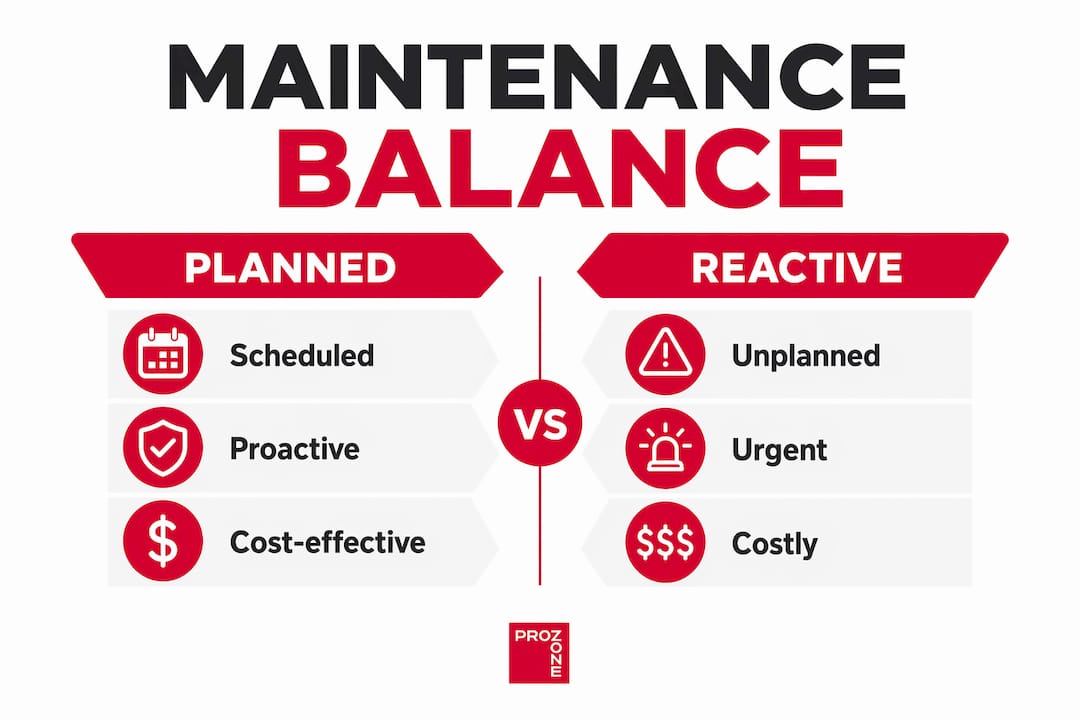
Shifting toward a planned majority requires three practical steps. First, audit your current maintenance spend and categorise every work order as planned or reactive for the past 12 months. Second, identify the assets generating the most reactive calls and schedule formal inspection intervals for each. Third, use key performance indicators such as mean time between failures and planned maintenance compliance rate to track progress monthly.
Pro Tip: Set a planned maintenance compliance target of at least 90% for critical systems such as HVAC, fire suppression, and electrical. Missing a scheduled task on these assets carries disproportionate risk compared to missing one on a low-consequence item like exterior signage lighting.
What best practices should property managers follow for preventive maintenance?
Effective preventive maintenance programmes share four characteristics: a detailed schedule, clear asset prioritisation, thorough documentation, and qualified contractors. Edmonton’s climate adds a fifth requirement: seasonal adaptation for freeze-thaw cycles that stress concrete, asphalt, and drainage systems more aggressively than in milder Canadian cities.
-
Build a master maintenance schedule. List every building system and asset, assign inspection intervals based on manufacturer guidance and Alberta Safety Codes, and load all tasks into a calendar. A facility maintenance guide for your specific property type provides a useful starting framework. Review and update the schedule annually.
-
Prioritise assets by consequence of failure. Critical systems, including HVAC, fire suppression, elevators, and electrical distribution, require rigorous scheduled maintenance. Lower-consequence assets such as interior paint, non-structural landscaping features, and decorative lighting can follow a run-to-failure approach without significant risk. World-class programmes blend rigorous scheduled checks on critical assets with run-to-failure on low-consequence assets. This blended approach is a key skill that separates efficient operators from those who over-maintain everything at equal cost.
-
Document every inspection and action. Record the date, technician, findings, and corrective actions for every maintenance event. Centralised logging protects you legally and gives you the data needed to identify recurring failures before they become chronic problems.
-
Coordinate with qualified contractors. Specialist contractors bring tools, certifications, and liability coverage that in-house staff typically cannot match for mechanical, electrical, or structural work. Hiring qualified contractors reduces both cost and risk when the scope of work exceeds internal capacity. Vet contractors for Alberta Safety Codes compliance and request proof of insurance before any work begins.
-
Adapt your schedule to Edmonton’s freeze-thaw cycle. Spring and autumn are the highest-risk seasons for concrete cracking, asphalt heaving, and drainage blockages. Schedule inspections of parking lots, walkways, and exterior concrete immediately after the spring thaw and again before the first hard frost. Prozoneltd’s experience with Edmonton’s climate confirms that properties without a seasonal inspection protocol face disproportionately high repair costs in these two windows.
Pro Tip: Add a post-winter inspection to your preventive maintenance checklist every april. Freeze-thaw damage to asphalt and concrete surfaces is easiest and cheapest to address before it progresses through a full summer of traffic loading.
What operational and legal risks does preventive maintenance mitigate?
Preventive maintenance is a risk management tool as much as it is a technical programme. Property managers who treat it as optional typically discover its value only after an incident, a dispute, or a failed inspection.
The legal dimension is particularly significant for commercial properties. Commercial maintenance obligations depend on lease agreements, and there is no automatic landlord duty to maintain unless the lease specifies it. Preventive maintenance records serve as evidence that obligations were met. Without them, a landlord’s position in a tenant dispute or insurance claim is materially weaker.
Key legal and operational risks that a preventive programme directly addresses include:
- Tenant liability claims: A slip on an icy walkway or a fall caused by a damaged surface becomes a liability issue if no inspection records exist. Documented preventive checks demonstrate due diligence.
- Insurance claim disputes: Insurers routinely investigate whether a loss resulted from deferred maintenance. Formal maintenance plans are legal and financial proof that the property was properly managed. Lacking records undermines the landlord’s case in liability claims.
- Building and fire code compliance: Scheduled inspections of fire suppression systems, emergency lighting, and exit hardware keep properties aligned with Alberta Safety Codes. A failed fire inspection can trigger occupancy restrictions that directly impact rental income.
- Lease enforcement: When a lease assigns maintenance responsibilities to the tenant, documented baseline inspections establish the property’s condition at lease commencement. That record is essential if a dispute arises at lease end.
- Unexpected system failures: A boiler failure in january or a roof drain blockage in spring can displace tenants and trigger business interruption claims. Preventive inspections catch the warning signs before failure occurs.
Centralised maintenance records are the single most underused asset in commercial property management. Most disputes and insurance complications arise not because maintenance was neglected, but because no one can prove it was performed.
ProZone’s perspective on maintenance investment in Edmonton properties
The most common mistake property managers make is treating every asset as equally critical. Applying the same rigorous scheduled maintenance to a high-consequence HVAC system and a low-risk exterior light fixture wastes budget and creates administrative burden without proportionate risk reduction. The skill is in the triage: knowing which assets justify intensive preventive schedules and which can safely run to failure.
Edmonton’s climate makes this triage more consequential than in most Canadian cities. The freeze-thaw cycle between october and april creates stress on exterior surfaces, drainage systems, and structural joints that simply does not exist in Vancouver or Toronto at the same intensity. A concrete inspection programme that works in Calgary may be inadequate for an Edmonton property that experiences 30 or more freeze-thaw cycles in a single winter season.
Rigorous record-keeping is not administrative overhead. It is the foundation of a defensible maintenance programme. Every inspection log, contractor invoice, and corrective action record is a piece of evidence that protects asset value, supports insurance claims, and demonstrates compliance with Alberta Safety Codes. Properties that invest in documentation consistently outperform those that do not, both financially and in tenant retention.
The importance of preventive maintenance is not theoretical. It shows up in budget variance reports, lease renewal rates, and the condition of a property’s exterior surfaces after five Edmonton winters.
— ProZone
Prozoneltd’s construction and maintenance services for Edmonton properties
Prozoneltd works with commercial property managers and facility operators across Edmonton and the surrounding region, delivering construction and maintenance services built around Alberta Safety Codes and the realities of the local climate. From asphalt paving and repair to concrete flatwork, earthworks, and snow removal, Prozoneltd’s programmes are designed to support the preventive maintenance schedules that protect your assets year-round. The team brings direct experience with Edmonton’s freeze-thaw conditions, ensuring that exterior surfaces, drainage systems, and parking areas receive the right treatment at the right time. Contact Prozoneltd through the online form or call directly for a free estimate on construction and maintenance services tailored to your property’s specific requirements.
FAQ
What is the role of preventive maintenance in commercial property management?
Preventive maintenance is a scheduled programme that keeps building systems operating reliably, reduces emergency repair costs, and protects asset value over time. It is the primary tool property managers use to control maintenance budgets and meet lease and regulatory obligations.
How much can preventive maintenance reduce costs?
Preventive programmes cut total maintenance costs by 25% to 40% and can deliver a return of more than five dollars for every dollar invested. Reactive maintenance costs 3 to 5 times more per task than planned work.
What is the ideal planned-to-reactive maintenance ratio?
The industry gold standard is 80% planned maintenance to 20% reactive. World-class programmes reach 90% planned, reducing total costs by 15% to 25% compared to reactive-heavy operations.
Why does Edmonton’s climate affect preventive maintenance schedules?
Edmonton’s freeze-thaw cycle stresses exterior concrete, asphalt, and drainage systems more aggressively than in milder Canadian cities. Seasonal inspections in spring and autumn are a non-negotiable part of any effective preventive maintenance checklist for Edmonton commercial properties.
How does preventive maintenance protect property managers legally?
Documented maintenance records serve as legal and financial proof in tenant disputes and insurance claims. Without centralised inspection logs, a landlord’s position in any liability matter is significantly weakened.