
TL;DR:
- Earthmoving equipment plays a central role in Canadian construction, handling excavation, grading, and material movement. Advances like GPS guidance and safety protocols have improved efficiency, accuracy, and site safety, especially in Edmonton’s challenging climate. Proper equipment selection, planning, and maintenance are essential to ensure successful projects and regulatory compliance.
Earthmoving equipment is defined as specialised construction machinery used to excavate, move, grade, and compact soil, rock, and other materials during site preparation and infrastructure development. The role of earthmoving equipment in Canadian construction is substantial: excavation and earthmoving machinery accounts for 53.95% of the Canadian construction equipment market as of Q1 2026. That figure reflects how central these machines are to every phase of a project, from breaking ground to final grading. Prozoneltd operates under Alberta Safety Codes and brings this machinery expertise to Edmonton-area infrastructure, earthworks, and site preparation projects.
What are the main types of earthmoving equipment?
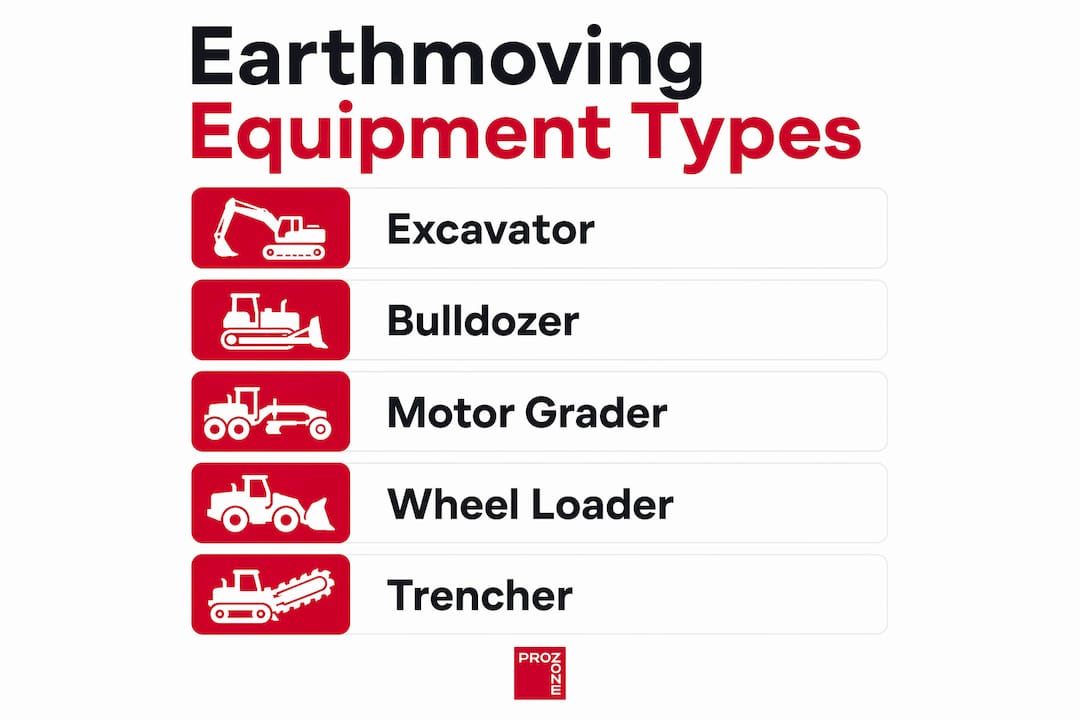
Earthmoving machinery falls into five primary categories, each designed for a specific task. Understanding which machine fits which condition is the first decision a project manager makes on any site.
| Equipment type | Primary function | Typical project role |
|---|---|---|
| Excavator | Digging, trenching, demolition | Foundation excavation, utility trenching |
| Bulldozer | Pushing, clearing, rough grading | Land clearing, road base preparation |
| Wheel loader | Loading, hauling, stockpiling | Material transfer, aggregate handling |
| Motor grader | Fine grading, levelling | Road subgrade, parking lot preparation |
| Trencher | Narrow trench cutting | Utility installation, drainage systems |
Excavators are the most versatile machines on a Canadian construction site. They rotate 360 degrees, accept interchangeable attachments including augers, hydraulic hammers, and compaction wheels, and work effectively in confined urban spaces when fitted with a short-radius boom. Bulldozers handle large-scale clearing and rough grading where volume matters more than precision. Wheel loaders move material quickly between stockpiles and haul trucks, making them indispensable on high-volume earthworks.
Motor graders deliver the fine tolerances required before paving. GPS-equipped grading equipment achieves design grade accuracy within centimetres, which directly reduces over-excavation costs and material waste. Compact machines, including mini-excavators and skid steers, fill the gap on tight urban Edmonton sites where full-size equipment cannot manoeuvre safely.
Pro Tip: Match machine size to site access before mobilising. A 30-tonne excavator that cannot reach the work face costs more in repositioning time than a smaller machine would cost in additional passes.
How does earthmoving equipment contribute to construction safety?
Safety on an earthmoving site is governed by provincial legislation, not by contractor preference. Canadian provincial OHS codes require protective systems such as sloping, shoring, or trench boxes for any excavation deeper than 1.2 metres. That threshold applies in Alberta, Ontario, and British Columbia, and non-compliance exposes project managers to stop-work orders and personal liability.
Daily inspections are not optional. Alberta and BC regulations mandate daily site inspections plus additional checks after rain, heavy machinery vibration, or freeze-thaw cycles. Edmonton’s climate makes the freeze-thaw trigger particularly relevant: a trench wall that was stable on a Friday afternoon can be compromised by monday morning after a weekend temperature swing.
The Canadian Construction Safety Council promotes Safe Start Checks as a pre-shift verification process before any earthmoving equipment enters service. This proactive approach replaces the older reactive model, where operators waited for a visible problem before stopping work. The shift matters because most earthmoving incidents occur within the first hour of a shift, when operators are establishing site conditions.
Key safety requirements for earthmoving operations include:
- Protective systems: Install shoring, trench boxes, or engineered slopes before workers enter any excavation deeper than 1.2 metres.
- PPE and training: Provincial OHS regulations require all workers to use appropriate personal protective equipment and employers to provide documented equipment operation training.
- Exclusion zones: Establish and mark equipment swing radii and travel paths before work begins each shift.
- Ground disturbance awareness: Identify buried utilities through Alberta One-Call before any machine breaks ground.
Pro Tip: Integrate pre-design risk identification into your project planning phase. Identifying ground hazards before mobilisation reduces costly mid-project design changes and keeps your safety documentation current from day one.
What technology is improving earthmoving equipment performance?
GPS and laser guidance systems have changed what project managers can expect from earthmoving equipment. GPS guidance on grading machines eliminates the need for traditional grade stakes, reduces surveyor visits, and cuts rework caused by over-excavation. The practical result is tighter material balances and lower haul costs on projects where every cubic metre counts.
In Edmonton’s freeze-thaw climate, technology also means smarter maintenance scheduling. Regular inspection and maintenance of earthmoving equipment prevents mechanical failure during critical project phases, particularly after winter shutdown and spring thaw when hydraulic seals, undercarriage components, and ground-engaging tools wear at accelerated rates. A machine that fails mid-excavation in frozen ground costs far more to recover than a machine kept on a preventive maintenance schedule.
Current technology improvements delivering measurable results include:
- 3D machine control: Excavators and dozers with 3D GPS guidance cut to design elevation automatically, reducing operator error on complex graded surfaces.
- Telematics and fleet monitoring: Real-time engine data, fuel consumption, and idle time reporting allow project managers to identify underperforming machines before they cause schedule delays.
- Compaction control: Intelligent compaction rollers measure soil density in real time, eliminating the guesswork of traditional test-strip methods.
- Hybrid and electric drive systems: Newer compact machines use electric drive to reduce fuel consumption and noise, which matters on urban Edmonton sites with noise bylaws.
Pro Tip: Request GPS machine control data files from your survey team before equipment arrives on site. Loading the design surface directly into the machine control system eliminates a full day of grade-staking and reduces the risk of human transcription errors.
How do project managers integrate earthmoving equipment into site planning?
Effective site planning treats earthmoving equipment as a design input, not an afterthought. Understanding equipment cycle times and turning radii allows project managers to design haul routes and stockpile locations that keep machines moving efficiently. A bulldozer pushing material uphill over 150 metres loses significant productivity compared to one working on a downhill push of 60 metres. That difference shows up directly in cost and schedule.
Successful earthworks design integrates geotechnical data, hydrological constraints, and construction logistics to prevent settlement, manage water, and deliver structural durability. Ground pressure tolerances are particularly important in Edmonton’s clay-heavy soils, where heavy equipment can cause subgrade failure if deployed before adequate drainage is established.
Environmental compliance adds another layer of planning complexity. In sensitive northern regions, invasive species cleaning protocols and rig matting are mandatory before equipment moves between sites. Even on standard Edmonton commercial projects, equipment must be cleaned of soil and organic material when moving between sites to meet Alberta’s weed control requirements.
The following sequence reflects best practice for integrating earthmoving equipment into a construction project:
- Geotechnical review: Confirm soil bearing capacity, groundwater depth, and frost penetration data before selecting equipment type and size.
- Utility clearance: Complete Alberta One-Call locate requests and verify all buried services before mobilising any ground-disturbing equipment.
- Haul route design: Plan internal site haul roads with turning radii matched to the largest machine on site, and designate separate pedestrian exclusion zones.
- Excavation sequencing: Sequence cuts and fills to minimise double-handling of material and maintain a positive drainage gradient throughout the work.
- Compaction verification: Specify compaction testing frequency in the project specification and hold points before placing structural fill or subbase.
- Hazard register updates: Maintain a dynamic hazard register that reflects changing site conditions, active trades, and equipment movements throughout the project.
Environmental and safety documentation must remain current throughout the project. Hazard registers are living documents that must be updated as site conditions change, new trades arrive, and equipment configurations shift. A register that was accurate at project start but not updated through the earthworks phase is a liability, not a safety tool.
| Planning factor | Key consideration | Risk if ignored |
|---|---|---|
| Ground pressure | Match machine weight to soil bearing capacity | Subgrade failure, equipment recovery costs |
| Cycle time | Design haul distances for machine efficiency | Schedule overrun, fuel cost increase |
| Freeze-thaw timing | Schedule earthworks outside deep frost periods | Compaction failure, rework |
| Environmental compliance | Clean equipment between sites | Regulatory fines, project shutdown |
ProZone’s perspective on earthmoving equipment in Canadian construction
The most consistent mistake I observe on Edmonton construction sites is treating earthmoving equipment selection as a procurement decision rather than an engineering one. Project managers who understand ground pressure tolerances, haul cycle times, and freeze-thaw soil behaviour make better decisions at every stage. Those who treat equipment as interchangeable units tend to discover the difference during a costly mid-project correction.
Safety culture has shifted noticeably over the past decade. The move toward proactive Safe Start Checks and dynamic hazard registers reflects a genuine change in how Canadian contractors approach risk. The old model of reacting to visible problems is giving way to systematic pre-shift verification, and that shift is reducing incidents. The regulatory framework in Alberta supports this direction, but the culture change has to come from project leadership.
Technology adoption is accelerating, but the fundamentals have not changed. GPS machine control and telematics are valuable tools. They do not replace a project manager who understands the site preparation process well enough to catch a design error before the machine acts on it. The best outcomes come from combining technical tools with experienced site judgement, particularly in Edmonton’s challenging climate where conditions can change between morning and afternoon.
— ProZone
Prozoneltd earthworks services for Edmonton projects
Prozoneltd delivers earthworks, site preparation, and construction materials to corporate, municipal, and private clients across Edmonton and the surrounding region. The company operates under Alberta Safety Codes and applies documented inspection protocols to every earthmoving project, from initial excavation through final compaction. For project managers who need reliable Edmonton excavation services backed by provincial compliance standards, Prozoneltd provides a direct point of contact for estimates and project scoping. The team also supplies graded aggregates, crushed stone, and drainage materials to support site preparation requirements. Contact Prozoneltd through the online form at prozoneltd.ca or call directly for a free project estimate.
FAQ
What is the role of earthmoving equipment in construction?
Earthmoving equipment excavates, grades, hauls, and compacts soil and rock to prepare sites for foundations, roads, and infrastructure. These machines are the primary means of shaping a site to meet design specifications before any structural work begins.
What types of earthmoving machinery are used on Canadian projects?
The most common types are excavators, bulldozers, wheel loaders, motor graders, and trenchers. Each machine serves a specific function, and project managers select equipment based on soil conditions, site access, and required tolerances.
How deep can you excavate before safety systems are required?
Canadian provincial OHS codes require protective systems such as shoring, trench boxes, or engineered slopes for any excavation deeper than 1.2 metres. This threshold applies in Alberta, Ontario, and British Columbia.
How does GPS technology improve earthmoving equipment performance?
GPS-equipped grading and excavation machines achieve design grade accuracy within centimetres, reducing over-excavation and material waste. This precision is especially valuable on projects with tight material balances or complex graded surfaces.
Why is equipment maintenance critical in Edmonton’s climate?
Edmonton’s freeze-thaw cycles accelerate wear on hydraulic seals, undercarriage components, and ground-engaging tools. Regular inspection and preventive maintenance prevent mechanical failure during critical project phases and support ongoing site safety compliance.