
Every property owner and occupier in Edmonton is legally required to keep the sidewalk adjacent to their land clear of snow and ice. Under Community Standards Bylaw 14600, failing to do so can result in a fine of $100, and if the City removes the snow on your behalf, you receive an additional invoice for the contractor’s cost.
The practical consequences of non-compliance are straightforward:
- A municipal tag (ticket) carrying a fine of $100
- The City dispatching a contractor to clear the sidewalk
- An invoice for the full cost of that contractor clearing, billed to the property owner
- Potential escalation if the property has a history of non-compliance
The City of Edmonton’s sidewalk snow and ice page confirms these outcomes and serves as the primary reference for residential property owners navigating their obligations.
Table of Contents
- What does Edmonton’s sidewalk clearing bylaw actually require?
- How clean is clean, and when do you need to clear it?
- How does enforcement work, and what are the fines?
- How to file a complaint or dispute a ticket
- Which sidewalks does the City of Edmonton clear?
- Assistance programmes and community support options
- Safe, bylaw-compliant sidewalk maintenance
- When should you hire a professional contractor?
- Proactive compliance is always cheaper than reactive enforcement
- ProZone handles Edmonton sidewalk clearing so you do not have to
- Sources
- FAQ
What does Edmonton’s sidewalk clearing bylaw actually require?
Community Standards Bylaw 14600 is the governing legal instrument for sidewalk snow removal regulations in Edmonton. The obligation is stated plainly: any person who owns or occupies land must maintain the adjacent sidewalk clear of all snow and ice.
Several definitions within the bylaw determine exactly how that obligation applies to your property:
- Sidewalk: a paved or unpaved path or walkway intended for pedestrian use, typically running alongside a roadway
- Own: to hold registered title to the land
- Occupy: to be in possession of or to use the land, which means tenants and property managers can bear responsibility alongside registered owners
- Highway: defined broadly in the bylaw to include the full road allowance, which is relevant because sidewalks typically sit within the highway right-of-way adjacent to private land
The bylaw’s use of “own or occupy” is significant. A tenant who occupies a property shares legal exposure with the registered owner, depending on the lease arrangement and who exercises day-to-day control of the property.
The bylaw also defines a municipal tag as an administrative penalty notice issued by a Municipal Enforcement Officer (MEO), distinct from a violation ticket issued through the provincial court process. Understanding this distinction matters if you intend to dispute a penalty, since the review pathway differs between the two.
How clean is clean, and when do you need to clear it?
The standard the City expects is not simply “passable.” The sidewalk must be cleared to the pavement or asphalt surface, across its full width and full length adjacent to your property. Partial clearing that leaves a packed snow lane down the centre does not meet the standard.
Temporary measures are permitted while you work:
- Sand or fine gravel applied to icy surfaces to improve traction
- Ice-melt products (calcium chloride or similar) used to break up bonded ice
- Rock chips as a traction aid, particularly useful during hard freeze periods
These measures buy time but do not substitute for full removal.
Timing and the 48-hour guideline are where many property owners misread their exposure. The City accepts complaints between November 1 and May 1, and its complaint intake guidance states that complaints are generally accepted only when it has not snowed for at least 48 hours. However, as Global News reporting on City statements clarifies, the 48-hour window is a guideline for complaint intake, not a strict bylaw requirement. Officers can ticket sooner in specific circumstances, particularly where a hazard is acute or a complaint is urgent.
Edmonton’s freeze-thaw cycle compounds the risk. A sidewalk cleared after a snowfall can refreeze overnight into a surface far more hazardous than fresh snow. Prompt clearing, followed by a traction aid during freeze periods, reduces both the slip risk and your liability exposure if someone is injured on the adjacent walkway.
How does enforcement work, and what are the fines?
The City’s enforcement process follows a graduated approach, as described in the Snow and Ice Annual Report. Education comes first, but the pipeline moves quickly when complaints are active.
| Enforcement stage | Who acts | Typical outcome |
|---|---|---|
| Education and awareness | MEOs, Snow and Ice Officers | Door hanger left at property |
| Warning | MEO | Verbal or written notice to comply |
| Municipal tag | MEO | a fine of $100 issued to owner/occupier |
| Contractor clearing | City-contracted crew | Sidewalk cleared; cost invoiced to owner |
| Violation ticket | MEO (escalated cases) | Provincial court process; higher penalties |
Municipal Enforcement Officers handle the bulk of sidewalk complaints. Seasonal Snow and Ice Officers are deployed specifically during winter to manage the volume of complaints the City receives. Both roles have authority to issue municipal tags and escalate to contractor clearing.
The financial risk compounds quickly. The fine of $100 is fixed, but the contractor clearing cost is variable and reflects actual time and equipment on site. A large corner lot with significant accumulation can generate an invoice that substantially exceeds the fine itself. Property owners who receive repeated tags in a single season may also face escalation to the violation ticket process, which carries higher penalties through provincial court.
How to file a complaint or dispute a ticket
Filing a complaint about an uncleared sidewalk
- Confirm the complaint window applies: it must be between November 1 and May 1, and it must not have snowed for at least 48 hours at the time you file.
- Document the condition with timestamped photos from a public vantage point, capturing the full length of the uncleared sidewalk.
- Note the civic address of the property, the date, and the approximate time of your observation.
- File the complaint through 311 by phone or online at the City of Edmonton’s 311 portal. You can also use the 311 app.
- Keep your complaint reference number. The City will assign an officer to investigate.
If the situation involves a neighbour, the Snow and Ice Annual Report notes that neighbourhood disputes sometimes benefit from community mediation before escalating to formal enforcement. The City does not provide mediation services directly, but community mediation resources are available in Edmonton.
Disputing a ticket or invoice
If you receive a municipal tag or a contractor clearing invoice and believe it was issued in error, the City offers a review process. For a municipal tag, you can request an administrative review within the timeframe stated on the tag itself. Submit your documentation, including timestamped photos showing the sidewalk was clear before the officer’s visit, to the address or portal listed on the notice.
For a contractor clearing invoice, contact the City directly to request a review. Grounds for dispute typically include evidence that the sidewalk was already cleared, that the property address on the invoice is incorrect, or that the clearing occurred outside the complaint window.
Pro Tip: Keep a short incident log each time you clear your sidewalk. A note with the date, time, and a photo takes 30 seconds and becomes your primary evidence if a tag or invoice arrives days later.
Which sidewalks does the City of Edmonton clear?
The City does not clear most residential or commercial sidewalks. Its resources are directed at a defined set of locations, as confirmed by the City’s sidewalk snow and ice page:
- Sidewalks adjacent to public schools
- Sidewalks at and near bus stops on transit routes
- Sidewalks adjacent to City-owned facilities
- Select river valley pathways and trails adjacent to City land
- Certain accessible walkways prioritised for mobility access
Outside these categories, the obligation falls entirely on the adjacent property owner or occupier. This is a common source of confusion: property owners sometimes assume that because a sidewalk is physically part of the road allowance (City land), the City is responsible for clearing it. The bylaw places that responsibility on the adjacent private property owner regardless of who holds title to the land beneath the sidewalk.
The City’s use of contractors for school and bus stop clearing reflects resource constraints. During high-volume snowfall events, even those priority sites may experience delays, which underscores why the private-property obligation exists as a parallel system rather than a fallback.
Assistance programmes and community support options
Not every property owner is physically able to clear a sidewalk. The City and community organisations offer several supports:
- Snow Angel programme: The City provides a poster that property owners can display to signal they need assistance from a neighbour or volunteer. Displaying the poster does not create a legal exemption from the bylaw obligation, but it can attract community help.
- Low-income seniors and people with disabilities: The City offers targeted clearing assistance for accessible walkways in some circumstances. Contact 311 to determine eligibility and current programme availability.
- Community leagues: Many Edmonton community leagues organise volunteer clearing networks during winter. Contact your local community league directly to ask about available support.
- Contracted services: For ongoing or recurring needs, a professional snow removal contract removes the personal physical burden entirely while keeping the property in bylaw compliance.
The Snow Angel poster is a community goodwill tool, not a legal shield. If a volunteer does not arrive and the sidewalk remains uncleared past the complaint window, enforcement can still proceed. Property owners who rely on assistance programmes should have a backup plan, particularly during heavy snowfall periods.
Safe, bylaw-compliant sidewalk maintenance
Clearing a sidewalk correctly protects both pedestrians and your property from enforcement. A practical checklist:
- Use a quality snow shovel or snow blower suited to the surface. Metal-edged shovels can chip concrete; use a rubber or plastic blade on exposed aggregate or decorative finishes.
- Clear the full width and length in one pass where possible, working from the property line to the curb.
- Apply sand, rock chips, or ice-melt immediately after clearing if temperatures are near or below freezing, to prevent refreeze bonding.
- Address windrows left by City plows at the curb. Per the City’s Snow and Ice Control Procedure, property owners are generally responsible for clearing windrows deposited adjacent to their land. Dense, compacted windrows may require mechanical removal to avoid damaging the pavement surface beneath.
Prohibited actions that can result in separate penalties or safety hazards:
- Pushing or blowing snow into the roadway or travel lanes
- Depositing snow on a neighbour’s property without permission
- Blocking storm drains with snow or ice accumulation
- Piling snow against fire hydrants, obscuring them from view
Edmonton’s freeze-thaw cycle means a sidewalk that was clear at noon can be a sheet of ice by 6 PM. Traction aids applied after clearing are not optional during shoulder-season temperature swings — they are the difference between a compliant surface and a liability.
When should you hire a professional contractor?
Some situations make professional snow removal the practical and financially sensible choice. Consider contracting a qualified service when:
- Your property has a large or corner lot with extended sidewalk frontage
- You manage a commercial property where foot traffic volume and liability exposure are higher
- Repeated freeze-thaw cycles are creating compacted ice that hand tools cannot safely remove
- The property is occupied by elderly or mobility-limited residents who cannot clear safely
- Windrow accumulation from City plowing requires mechanical equipment to handle without pavement damage
When evaluating a contractor, ask directly about:
- Liability insurance and WCB coverage for workers on your property
- Alberta Safety Codes awareness and whether their equipment and methods comply with applicable standards
- Equipment suitability: skid steers and commercial blowers with rubber cutting edges protect pavement surfaces; generic equipment can cause long-term damage to concrete and asphalt
- Response time guarantees for post-storm clearing, particularly relevant for commercial sites
- Invoice and dispute handling procedures if a City tag arrives during their service period
- Scope of service: does the contract include windrow clearing, ice control application, and curb-to-property-line clearing, or only the main sidewalk pass?
A contractor who cannot answer these questions clearly is not operating at the standard Edmonton’s climate and bylaw environment demands. Prozoneltd’s sidewalk and curb repair services and professional snow removal are built around exactly these operational requirements.
Proactive compliance is always cheaper than reactive enforcement
The City’s education-first approach is well-intentioned, but the enforcement pipeline is real and moves faster than many property owners expect. A single contractor clearing invoice on a large lot can cost considerably more than the $100 tag that triggered it. Multiply that across a season of repeated non-compliance and the financial exposure becomes significant.
What the bylaw compliance conversation often misses is the neighbourhood dimension. A block where most owners clear promptly creates a network of safe, connected walkways. One uncleared property breaks that network for everyone, including children walking to school and seniors navigating to transit. Coordinated clearing, whether through community leagues, Snow Angel networks, or shared professional contracts among adjacent properties, produces better outcomes than individual reactive compliance.
ProZone’s approach to winter maintenance treats sidewalk clearing as a quality-controlled process, not a reactive task. Equipment matched to Edmonton’s freeze-thaw conditions, traction materials applied at the right time, and documentation practices that protect property owners from disputed invoices are the operational standard that separates professional service from a generic contractor showing up with a shovel.
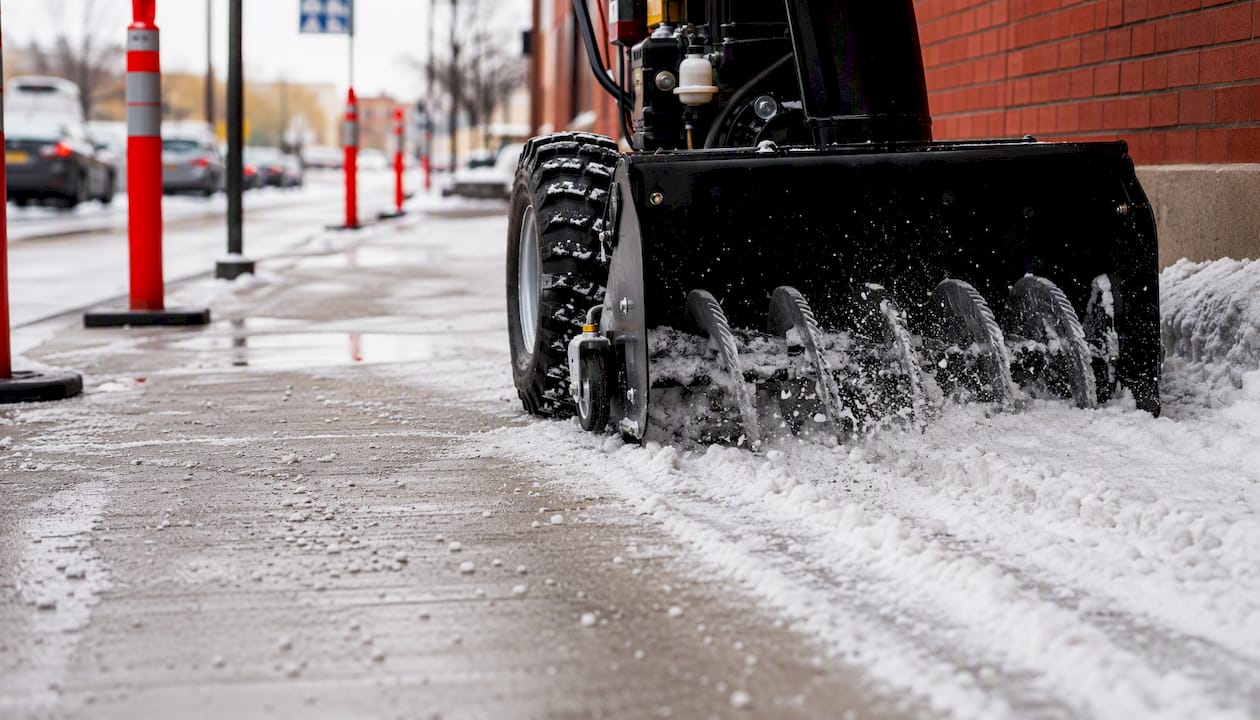
ProZone handles Edmonton sidewalk clearing so you do not have to
ProZone provides professional snow removal in Edmonton covering sidewalk clearing, windrow management, ice control application, and concrete and curb repair for residential and commercial properties. The team operates with safety certifications, Alberta Safety Codes familiarity, and equipment selected specifically for Edmonton’s freeze-thaw cycles, protecting your pavement surface while keeping your property bylaw-compliant throughout the season.
If you discover sidewalk damage while clearing this winter, ProZone’s concrete and curb repair services address cracks, spalling, and surface deterioration before they become a separate compliance issue. For property owners who need winter supplies such as rock chips and ice control materials, ProZone supplies those directly as well.
Contact ProZone through the online form at Prozoneltd or call directly for a free estimate on seasonal snow removal or sidewalk repair.
Sources
The following City of Edmonton documents and resources are the primary authorities for sidewalk snow removal obligations and enforcement in Edmonton. Use official City URLs when filing complaints or verifying bylaw text.
Always verify current bylaw text and complaint procedures directly through the City of Edmonton’s official website, as operational guidance can be updated between winter seasons.
FAQ
What is the 15-minute rule for Edmonton sidewalks?
There is no “15-minute rule” in Edmonton’s sidewalk clearing bylaw. Community Standards Bylaw 14600 requires property owners to clear sidewalks as soon as possible after snowfall, with no specific time limit stated in the bylaw text itself.
How long do you have to shovel your sidewalk in Edmonton?
The bylaw does not set a fixed deadline. The City accepts complaints between November 1 and May 1, generally after at least 48 hours without snowfall, but officers can act sooner in acute hazard situations, so clearing promptly after each snowfall is the safest approach.
How do I file a complaint about an uncleared sidewalk in Edmonton?
Contact 311 by phone, online, or through the 311 app. Confirm that at least 48 hours have passed since the last snowfall, document the address and condition with timestamped photos, and keep your complaint reference number for follow-up.
What are the rules for clearing snow off a sidewalk in Edmonton?
Under Community Standards Bylaw 14600, the sidewalk must be cleared to the pavement surface across its full width and length. Sand, rock chips, or ice-melt may be used as temporary traction aids. Pushing snow into the roadway or onto a neighbour’s property is prohibited.
Can a tenant be fined for an uncleared sidewalk in Edmonton?
Yes. The bylaw applies to anyone who “owns or occupies” the adjacent land, which includes tenants in day-to-day control of the property. Responsibility between owner and tenant depends on the lease terms, but both can face enforcement action.