
TL;DR:
- Proper base preparation and permit compliance are crucial for driveway longevity in Edmonton.
- Using adequate thickness, reinforcement, and curing techniques helps prevent cracking and heaving.
- Professional assistance is recommended for critical phases due to Edmonton’s specific climate and regulations.
A cracked, sunken driveway after one brutal Edmonton winter is not just ugly. It’s expensive, it’s avoidable, and it almost always traces back to the same handful of mistakes made during installation. Edmonton’s freeze-thaw cycles, deep frost lines, and specific city permit requirements make this project more demanding than a standard pour in a milder climate. Site preparation per Concrete Alberta confirms that poor curing and inadequate base preparation are the leading causes of concrete failure in freeze-thaw environments. This guide walks you through every phase, from pulling the right permits to sealing the finished slab, so your driveway lasts decades instead of seasons.
Table of Contents
- What to know before you start your concrete driveway
- Essential tools, materials, and thickness guide
- Step-by-step: How to install a concrete driveway
- Preventing common mistakes and driveway failures
- Why professional help matters for Edmonton concrete driveways
- Get professional support for your Edmonton driveway
- Frequently asked questions
Key Takeaways
| Point | Details |
|---|---|
| Follow Edmonton bylaws | Get the right permits and measure proper widths before starting any driveway work. |
| Base prep is vital | A compacted gravel base and proper slope prevent common driveway failures in Edmonton. |
| Thickness matters | Choose at least 4 inches of concrete, with 5-6 inches offering much longer life in Edmonton’s climate. |
| Reinforce and cure well | Include rebar or mesh and allow full curing to reduce cracking risks. |
| Consider professional help | Pros can navigate city rules, climates, and technical installs for lasting results. |
What to know before you start your concrete driveway
With the risks and goals clear, it’s time to tackle the specific requirements and checks for your Edmonton driveway. Skipping this step is where most homeowners get into trouble. You might pour a perfect slab, only to have the city require you to tear it out because you missed a permit or violated a setback rule.
Permits and city rules
Installing a driveway in Edmonton requires a development permit costing $190 for new driveways, widening projects, or material replacement. You do not need a separate building permit, but the development permit is mandatory before any work begins. Skipping it can result in fines or a forced removal of the finished driveway, which means paying twice for the same project.
Edmonton also has rules about driveway width, curb crossings, and proximity to property lines. A standard residential driveway is typically limited to a maximum width of 9 meters at the property line. If your driveway crosses a city curb, you may need additional approval from the city’s right-of-way office. Understanding paving processes explained for Edmonton properties can help you see how these rules apply in practice before you commit to a design.
Site evaluation checklist
Before you dig a single shovel of dirt, walk your property and answer these questions:
- Where do underground utilities run? Always call 811 before digging. This is not optional. Hitting a gas line or electrical conduit is dangerous and costly.
- What is the current grade of the land? Edmonton requires a slope of 2 to 4 percent away from the house for drainage.
- Is there existing pavement to remove? Demolition and disposal add time and cost.
- What is the soil type? Clay-heavy soil, which is common in many Edmonton neighborhoods, requires more aggressive base preparation.
- Are there tree roots nearby? Roots can heave concrete from below within a few years.
Safety first: Calling 811 is a legal requirement in Alberta before any ground disturbance. The service is free and can save your life.
Why base preparation is non-negotiable in Edmonton
Edmonton sits in a climate zone where ground temperatures swing dramatically between summer and winter. The frost line in Edmonton can reach 1.2 meters or deeper. When water in the soil freezes, it expands. If your base is not properly compacted and graded, that expansion pushes your concrete slab upward, then drops it when the ground thaws. This cycle, repeated year after year, causes cracking, heaving, and surface scaling.
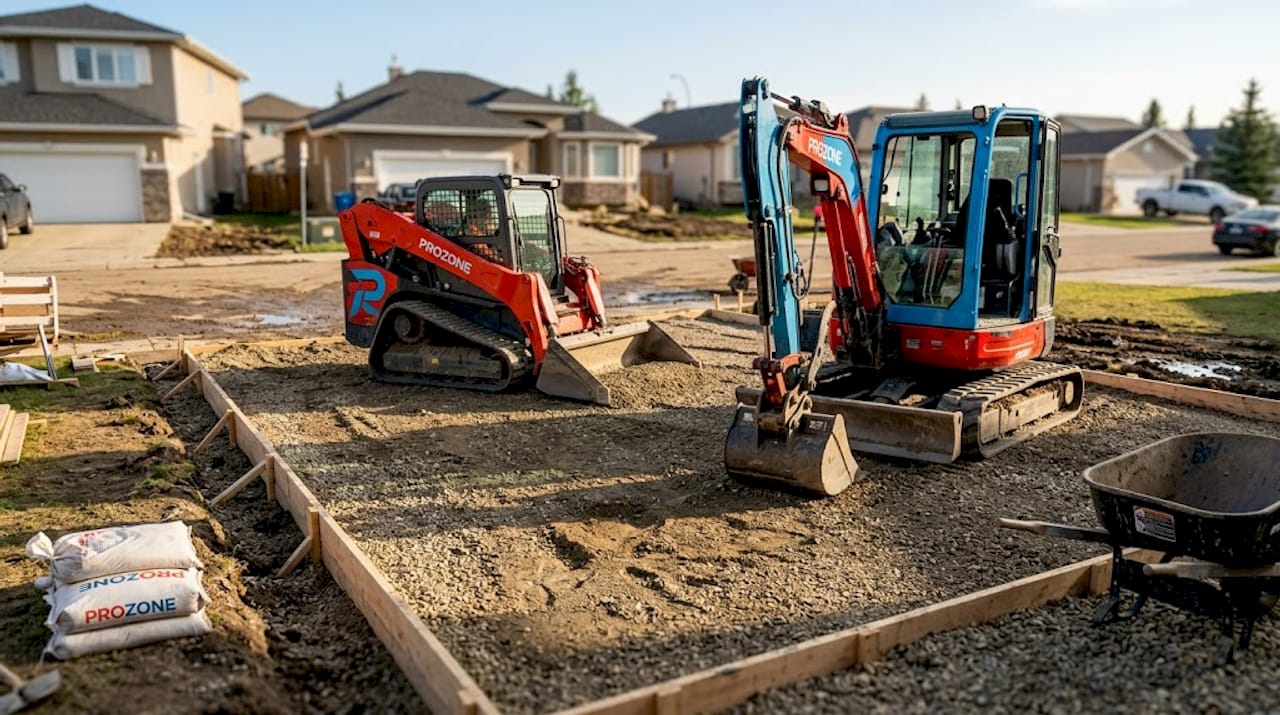
A properly prepared base distributes the load of the slab and prevents water from pooling underneath it. This is not a step you can rush or skip to save money. Reviewing asphalt installation steps for Edmonton gives you a useful comparison of how base prep differs between material types, which helps you understand why concrete has its own specific requirements.
| Requirement | Details |
|---|---|
| Development permit | $190, required before work begins |
| Max driveway width | 9 meters at property line |
| Minimum slope | 2% away from the house |
| Utility check | Call 811 before any digging |
| Frost line depth | Up to 1.2 meters in Edmonton |
Essential tools, materials, and thickness guide
With the rules and risks clear, get equipped for a successful Edmonton driveway install. Having the wrong tools or the wrong concrete mix on-site wastes time and money. Edmonton’s climate also demands specific material choices that you would not necessarily need in a warmer province.
Tools you will need
- Plate compactor: essential for compacting the gravel base evenly
- Concrete forms (2×6 or 2×8 lumber): used to frame the shape of the slab
- Screed board: levels the wet concrete to the top of the forms
- Bull float: smooths the surface after screeding
- Edger: creates a rounded edge that resists chipping
- Groover or control joint tool: cuts grooves that control where cracks form
- Concrete saw: for cutting control joints after the pour if needed
- Vibrator (optional but recommended): removes air pockets from the mix
- Broom: creates a textured, slip-resistant surface finish
- Wheelbarrow and shovels: for moving and spreading concrete
Materials and their roles
The base layer is typically 150 to 200mm (6 to 8 inches) of compacted granular gravel. This layer drains water away from the slab and provides a stable, frost-resistant platform. Gravel and sand types matter here. A well-graded crushed gravel, often called Class A or road base gravel, compacts tightly and resists frost movement better than round river gravel.
The concrete mix itself should be a minimum of 32 MPa (megapascals) for Edmonton driveways. This is a measure of compressive strength. Higher MPa means the concrete resists cracking and surface wear better under heavy loads and temperature swings. Using the right mix is as important as the right thickness. You can learn more about choosing concrete types for Alberta conditions to match the mix to your specific project needs.
Thickness specifications
Concrete Alberta recommends a minimum thickness of 100mm (4 inches) for driveways used by passenger cars, and 150mm (6 inches) for areas that will see heavier vehicles like trucks or RVs. In Edmonton’s climate, going with 5 inches as a standard residential thickness is a smart middle ground that adds durability without dramatically increasing cost.
| Thickness | Best for | Notes |
|---|---|---|
| 4 inches (100mm) | Light passenger cars | Minimum allowed; not ideal for Edmonton winters |
| 5 inches (125mm) | Standard residential | Recommended for most Edmonton homes |
| 6 inches (150mm) | Trucks, RVs, heavy loads | Required for heavier vehicles |
Reinforcement options
Reinforcement holds the slab together if cracks do form, preventing them from widening into dangerous gaps.
- Rebar (steel reinforcing bar): Provides the strongest reinforcement. Placed in a grid pattern, typically 12 to 18 inches apart, and held 1.5 to 2 inches off the base with plastic chairs.
- Wire mesh: A lighter, cheaper option. Easier to work with but provides less tensile strength than rebar. Common in residential driveways.
- Fiber reinforcement: Synthetic or steel fibers mixed directly into the concrete. Reduces surface cracking and plastic shrinkage cracks. Works well alongside rebar or mesh rather than as a standalone replacement.
Pro Tip: In Edmonton, use fiber-reinforced concrete as your base mix even if you also install rebar. The fibers control the micro-cracks that form during the initial curing phase, which is when Edmonton’s temperature swings are most damaging to a fresh pour.
Step-by-step: How to install a concrete driveway
Now that you’re ready to build, here’s exactly how to execute a lasting, code-compliant driveway. Following this sequence matters. Each step depends on the one before it being done correctly.
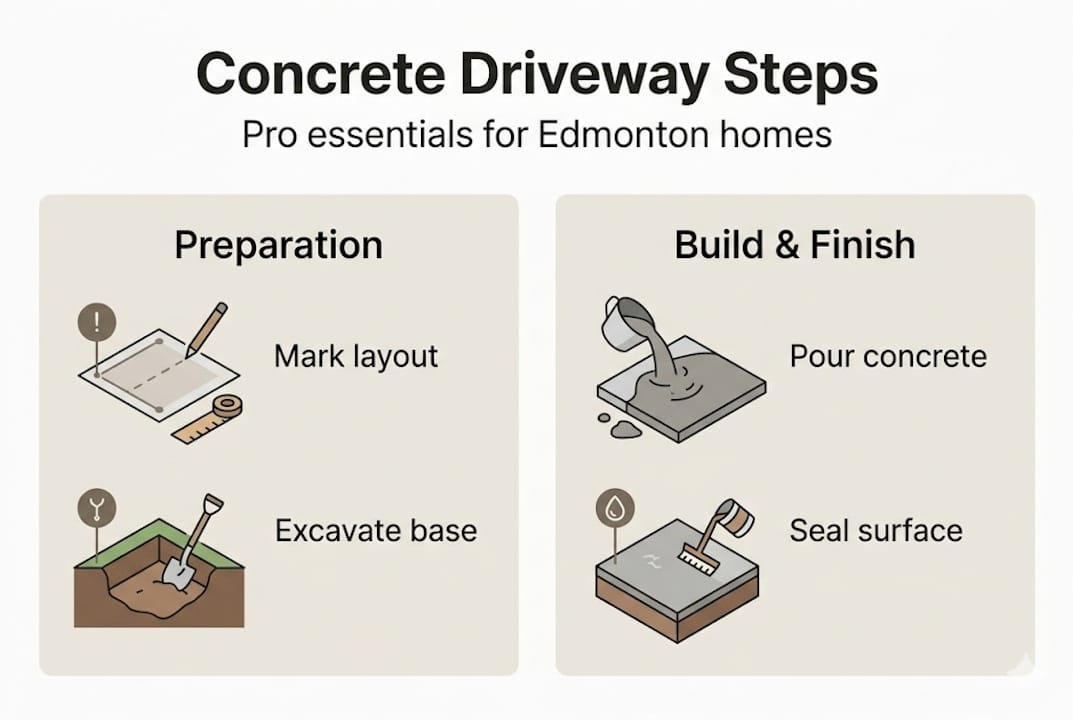
1. Plan and layout
Mark the driveway outline with stakes and string. Confirm the 2 to 4 percent slope away from the house. Measure twice. Check your permit approval to confirm the dimensions match what was approved.
2. Call 811 and wait for clearance
Do this before any digging. Wait for all utilities to be marked before you break ground. This step takes a few days, so plan ahead.
3. Demolition and excavation
Remove any existing pavement, vegetation, or topsoil. Excavate to a depth that accommodates your base gravel plus your slab thickness. For a 5-inch slab with a 7-inch gravel base, you’re digging roughly 12 inches down. Haul away all debris.
4. Base preparation
Spread and compact your gravel base in layers no thicker than 4 inches at a time. Compact each layer with a plate compactor before adding the next. This is the most critical step in the entire process. A poorly compacted base is the number one cause of driveway failure in Edmonton. Base course prep for Alberta roads follows the same principle: compaction is everything.
5. Set forms
Install your lumber forms along the edges of the driveway. Use stakes to hold them firmly in place. Check that the forms follow the correct slope. The top of the forms defines the finished surface height of your slab.
6. Install reinforcement
Lay rebar or wire mesh across the base. Use plastic chairs to hold the reinforcement at mid-depth in the slab, not resting on the gravel. If you’re using fiber-reinforced concrete, confirm with your supplier that the fibers are already in the mix.
7. Pour the concrete
Order ready-mix concrete from a local Edmonton supplier. Have your crew ready before the truck arrives. Concrete in Edmonton should include air entrainment, a process that adds tiny air bubbles to the mix. These bubbles give the concrete room to expand and contract during freeze-thaw cycles without cracking. Aim for 5 to 8 percent air content in the mix.
Pour from one end and work toward the other. Use a vibrator to remove air pockets, especially near the forms. Screed the surface level with the top of the forms immediately after pouring.
8. Finish the surface
Use a bull float to smooth the surface after screeding. Once the bleed water (the shiny film that rises to the surface) disappears, use an edger along the forms and a groover to cut control joints. Space control joints every 8 to 10 feet. These joints tell the concrete where to crack, keeping any cracks hidden inside the joint rather than running randomly across your driveway. Finish with a broom drag for texture.
Timing note: Do not overwork the surface. Finishing too early, while bleed water is still present, weakens the surface layer and leads to scaling. Scaling is when the top layer of concrete flakes off, which is a very common problem in Edmonton driveways exposed to road salt and freeze-thaw cycles.
9. Cure the concrete
Standard curing practice calls for keeping the concrete moist for at least 7 days. Cover the slab with plastic sheeting or apply a curing compound immediately after finishing. In Edmonton’s dry summers, moisture evaporates fast. Curing is what gives concrete its strength. A slab that dries out too quickly in the first week will never reach its design strength, no matter how good the mix was.
10. Seal after 28 days
Wait the full 28 days before applying a penetrating concrete sealer. At this point, the concrete has reached most of its design strength. A good sealer blocks water, road salt, and oil from penetrating the surface, dramatically extending the life of your driveway.
Pro Tip: Schedule your pour for a day when temperatures will stay between 10°C and 25°C for at least 48 hours. Pouring in extreme heat causes the surface to dry too fast. Pouring when temperatures drop below 5°C risks frost damage to the fresh concrete before it gains strength.
Knowing what causes concrete to crack can help you understand why each of these steps matters so much in Edmonton’s demanding climate.
Preventing common mistakes and driveway failures
Solid execution is vital, but even small errors can lead to costly issues. Here’s how to avoid or fix the problems that show up most often in Edmonton driveways.
The most common failure points
Poor base preparation causes roughly 90% of driveway failures. That is not a small number. It means that most cracked, sunken, or heaved driveways could have been avoided with better compaction and grading before the pour. The concrete itself is rarely the problem.
Other frequent mistakes include:
- Pouring too thin: Going with 3.5 inches to save money almost always results in cracking within two to three winters in Edmonton.
- Skipping air entrainment: Non-air-entrained concrete in Edmonton’s climate will scale and crack. This is not a maybe. It is a certainty over time.
- Finishing too early or too late: Both ruin the surface. Too early traps bleed water, weakening the top layer. Too late means the concrete has stiffened and won’t accept a proper finish.
- Inadequate curing: Cutting the curing period short, especially in hot or windy Edmonton summers, permanently weakens the slab.
- No control joints: Without control joints, concrete cracks wherever it wants to. With them, cracks are hidden and controlled.
How to spot early warning signs
If you notice surface scaling within the first winter, it usually means the surface was finished while bleed water was still present, or the concrete was not air-entrained. If you see random cracking across the slab, the base was likely not compacted properly or control joints were spaced too far apart. Sinking or heaving in sections points to base failure or poor drainage.
Edmonton freeze-thaw tips
Edmonton averages over 100 freeze-thaw cycles per year. That is 100 opportunities for water in your slab or base to expand and contract. Sealing your driveway annually with a penetrating sealer is your best defense. Avoid using rock salt for ice control. Rock salt accelerates surface scaling dramatically. Use sand or a calcium magnesium acetate product instead.
Pro Tip: If you see a small crack forming in the first year, fill it immediately with a concrete crack filler. A 1mm crack that gets water in it will become a 10mm crack after one winter. Early intervention is cheap. Waiting is expensive.
Comparing asphalt vs. concrete parking lots shows that concrete generally outperforms asphalt in longevity when installed correctly, but that advantage disappears entirely if the base or curing is compromised.
Why professional help matters for Edmonton concrete driveways
Here is a perspective that most installation guides won’t give you. Even experienced, capable homeowners who follow every step in this guide often call in professionals for at least one or two critical phases of the project. That is not a sign of failure. It is a sign of good judgment.
Edmonton’s context is genuinely different from a mild-climate driveway install. The permit process requires specific documentation and knowledge of local zoning rules that change periodically. The base preparation requires equipment, specifically a plate compactor and a laser level, that most homeowners don’t own and that rental equipment alone doesn’t guarantee you’ll use correctly. And the concrete pour itself is a time-sensitive operation where mistakes cannot be undone once the mix starts to set.
Concrete Alberta notes that DIY installation is possible but that professional crews are recommended for Edmonton specifically because of climate demands, permit complexity, and the nuances of base preparation in frost-prone soil. This is not marketing language from a contractor. It is guidance from an industry body that has no financial stake in whether you hire someone or not.
The hidden costs of a failed DIY install are real. A driveway that fails permit inspection must be removed and redone, which means paying for demolition, disposal, and a second installation. A slab that cracks in the first two years because the base wasn’t compacted properly costs more to repair than the savings from doing it yourself. And a driveway that scales because air entrainment was skipped or curing was rushed will need resurfacing within five to ten years.
What professional crews do differently is not always visible. They test soil compaction with a compaction meter rather than guessing. They order concrete with a verified mix design that meets Edmonton’s specific requirements. They monitor the pour in real time and adjust finishing timing based on temperature and humidity readings. They know from experience exactly when to cut control joints and how deep to make them. These are skills that come from doing dozens or hundreds of pours in Edmonton’s specific conditions, not from reading a guide.
This doesn’t mean you should never attempt a driveway project yourself. It means you should be honest about which phases carry the most risk and consider professional support for those specific steps, even if you handle the rest. Exploring Alberta paving insights can help you understand the full scope of what experienced crews bring to projects like this one.
Get professional support for your Edmonton driveway
If this guide has shown you anything, it’s that a concrete driveway in Edmonton is a serious project with real consequences when steps are missed. ProZone Ltd works with Edmonton homeowners to handle exactly these situations, from permit navigation and base preparation to the final pour and sealing. Our concrete contractor services are built around Edmonton’s specific climate and regulatory requirements, so you get a driveway that lasts. Whether you want full installation support or just professional oversight for the critical phases, our team can help. You can also review our construction service options to understand the full range of what we offer Edmonton property owners. And once your driveway is in, our concrete maintenance guide will help you protect your investment for years to come.
Frequently asked questions
Do I need a permit to install a new concrete driveway in Edmonton?
Yes. A development permit costing $190 is required for new driveways, widening, or material replacement in Edmonton. No separate building permit is needed, but the development permit must be approved before work begins.
How thick should my concrete driveway be for Edmonton weather?
Concrete Alberta specifies a minimum of 4 inches for passenger vehicles, but 5 to 6 inches is the practical recommendation for Edmonton homes, especially if you park trucks or heavier vehicles on the driveway.
How long before I can drive or walk on my new concrete driveway?
Wait at least 7 days before allowing foot traffic on a new slab, and a full 28 days before driving vehicles on it. Driving on concrete too early causes permanent surface damage that cannot be repaired without resurfacing.
What causes concrete driveways to crack in Edmonton?
Most cracks trace back to poor base preparation or inadequate curing, both of which are made significantly worse by Edmonton’s freeze-thaw cycles. Skipping air entrainment in the concrete mix is another major cause of surface cracking and scaling in cold climates.