
TL;DR:
- Compacted gravel is aggregate that has been mechanically compressed to reduce air voids and increase density. Proper compaction is essential in Edmonton to prevent freeze-thaw damage, with particle shape and moisture content playing key roles in material stability. Using appropriate gravel types and following correct installation procedures extends pavement life and resists frost heaving.
Compacted gravel is defined as aggregate that has been mechanically compressed to reduce air voids, producing a dense, load-bearing base suitable for construction and landscaping projects. In its loose state, gravel contains air voids of roughly 35–40%; proper mechanical compaction reduces those voids to 20–25%, significantly increasing the material’s density and structural capacity. This distinction matters enormously in Edmonton, where freeze-thaw cycles can destroy an improperly prepared base within a single winter season. Understanding what compacted gravel is, and how to apply it correctly, separates a surface that lasts decades from one that fails in the first spring thaw.
What is compacted gravel and what are its physical properties?
Compacted gravel is not simply gravel that has been poured and left to settle. It is aggregate that has been mechanically processed to interlock particles and expel excess air, creating a material with measurably higher density and load capacity than its loose equivalent.
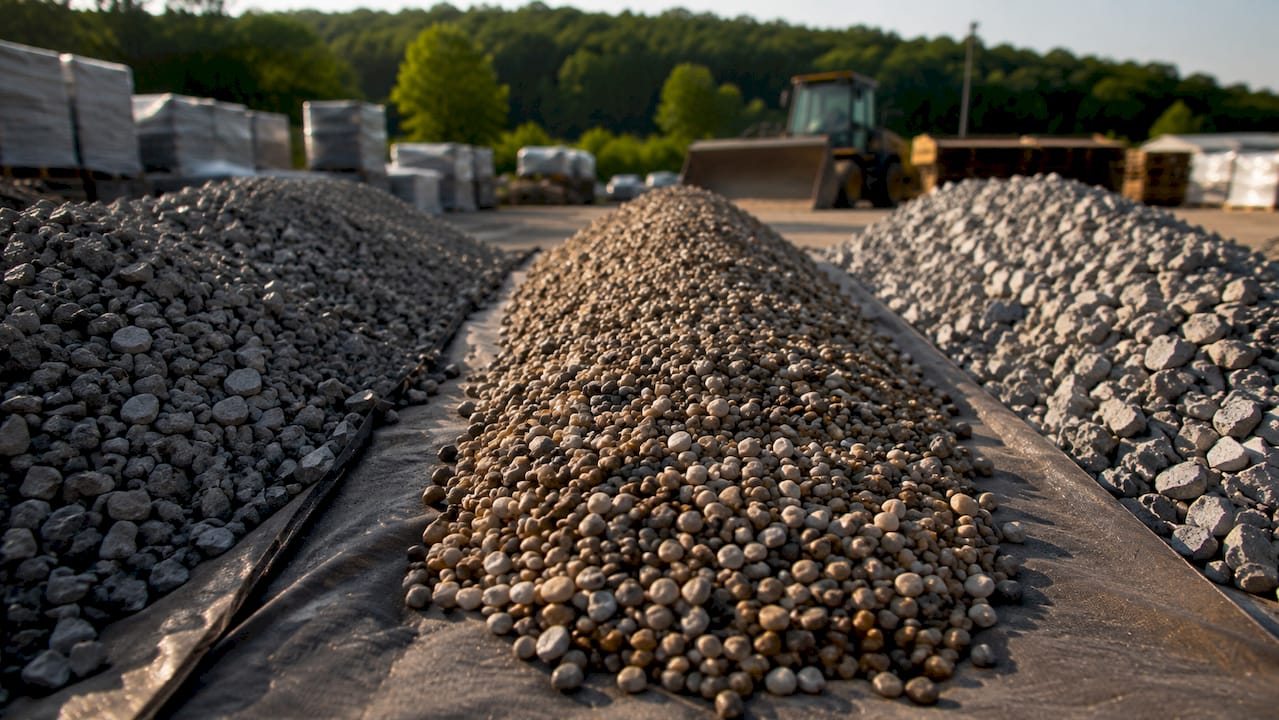
Particle shape is the single most important factor in compaction performance. Angular, crushed stone locks under pressure because fractured edges grip adjacent particles. Rounded gravel, such as river stone or pea gravel, does not interlock and remains relatively loose regardless of compaction effort. This is why crusher run and road base materials consistently outperform decorative rounded gravels in structural applications.
Grading and fines content also determine how well a material compacts. Dense-graded aggregates contain a mix of particle sizes, including fine material that fills the gaps between larger stones. This gradation distributes load more evenly and produces a cohesive, stable matrix when compacted. Open-graded materials, which lack fines, rely on gravity and traffic rather than mechanical compaction for stability.
Moisture content plays a critical role that many builders underestimate. Gravel that is barely damp compacts better than bone-dry material because slight moisture lubricates particle movement and improves binding. Excess moisture, however, creates a slurry condition that prevents proper densification and causes long-term instability.
Common gravel types used in Edmonton
| Gravel type | Particle shape | Fines content | Compaction suitability |
|---|---|---|---|
| Crusher run (road base) | Angular | High | Excellent |
| Limestone (10–20mm) | Angular | Moderate | Good |
| Limestone (40mm) | Angular | Low | Moderate |
| #57 stone (open-graded) | Angular | Very low | Poor mechanically |
| Pea gravel | Rounded | None | Not suitable |
The Edmonton region’s clay-heavy subgrades make material selection even more consequential. A poorly graded base on expansive clay will heave and crack regardless of how well it is compacted on the surface.
How is gravel properly compacted for construction and landscaping use?
Proper compaction follows a defined sequence. Skipping any step reduces the final density and shortens the life of the surface above it.
- Prepare the subgrade. Remove organic material, soft soil, and debris. The subgrade must be stable before any gravel is placed. Soft spots should be excavated and backfilled with suitable material.
- Place gravel in lifts. Compaction penetrates only 2–4 inches per pass, so gravel must be placed in layers not exceeding that depth. Attempting to compact a 6-inch layer in one pass leaves the bottom portion loose and unstable.
- Condition moisture. Check that the gravel is slightly damp before compacting. In dry Alberta summers, lightly misting the surface with water before each pass improves density achievement.
- Select appropriate equipment. Plate compactors suit residential driveways and patio bases. Vibratory rollers are standard for road base and commercial applications. Hand tampers are acceptable only for small, confined areas where equipment cannot reach.
- Make multiple passes. A single pass is never sufficient. Make a minimum of three to four overlapping passes over each lift, then verify density before placing the next layer.
- Verify compaction. On commercial projects, a nuclear density gauge or sand cone test confirms that the required density has been achieved. On residential projects, a simple proof-roll test (driving a loaded vehicle slowly over the surface and watching for deflection) provides a basic check.
- Account for volume loss. Order a 10% volume buffer for standard projects. Soft subgrades or heavy compaction requirements may demand a 15–25% buffer to account for material lost to compaction and minor site irregularities.
Pro Tip: In Edmonton, schedule compaction work when daytime temperatures are above 5°C. Compacting frozen or near-frozen gravel produces false density readings. The material appears solid but loses that density as temperatures rise and particles shift.
Freeze-thaw cycles are the dominant failure mechanism for compacted bases in Alberta. A base that is not compacted to sufficient density will absorb water, freeze, expand, and heave the surface above it. Proper lift thickness and moisture control during installation are the primary defences against this failure mode.
What are the main uses and benefits of compacted gravel in Edmonton projects?
A compacted granular base acts as a structural bridge, distributing vehicle wheel loads over a larger soil area and preventing subgrade failure and rutting. This load-distribution function is the reason compacted gravel appears under virtually every durable outdoor surface, from residential driveways to municipal roads.
Key applications
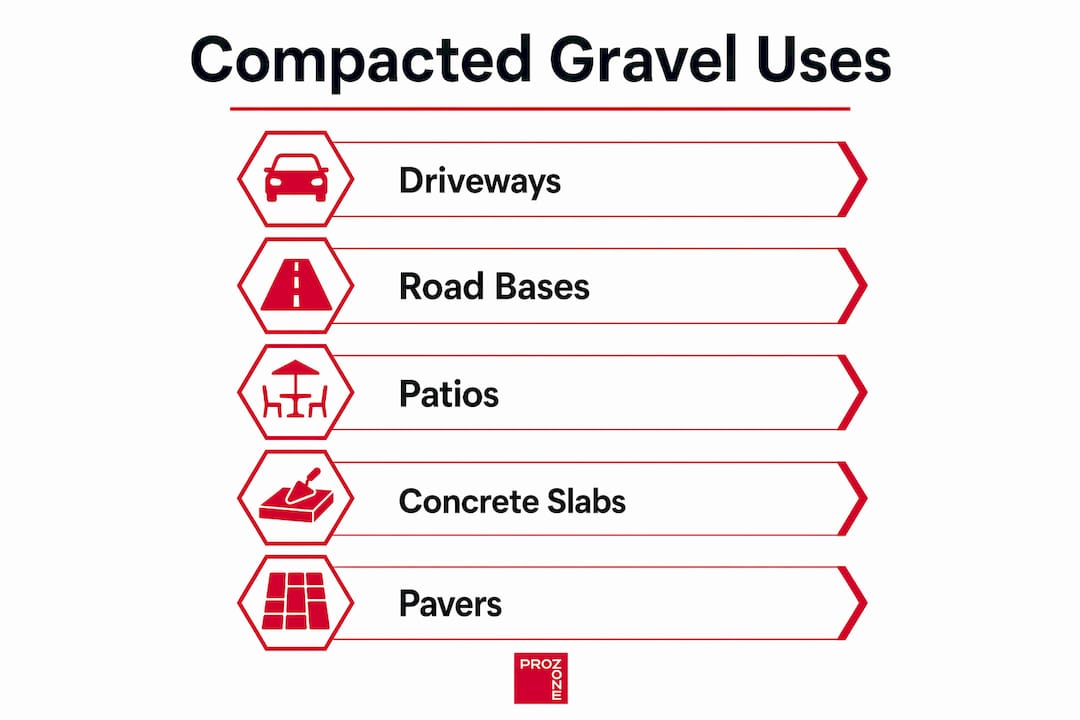
- Road base and driveways. Standard residential projects use 3–4 inches of compacted road base (crusher run) as a foundation layer. Commercial roads and heavy-traffic areas require greater depth, determined by traffic load calculations.
- Patio and paver sub-bases. A compacted gravel sub-base prevents differential settlement under interlocking pavers and concrete slabs. Without it, pavers sink unevenly and joints open up within a few seasons.
- Concrete slab preparation. Compact base preparation before concrete placement prevents differential settlement and cracking, directly extending slab longevity.
- Drainage layers. Gravel bases manage subsurface water by directing it away from structures. In Edmonton’s wet spring conditions, this drainage function protects foundations and prevents frost heaving.
- Landscaping and pathway foundations. Compacted gravel provides a stable, weed-resistant base for pathways, retaining wall footings, and garden borders.
Benefits specific to Edmonton’s climate
Frost heaving is the primary threat to outdoor surfaces in Alberta. A properly compacted base resists heaving in two ways: it limits the water that can infiltrate the base, and its density reduces the expansion space available when water freezes. Compacted crusher run, for example, holds its structure through repeated freeze-thaw cycles far better than loose or rounded aggregate.
Durability against rutting is a direct result of particle interlocking. Dense-graded mixes with fines compact hard mechanically, creating a surface that resists deformation under load. This makes compacted road base the standard choice under asphalt and concrete in Alberta’s commercial construction sector.
Cost effectiveness is another clear advantage. A properly installed compacted gravel base extends the service life of the surface above it, reducing the frequency of repairs and resurfacing. The upfront material and labour cost is consistently lower than the cost of repairing a failed surface caused by inadequate base preparation.
How to select the right gravel type for your compacted base
Gravel selection depends on two competing priorities: drainage and load bearing. Open-graded aggregates like #57 stone drain freely because water passes through the large voids between particles. Dense-graded aggregates like crusher run resist water infiltration but compact to a much higher density and load capacity.
Pro Tip: For most Edmonton driveways and patio bases, crusher run is the correct choice. Use open-graded stone only where drainage is the primary concern, such as behind retaining walls or under permeable paving systems.
Gravel selection comparison
| Gravel type | Best use | Drainage | Load bearing | Compaction method |
|---|---|---|---|---|
| Crusher run | Driveways, road base, slab sub-base | Low | Very high | Plate compactor or roller |
| Limestone (10–20mm) | Pathways, landscaping bases | Moderate | High | Plate compactor |
| Limestone (40mm) | Drainage layers, large fill areas | High | Moderate | Roller preferred |
| #57 open-graded stone | Drainage, retaining wall backfill | Very high | Low | Not mechanically compacted |
| Pea gravel | Decorative, walkways | High | Very low | Not suitable |
Particle shape and fines content remain the deciding factors for structural applications. Angular particles with adequate fines produce the highest compacted density and the most stable base. In Alberta’s clay-heavy soils, a well-graded crusher run base also acts as a separation layer, preventing clay migration into the gravel and maintaining long-term drainage performance.
For projects where both drainage and load bearing matter, a two-layer approach works well. Place open-graded stone at the bottom for drainage, then cap it with a dense-graded crusher run layer that compacts to a firm, stable surface. This combination is standard practice in base course paving for Alberta roads and commercial parking areas.
What working on Edmonton sites has taught me about compacted gravel
The most common failure pattern on Edmonton projects is not poor material selection. It is contractors compacting lifts that are too thick, too dry, or both. A 6-inch lift compacted in one pass looks solid on the surface but remains loose at depth. That loose zone becomes a water reservoir in spring, and frost heaving follows within one or two winters.
Material quality disparities are real and consequential. Crusher run sourced from a reputable supplier with consistent gradation performs predictably. Material from unverified sources often contains excess clay or inconsistent fines content, which undermines compaction density regardless of the equipment used. The difference shows up not in the first season but in the third or fourth, when differential settlement begins to crack the surface above.
DIYers consistently underestimate the number of passes required. Three passes with a plate compactor on a 2-inch lift is a minimum, not a target. On projects where the subgrade is soft or the surface will carry vehicle loads, four to six passes per lift is the correct standard. Skipping passes to save time is the most expensive shortcut in site preparation.
Partnering with a certified provider who follows Alberta Safety Codes and uses verified materials eliminates the guesswork from base preparation. The long-term performance of any paved or landscaped surface depends almost entirely on what happens below the surface during installation.
— ProZone
Prozoneltd’s gravel base and site preparation services in Edmonton
Prozoneltd operates across Edmonton and the surrounding region, delivering road construction and base preparation services for municipal, commercial, and private clients. Every project follows Alberta Safety Codes, with compaction verified to specified density standards before any surface layer is placed. Prozoneltd supplies crusher run, limestone variants, and other gravel and sand products suited to Edmonton’s freeze-thaw conditions, sourced and graded for consistent compaction performance. Contact Prozoneltd directly through the online form or by phone to receive a free estimate for your site preparation or gravel base project.
FAQ
What is compacted gravel used for?
Compacted gravel is used as a base layer under driveways, roads, concrete slabs, patios, and paver installations. Its primary function is to distribute loads and prevent settlement, rutting, and frost heaving.
How deep should a compacted gravel base be?
Standard residential projects require 3–4 inches of compacted road base. Commercial roads and heavy-load applications require greater depth based on traffic load calculations and subgrade conditions.
What is the best gravel type for compaction?
Crusher run (dense-graded road base) is the best material for mechanical compaction. Its angular particles and high fines content interlock under pressure to produce a dense, stable base.
Does pea gravel compact well?
Pea gravel does not compact well mechanically. Its rounded particles do not interlock, so it remains loose regardless of compaction effort. It is suitable for decorative and drainage applications only.
How does moisture affect gravel compaction?
Barely damp gravel compacts to a higher density than dry gravel because slight moisture improves particle binding. Excess moisture creates a slurry condition that prevents proper densification and causes long-term instability.