
TL;DR:
- Exterior surface solutions protect and restore outdoor property surfaces against weathering and wear in Edmonton’s challenging climate. High-quality coatings last 7 to 10 years when properly applied, with specific products suited for natural stone, concrete, or commercial use, considering Edmonton’s freeze-thaw cycles. Proper surface preparation, climate-aware product selection, and proactive maintenance are essential for long-term performance and cost savings.
Exterior surface solutions are specialised treatments and coatings designed to protect, restore, and beautify outdoor property surfaces against weathering and wear. In Edmonton, where freeze-thaw cycles can shift temperatures by 30°C or more within a single season, choosing the right outdoor surface treatments is not a cosmetic decision. It is a structural one. High-quality protective systems deliver 7–10 years of service when correctly applied, covering driveways, patios, retaining walls, and landscaped areas. Prozoneltd applies certified, Alberta Safety Codes-compliant materials to every project, ensuring treatments perform through the full range of Edmonton’s climate exposure.
What types of exterior surface solutions are available for driveways, patios, and landscaping?
The two foundational categories of exterior coating options are penetrating sealers and film-forming coatings. Each serves a distinct purpose, and selecting the wrong type for a given substrate causes premature failure.
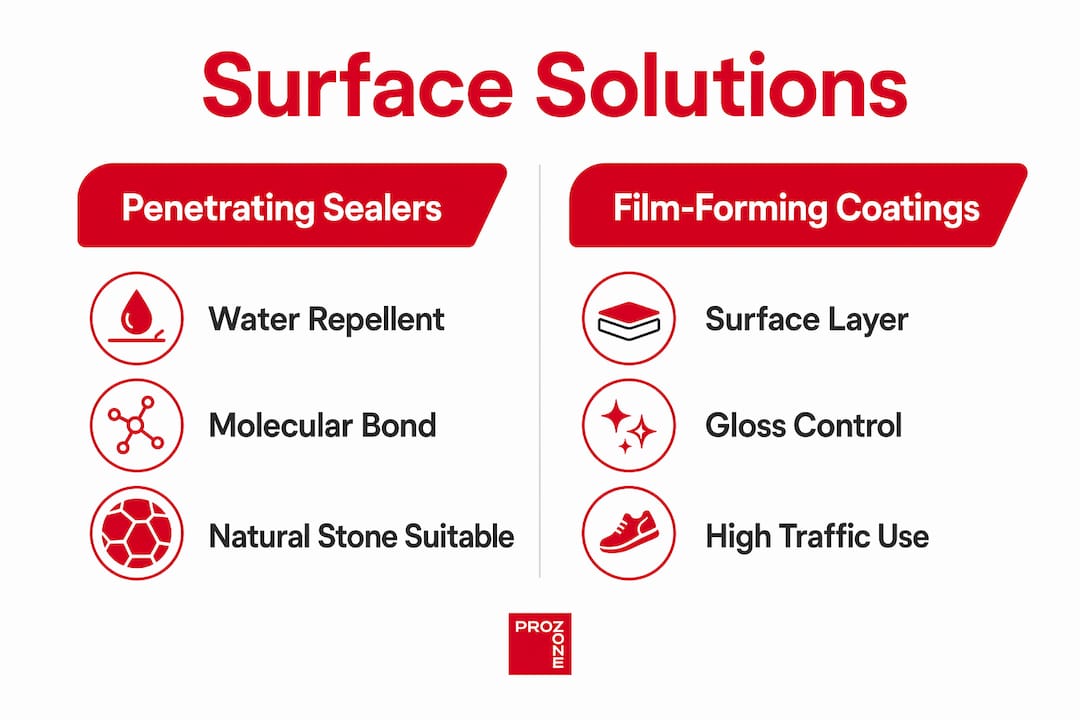
Penetrating sealers absorb into the substrate at a molecular level, repelling water without forming a surface layer. This breathability is critical for natural stone, exposed aggregate, and masonry, where trapped moisture causes spalling. Film-forming coatings, by contrast, sit on top of the surface and create a physical barrier. They deliver higher gloss, easier cleaning, and a tighter moisture seal, making them well suited to concrete driveways and sealed patios.
Advanced nano-coatings represent a third category. These products penetrate at a nanoscale level, bonding to the substrate and providing water and oil repellency without altering the surface appearance. Nano-coatings dry within 0.5–1 hour under ideal conditions, which reduces project downtime considerably. Coverage runs approximately 8–10 m² per litre, making them cost-effective for large commercial surfaces.
For high-traffic commercial driveways and parkades, neither basic sealers nor standard film-forming coatings are sufficient. Structural traffic coating systems use multi-layer assemblies, including moisture-mitigation primers, bridging membranes, and aggregate-reinforced wear coats, to distribute mechanical loads and resist thermal cycling. These are the correct specification for any surface bearing vehicular traffic.
| Solution type | Best substrate | Key benefit | Typical use case |
|---|---|---|---|
| Penetrating sealer | Natural stone, masonry | Breathable, prevents spalling | Patios, retaining walls |
| Film-forming coating | Concrete, pavers | High gloss, tight moisture barrier | Driveways, sealed patios |
| Nano-coating | Concrete, stone, tile | Fast dry, invisible finish | Large commercial surfaces |
| Traffic coating system | Concrete slabs | Load distribution, waterproofing | Parkades, commercial driveways |
Pro Tip: For exposed aggregate or natural stone patios, always specify a penetrating impregnating sealer. A film-forming product on these substrates traps vapour and will delaminate within one to two winters in Edmonton.
How does Edmonton’s climate affect exterior coating performance?
Edmonton’s climate creates one of the most demanding environments for outdoor surface treatments in Canada. The city experiences dozens of freeze-thaw cycles annually, where water infiltrates surface pores, freezes, expands, and fractures the substrate from within. This mechanism is the primary cause of concrete spalling, paver heaving, and sealer delamination on untreated or improperly treated surfaces.
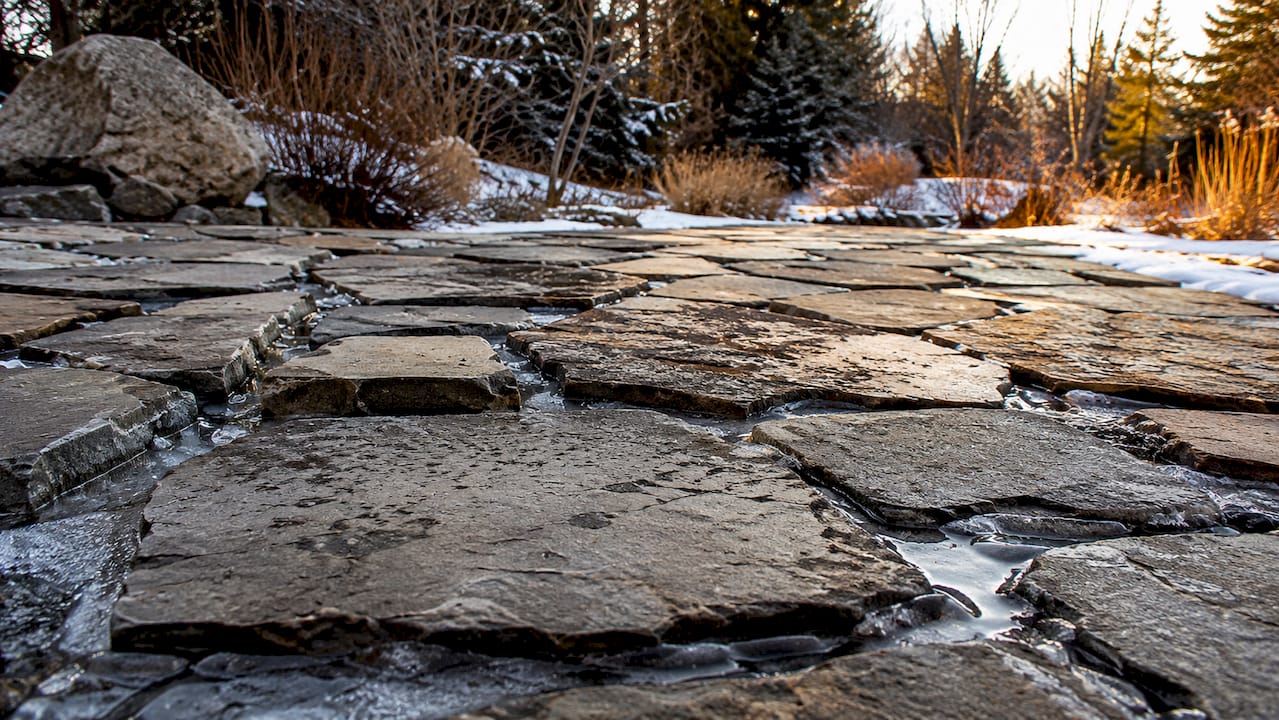
Surface treatments must account for climate exposure class, a specification standard that categorises products by their ability to handle moisture migration in freeze-thaw conditions. Products rated for Edmonton’s exposure class are engineered to flex with thermal movement rather than crack under it. Standard consumer-grade sealers are not rated for this class and fail within one to two seasons.
Vapour permeability is the most overlooked factor in product selection. Applying film-forming sealers to damp substrates traps moisture below the coating, which then freezes, expands, and forces the coating off the surface. This failure mode is common on below-grade concrete and natural stone in Edmonton. Vapour-permeable impregnating sealers eliminate this risk by allowing moisture to escape while still blocking liquid water ingress.
| Surface type | Climate risk | Recommended treatment |
|---|---|---|
| Natural stone patio | Spalling from trapped moisture | Vapour-permeable impregnating sealer |
| Concrete driveway | Surface scaling, freeze-thaw cracking | Penetrating sealer or traffic coating |
| Asphalt surface | Oxidation, thermal cracking | Rejuvenating surface treatment |
| Exposed aggregate | Aggregate pop-out | Breathable penetrating sealer |
Pro Tip: Schedule sealer applications in late summer or early autumn, when substrate temperatures are stable and humidity is lower. Applying any coating when ground temperatures fall below 10°C compromises adhesion and curing.
What should property managers consider when selecting exterior surface treatments?
Material compatibility is the first selection criterion. The substrate type, whether concrete, asphalt, natural stone, or pavers, determines which product chemistry will bond correctly. Applying an incompatible coating creates adhesion failure regardless of product quality. Review best materials for outdoor landscaping to understand how substrate choice affects treatment options from the ground up.
Traffic load and use frequency are equally important. A residential patio sealer is not engineered for a commercial loading dock. Vehicular loads on commercial driveways require multi-layer traffic coating systems rather than simple water-repellent sealers. Specifying the wrong product class for the load results in rapid surface degradation and costly remediation.
Gloss level affects both aesthetics and maintenance. High-gloss finishes clean more easily and form tighter moisture barriers, making them appropriate for trim, doors, and sealed concrete. Flat or matte finishes are correct for masonry and stucco, where breathability and concealment of surface texture matter more than sheen. Selecting the wrong sheen level for a substrate can compromise its structural integrity over time.
Environmental compliance is a non-negotiable factor in 2026. Modern high-performance coatings are waterborne and VOC-compliant, delivering premium durability without strong odours or environmental toxicity. Alberta regulations increasingly restrict high-VOC solvent-based products for commercial applications.
Selection checklist for property managers and homeowners:
- Identify the substrate material and its current condition.
- Assess the traffic load: pedestrian, light vehicle, or heavy commercial.
- Determine the climate exposure class required for Edmonton’s freeze-thaw conditions.
- Choose gloss level based on substrate type and maintenance preference.
- Confirm VOC compliance with current Alberta environmental standards.
- Verify that the product is rated for the application temperature range.
- Engage a certified applicator to assess surface preparation requirements before purchase.
Pro Tip: Property managers often select a coating based on appearance alone. Finish sheen is a functional specification, not just an aesthetic one. An inappropriate sheen on masonry reduces breathability and accelerates moisture damage.
How should exterior surface solutions be applied and maintained for long-term performance?
Surface preparation is the single largest determinant of coating success. Applying coatings in suboptimal conditions leads to failure within months, regardless of product quality. The substrate must be clean, dry, and free of existing coatings, oils, or efflorescence before any treatment is applied. For nano-coatings specifically, relative humidity must be below 30% and temperature within the manufacturer’s specified range.
Concrete and masonry surfaces benefit from mechanical preparation, such as pressure washing followed by acid etching or shot blasting, to open the surface profile and improve adhesion. Asphalt surfaces require crack filling and surface cleaning before any rejuvenating treatment. Skipping preparation to save time is the most common cause of premature coating failure on Edmonton properties. Review concrete maintenance best practices for a detailed preparation protocol.
Curing and drying times vary significantly by product type. Nano-coatings cure within 0.5–1 hour under ideal conditions. Film-forming coatings typically require 24–48 hours before foot traffic and 72 hours before vehicle traffic. Applying traffic too early disrupts the film and creates permanent surface defects.
Routine maintenance extends service life and reduces the frequency of full reapplication. The following actions protect your investment between major treatment cycles:
- Inspect surfaces each spring after the final freeze-thaw cycle for cracks, spalling, or sealer delamination.
- Clean surfaces with a pH-neutral cleaner to remove de-icing salt residue, which accelerates concrete degradation.
- Reapply penetrating sealers every 3–5 years, or sooner if water no longer beads on the surface.
- Fill minor cracks immediately. Water infiltration into an unsealed crack expands the damage exponentially through freeze-thaw action.
- Avoid using metal-bladed snow removal equipment on sealed surfaces. Rubber or polyurethane blades prevent coating damage.
- Document application dates and product specifications for each surface area to track reapplication schedules accurately.
Pro Tip: De-icing salts are more damaging to sealed concrete than freeze-thaw cycles alone. Use sand or rock chips for winter traction on sealed driveways and patios wherever possible.
What working in Edmonton’s climate has taught me about surface coatings
The most consistent mistake property managers make is treating exterior coatings as a one-time installation rather than a maintenance cycle. Edmonton’s climate does not allow for that approach. A coating applied correctly in year one will need inspection in year three and reapplication by year five on most surfaces. Properties that follow this cycle avoid the far more expensive outcome of full surface restoration.
The second pattern worth noting is the tendency to under-specify for commercial applications. A penetrating sealer that performs well on a residential patio will not survive two winters on a commercial loading area. Branding and surface quality in construction spaces both depend on specifying the correct product class for the actual load and exposure. The cost difference between a sealer and a structural traffic coating system is modest compared to the cost of replacing a failed surface.
Prozoneltd’s approach prioritises certified product selection and professional surface preparation above all else. The material cost is rarely the limiting factor in a failed coating. The preparation and application conditions almost always are. Property owners who invest in proper preparation and certified applicators consistently achieve the upper end of the 7–10 year service life range.
Proactive maintenance aligned with Edmonton’s seasonal calendar is the most cost-effective strategy available. A spring inspection and targeted repair costs a fraction of a full surface restoration. The property managers who understand this treat their exterior surfaces as infrastructure, not decoration.
— Prozoneltd
Prozoneltd’s exterior surface services for Edmonton properties
Prozoneltd delivers certified exterior surface work across Edmonton and the surrounding region, with materials and methods that meet Alberta Safety Codes requirements. Every project begins with a professional surface assessment to identify substrate condition, climate exposure class, and the correct treatment specification for the load and use case. Whether you manage a commercial property with high-traffic driveways or a residential site with natural stone patios, Prozoneltd provides the right solution for Edmonton’s conditions. Review Prozoneltd’s full range of construction services for Edmonton managers or use the online contact form to request a free, detailed estimate. The team is also available by phone for urgent assessments ahead of the application season.
FAQ
What are exterior surface solutions?
Exterior surface solutions are specialised coatings, sealers, and treatment systems applied to outdoor property surfaces to protect against weathering, moisture, and wear. They include penetrating sealers, film-forming coatings, nano-coatings, and structural traffic coating systems.
How long do exterior coatings last in Edmonton’s climate?
High-quality protective systems last 7–10 years when correctly applied to a properly prepared substrate. Edmonton’s freeze-thaw cycles reduce this range for products not rated for the region’s climate exposure class.
What is the difference between a sealer and a traffic coating?
A sealer provides water repellency and surface protection for pedestrian or light-use areas. A structural traffic coating system uses multiple layers, including primers and aggregate-reinforced wear coats, to handle vehicular loads and thermal cycling on commercial surfaces.
Why do sealers fail on natural stone in Edmonton?
Film-forming sealers applied to damp or porous natural stone trap vapour beneath the coating. When that moisture freezes, it forces the coating off the surface. Vapour-permeable impregnating sealers prevent this by allowing moisture to escape while blocking liquid water.
When is the best time to apply exterior surface treatments in Edmonton?
Late summer or early autumn is the optimal application window, when substrate temperatures are stable and humidity is lower. Coatings applied when ground temperatures fall below 10°C do not cure correctly and fail prematurely.