
TL;DR:
- Edmonton’s sidewalk standards emphasize durability, accessibility, and integration within Complete Streets principles.
- Construction involves multiple precise steps, including utility locates, excavation, gravel base, reinforcement, and proper curing.
- Funding relies on city programs and property owner contributions, with policies addressing exceptions and community input.
Sidewalk construction in Edmonton is far more than pouring concrete and calling it done. The city’s approach is shaped by detailed technical standards, climate realities, equity goals, and a growing emphasis on active transportation. Municipal authorities who treat sidewalks as a simple infrastructure checkbox often find themselves dealing with costly retrofits, accessibility complaints, and community frustration. Edmonton’s updated framework demands something more rigorous: a clear understanding of definitions, funding mechanisms, construction methodology, and the programs designed to close persistent gaps. This article walks through every layer of that framework so your team can plan, approve, and communicate sidewalk projects with confidence.
Table of Contents
- How Edmonton defines municipal sidewalk construction
- Step-by-step methodology: How sidewalks are built and reconstructed
- Accessibility, safety, and the role of the PED Connections strategy
- Funding and programs: Who pays and how gaps are addressed
- Practical edge cases: Assessments, exceptions, and responding to public input
- A fresh perspective: Why consistency and flexibility both matter in Edmonton’s sidewalks
- Expert support for Edmonton’s sidewalk projects
- Frequently asked questions
Key Takeaways
| Point | Details |
|---|---|
| Standards are foundational | Edmonton’s CSDCS documents define sidewalk design, materials, and performance expectations. |
| Methodology ensures durability | Step-by-step reconstruction prioritizes climate resilience, accessibility, and consistent public safety. |
| Funding programs address gaps | The city uses cost-sharing and dedicated programs to build missing segments and renew aging sidewalks. |
| Edge cases require flexibility | Unique lots, community petitions, and maintenance exceptions need clear, fair handling by officials. |
| Balance is key | Authorities must combine strict standards with practical flexibility to serve Edmonton’s changing needs. |
How Edmonton defines municipal sidewalk construction
Most infrastructure work starts with a definition, and sidewalk construction in Edmonton is no exception. What separates Edmonton’s approach from a generic “pour concrete, move on” model is the depth of its governing documents and the explicit connection between design standards and community outcomes.
Edmonton defines municipal sidewalk construction through its City Design and Construction Standards (CSDCS), particularly Volumes 2 (Complete Streets), 2-01 Standards, and 2-03 Details, which establish expectations for design, materials, and methodologies. These documents are not suggestions. They are the operational backbone that every project, whether city-led or developer-driven, must follow. Volume 2 frames sidewalks within the broader Complete Streets philosophy, meaning pedestrian infrastructure is designed alongside cycling lanes, transit stops, and vehicle lanes as an integrated system rather than an afterthought.
The 2025 updates to the CSDCS placed a sharper focus on active transport corridors and climate resilience. Edmonton’s freeze-thaw cycle is brutal on concrete, and the revised standards reflect that reality by specifying materials and base preparation that can withstand repeated thermal stress. This is not just about durability. It is about reducing the long-term cost burden on municipal budgets by building right the first time.
For authorities reviewing project submissions, understanding sidewalk construction standards means knowing what to look for in design packages. A submission that references the CSDCS but ignores Volume 2-03 detail drawings is incomplete. Consistency across projects is what builds public trust and reduces variance in quality across neighborhoods.
“The CSDCS is not a minimum threshold. It is a shared language that ensures every sidewalk in Edmonton, from a new subdivision to a downtown renewal zone, meets the same baseline of safety and function.”
Here is a summary of the key design requirements every municipal authority should internalize:
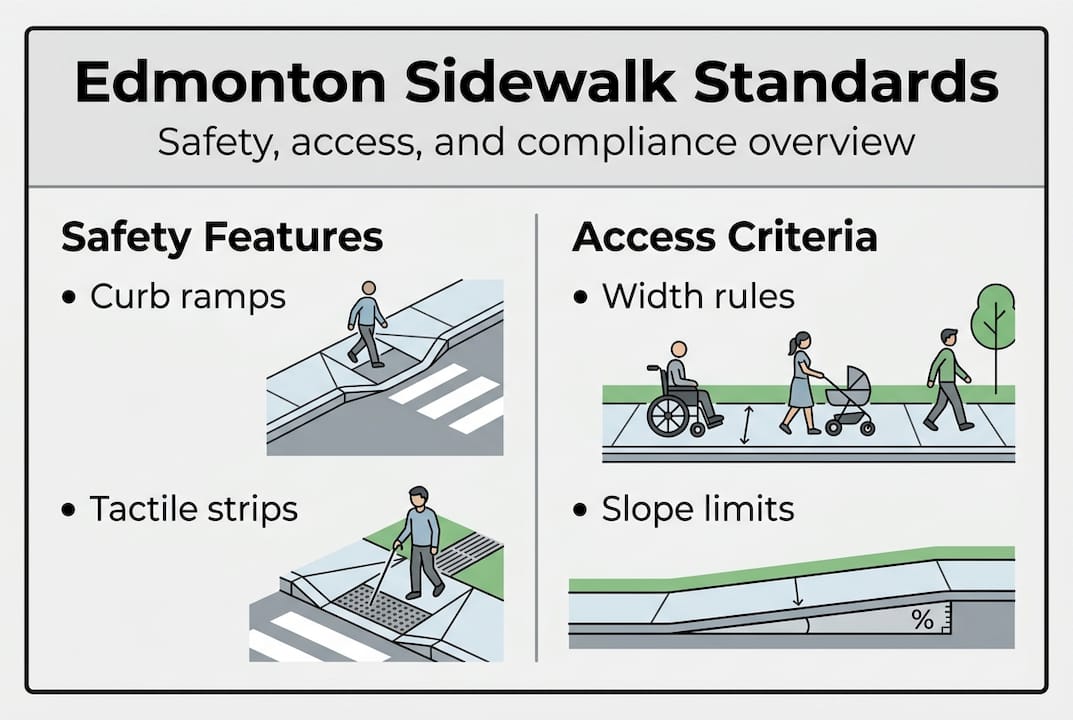
- Minimum width: 1.5 meters for standard sidewalks, wider in high-pedestrian zones
- Materials: Concrete with specified compressive strength for freeze-thaw resistance
- Base preparation: Compacted granular sub-base to prevent frost heave
- Connections: Must link to adjacent sidewalk networks, curb ramps, and transit stops
- Accessibility: Tactile warning surfaces at all pedestrian crossings
- Slope: Cross-slope must not exceed 2% to remain accessible for mobility device users
Critics of the CSDCS have noted that some flexibility provisions allow lower-standard shared paths to substitute for dedicated sidewalks, which creates inconsistency in practice. Understanding municipal paving processes helps authorities recognize when a submitted design is genuinely compliant versus technically compliant but practically inadequate. The distinction matters when approving projects that will serve residents for decades.
Step-by-step methodology: How sidewalks are built and reconstructed
Knowing the standards is one thing. Understanding how they translate into physical construction is what allows municipal authorities to supervise projects effectively, write accurate specifications, and catch problems before they become expensive.
The official reconstruction guide outlines the key construction methodology for sidewalk reconstruction: removal of existing concrete, excavation, laying gravel base, pouring new concrete with reinforcing steel, connecting to property sidewalks, and re-landscaping to City specifications. Each of these steps has specific requirements that affect both cost and long-term performance.
Here is the full sequential breakdown:
- Site assessment and utility locates: Before any demolition begins, underground utilities must be marked. Skipping this step is not just dangerous, it is a regulatory violation.
- Removal of existing concrete: Slabs are broken up and hauled away. The condition of the existing base is assessed at this stage.
- Excavation: Soil is removed to the required depth, typically 200-300mm, to accommodate base material and concrete.
- Gravel base installation: A compacted granular base is laid to provide drainage and structural support. This step is critical in Edmonton’s climate.
- Formwork and reinforcement: Steel rebar or wire mesh is placed before pouring to improve tensile strength.
- Concrete pour and finishing: Concrete is poured to the specified depth, typically 100-125mm, and finished with a broom texture for traction.
- Curing: Concrete must cure for a minimum period before foot traffic is allowed. Rushing this step causes premature cracking.
- Connections and transitions: New sidewalk sections are tied into adjacent infrastructure, including curb ramps and private property walks.
- Re-landscaping: Disturbed boulevard areas are restored with topsoil and sod to City specifications.
The effects of Edmonton climate on concrete are significant. Mechanics emphasize concrete slabs with gravel base and rebar for durability in winter climate, with standards ensuring consistency across public and private projects.

| Construction step | Key specification | Common pitfall |
|---|---|---|
| Excavation | 200-300mm depth | Insufficient depth causes frost heave |
| Gravel base | 150mm compacted granular | Skipping compaction leads to settlement |
| Concrete thickness | 100-125mm | Under-pouring reduces load capacity |
| Rebar placement | 10M bars at 400mm spacing | Missing reinforcement causes cracking |
| Curing time | Minimum 7 days before traffic | Early loading causes surface damage |
| Re-landscaping | Topsoil and sod to City spec | Bare soil causes erosion and complaints |
Pro Tip: During project review, request the contractor’s quality control log for base compaction testing. Compaction failures are the leading cause of premature sidewalk settlement in Edmonton, and they are invisible once concrete is poured. A contractor who cannot produce compaction test records is a red flag.
For a deeper look at restoration approaches, the sidewalk restoration guide covers how these steps apply in both new construction and repair contexts.
Accessibility, safety, and the role of the PED Connections strategy
Building a structurally sound sidewalk is necessary but not sufficient. Edmonton’s standards require that sidewalks actively support accessibility for all users, including those with mobility devices, visual impairments, and age-related limitations. This is where the PED Connections strategy becomes essential.
Sidewalks are integral to accessibility and complete streets, governed by the PED Connections strategy for planning and infrastructure. This strategy maps pedestrian network gaps, prioritizes connections near schools, transit, and seniors facilities, and sets the policy framework for where new sidewalks are built and how existing ones are upgraded.
“A sidewalk that meets structural standards but lacks a curb ramp at the intersection is not accessible. It is a barrier with good concrete.”
For municipal authorities, the practical implication is that every sidewalk project must be reviewed not just for material compliance but for network connectivity and accessibility features. A new sidewalk that dead-ends without connecting to an existing path fails the PED Connections test, regardless of how well it is built.
Key design elements that improve accessibility and safety include:
- Curb ramps: Required at every intersection and mid-block crossing, with slopes meeting ADA-equivalent standards
- Tactile walking surface indicators: Installed at the top of curb ramps and at hazardous locations
- Adequate lighting: Particularly important in Edmonton’s long winter nights
- Clear width maintenance: Minimum 1.5 meters must remain clear of obstructions including utility poles and signage
- Surface continuity: No abrupt level changes greater than 6mm between slabs
- Snow and ice management: Design must account for winter maintenance access
A debate in the local planning community, captured in a standards debate analysis, highlights that some CSDCS provisions allow shared paths to substitute for sidewalks in ways that may not serve all users equally. Authorities should scrutinize these substitutions carefully during project approval.
Pro Tip: When assessing compliance for a project near a school or transit stop, cross-reference the PED Connections priority map. If the location is flagged as a priority connection, the project must meet the higher accessibility specification, not the minimum standard.
For a detailed look at how maintenance intersects with accessibility outcomes, sidewalk maintenance for accessibility covers the ongoing responsibilities that follow initial construction.
Funding and programs: Who pays and how gaps are addressed
Understanding construction standards is only half the job. Municipal authorities also need to navigate the funding structures that determine who pays, how much, and through what process. Edmonton uses a layered approach that combines city-wide programs with local improvement mechanisms.
Reconstruction often via Neighbourhood Renewal as a 50/50 cost-share local improvement means property owners adjacent to reconstructed sidewalks typically share the cost with the city. Owners can petition against the project, which changes the outcome significantly.
The standard cost-sharing model works as follows: the City of Edmonton covers 50% of reconstruction costs, and the remaining 50% is assessed to adjacent property owners as a local improvement levy. Owners can pay as a one-time cash payment or have the cost amortized over 20 years through their property tax bill.
| Payment option | 2026 rate | 50-ft lot total cost |
|---|---|---|
| One-time cash payment | $209.90 per meter | Approximately $3,198 |
| Amortized over 20 years | $17.25 per meter per year | Spread over tax bill |
For sidewalk budgeting purposes, the amortized option reduces upfront impact but increases total cost over time due to financing charges. Authorities communicating this to residents should present both options clearly.
The Missing Sidewalk Program fills gaps in the network with $17.6 million in funding for approximately 13 kilometers of design and construction between 2021 and 2026. This program targets locations where no sidewalk exists at all, prioritizing areas near schools, transit, and high-pedestrian corridors.
Here is how authorities and property owners can engage with the funding process:
- Identify the project trigger: Is this a Neighbourhood Renewal project, a Missing Sidewalk Program initiative, or a developer-driven requirement?
- Review the local improvement notice: Property owners receive formal notice with cost details and the petition window.
- Communicate options clearly: Explain cash versus amortized payment and the petition process in plain language.
- Manage the petition process: If a majority of affected owners oppose reconstruction, the City may approve maintenance-only measures instead.
- Document decisions: All petitions and outcomes should be recorded for future reference and audit purposes.
- Follow up on program outcomes: Track whether Missing Sidewalk Program installations meet their connectivity goals post-construction.
The Neighbourhood Renewal Program is the primary vehicle for systematic reconstruction in older neighborhoods, and understanding its timeline helps authorities set realistic expectations with residents.
Practical edge cases: Assessments, exceptions, and responding to public input
Policy documents describe the standard case. Real projects rarely are standard. Municipal authorities regularly encounter situations that require judgment, careful communication, and an understanding of how exceptions work within Edmonton’s framework.
Edge cases include corner lots assessed at the full rate on the short side and 15% on the flankage side, odd-shaped lots where front and rear dimensions are averaged, and petitions that allow maintenance-only measures like patching or grinding if a majority of owners oppose full reconstruction.
Corner lots are a frequent source of confusion. A property owner on a corner may face assessment on two sides, which feels disproportionate. The 15% flankage rate is designed to address this, but communicating it clearly requires patience and a willingness to walk through the math with residents.
Best practices for fairness and transparency in edge case management:
- Document the assessment methodology used for each non-standard lot before issuing notices
- Provide a written explanation of how the rate was calculated for corner and irregular lots
- Hold pre-project information sessions in neighborhoods with a high proportion of corner or irregular lots
- Maintain a clear petition timeline so owners know exactly when and how to respond
- Track petition outcomes to identify patterns that might indicate a need for policy adjustment
- Coordinate with sidewalk repair processes when maintenance-only outcomes are approved, to ensure quality is still meeting safety standards
The maintenance-only exception is particularly important to understand. When a petition succeeds, the City does not simply walk away. It approves targeted interventions like crack filling, grinding of trip hazards, or panel replacement. These are not permanent solutions, and authorities should communicate that clearly to residents who may interpret a successful petition as a permanent reprieve.
Pro Tip: When a neighborhood has a high rate of petition success, review whether the communication materials adequately explained the long-term cost implications of maintenance-only outcomes. Residents who understand that deferred reconstruction typically costs more in the long run are better positioned to make informed decisions.
The City assessment policy provides the formal framework, but the human side of these conversations is where municipal staff earn community trust or lose it.
A fresh perspective: Why consistency and flexibility both matter in Edmonton’s sidewalks
Here is something most infrastructure guides will not tell you: the tension between rigid standards and real-world flexibility is not a problem to be solved. It is a feature of a mature system, if you manage it deliberately.
Edmonton’s CSDCS gives authorities a consistent baseline that prevents the worst outcomes. Without it, you get neighborhoods where sidewalk width varies by a meter from one block to the next, where curb ramps are optional, and where contractors make structural decisions based on budget rather than engineering. Consistency is equity. It means a resident in a lower-income neighborhood gets the same sidewalk quality as someone in a newer subdivision.
But critics are right that flexible minimums can function as institutional permission to fall short. When a shared path substitutes for a dedicated sidewalk because the standard technically allows it, the result may meet the letter of the CSDCS while failing its intent. Authorities who rely solely on compliance checklists without exercising judgment will approve projects that look fine on paper but frustrate users on the ground.
The sidewalk restoration perspective we have developed through years of work in Edmonton points to a practical middle ground: use the standards as a floor, not a ceiling, and build in regular review cycles that incorporate community feedback. A sidewalk that was adequate in 2015 may not meet current accessibility expectations in 2026, and the standards themselves need to evolve with the city.
Transparent communication is the most underrated tool in this space. When authorities explain why a specific standard was applied, or why an exception was granted, they build the kind of trust that makes future projects easier to deliver. The communities that push back hardest on sidewalk projects are usually the ones that feel decisions were made without them.
Expert support for Edmonton’s sidewalk projects
Managing sidewalk construction at a municipal scale requires more than policy knowledge. It requires partners who understand Edmonton’s standards, climate conditions, and community expectations from the ground up. ProZone Ltd works directly with municipal teams on projects that demand both technical precision and clear communication with residents.
From sidewalk repair and curb installation to full reconstruction under CSDCS specifications, our team brings hands-on experience with Edmonton’s freeze-thaw realities and local improvement processes. We understand what compliance actually looks like in the field, not just on paper. For authorities navigating complex projects, tight timelines, or community-sensitive neighborhoods, explore our municipal construction services to see how we support Edmonton’s infrastructure goals with local expertise and proven results.
Frequently asked questions
What are the main standards for sidewalk construction in Edmonton?
The CSDCS Volumes set critical standards and design rules for sidewalks, with Volumes 2, 2-01, and 2-03 defining materials, width, reinforcement, and accessibility requirements for all municipal sidewalks.
How much does sidewalk reconstruction typically cost for a standard residential lot?
For a 50-foot lot, 2026 rates set the one-time cash payment at approximately $3,198, or about $17.25 per meter per year if amortized over 20 years through the property tax bill.
What happens if property owners oppose a sidewalk reconstruction project?
If most owners petition against reconstruction, the City may approve maintenance measures like patching or grinding instead of full reconstruction, though these are not permanent solutions.
How is accessibility considered in sidewalk projects?
Projects must follow accessibility guidelines including curb ramps and tactile surfaces, with PED Connections strategy governing where sidewalks are built and how they connect to the broader pedestrian network.
What is the Missing Sidewalk Program?
This multi-year program funds and builds sidewalks to connect network gaps, with $17.6 million dedicated between 2021 and 2026 for approximately 13 kilometers of new sidewalk design and construction.