
TL;DR:
- Regular pavement inspections reduce liability, repair costs, and legal risks for property managers and municipalities.
- Implementing seasonal, documented inspection programs extends pavement lifespan and supports compliance.
- Using advanced assessment methods and thorough record-keeping ensures cost-effective maintenance and defensible legal positioning.
Skipping a pavement inspection might feel like a reasonable way to save time, but a single missed crack or pothole can expose your organization to settlements over $25,000 per incident. For property managers and municipal authorities across Alberta, pavement conditions are not just an aesthetic concern. They are a direct liability, a compliance obligation, and a budget driver. This article breaks down exactly why regular inspections matter, what they involve in practice, and how a structured program protects your organization legally, financially, and operationally.
Table of Contents
- The real costs and risks of neglecting pavement maintenance
- How regular inspections support safety, compliance, and smart budgeting
- What a thorough pavement inspection looks like: Tools, techniques, and Alberta benchmarks
- Documentation, technology, and prioritization: Keys to defensible and efficient inspection programs
- Why most managers underestimate inspection value – and how to build a truly resilient pavement program
- Let ProZone help you simplify inspections and maximize pavement life
- Frequently asked questions
Key Takeaways
| Point | Details |
|---|---|
| Inspections reduce liability | Routine checks help prevent injuries and costly legal claims by addressing hazards early. |
| Save money with early action | Proactive inspections let you fix minor issues inexpensively before they require major repairs. |
| Alberta’s climate requires seasonal schedules | Freeze-thaw cycles and seasonal wear make it crucial to plan inspections around local weather patterns. |
| Use data and documentation | Combining official guidelines, modern tech, and solid records ensures compliance and defensibility. |
| Inspections are strategic assets | Viewing inspections as investments increases road longevity and strengthens your professional reputation. |
The real costs and risks of neglecting pavement maintenance
Once you understand the stakes, it becomes impossible to treat pavement inspections as optional. Alberta’s climate, combined with heavy vehicle traffic and aging infrastructure, creates conditions where pavement deteriorates faster than most managers expect. What starts as a hairline crack becomes a pothole. What starts as a pothole becomes a lawsuit.
Under Alberta’s Occupiers’ Liability Act (OLA), property owners and managers have a legal duty to keep their premises reasonably safe for anyone who enters. That includes parking lots, walkways, driveways, and access roads. Regular pavement inspections directly reduce liability by catching hazards like cracks, potholes, and uneven surfaces before they cause trips, falls, or vehicle damage. If you cannot show you made a reasonable effort to identify and address hazards, you are legally exposed.
The financial consequences are significant. Failing to maintain pavement can lead to settlements over $25,000 per incident, rising insurance premiums, and in some cases, policy cancellations. That is not a theoretical risk. Insurers increasingly review maintenance records during claims, and a lack of documentation is treated as negligence.
“A single unaddressed pothole is not just a maintenance failure. It is a documented liability gap, and plaintiffs’ attorneys know exactly how to use it.”
The cost escalation pattern is also well documented. Minor surface cracking costs a fraction of what full-depth resurfacing or base repair costs. Ignoring a $300 crack seal job can lead to a $30,000 resurfacing project within a few years when water infiltrates the base. That math does not work in any municipality’s favor.
Common risks property managers face when inspections are skipped:
- Slip-and-fall injuries in parking lots or pedestrian zones
- Vehicle damage claims from ruts, potholes, or raised edges
- Regulatory non-compliance under the Occupiers’ Liability Act
- Insurance claim rejections due to missing maintenance records
- Accelerated deterioration requiring expensive emergency repairs
- Reputational damage from visible, unaddressed surface failures
Reviewing road maintenance strategies specific to Alberta conditions can help you build a framework that addresses these risks before they escalate. The pattern is consistent: organizations that treat pavement maintenance reactively always pay more and face greater legal exposure than those that inspect proactively.
How regular inspections support safety, compliance, and smart budgeting
Once the risks are clear, the next step is understanding how a structured inspection schedule directly addresses those risks. This is where inspections shift from a bureaucratic obligation into a genuinely useful management tool.
Routine inspections enable proactive maintenance scheduling, including spring checks for freeze-thaw cracking, summer assessments for heat-related wear, and fall sealing before temperatures drop. This seasonal approach prevents minor problems from escalating into full resurfacing projects, which cost several times more. Alberta’s freeze-thaw cycles are particularly destructive. Water enters micro-cracks, freezes and expands overnight, and turns surface damage into structural failure. A spring inspection catches that damage early, when repair costs are still manageable.
From a compliance standpoint, OLA requirements are satisfied when you can demonstrate a structured approach to hazard identification and remediation. Alberta.ca publishes standardized guidelines and methodologies that property managers and municipalities should use to document their inspection processes. This gives your program legal credibility.
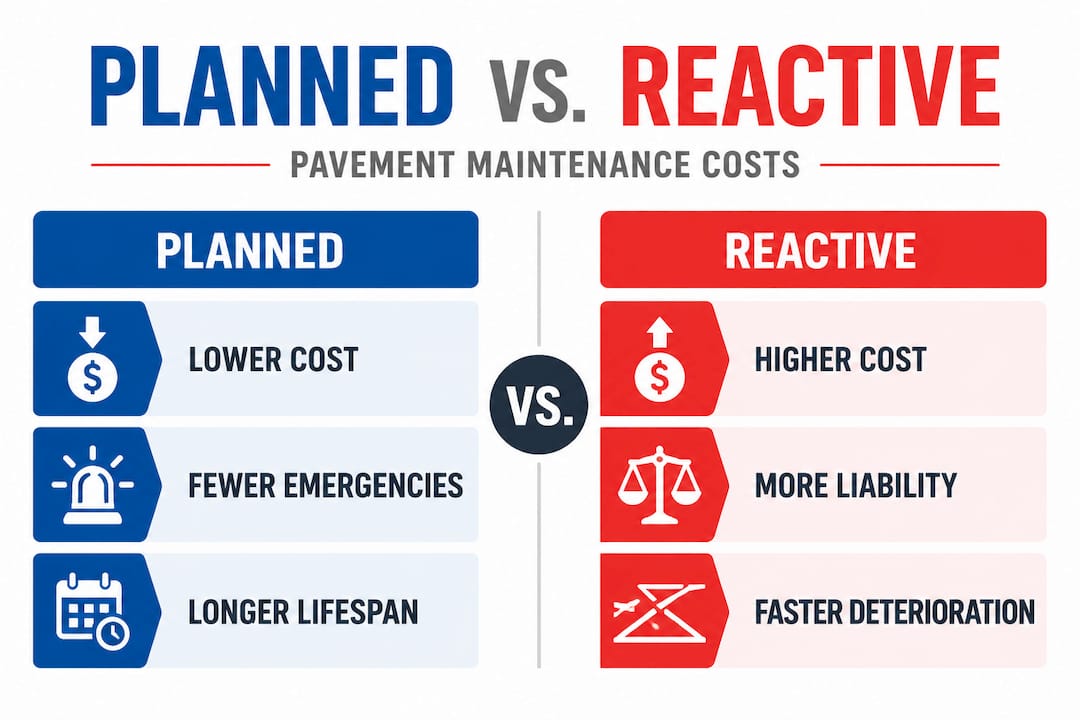
Planned vs. reactive maintenance: A real cost comparison
| Factor | Planned maintenance | Reactive maintenance |
|---|---|---|
| Average repair cost | Low to moderate | High to very high |
| Response time | Scheduled, controlled | Emergency, unpredictable |
| Legal exposure | Low (documented) | High (reactive, undocumented) |
| Pavement lifespan | Extended significantly | Shortened by compounding damage |
| Insurance impact | Favorable, lower premiums | Negative, potential cancellation |
| Disruption to operations | Minimal, planned | Major, unplanned closures |
The table above illustrates a pattern that plays out consistently across Alberta properties. Reactive maintenance is never cheaper in the long run. It just feels cheaper in the short term because you avoid a scheduled expense. That logic breaks down the moment you receive a legal claim or face an emergency repair in February.
Steps for building an effective inspection and maintenance calendar:
- Schedule a baseline inspection in spring, once temperatures are consistently above freezing.
- Conduct a mid-season check in summer, focusing on high-traffic zones and drainage areas.
- Perform a pre-winter inspection in fall, prioritizing sealing and pothole repair before freeze-up.
- Log every inspection date, inspector name, findings, and any actions taken.
- Set condition thresholds that trigger escalation to a licensed contractor.
- Review and update your calendar annually based on findings from the previous year.
Understanding asphalt maintenance tips for Edmonton-area conditions can help you calibrate what to look for in each seasonal check. A solid pavement sealing guide is also essential for fall preparation, since sealing before winter is one of the single most cost-effective steps you can take.
Pro Tip: Alberta.ca publishes pavement preservation guidelines specifically designed for the province’s climate zones. Using those standards as your inspection framework not only improves your maintenance decisions but also gives you a defensible methodology if your records are ever reviewed by an insurer or a court.
What a thorough pavement inspection looks like: Tools, techniques, and Alberta benchmarks
With the importance of regular inspection established, it is worth being specific about what a proper inspection actually involves. Not all inspections are equal. A quick visual walkthrough is better than nothing, but a structured assessment using the right methods catches problems that the naked eye misses entirely.
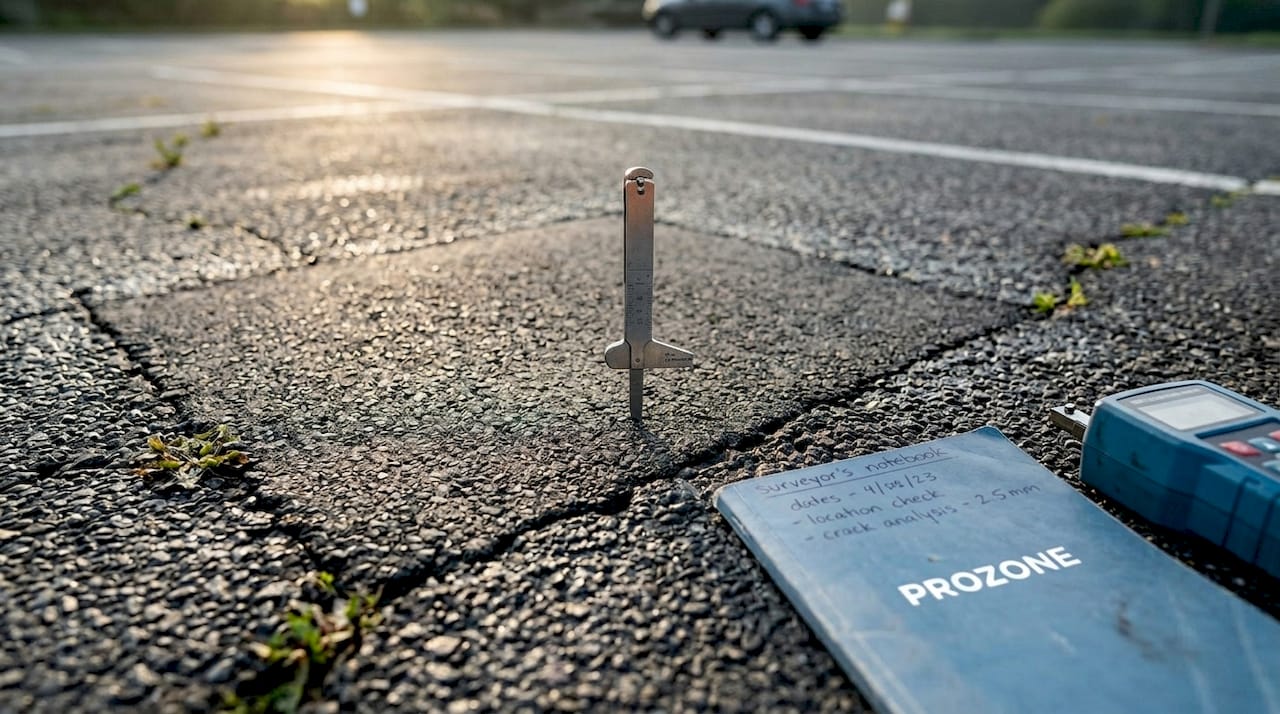
Key inspection methodologies used in Alberta include visual distress surveys, International Roughness Index (IRI) measurements for ride quality, Falling Weight Deflectometer (FWD) testing for structural capacity, ground-penetrating radar (GPR) for subsurface assessment, profilometers for surface profiling, and skid resistance testing for safety. Alberta Transportation publishes IRI and rut depth data regularly, and those benchmarks should inform how you evaluate your own assets.
Inspection methods and what they detect
| Method | Primary use | What it detects |
|---|---|---|
| Visual survey | Routine condition assessment | Surface cracking, rutting, potholes, drainage issues |
| IRI measurement | Ride quality evaluation | Surface roughness, bumps, uneven sections |
| FWD testing | Structural capacity analysis | Base and subgrade weaknesses |
| Ground-penetrating radar | Subsurface imaging | Hidden voids, delamination, moisture infiltration |
| Profilometer | Longitudinal profiling | Surface shape and elevation variance |
| Skid resistance testing | Safety evaluation | Friction loss, polishing, winter hazard risk |
For many Alberta property managers, the starting point is a structured visual survey, which is exactly where pavement condition scoring begins. Benchmarks from pavement engineering practice put a score of 90 out of 100 as “excellent condition,” meaning a smooth ride with minimal distress. Once scores drop below 70, maintenance urgency increases sharply, and below 50 you are typically looking at resurfacing rather than patching.
Understanding road repair methods specific to Edmonton and Alberta gives you context for how inspection findings translate into action. The paving process guide from ProZone provides a practical look at what repair and resurfacing actually involves, which helps managers communicate more clearly with contractors and plan budgets more accurately.
Common pavement distresses to watch for in Alberta:
- Longitudinal and transverse cracking from freeze-thaw stress
- Alligator cracking indicating base failure under repeated loads
- Rutting in high-traffic lanes from heavy vehicle loading
- Potholes from water infiltration and freeze-thaw expansion
- Edge cracking from poor drainage or subgrade movement
- Raveling, where surface aggregate loosens from aged binder
- Shoving and corrugation near intersections and braking zones
Each of these distress types tells a different story about what is happening structurally. A good inspector does not just note that a crack exists. They assess its severity, extent, and likely cause, which determines what kind of repair is needed and how urgently.
Documentation, technology, and prioritization: Keys to defensible and efficient inspection programs
Having explored inspection methods, it is important to address what happens after the inspection. The value of your inspection program is only as good as your records. Without documentation, even a rigorous inspection offers limited legal or financial protection.
Documentation of inspections and repairs demonstrates due diligence in court and insurance contexts. Machine learning models, including Random Forest and XGBoost classifiers, are increasingly used to analyze inspection data and classify pavement conditions as Good, Fair, or Poor for prioritization purposes. These tools help large municipalities manage many kilometers of roadway more efficiently than manual review alone could allow.
“In a legal dispute or insurance claim, your paperwork is your defense. A thorough record of inspections, findings, and remediation is worth more than any verbal assurance.”
Modern inspection programs benefit from combining traditional manual methods with technology-assisted tools. Expert guidance on inspection emphasizes that FWD, IRI, and machine learning aids should be used alongside visual and manual assessments, not as replacements. Context matters enormously. A model trained on urban arterial roads will not make accurate predictions for a rural industrial access road. Human judgment fills those gaps.
How to set up a defensible documentation process:
- Assign a named responsible inspector for each inspection event.
- Record the date, weather conditions, and areas covered in every report.
- Photograph all distresses with date-stamped images and GPS coordinates where possible.
- Use a standardized condition rating scale consistently across all properties.
- Log every repair action, including the contractor name, materials used, and date completed.
- Store records in a centralized system accessible to your legal, insurance, and operations teams.
- Retain records for a minimum of seven years, or longer if your insurer requires it.
Connecting your inspection records to base course durability assessments is also valuable, since surface distress often originates in subsurface issues that a surface inspection alone will not catch.
Pro Tip: Do not rely entirely on automated technology to tell you when to act. Machine learning models are excellent at sorting and prioritizing large data sets, but they miss local context like a known drainage problem or a stretch of road that serves emergency vehicles. Always layer human review on top of algorithmic outputs before making capital decisions.
Why most managers underestimate inspection value – and how to build a truly resilient pavement program
There is a persistent disconnect in how many property managers think about pavement inspections. They are viewed as a cost, a regulatory formality, or something to schedule when there is budget left over. The evidence points in exactly the opposite direction.
Delaying pavement maintenance consistently multiplies costs. Research on pavement deterioration indices shows that visual distress carries a weighting of 0.439 in standard deterioration models, making it the single highest-weighted factor in pavement condition decline. That means what you can see with your eyes during a simple walkthrough already accounts for the largest share of deterioration risk. Ignoring visible distress is not saving money. It is accelerating a much larger expense.
The mental reframe that experienced infrastructure managers make is to treat inspections as an investment with a measurable return. A properly conducted and documented inspection program reduces emergency repair costs, extends pavement life by years, lowers insurance premiums, and keeps your legal risk at a manageable level. That is a return that no reactive approach can match.
We have seen this play out repeatedly in Alberta. Properties that consistently inspect and seal see their asphalt lasting 20 to 25 years with moderate maintenance. Properties that skip inspections for several years in a row often find themselves facing full-depth reconstruction within 12 to 15 years of the original paving, sometimes even sooner when base failures develop. The financial gap between those two outcomes is substantial.
There is also a reputational dimension that rarely gets discussed. For municipal authorities, visible pavement failures signal to residents that infrastructure management is not a priority. That perception is hard to reverse once it forms. Regular inspection and timely maintenance keeps roads and facilities looking well-managed, which matters when budget cycles come up for review and public trust is on the line.
Comparing asphalt versus concrete options can also shift how you think about long-term maintenance obligations. Understanding the inspection and maintenance profile of each material type from the start means fewer surprises over the life of the asset. Choosing the right material for the right application is itself a risk management decision.
The professionals who run the best pavement programs are not the ones with the biggest budgets. They are the ones who treat every inspection as actionable intelligence and who have built systems to turn that intelligence into timely, cost-effective decisions. That discipline, applied consistently, is what separates organizations that control their infrastructure costs from those that are perpetually behind.
Let ProZone help you simplify inspections and maximize pavement life
Now that you have a clear picture of what rigorous pavement inspection and maintenance involves, the practical question is how to implement it without stretching your team beyond capacity. ProZone Ltd supports property managers and municipal authorities across Edmonton and the surrounding region with the full range of services needed to turn inspection findings into action. From construction services for Edmonton managers to detailed guidance on asphalt paving explained for property owners, we provide the technical knowledge and field expertise to keep your infrastructure safe, compliant, and budget-efficient. Whether you need a repair after your spring inspection or a structured road construction plan for a larger project, ProZone is ready to help you get ahead of the problem before it becomes an emergency.
Frequently asked questions
What hazards does regular pavement inspection help prevent?
Regular inspections help prevent trips, falls, and vehicle damage caused by cracks, potholes, and uneven surfaces, directly reducing liability under Alberta’s Occupiers’ Liability Act.
How often should pavement be inspected in Alberta?
Most experts recommend at least two formal inspections per year, with spring checks targeting freeze-thaw damage and fall inspections focused on sealing before winter sets in.
What’s the legal risk if I skip pavement inspections?
You could face liability for injuries under the Occupiers’ Liability Act, and inadequate maintenance records can result in settlements over $25,000, higher premiums, or outright insurance policy cancellations.
Which methods or technology are used in Alberta pavement inspections?
Common methods include visual distress surveys, IRI roughness measurement, FWD structural testing, ground-penetrating radar, profilometers, and skid resistance testing, with Alberta publishing standardized benchmarks for each.
How does proper documentation help in claims or legal cases?
Thorough records of inspections and repairs demonstrate due diligence to insurers and courts, making it far easier to defend against claims or challenge liability allegations.