
TL;DR:
- In Alberta’s commercial sector, landscaping functions as both an exterior impression and critical site infrastructure, requiring proper design, installation, and maintenance to ensure compliance and durability.
- A well-executed landscape incorporates softscape, hardscape, and utilities, with emphasis on proper grading and drainage to withstand Alberta’s extreme climate.
Landscaping in Alberta’s commercial sector is rarely just about aesthetics. Most property developers and commercial owners treat it as a finishing touch, a cosmetic layer applied after the real construction work is done. That assumption is expensive. In practice, commercial landscaping functions as both an exterior first impression layer and a full site infrastructure system, covering design, installation, drainage, utilities, and ongoing maintenance. In Alberta specifically, seasons are extreme, regulations are specific, and the gap between a compliant landscape and a costly, permit-blocking one is narrower than many developers expect.
Table of Contents
- Why landscaping matters: More than meets the eye
- Key elements of Alberta commercial landscaping
- Regulatory realities: Permit, inspection, and compliance essentials
- Best practices for year-round strategy and maintenance
- Separating fact from marketing: ROI and landscaping value claims
- A practical perspective from Alberta: Landscaping as operational infrastructure
- Linking landscaping strategy to top-notch site solutions
- Frequently asked questions
Key Takeaways
| Point | Details |
|---|---|
| Landscaping is infrastructure | Successful commercial landscapes in Alberta combine functionality, compliance, and appeal – they are not just decorative. |
| Permit and compliance are critical | Municipal regulations require landscaping that meets technical and maintenance standards for approval. |
| Year-round maintenance is essential | A scheduled, systematic approach prevents risks and supports long-term property value. |
| Document processes and choices | Documentation is vital for navigating permit, inspection, and regulatory requirements. |
| Skepticism on ROI claims | Treat ROI figures with caution; prioritize compliance and operational reliability for actual value. |
Why landscaping matters: More than meets the eye
If you manage or develop commercial properties in Alberta, the idea that landscaping is optional decoration needs to go. It is one of the first things prospective tenants, inspectors, and clients notice when they arrive on site. But more critically, it is a functional system that handles water, foot traffic, utilities, and safety requirements simultaneously.
Landscaping in commercial spaces serves as both an exterior first impression and a site infrastructure system, covering everything from plant selection to stormwater routing. That is not a minor distinction. When your parking lot curbs, planted beds, and irrigation system all work together, your property drains correctly, looks maintained, and passes inspections. When they do not work together, you face rework, delays, and regulatory penalties.
“Municipal rules in Edmonton require landscaping as part of development approvals and impose a maintenance and financial security period.” Edmonton requires landscaping as a formal condition of commercial development, not an afterthought.
This means landscaping is tied directly to your ability to receive occupancy approvals and move forward with operations. Missing or deficient landscaping can hold up a project even when the structure itself is complete and code-compliant. The city wants to see a fully functional exterior, not just walls and a roof.
A high-performance commercial landscape typically includes three layers of elements:
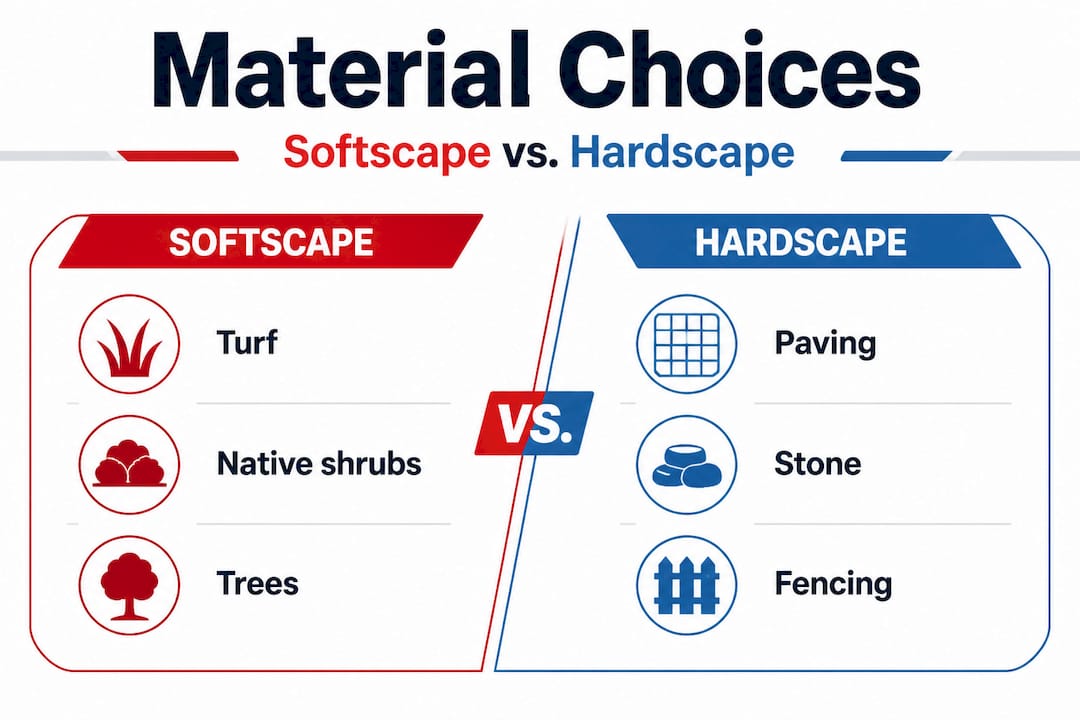
- Softscape: Turf, shrubs, trees, perennials, soil prep, and mulch
- Hardscape: Paths, curbs, retaining walls, paving, and site furniture
- Utilities: Irrigation systems, drainage infrastructure, and exterior lighting
Each layer serves a distinct purpose, and each can become a compliance problem if poorly planned or installed. For developers working through landscape construction in Edmonton, understanding this layered structure early prevents costly redesigns mid-project. The same applies when you are sourcing landscaping materials in Alberta, where material choices affect both performance and permit compliance.
Key elements of Alberta commercial landscaping
Having established the why, it is time to detail what high-performance commercial landscapes are actually made of, and how each component functions under Alberta’s specific conditions.
A professional approach to commercial landscaping deliberately pairs softscape elements like planting and turf with hardscape and utility infrastructure, including paving, curbs, irrigation, lighting, and drainage, so the overall exterior performs safely and predictably under heavy use. For a commercial property in Alberta, that predictability is not optional. It is what keeps your site operational through freeze-thaw cycles, heavy snowfall, and the brief but intense summer seasons.
| Element category | Examples | Primary function |
|---|---|---|
| Softscape | Turf, native shrubs, trees, soil | Aesthetics, erosion control, air quality |
| Hardscape | Paving, curbs, retaining walls | Access, structure, drainage routing |
| Utility infrastructure | Irrigation, drainage pipes, lighting | Safety, water management, compliance |
One of the most technically critical elements is lot grading. Stormwater mechanics and regulated drainage control must be respected in every landscaping project, directing water away from buildings and neighboring properties. In Alberta, where spring melt combined with summer thunderstorms can produce significant water volume in short periods, improper grading is not just a nuisance. It is a liability that can damage foundations, flood neighboring lots, and trigger municipal enforcement.
Here is how a well-sequenced commercial landscaping project typically unfolds:
- Site assessment and planning: Survey existing grades, drainage paths, and utility locations before any design is finalized.
- Lot grading and earthworks: Establish proper slopes and drainage channels in accordance with municipal requirements.
- Utility installation: Lay irrigation lines, drainage infrastructure, and conduit for exterior lighting before any softscape or hardscape goes in.
- Hardscape installation: Install paving, curbs, and retaining walls on the prepared subgrade.
- Softscape installation: Plant trees, shrubs, and turf after all hard elements are fixed in place.
- Inspection and documentation: Request the required inspections and retain records for the security release period.
Choosing the right materials at each stage matters enormously. Selecting best outdoor landscaping materials for Edmonton’s freeze-thaw cycle means the difference between surfaces that hold up for a decade and surfaces that crack and heave within two winters. Similarly, knowing the correct landscaping aggregates and uses ensures drainage layers and base courses perform as engineered rather than compacting unevenly over time.
Pro Tip: Document your grading plan and utility layout with photographs and as-built drawings before softscape goes in. This documentation protects you during inspections and proves existing infrastructure placement if disputes arise later.
Regulatory realities: Permit, inspection, and compliance essentials
Understanding the elements is only half the equation. Knowing what Alberta’s municipalities actually require, and where projects most commonly go off track, is what separates developers who hit their timelines from those who get stuck in inspection limbo.
Edmonton’s commercial landscaping requirements are detailed and have real financial implications. Municipal rules require landscaping as a condition of development approvals, and they impose a maintenance and financial security period afterward. That security period typically means the city holds a deposit, sometimes called a landscape security or performance bond, until the landscaping has been installed and maintained through a defined window, often one or two growing seasons. If the landscaping fails inspection during that period, you do not get your deposit back.
“The security process is designed to confirm that landscaping is not only installed but surviving and maintained to the approved plan, which means developers bear real financial exposure long after the contractor leaves.”
This is a key risk that many owners do not fully account for in their project budgets. The landscaping contract does not end at installation. It extends through the maintenance period, and gaps in that maintenance can cost you thousands in unreleased deposits.
Right-of-way compliance adds another layer of complexity. Edmonton’s landscaping rules for the road right-of-way prohibit several categories of installations and restrict the use of irrigation, fertilizers and pesticides, and certain materials in those zones. Commercial properties that front public roads or municipal corridors need to know exactly where their property boundary ends and the right-of-way begins, because violations in that strip create separate enforcement actions from regular development permit issues.
The most common regulatory pitfalls in Alberta commercial landscaping include:
- Installing irrigation systems in the road right-of-way without the correct license or within prohibited zones
- Using non-approved materials like certain bark mulches or gravel types that conflict with drainage or weed control standards
- Failing to complete the required growing season maintenance before requesting inspection
- Inadequate stormwater routing that does not match the approved lot grading plan
- Missing the inspection window and triggering deposit forfeitures
- Applying fertilizers or pest control products in restricted zones near watercourses or right-of-way areas
Following a proper material installation guide tailored to Alberta’s standards reduces many of these risks. Working with knowledgeable suppliers for your landscaping supplies in Edmonton also means you are less likely to source materials that look right but fail compliance checks. For anyone managing multiple sites, understanding construction safety regulations as they intersect with landscaping work on active commercial properties is equally important for managing contractor oversight and site liability.
Best practices for year-round strategy and maintenance
Once compliant landscaping is in place, sustained value depends entirely on what happens every month after the installation crew leaves. Alberta’s climate does not allow a passive approach. Your landscape needs active management across all four seasons to stay compliant, safe, and functional.
A core commercial landscaping methodology is year-round planning with seasonally sequenced tasks, including spring cleanup, pruning and aeration, summer irrigation and weed control, fall soil testing, fertilization and leaf removal, and winter protection with scheduled inspections. That is not a luxury schedule. For properties under a municipal security period, it is a contractual necessity.
Here is how a practical annual maintenance cycle looks for an Alberta commercial property:
- Spring (April to May): Remove winter protection, inspect for frost heave damage on hardscape, aerate turf, prune woody plants, start irrigation systems and check for winter damage to lines.
- Early summer (June): Begin weed control program, confirm mulch depth, monitor new plantings for establishment stress, verify drainage channels are clear.
- Mid to late summer (July to August): Manage irrigation schedules around heat and rainfall, apply fertilizer according to soil test results from the prior fall, inspect hardscape for surface cracking.
- Fall (September to October): Conduct soil testing, apply fall fertilizer, remove leaves before they mat and suffocate turf, wrap sensitive plantings, shut down and drain irrigation systems before freeze.
- Winter (November to March): Inspect for snow load damage on structural plantings, monitor hardscape for frost damage, document site condition for spring reports.
Safety intersects with this cycle at multiple points. Leaf accumulation on walkways and paved areas creates slip hazards. Dead or damaged tree limbs above pedestrian zones are a liability. Keeping these addressed is not just good maintenance. It is part of your operational risk management. For a structured approach to tracking these tasks, a seasonal landscaping checklist built around Alberta’s climate keeps your team accountable across the full year.
A streamlined maintenance workflow also ties directly to the security release process. Municipalities reviewing your landscape for deposit release want to see documented, consistent maintenance. If you cannot demonstrate that the site was properly cared for through the required period, that documentation gap becomes a negotiation problem. Pairing your landscape maintenance calendar with your year-round parking lot maintenance program creates a unified exterior operations schedule that covers both compliance obligations efficiently.
Pro Tip: Treat your landscape maintenance log the same way you treat equipment service records. Date every task, note who performed the work, and photograph conditions before and after. That paper trail is your best defense if a municipal inspector questions whether maintenance obligations were met.
Separating fact from marketing: ROI and landscaping value claims
It is worth addressing the claims you will encounter when shopping for landscaping services or reviewing industry publications. Many vendors and trade associations present landscaping as a clear financial investment with measurable returns. The reality, especially in Alberta’s commercial market, is more nuanced.
Some commercial landscaping claims frame landscaping as a measurable ROI driver, but the supporting figures come largely from vendor or industry articles rather than independently audited, Alberta-specific empirical benchmarks. That is not a reason to dismiss landscaping value entirely. It is a reason to evaluate claims critically before factoring them into your financial projections.
“Property value increases and reduced vacancy rates are frequently cited as landscaping benefits, but these figures are almost always derived from general market studies, not from controlled research in Alberta’s commercial property environment.”
Here is a realistic breakdown of where landscaping delivers genuine, verifiable value versus where claims should be treated with skepticism:
- Compliance value (high certainty): Meeting permit conditions, securing deposit release, and avoiding enforcement actions are direct, measurable outcomes of proper landscaping.
- Operational reliability (high certainty): Correct drainage, durable hardscape, and well-maintained softscape reduce repair costs and safety incidents over time.
- Tenant and client perception (moderate certainty): A well-maintained exterior positively affects first impressions, though quantifying this as a precise rent premium in Edmonton requires local market data most owners do not have.
- Generic property value claims (low certainty for Alberta): Broad industry claims about landscaping increasing property values by specific percentages should not be used as budget justifications without verifying the source methodology.
The most defensible reason to invest properly in commercial landscaping in Alberta is not the ROI headline. It is compliance, operational continuity, and liability management. Those three factors alone justify treating landscaping as a serious line item in your capital and operating budgets.
A practical perspective from Alberta: Landscaping as operational infrastructure
Here is the view we have developed working with commercial property owners and developers across the Edmonton region: most landscaping problems are fundamentally operations problems. They are not caused by bad plants or poor aesthetics. They are caused by treating a dynamic, regulated, climate-sensitive system as if it were a static installation.
The one-and-done mindset does not work in Alberta. The climate cycles between extremes that expose every weakness in your exterior. Frost heaves misaligned paving. Spring melt tests every drainage assumption. Summer drought stresses plantings that were put in without considering local conditions. If your landscape was designed for a mild coastal climate and nobody adjusted the plant palette or irrigation for Alberta, you will be replacing significant portions of it within three years.
Treating landscaping as operational infrastructure means approaching it the way you would approach your HVAC system or your parking structure. It gets a budget line. It gets scheduled maintenance. It gets documented inspections. And when something fails, you respond with the same urgency you would give a broken boiler in January, because the regulatory and liability consequences can be just as serious.
The permit and security deposit system in Alberta actually enforces this thinking, even for owners who resist it. You cannot collect your deposit without demonstrating sustained maintenance. You cannot pass your occupancy inspection without a compliant landscape. The system is designed to make you engage with landscaping as an ongoing obligation, and that framing is correct.
What we see in the properties that consistently pass inspections and maintain their exterior quality over time is a clear, documented maintenance program tied to the seasonal cycle, a team that understands both the softscape and the hardscape components, and an ownership group that budgets for renewal and repair rather than waiting for visible deterioration. Reviewing commercial landscaping examples from projects in the Edmonton area gives you a concrete benchmark for what properly executed and maintained commercial landscapes look like at different scales and property types.
Pro Tip: Benchmark your landscape contractor’s workflow against the standards you apply to infrastructure trades. Ask for maintenance logs, inspection reports, and seasonal task documentation. If they cannot provide those, they are not operating at the level your compliance obligations require.
Linking landscaping strategy to top-notch site solutions
ProZone Ltd works with commercial property owners and developers across Edmonton and the surrounding Alberta region to deliver landscaping, earthworks, and site maintenance that meet both operational and regulatory demands. From grading and drainage to hardscape installation and material supply, our team understands what Alberta municipalities expect and how to keep your exterior performing through every season. Whether you need to review construction services for Edmonton managers, explore completed projects similar to yours, or discuss your site’s concrete and paving needs with our Edmonton concrete contractors, we offer the local expertise to move your project from planning to a compliant, durable outcome. Contact ProZone to discuss your site requirements and get a clear picture of what your exterior actually needs.
Frequently asked questions
Is landscaping mandatory for commercial developments in Alberta cities?
Yes. In major Alberta cities like Edmonton, landscaping is required as part of development permits and must be maintained through a set period before the financial security deposit is released.
What are the most common violations in commercial landscaping compliance?
Typical violations include improper stormwater drainage, unauthorized materials, and irrigation within right-of-way areas, along with missing or undocumented routine maintenance inspections.
How does Alberta’s climate affect landscaping choices and maintenance?
Alberta’s climate demands year-round seasonal planning covering spring cleanup and aeration, summer irrigation management, fall fertilization and leaf removal, and winter protection with periodic site inspections.
Do claims about landscaping increasing property value apply in Alberta?
Most ROI claims come from industry or vendor sources rather than independently verified Alberta data. Compliance, safety, and operational reliability deliver more certain value than theoretical property value increases.
What is a key operational tip for successful landscaping in Edmonton?
Treat your landscape as ongoing site infrastructure by maintaining a documented maintenance program. Edmonton’s requirements link deposit release directly to demonstrated, sustained maintenance, making documentation essential.