
TL;DR:
- Asphalt milling removes only the damaged surface layer, saving costs and preserving the pavement base.
- Proper execution and timing are critical to ensure long-lasting overlays, especially in Edmonton’s variable climate.
- Professional planning, quality controls, and local expertise are essential for durable, cost-effective pavement maintenance.
Many property managers assume that crumbling or rutted asphalt means one thing: a full, expensive replacement. That assumption costs thousands of dollars every year across Edmonton’s commercial properties. Asphalt milling, sometimes called cold planing or profiling, removes only the damaged top layer of pavement, leaving the stable base intact. The result is a clean, level surface ready for a fresh overlay, at a fraction of the cost of tearing everything out. This guide walks you through exactly how milling works, when it’s the right call, and how Edmonton’s climate shapes the decisions you’ll need to make for your parking lots and roadways.
Table of Contents
- Understanding asphalt milling: The basics and process
- When to use asphalt milling: Key criteria and limitations
- Precision and best practices: Ensuring long-lasting asphalt overlays
- Applying asphalt milling in Edmonton: Local climate, costs, and practical steps
- Why careful planning and expertise set successful milling projects apart
- Smart solutions for your asphalt and property needs in Edmonton
- Frequently asked questions
Key Takeaways
| Point | Details |
|---|---|
| Asphalt milling saves costs | Milling lets you reuse existing pavement layers for quicker, cheaper repairs. |
| Precision is essential | Careful control of depth and profile boosts overlay durability and prevents issues. |
| Timing matters in Edmonton | Milled surfaces must be overlaid promptly and never left exposed in cold weather. |
| Not all surfaces qualify | Avoid milling where the base is unstable or severely cracked to ensure sound repairs. |
Understanding asphalt milling: The basics and process
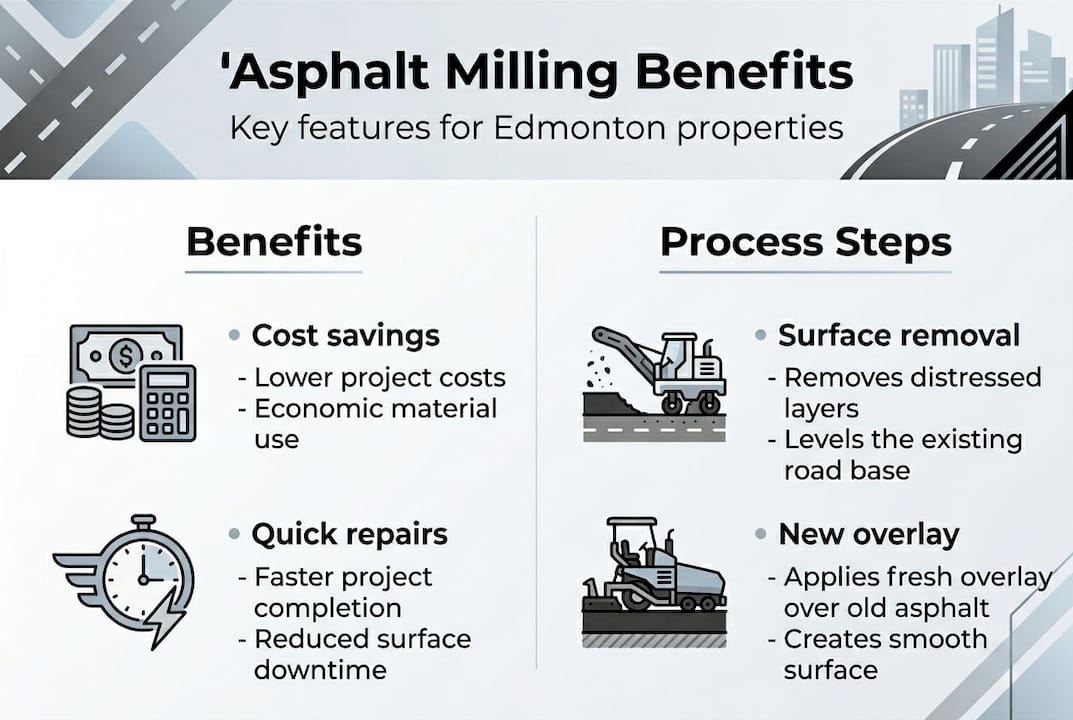
Asphalt milling is the controlled removal of the top layer of an existing asphalt surface using a specialized machine called a cold planer or milling machine. The machine grinds down the pavement to a precise depth, leaving behind a textured, uniform surface that bonds exceptionally well with new asphalt overlay. Unlike full-depth removal, milling targets only what’s damaged, preserving the structural integrity of the base layers below.
The process is more precise than most property managers expect. Milling machines use up-cut drums with water for dust control and automatic grade and slope controls for precision, ensuring the milled surface meets exact specifications. That level of control is critical when you’re preparing a surface for a new overlay, because even small inconsistencies in depth can cause bonding problems later.
Here’s a simplified breakdown of how a typical milling project runs:
- Site assessment: A contractor evaluates the pavement condition, identifies distress areas, and determines the required milling depth.
- Machine setup: The cold planer is calibrated for depth, slope, and grade based on the site’s drainage requirements.
- Milling pass: The machine grinds the surface, with water suppressing dust and the conveyor belt loading reclaimed asphalt pavement (RAP) into trucks.
- Surface inspection: Crews check the milled surface with straightedges and grade checks before overlay begins.
- Overlay application: New hot-mix asphalt is applied promptly to the prepared surface.
There are three main classes of milling that apply to different project needs:
| Milling class | Description | Best use case |
|---|---|---|
| Uniform depth | Removes a consistent depth across the full surface | General resurfacing, parking lots |
| Cross-slope correction | Adjusts the surface slope for drainage improvement | Roads and lots with pooling water issues |
| Variable depth | Removes varying amounts to correct surface irregularities | Heavily rutted or uneven commercial surfaces |
For commercial property owners, the benefits are significant. Milling is substantially cheaper than full replacement, recycles the removed asphalt material (RAP is reused in new mixes), and causes minimal disruption to tenants and customers. A parking lot can often be milled and overlaid within a few days, compared to weeks for a full reconstruction project.
Common applications include parking lots, private access roads, loading docks, and drive-through lanes. If you’re thinking about parking lot maintenance best practices for your property, milling fits naturally into a long-term pavement management plan. For a broader look at how paving work is structured, paving processes explained offers useful context for property managers new to the subject.
When to use asphalt milling: Key criteria and limitations
After reviewing the basics, it’s critical to understand when asphalt milling is and isn’t the right option for your property. Milling solves specific problems. It doesn’t fix everything, and applying it in the wrong situation wastes money and accelerates pavement failure.
Situations where milling works well:
- Surface distress without base failure: Cracking, raveling, or rutting confined to the top layer is a strong indicator that milling can restore the surface without touching the base.
- Overlay preparation: When you need to add a new layer of asphalt without raising the surface elevation (important near curbs, drainage structures, and building entrances), milling creates the necessary clearance.
- Drainage correction: Cross-slope milling can eliminate standing water problems by reshaping the surface profile.
- Friction restoration: Worn, polished surfaces with poor skid resistance can be revived by milling to expose fresh aggregate.
- Pavement marking removal: Milling efficiently removes old striping before resurfacing.
However, milling has real limits. Not for failing base layers, alligator cracking, or significant settlement; avoid milling at layer interfaces to prevent delamination, and expose milled surfaces briefly while avoiding cold temperatures to preserve underlying strength. If your pavement shows alligator cracking (a pattern resembling broken glass spread across large areas), that signals base failure. Milling the top won’t address the root cause, and the new overlay will fail quickly.
Pro Tip: If you’re unsure whether your pavement has base failure, ask your contractor to perform a deflection test or core sample before committing to milling. It’s a small upfront cost that prevents a much larger mistake.
“Rapid overlay and temperature control are vital. Exposing a milled surface for extended periods, especially in cold weather, weakens the remaining pavement layers and reduces the bond strength of the new overlay.”
Timing matters more than most people realize. The milled surface should receive its overlay as quickly as possible. Every day of exposure to traffic, weather, and temperature swings degrades the surface you just paid to prepare. For Edmonton properties, this is especially relevant given the city’s temperature extremes.
When you’re budgeting for paving projects, factor in the cost of milling as preparation work, not just the overlay itself. And if your lot has sections with deeper structural issues, asphalt pulverization repair may be a better fit for those specific zones, with milling applied elsewhere.
Precision and best practices: Ensuring long-lasting asphalt overlays
Knowing when to mill is just part of the equation. Executing the process with precision makes all the difference for overlay durability. Property managers who push for the lowest bid without asking about quality controls often end up with overlays that fail within two or three seasons.
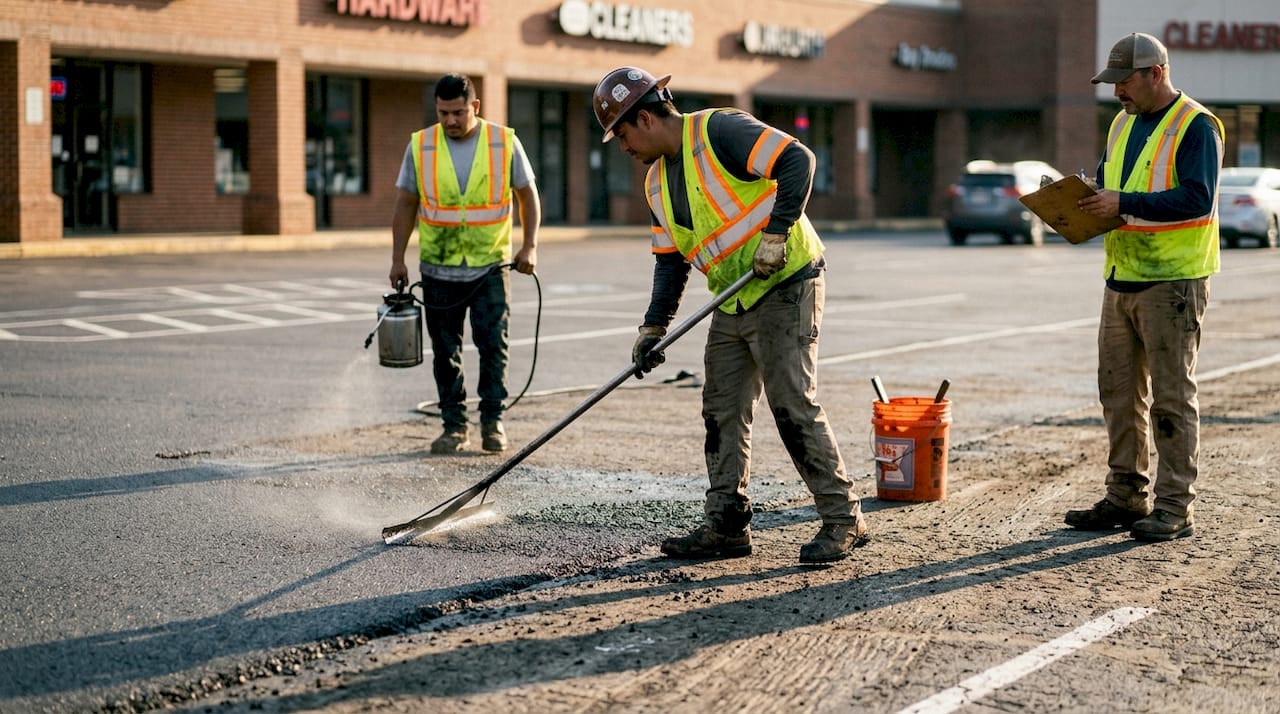
Precision depth and profile are critical for overlay bond strength; micro-milling produces fine surface texture; test sections, straightedge checks, and rapid overlay prevent strength loss. Each of these steps is a checkpoint that separates a durable result from a costly redo.
Here’s what precision looks like in practice:
- Consistent milling depth: Variations in depth across the surface create weak spots in the overlay. A quality contractor checks depth frequently during the milling pass.
- Proper surface texture: The milled surface should have a uniform ridged texture. This texture increases the surface area for bonding with the new asphalt.
- Straightedge verification: Running a straightedge across the milled surface reveals high and low spots that need correction before overlay.
- Tack coat application: A thin layer of asphalt emulsion (tack coat) is applied to the milled surface before overlay to improve adhesion.
- Rapid overlay scheduling: The longer the milled surface sits exposed, the more it degrades. Quality contractors schedule overlay within days, not weeks.
Micro-milling deserves special attention. Standard milling leaves ridges roughly 12 to 18 millimeters apart. Micro-milling uses a drum with more cutting teeth, producing ridges just 6 millimeters apart. The result is a much smoother, more uniform texture that significantly improves overlay bond and ride quality.
Pro Tip: For high-traffic areas like main drive aisles, delivery zones, and accessible parking spaces, specify micro-milling in your contract. The smoother texture reduces tire noise, improves ride comfort, and produces a tighter bond with the overlay.
For a practical look at how these steps fit into a broader repair strategy, the asphalt repair workflow guide breaks down sequencing decisions in detail. If you’re comparing milling against other options, road repair methods Edmonton covers the full range of techniques available to property managers in 2026.
The statistic that matters most here: overlay performance is directly tied to the quality of the prepared surface beneath it. A poorly milled base produces a poorly bonded overlay, regardless of how good the new asphalt mix is. Don’t let a contractor skip the verification steps.
Applying asphalt milling in Edmonton: Local climate, costs, and practical steps
You’ve seen how best practice ensures quality overlays, but Edmonton’s unique conditions require specific strategies. This city’s climate is one of the most demanding in North America for asphalt pavement. Temperatures swing from below minus 30 degrees Celsius in winter to above 30 degrees in summer, and freeze-thaw cycles accelerate surface deterioration faster than in milder climates.
Timing your milling project around Edmonton’s seasons is not optional. Avoid exposing milled surfaces in cold temperatures to preserve underlying strength. In practical terms, this means the ideal milling and overlay window in Edmonton runs from late May through early September. Work done in shoulder seasons (April or October) carries real risk if temperatures drop unexpectedly between milling and overlay.
For more on how winter weather and asphalt interact in Edmonton, that resource explains the freeze-thaw damage cycle in detail and helps you understand why spring is often when surface distress becomes most visible.
Cost and planning comparison for Edmonton milling projects:
| Factor | Milling plus overlay | Full-depth replacement |
|---|---|---|
| Typical cost per square meter | Lower (30 to 50% savings) | Higher baseline cost |
| Project duration | 2 to 5 days | 1 to 3 weeks |
| Disruption to tenants | Minimal | Significant |
| Best for | Stable base, surface distress | Failed base, severe settlement |
| Seasonal window in Edmonton | May to September | May to August (longer cure needed) |
Practical checklist for planning your milling project:
- Conduct a pavement condition assessment in early spring to identify distress areas.
- Request core samples or deflection testing if base failure is suspected.
- Obtain at least two contractor quotes that specify milling depth, class, and overlay timing.
- Confirm the contractor uses automatic grade and slope controls on their milling equipment.
- Schedule the project for June, July, or August to maximize overlay cure time before winter.
- Arrange traffic management and tenant notification at least two weeks in advance.
- Verify that the reclaimed asphalt pavement will be recycled, not landfilled.
For foundational context on pavement structure, asphalt road basics explains how the layers work together, which helps you understand why preserving the base is so valuable. Coordinating early with your contractor also lets you lock in scheduling during Edmonton’s busy summer construction season, when quality crews book up fast.
Why careful planning and expertise set successful milling projects apart
Bringing all these insights together, it’s worth considering what sets truly durable, efficient milling projects apart in Edmonton. Most guides treat milling as a mechanical process: bring in the machine, grind the surface, lay the overlay. That framing misses the most important variable, which is the human judgment behind every decision.
We’ve seen projects where the milling itself was technically correct but the overlay was delayed by two weeks due to poor scheduling. The result was a weakened bond and premature cracking within the first winter. The machine did its job. The planning didn’t.
Edmonton’s climate punishes shortcuts in ways that milder cities don’t experience. A milled surface left exposed during an unexpected cold snap in late September loses a meaningful amount of its bonding potential. That’s not a theoretical risk. It’s a pattern we see repeatedly when property managers choose contractors based on price alone rather than on demonstrated local experience.
The guides that focus purely on technique underplay one critical factor: working with contractors who understand Edmonton’s seasonal realities and insist on test sections and real-time quality checks. Those checks catch problems before they become expensive failures.
For property managers, the practical takeaway is straightforward. Insist on a written project timeline that accounts for weather windows. Ask your contractor how they handle unexpected temperature drops between milling and overlay. Request documentation of the milling depth and profile checks. These aren’t unreasonable demands. They’re the standard of care that separates a 15-year overlay from one that needs attention in five. The expert asphalt repair workflow resource outlines exactly the kind of sequenced, documented approach that produces lasting results.
Smart solutions for your asphalt and property needs in Edmonton
To put these insights into action, Edmonton property managers can tap into local expertise and proven solutions. ProZone Ltd. brings hands-on experience with Edmonton’s climate conditions, pavement behavior, and the precise execution that milling projects demand. Whether you’re planning a parking lot resurfacing, correcting drainage problems, or preparing surfaces for a quality overlay, ProZone’s team understands the local factors that determine long-term success.
Explore asphalt road solutions to understand the full range of pavement options available for your property. The parking lot maintenance guide gives you a framework for building a proactive maintenance plan that extends pavement life and controls costs. When you’re ready to move forward, budget planning for paving helps you ask the right questions and set realistic expectations before you request quotes.
Frequently asked questions
How does asphalt milling differ from full-depth removal?
Milling removes only damaged layers, preserving the stable base and cutting costs significantly, while full-depth removal strips out all pavement layers down to the subgrade and rebuilds from scratch.
Is asphalt milling suitable for all parking lots in Edmonton?
No. Milling works well when the base is structurally sound, but not for failing base conditions, alligator cracking, or areas with significant settlement, where full reconstruction is the appropriate solution.
What are the main benefits of asphalt milling for property managers?
Milling offers sustainability and minimal disruption, along with cost savings of 30 to 50 percent compared to full replacement, faster project completion, and the ability to recycle removed material into new asphalt mixes.
How quickly should the overlay be applied after milling?
Rapid overlay prevents strength loss in the underlying layers, so the new asphalt should be placed within days of milling, especially in Edmonton where temperature changes can compromise the prepared surface quickly.