
TL;DR:
- Alberta’s freeze-thaw cycles make asphalt more flexible and resistant to cracking than concrete.
- Asphalt offers lower upfront costs and quicker repairs, while concrete provides longer lifespan and low maintenance.
- A site-specific assessment is essential for choosing the optimal pavement material in Alberta’s challenging climate.
Choosing between asphalt and concrete for your commercial property sounds straightforward until Alberta’s climate enters the picture. Many property managers assume concrete is always the tougher, longer-lasting option, but asphalt’s flexibility actually makes it better suited to freeze-thaw conditions common across the province. This guide breaks down how both materials perform in Alberta’s seasonal extremes, what each costs over a full lifecycle, and how to match the right surface to your specific property type. By the end, you will have a clear framework for making a confident, cost-effective pavement decision.
Table of Contents
- Understanding Alberta’s climate and pavement needs
- Comparing material performance: Asphalt vs concrete
- Lifecycle costs and maintenance considerations
- Matching material to property type and usage
- Practical steps for property managers: Making your choice
- Why standard advice about asphalt and concrete can mislead Alberta property owners
- Get expert guidance for your next Alberta pavement project
- Frequently asked questions
Key Takeaways
| Point | Details |
|---|---|
| Climate impacts material choice | Alberta’s freeze-thaw cycles make asphalt more resilient than many expect. |
| Cost vs. longevity trade-offs | Asphalt is budget-friendly and easy to repair, while concrete lasts longer but costs more up front. |
| Tailor to property needs | The best paving solution depends on your property’s use, expected traffic, and operational needs. |
| Professional advice pays off | Local expertise ensures you choose a pavement solution built for Alberta’s conditions. |
Understanding Alberta’s climate and pavement needs
Alberta does not have a gentle climate. Edmonton and surrounding areas regularly experience temperatures that swing from below -30°C in January to above 30°C in July. That is a temperature range of 60°C or more within a single year. For pavement, those swings are not just uncomfortable. They are structurally destructive.
The core problem is the freeze-thaw cycle. Water seeps into small cracks or pores in a pavement surface. When temperatures drop, that water expands as it freezes, widening the crack. When it thaws, the crack stays wider than before. Repeat this process dozens of times in a single winter season, and you can see why rigid pavements deteriorate faster in Alberta than in milder climates.
For commercial property owners, this is not just a maintenance headache. It directly affects operational budgets, tenant satisfaction, liability exposure from trip hazards, and the long-term value of your asset. Pavement that fails ahead of schedule costs you twice: once for emergency repairs and again in lost confidence from tenants and customers.
Here are the main factors Alberta property managers should weigh when selecting pavement materials:
- Temperature range and freeze-thaw frequency at your specific location
- Traffic volume and load type, including delivery trucks, forklifts, or standard passenger vehicles
- Drainage design, since standing water accelerates freeze-thaw damage on both surfaces
- Maintenance access and downtime tolerance, especially for properties with year-round operations
- Budget structure, distinguishing between upfront capital costs and ongoing operational expenses
- Aesthetic requirements, particularly for retail or mixed-use properties where curb appeal matters
It is also worth noting that Alberta’s government prioritizes asphalt for many roadway applications across the province, and that preference is grounded in decades of performance data from local conditions. This is not a coincidence. It reflects a practical understanding that material choice must align with the environment, not just engineering specs written for moderate climates.
“The best pavement material is not the strongest one on paper. It is the one that holds up best under your specific conditions, your traffic, and your maintenance capacity.”
For property managers looking to stay ahead of maintenance costs, reviewing paving maintenance tips for Alberta can help you build a proactive schedule rather than reacting to failures. Understanding paving processes in Edmonton also gives you a clearer picture of what installation and repair actually involve at the local level.
The bottom line for this section: Alberta’s climate is not average, and your pavement decisions should not be based on average conditions. Context is everything.
Comparing material performance: Asphalt vs concrete
With Alberta’s challenging climate in mind, we can now compare how asphalt and concrete really stack up across the criteria that matter most to commercial property owners.
Flexibility and freeze-thaw resilience
Asphalt is a flexible pavement. It bends slightly under load and with temperature changes rather than resisting them rigidly. This is a major advantage in Alberta. When the ground shifts due to frost heave or thermal expansion, asphalt moves with it. Concrete, being rigid, resists that movement until it cannot anymore, and then it cracks and spalls. A spalled concrete surface is not just ugly. It creates uneven surfaces, drainage problems, and accelerating structural damage.
Repairability and downtime
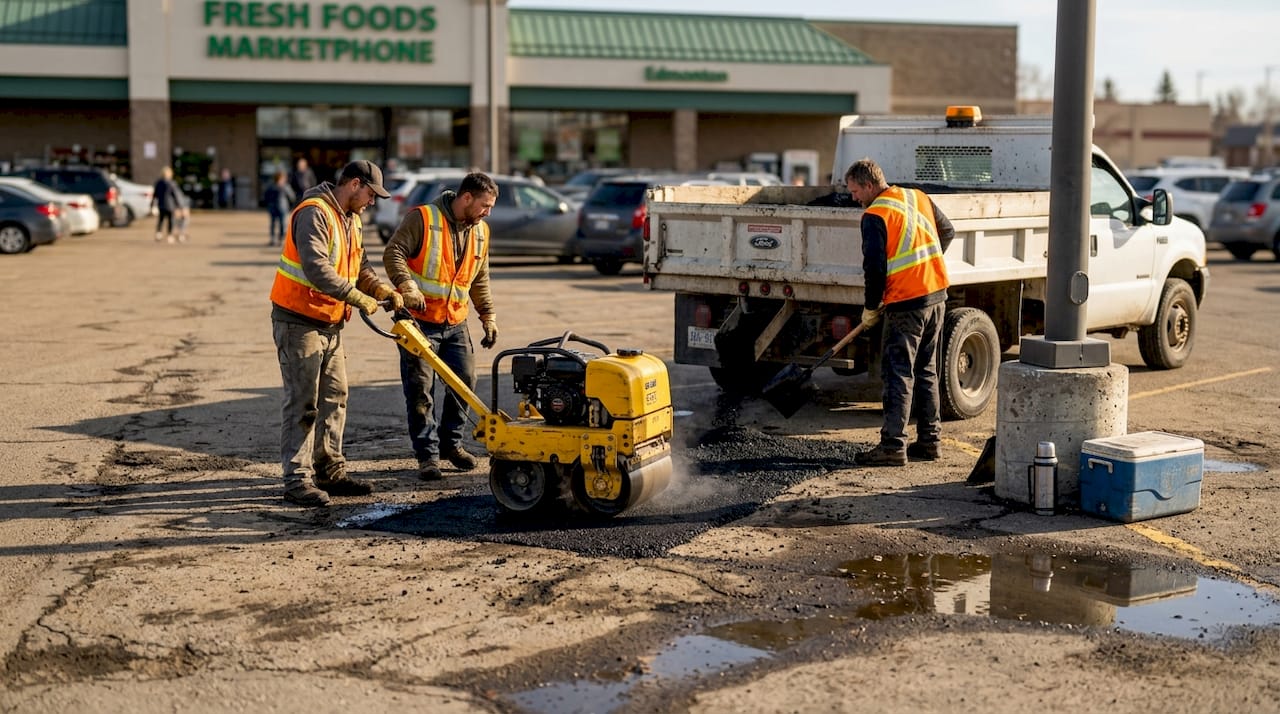
When asphalt cracks or develops potholes, repairs are fast. A crew can patch a section, compact it, and have it open to traffic within hours. Concrete repairs are a different story. You typically need to cut out a section, pour new concrete, and then wait for curing time that can stretch to several days. For a commercial parking lot or loading area, that downtime has a real cost.
Pro Tip: If your property operates seven days a week, factor repair downtime into your material decision. A single concrete repair event can cost you more in lost revenue or tenant complaints than the price difference between materials.
Here is a side-by-side comparison of how both materials perform across key criteria:
| Criterion | Asphalt | Concrete |
|---|---|---|
| Freeze-thaw resilience | High (flexible) | Moderate (rigid, prone to cracking) |
| Initial installation cost | Lower | Higher |
| Repair speed | Fast (hours) | Slow (days) |
| Load capacity | Good for moderate traffic | Excellent for heavy static loads |
| Lifespan (maintained) | 20-30 years | 30-50 years |
| Surface heat absorption | Higher (dark surface) | Lower (reflective surface) |
| Maintenance frequency | Every 3-5 years (seal coat) | Less frequent but costlier |
For a deeper look at how these numbers play out over a property’s lifecycle, the cost and durability guide breaks down the real numbers for Alberta conditions.
Performance under traffic
Concrete handles heavy, static loads extremely well. If your property includes a loading dock where semi-trucks sit idling for extended periods, concrete resists rutting better than asphalt in warm weather. Asphalt can soften slightly in peak summer heat, which is worth considering for high-load zones.
For general parking areas with regular passenger vehicle traffic, asphalt performs excellently and recovers better from the stress of seasonal ground movement. You can also review concrete types suited for Alberta projects to understand when concrete-specific solutions make sense for your site.
Our project gallery shows real examples of both materials applied across different commercial settings in the Edmonton region, which can help you visualize performance in practice.
The statistic worth remembering: properly maintained asphalt in Alberta can last 20 to 30 years, which means the flexibility advantage is not just a short-term win. It pays out over decades.
Lifecycle costs and maintenance considerations
Performance is only half the story. Let’s break down the financial side of this decision.
When property managers compare asphalt and concrete, the upfront cost difference is often the first thing they notice. Asphalt typically costs significantly less per square meter to install. But installation cost is just one line item in a much longer budget picture.
Asphalt excels in cost, speed, and easy repairs while concrete offers longevity and lower maintenance frequency but demands a higher upfront investment. Neither is universally cheaper. The right answer depends on your time horizon and operational context.
Here is a simplified cost comparison over a 30-year period for a mid-size commercial parking lot:
| Cost category | Asphalt | Concrete |
|---|---|---|
| Installation (per sq. meter) | Lower | 20-40% higher |
| Seal coating (every 3-5 years) | Required | Not required |
| Crack repair frequency | Moderate | Low to moderate |
| Major resurfacing | Once or twice in 30 years | Rarely needed |
| Emergency repair cost | Low | High |
| Total 30-year cost estimate | Comparable or lower | Comparable or higher |
The numbers converge more than most people expect. Asphalt’s lower installation cost is partially offset by ongoing maintenance. Concrete’s higher installation cost is partially offset by lower maintenance frequency. Over 30 years, the gap narrows considerably.
Key factors that shift the financial balance:
- Climate severity at your site. More freeze-thaw cycles mean more asphalt maintenance, but also more concrete cracking risk.
- Traffic intensity. Heavy truck traffic accelerates asphalt wear in summer, adding resurfacing costs.
- Drainage quality. Poor drainage harms both materials but hits concrete harder in terms of repair complexity.
- Your maintenance schedule discipline. Asphalt that is seal coated on schedule lasts much longer than neglected asphalt.
Pro Tip: Budget for seal coating asphalt every three to five years from day one. Property managers who skip this step often face full resurfacing costs a decade earlier than necessary.
For properties where minimizing disruption is critical, the case for concrete strengthens despite the higher upfront cost. Retail centers, medical facilities, and properties with continuous operations often find that concrete’s lower repair frequency justifies the premium.
For a practical look at extending pavement life through proactive maintenance, concrete repair and asphalt maintenance strategies offer proven approaches used across Edmonton commercial properties. Understanding the long-term benefits of professional paving investment also helps frame this as an asset decision, not just a construction expense.
Matching material to property type and usage
Making the right material choice depends on your property’s specific needs and typical usage.
Not every commercial property has the same demands. A retail strip mall in south Edmonton has different pavement requirements than an industrial yard in Nisku or a medical office complex in St. Albert. Getting this match right from the start saves you significant money and frustration over the life of the surface.
Here is a step-by-step framework for matching material to property type:
- Identify your dominant traffic type. Passenger vehicles favor asphalt. Heavy trucks or forklifts favor concrete, especially in loading zones.
- Map your seasonal usage patterns. Properties with peak winter traffic need surfaces that hold up through repeated freeze-thaw cycles without becoming hazardous.
- Assess your drainage infrastructure. If drainage is poor or you are in a low-lying area, factor in how each material handles standing water and ice formation.
- Evaluate your maintenance capacity. Do you have a property management team that can schedule regular seal coating? Or do you need a lower-touch solution?
- Consider aesthetics and tenant expectations. Concrete offers a cleaner, lighter appearance that some retail tenants prefer. Asphalt is more neutral and widely accepted.
For parking lots with moderate traffic, asphalt offers great flexibility, while concrete is best for heavy loads and situations where repair disruptions must be minimized.
Property types and recommended approaches:
- Retail and mixed-use: Asphalt for general parking, concrete for curbs, sidewalks, and entrance features
- Industrial and logistics: Concrete for loading docks and high-traffic lanes, asphalt for general yard areas
- Medical and office: Concrete preferred where smooth, low-disruption surfaces are critical
- Hospitality and multi-family: Asphalt for cost efficiency, with concrete accents for aesthetics
A hybrid approach, using both materials strategically across a single property, is increasingly common and often delivers the best value. You get asphalt’s cost and flexibility advantages where they matter most, and concrete’s strength and durability where loads are heaviest.
Pro Tip: Always consult Alberta pavement guidelines when planning a project near municipal infrastructure. Compliance requirements can influence your material choice in ways that are not obvious at the planning stage.
When you are ready to move from planning to execution, choosing the right paving contractor in Edmonton is the next critical step. Also consider how your pavement integrates with surrounding landscaping materials for Alberta commercial properties for a cohesive, functional outdoor environment.
Practical steps for property managers: Making your choice
Having compared all aspects, here is how to reach the right decision for your property.
Good pavement decisions are not made on gut feeling or based on what the neighboring property used. They come from a structured evaluation of your site, your operations, and your budget. Here is a practical checklist to guide that process.
- Document your site conditions. Note soil type, drainage patterns, existing pavement condition, and any areas with known frost heave history.
- Define your traffic profile. Count vehicle types, estimate daily volume, and identify any concentrated load zones like dumpster pads or delivery areas.
- Set a realistic budget range. Include installation, a five-year maintenance reserve, and a contingency for unexpected repairs.
- Get at least two contractor assessments. Ask specifically about Alberta-specific experience and request references from similar commercial projects.
- Request a written maintenance plan. Any qualified contractor should be able to outline what your surface will need over its first ten years.
- Factor in your long-term plans. If you plan to sell or refinance within five years, a lower upfront cost may be more important than long-term durability.
The pavement industry itself holds contrasting views on cost and flexibility versus durability and ROI, which is why getting local, site-specific advice matters more than following any single national guide.
“A pavement decision made without a site assessment is just a guess. The variables that matter most, soil stability, drainage, load patterns, are invisible until someone looks.”
Once you have your site data and contractor input, revisit the detailed cost and durability analysis to validate your thinking against real-world numbers from Alberta projects. This step often reveals cost assumptions that need adjusting before you commit.
The most common mistake property managers make is treating this as a one-time decision. Pavement is an asset that requires ongoing management. Building a maintenance calendar into your property management system from day one is the single most cost-effective thing you can do after the initial installation.
Why standard advice about asphalt and concrete can mislead Alberta property owners
Most online guides about asphalt versus concrete are written for a general North American audience. They cite average costs, average lifespans, and average maintenance schedules. Alberta is not average.
National guides rarely account for the intensity of Alberta’s freeze-thaw cycles, which can occur dozens of times in a single winter season rather than just a few times in milder climates. When a guide says “concrete lasts 30 to 50 years,” that figure assumes conditions that simply do not exist in Edmonton in February.
The oversimplification goes further. Standard manuals tend to frame the decision as a binary cost trade-off: pay more now for concrete, or pay less now and more later for asphalt. That framing ignores site-specific variables that can completely flip the math. A poorly drained concrete lot in a high-freeze-thaw zone can fail faster and cost more to repair than a well-maintained asphalt surface.
What actually works for Alberta property managers is a site-first approach. Alberta’s public sector and industry both adapt standards rather than applying a single formula, and that is the right instinct. The province’s own infrastructure decisions reflect decades of learning about what holds up locally.
For practical guidance grounded in Alberta conditions, the Alberta parking lot cost and durability analysis cuts through the generic advice and focuses on what actually matters in this climate. Trust local expertise over national averages every time.
Get expert guidance for your next Alberta pavement project
If you are ready to take the next step, it pays to speak with Alberta-specific experts who know the local environment. Generic pavement advice can lead to costly mistakes when Alberta’s freeze-thaw cycles and heavy seasonal use are not properly accounted for. A professional site assessment identifies the variables that matter most for your specific property, from soil conditions to drainage to traffic load, and translates them into a material recommendation you can actually trust.
At ProZone Ltd, we work with commercial property managers and owners across Edmonton and the surrounding region on exactly these decisions. Whether you need to understand what asphalt road construction involves, explore the full range of construction services available for Edmonton property managers, or get a detailed quote for road construction in Edmonton, our team brings local experience to every project. Reach out to start a conversation about your site.
Frequently asked questions
How does Alberta’s climate affect asphalt and concrete durability?
Alberta’s repeated freeze-thaw cycles strongly favor asphalt because its flexibility resists cracking better than rigid concrete, which is more prone to spalling and structural failure under ground movement.
Which is cheaper for commercial parking lots: asphalt or concrete?
Asphalt costs less to install and repair upfront, while concrete requires a higher initial investment but can reduce long-term maintenance frequency. The total cost over time depends heavily on traffic load and how well either surface is maintained.
What are the maintenance differences between asphalt and concrete?
Asphalt needs seal coating every three to five years and periodic patching, while concrete resists wear longer but repairs are slower and costlier when they do become necessary.
Is it possible to use both asphalt and concrete in one project?
Absolutely. Many Alberta commercial properties use asphalt for general parking areas and concrete for high-stress zones like loading docks, combining each material’s strengths where they matter most.