
Installed Barkman paver projects in Canada typically run $150 to $350 per square metre, or roughly $15 to $35 per square foot, with most residential jobs landing in the $180 to $260 per square metre band. Material alone accounts for a fraction of that. In Alberta, the granular base and compaction work under the pavers, not the pavers themselves, is what separates a durable patio from one that may heave after winters.
Table of Contents
- What determines barkman pavers cost in a typical quote?
- How does a contractor build the total cost breakdown?
- What do real sample projects cost?
- Which Barkman product choices change the price?
- How do you get an accurate contractor quote?
- Why does Alberta’s freeze-thaw cycle change the math?
- What actually drives the final price on this job?
- Get a site-specific estimate from ProZone
- Sources
- FAQ
What determines barkman pavers cost in a typical quote?
Material-only pricing for Barkman concrete pavers generally sits between $5 and $15 per square foot, depending on the product line, colour blend, and finish. That number is deceptive on its own. Once excavation, base material, bedding sand, and labour get added, the installed price climbs well beyond the shelf price of the paver itself.
For context on the full installed picture, regional guides for 2026 put many residential interlocking jobs at $15 to $25 per square foot, with driveways and heavy-load surfaces trending toward the top of that range or past it. Barkman pavers pricing tends to track close to this benchmark, since the manufacturer competes in the same mid-to-premium tier as other Canadian interlocking producers.
Here’s how the installed price generally breaks out by application:
- Walkways and pedestrian paths: lower end of the range, since base depth requirements are shallower and drainage loads are minimal.
- Patios: mid-range pricing, driven mostly by pattern complexity and edge detailing rather than structural demands.
- Driveways: highest cost per square foot, because vehicular loading demands a thicker paver, deeper base, and often a geotextile separation layer.
A handful of variables push any project toward the low or high end of these bands:
- Paver thickness (60mm versus 80mm) changes both material cost and the base engineering required beneath it.
- Pattern complexity, herringbone and multi-size layouts, adds labour hours that a running-bond pattern does not.
- Site access and existing surface removal (old concrete, asphalt, or compacted soil) can add significant excavation and disposal cost before a single paver goes down.
- Drainage requirements, including catch basins or French drains tied into grading, add both material and labour.
Barkman does not sell direct to homeowners. Product is ordered through authorized Canadian dealers, including hardscape retailers and installation contractors who stock or special-order specific colours and profiles.
How does a contractor build the total cost breakdown?
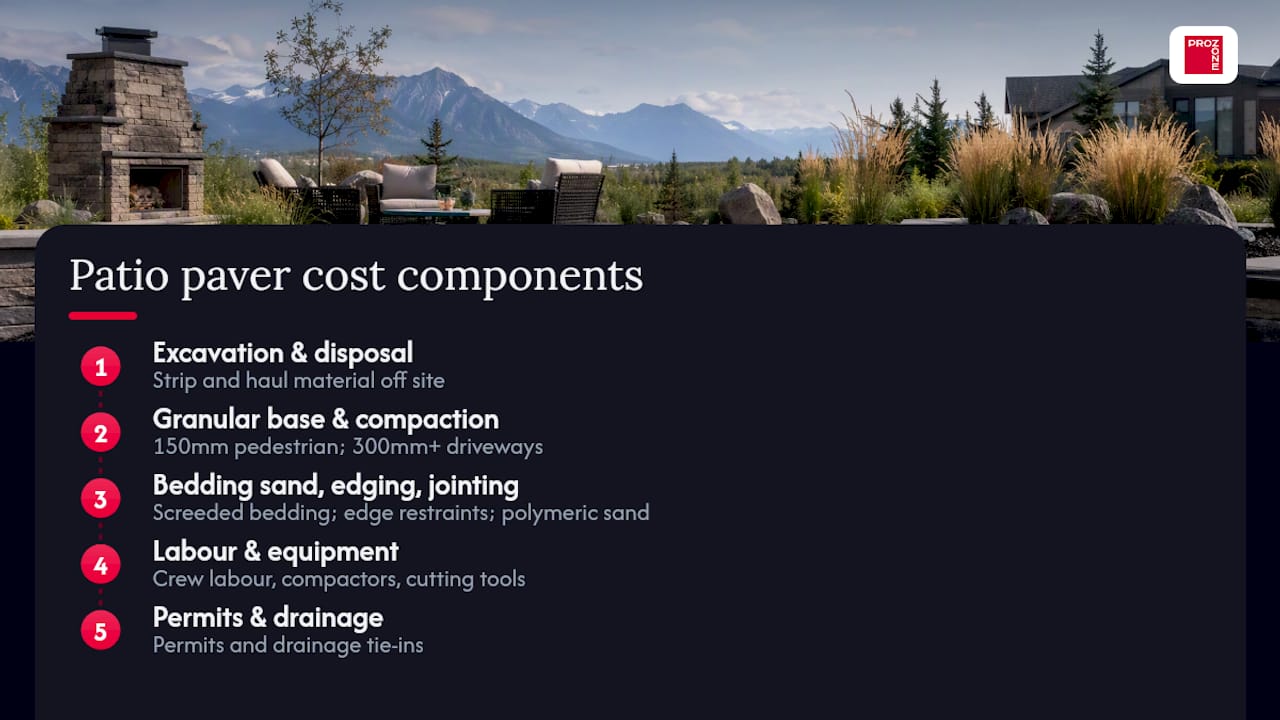
A legitimate Barkman patio paver price quote is really five line items stacked together, and each one has its own cost logic worth understanding before you sign anything.
1. Excavation and disposal. The contractor strips existing sod, soil, or old hardscape down to subgrade, then hauls that material off site. Cost here depends heavily on access. A backyard reachable only through a narrow gate side gate costs more to excavate than a driveway a skid steer can drive straight onto.
2. Granular base and compaction. This is the layer that matters most in Alberta’s climate. Contractors place and compact crushed granular base in lifts, typically targeting 150mm for pedestrian areas and 300mm or more under driveways, depending on subgrade conditions and frost penetration depth. A geotextile membrane often goes beneath the base on clay-heavy sites to stop fines from migrating upward and destabilizing the compacted layer over successive freeze-thaw cycles.
3. Bedding sand, edging, and jointing. A thin, screeded bedding sand layer sits under the pavers themselves. Edge restraints, whether aluminum, plastic, or concrete curbing, lock the perimeter so the field doesn’t spread under traffic. Polymeric sand fills the joints and hardens to resist weed growth and washout.
4. Labour and equipment. Skilled installation crews price by square footage but factor in compaction equipment (plate compactors, vibratory rollers for larger jobs), cutting tools for pattern work, and crew size needed to hit a reasonable timeline.
5. Permits and drainage integration. Some municipalities require permits for grading changes or work near property lines. Tying new hardscape into existing downspouts or swales adds a further line item that’s easy for a low-ball quote to skip entirely.
Pro Tip: Ask your contractor to itemize granular base depth and compaction method separately from the flat “site prep” line. If they can’t tell you the base depth in millimetres, they likely haven’t engineered it for your subgrade or frost depth.
Labour rates vary by region, project complexity, and time of year. Spring bookings in Alberta often carry a premium because everyone wants their patio in before summer. Booking installation in late summer or early fall, once base soil has dried out from spring runoff, frequently gets better contractor availability and pricing.
What do real sample projects cost?
Numbers land differently once they’re attached to an actual project size. The table below reflects typical installed pricing across common residential applications in Canada, based on current interlocking price benchmarks.
| Project type | Cost per sq ft (installed) | Cost per m² (installed) |
|---|---|---|
| Walkway (narrow, pedestrian) | $15 to $35 | $150 to $350 |
| Patio (standard pattern, 60mm) | $15 to $35 | $150 to $350 |
| Driveway (80mm, reinforced base) | $15 to $35 | $150 to $350 |
| High-end (natural stone accents, steps, curves) | $35+ | $350 or more |
A 12 x 12 ft patio (144 sq ft, about 13.5 m²) with mid-range Barkman pavers commonly lands between $2,600 and $3,600 installed, depending on access and existing surface removal.
Scale that to a 500 sq ft project (roughly 46.5 m²), a common size for a larger patio or a combined patio-and-walkway package, and the installed total generally falls between $9,000 and $15,500 at standard pricing. That’s a wide band, and the variance almost always traces back to base depth, pattern complexity, and how much excavation the site demands before any paver arrives.
A few conditions reliably push a project above these ranges:
- Natural stone borders or accent bands mixed into the field.
- Steps, retaining walls, or elevation changes built into the same scope.
- Complex grading around existing trees, utilities, or drainage structures.
- Curved layouts requiring extensive cutting versus straight-line patterns.
Which Barkman product choices change the price?
Not every Barkman paver costs the same, and the differences aren’t arbitrary. Thickness is the first fork in the road. Sixty-millimetre pavers suit patios, walkways, and other pedestrian surfaces. Eighty-millimetre pavers are the standard for driveways and any area carrying vehicle loads, since the added thickness distributes weight over a wider footprint and resists cracking under repeated freeze-thaw stress.
Large-format slabs and pre-designed landscape kits change the labour equation too. A kit with matched coping, wall units, and paver fields simplifies design decisions and can reduce cutting waste, but it also carries a different price point than ordering individual paver pallets.
A few product-level factors worth budgeting around:
- Colour and finish: blended or tumbled finishes typically cost more per unit than standard single-tone pavers.
- Large-format slabs: fewer joints per square foot can reduce labour hours slightly, though unit cost runs higher.
- Landscape kits: bundled products simplify ordering but limit customization compared to mixing individual lines.
- Regional shipping: some Barkman product lines manufactured in British Columbia carry additional freight or dealer fees when shipped to Alberta, so confirm this with your dealer before locking in a budget.
Retail listings through major Canadian home improvement chains and regional dealers show per-unit pricing and volume discounts on popular lines, which is useful for a rough material estimate before a contractor site visit.
How do you get an accurate contractor quote?
A written estimate is only as good as what it specifies. Compare bids using this checklist, not just the bottom-line number.
- Confirm granular base depth and compaction specification. Ask for the exact millimetre depth planned for your subgrade and application, plus whether a geotextile membrane is included.
- Request itemized unit pricing. A quote broken into per square metre material, labour hours, equipment rental, and disposal fees lets you compare bids on equal footing.
- Ask about jointing material. Confirm whether polymeric sand is included and specified by name, not just “sand.”
- Verify insurance and code compliance. Confirm the contractor carries liability insurance and follows Alberta Safety Codes for any excavation or grading work.
- Check references and warranty terms. Ask to see completed projects at least one full winter old, since that’s when base failures show up.
- Request alternates. A contractor who can price the job with and without geotextile, or at two different base depths, is giving you real engineering options rather than a single guess.
Watch for red flags: a single line item labelled “site prep” with no depth or material specified, a bid dramatically lower than every other quote with no explanation, or reluctance to discuss compaction method. These almost always signal corners being cut on the one component that determines whether your investment lasts fifteen years or fails in three.
Why does Alberta’s freeze-thaw cycle change the math?
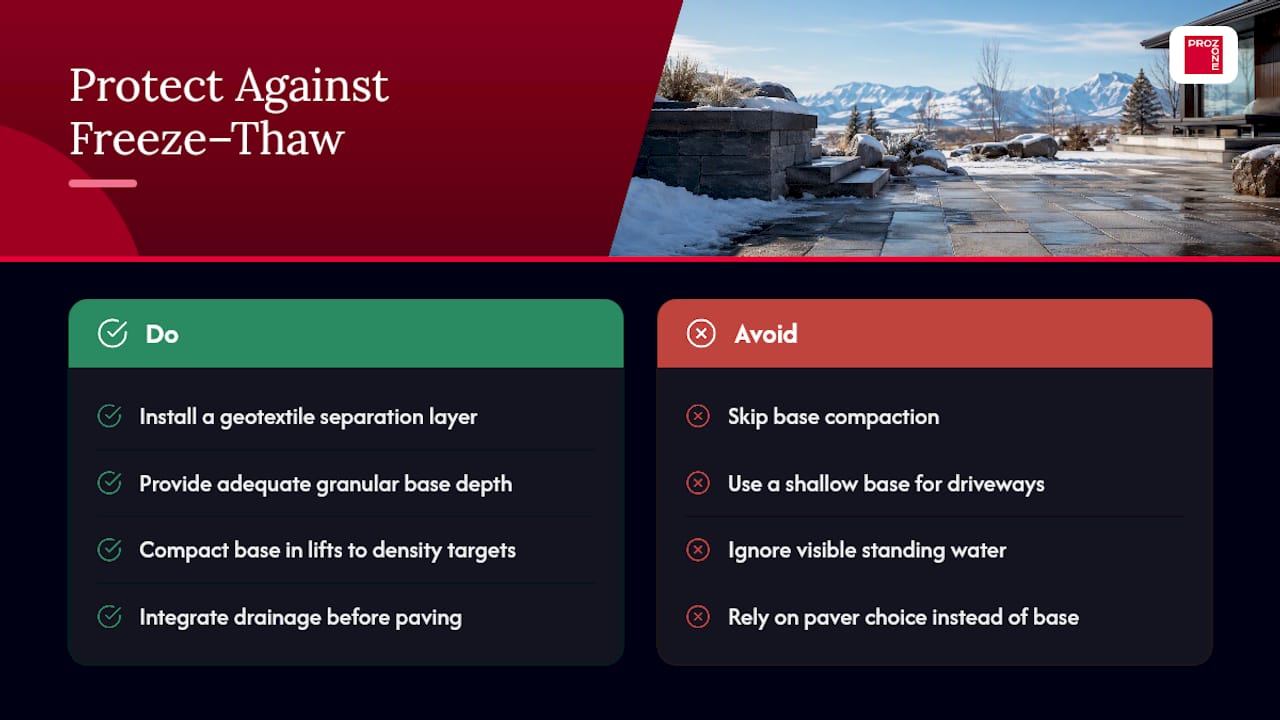
Edmonton’s climate swings through dozens of freeze-thaw cycles each winter, and every cycle exerts pressure on whatever sits beneath your pavers. Moisture in an undercompacted or poorly drained base expands when it freezes and contracts when it thaws, gradually shifting pavers out of level. This is the mechanism behind nearly every “my patio heaved after one winter” complaint we hear.
The granular base and compaction standard beneath the pavers, not the paver product itself, is the dominant controllable factor in how a hardscape performs through repeated freeze-thaw cycles.
Alberta subgrade conditions, particularly clay-heavy soils common across the Edmonton region, make a geotextile separation layer and adequate base depth non-negotiable rather than optional upgrades. We size granular base assemblies to the specific application, typically deeper for driveways than for pedestrian patios, and compact in lifts to hit density targets rather than compacting once at full depth.
Pro Tip: If your yard has visible standing water after rain, budget for drainage integration before you budget for paver colour. Fixing water first prevents almost every heave and settling issue that shows up two winters later.
Readers wanting the technical detail can review our sub-base preparation guide or browse completed installations before requesting a site visit for an accurate, subgrade-specific price.
What actually drives the final price on this job?
The conventional advice on hardscape budgeting spends too much time comparing paver brands and not nearly enough time on what’s underneath them. Every price range in this guide holds true only if the base assembly matches Alberta’s frost depth and soil conditions, and that’s precisely the variable most generic online calculators ignore entirely.
Here’s where we’d push back on the typical approach: homeowners often treat the quote comparison as a paver-selection exercise, picking colour and pattern first, then shopping price on installation. Flip that order. Get your site assessed for drainage and subgrade type first, because that determines whether you need 150mm or 300mm of base, and that number moves your total budget more than any product upgrade will.
Prioritize the contractor’s compaction specification and base depth over the sticker price on the paver itself. A slightly higher quote that specifies geotextile and proper lift compaction will almost always outlast a cheaper bid that glosses over subsurface work, and the long-term repair savings dwarf the upfront difference.
— ProZone
Get a site-specific estimate from ProZone
The company supplies Barkman concrete products as an authorized dealer and handles the full scope from excavation through final compaction and paver installation in the Edmonton area and surrounding regions. Rather than guessing at a price range from a generic calculator, you get a quote engineered to your actual subgrade, drainage needs, and frost depth requirements, the details that determine whether your investment lasts through a decade of Alberta winters or needs repair after two.
Our crews follow Alberta Safety Codes on every excavation and grading scope, using granular base assemblies specified to the application rather than a one-size-fits-all depth. If you’re planning a patio, walkway, or driveway project, review our site preparation services and request a free, no-obligation estimate through our online form, or call ProZone directly to book a site visit.
Sources
For readers verifying product specs or comparing benchmark pricing:
- Interlocking paver installation in Canada, complete price guide per square metre and square foot
- About Us – Barkman Concrete
- Barkman spaces catalogue 2026 (dealer PDF)
- Interlocking cost per square foot 2026: GTA pricing guide
FAQ
How much does 500 sq ft of pavers cost installed?
A 500 sq ft Barkman paver project typically runs $9,000 to $15,500 installed in Canada, depending on pattern complexity, access, and how much granular base depth the site requires.
Is Barkman a Canadian company?
Yes. Barkman is a Canadian hardscapes manufacturer founded in Manitoba, with dealer distribution across western Canada including Alberta.
Where can I buy Barkman products?
Barkman sells through authorized Canadian dealers and select retail partners rather than direct to consumers; ProZone is an authorized dealer for Alberta customers.
How thick are Barkman pavers?
Barkman pavers commonly come in 60mm thickness for patios and pedestrian areas, and 80mm for driveways and other vehicle-load surfaces requiring a reinforced granular base.