
Paving in Alberta costs significantly more than in warmer provinces, and that gap is not arbitrary. Asphalt driveway costs in Alberta run higher because Edmonton’s freeze-thaw cycles demand deeper base preparation, thicker asphalt layers, and materials engineered for extreme temperature swings. For corporations managing large parking lots and municipalities responsible for public roads, the temptation to cut costs with quick fixes is real. But that shortcut almost always leads to accelerated cracking, liability exposure, and emergency repair budgets that dwarf what proper installation would have cost. This article breaks down the real value equation behind professional paving, the methods that matter, and how to choose the right solution for your specific property or infrastructure goals.
Table of Contents
- The cost and value equation for professional paving in Edmonton
- Core methods used by professional paving teams
- How professional paving improves safety, longevity, and property value
- Choosing the right paving solution for Edmonton properties
- What most property managers miss when investing in professional paving
- Connect with Edmonton’s top paving specialists
- Frequently asked questions
Key Takeaways
| Point | Details |
|---|---|
| Local climate increases costs | Edmonton’s harsh weather means professional paving costs more upfront, but pays off in durability and reduced repairs. |
| Advanced methods boost results | Techniques like micro-surfacing and concrete raising help municipalities and corporations achieve safer, longer-lasting infrastructure. |
| Professional paving adds value | Well-executed paving boosts property value, safety, and reduces liability for organizations and municipal departments. |
| Choose expert teams | Local professional paving contractors ensure city-specific compliance and optimal performance for Edmonton properties. |
The cost and value equation for professional paving in Edmonton
Edmonton’s climate is unforgiving. Temperatures swing from minus 30°C in January to plus 30°C in July, and that range forces pavement through hundreds of expansion and contraction cycles every year. Without proper sub-base preparation and high-quality binder mixes, asphalt fails fast. This is not a theoretical risk. It is the reason asphalt paving costs in this region reflect a level of engineering that cheaper bids simply cannot match.
Professional installation in Alberta averages $7 to $13 per square foot, depending on site conditions, material grade, and preparation depth. That range sounds wide, but the difference between the low and high end often comes down to sub-base thickness and drainage design. Skimping on either creates a pavement that looks fine for one season and starts crumbling by the third.
The table below illustrates how upfront investment compares to long-term costs when you choose professional paving versus a budget approach:
| Factor | Professional paving | Budget or DIY approach |
|---|---|---|
| Initial cost per sq ft | $7 to $13 | $3 to $6 |
| Expected lifespan | 20 to 30 years | 5 to 10 years |
| Repair frequency | Low (scheduled maintenance) | High (reactive patching) |
| Liability risk | Minimized | Elevated |
| Total 20-year cost | Lower overall | Often 2x or more |
When you look at the 20-year picture, the math shifts decisively toward quality. A parking lot that lasts 25 years with minimal intervention costs far less per year than one that needs major patching every three to five years. You can explore how this plays out across different surface types in our parking lot durability comparison.
Several factors drive professional paving pricing in Edmonton specifically:
- Sub-base depth and compaction: Edmonton’s frost line requires deeper excavation and gravel base layers than most Canadian cities.
- Material specification: High-performance polymer-modified asphalt binders cost more but resist cracking under thermal stress.
- Drainage engineering: Poor drainage is the leading cause of early pavement failure in flat urban sites.
- Equipment and crew expertise: Proper compaction requires calibrated rollers and experienced operators, not just any paving crew.
- Seasonal timing: Paving outside the optimal temperature window (typically May through September) requires additional precautions.
You can see how these factors play out across completed Edmonton paving projects in our project gallery, where site conditions vary widely from corporate campuses to municipal access roads.
Pro Tip: When reviewing bids, ask each contractor to specify sub-base depth and material grade. A bid that omits these details is almost certainly cutting corners that will cost you more within five years.
The value equation is not just about avoiding repairs. It is about predictability. Corporations and municipalities operate on budget cycles, and pavement that performs reliably lets you plan maintenance costs years in advance instead of scrambling for emergency funds.
Core methods used by professional paving teams
Not all paving work is the same, and understanding the methods professional teams use helps you ask better questions and make smarter decisions. The gap between a professional repair and a basic patch job is not just cosmetic. It is structural.
Edmonton’s municipal road network relies on a defined set of roadway repair types that prioritize long-term performance over short-term cost savings. These same methods translate directly to corporate property maintenance.
“Municipal authorities prioritize professional repair methods like asphalt patching, micro-surfacing, and concrete raising because they deliver cost-effective infrastructure maintenance and reduce safety risks for the public.”
Here is how the most common professional methods compare to basic repair techniques:
| Method | Professional approach | Basic repair |
|---|---|---|
| Surface patching | Full-depth removal and replacement | Cold-mix fill |
| Crack sealing | Hot-pour rubberized sealant | DIY filler |
| Micro-surfacing | Polymer-modified slurry application | Surface coating |
| Concrete raising | Polyurethane foam injection | Gravel fill |
| Line marking | Thermoplastic with reflective beads | Paint |
For large-scale projects, professional paving teams follow a structured process that ensures quality at every stage. Our road repair methods guide covers this in depth, but here is the core sequence:
- Site assessment and core sampling: Professionals test existing pavement depth and sub-base condition before designing a repair plan.
- Drainage evaluation: Water management issues are identified and addressed before any surface work begins.
- Sub-base preparation: Weak or contaminated base material is removed and replaced with compacted granular fill.
- Binder course installation: A structural asphalt layer is laid and compacted to specification.
- Surface course application: The wearing layer is applied at the correct temperature and compacted to achieve target density.
- Joint and edge sealing: All seams and perimeter edges are sealed to prevent water infiltration.
- Quality verification: Compaction density and surface tolerance are checked against project specifications.
Micro-surfacing deserves special mention for municipal and corporate clients managing large paved areas. It extends pavement life by four to eight years at a fraction of full reconstruction cost, making it one of the most cost-effective tools in preventive maintenance. Our concrete repair solutions page explains how pulverization and resurfacing work together to restore aging lots without full replacement.
For organizations managing multiple sites, optimizing asphalt repairs across a portfolio requires a systematic approach. Prioritizing high-traffic zones and addressing drainage failures first prevents small problems from becoming expensive structural failures.
How professional paving improves safety, longevity, and property value
Safety is not a soft benefit. It is a legal obligation. Corporations and municipalities that allow deteriorated pavement to persist face real liability exposure when trips, falls, or vehicle damage occur on their property. Professional paving directly reduces that risk.

Municipal authorities rely on professional methods for safety and cost-effective maintenance because the consequences of failure are measured in both dollars and public trust. The same logic applies to any organization responsible for high-traffic paved surfaces.
Here are the direct benefits that professional paving delivers:
- Reduced liability: Smooth, well-maintained surfaces eliminate the trip hazards and pothole damage that generate insurance claims.
- Extended pavement life: Properly installed asphalt in Edmonton lasts 20 to 30 years with scheduled maintenance, versus 5 to 10 years for budget installations.
- Higher property value: Commercial properties with well-maintained paving consistently command higher lease rates and better appraisals.
- Lower disruption: Long-lasting pavement means fewer closures, less construction noise, and fewer interruptions to daily operations.
- Improved drainage: Professional grading and drainage design prevent water pooling, which is a major cause of both pavement failure and slip hazards.
- Better first impressions: For corporate properties, the parking lot is often the first thing clients and employees see. Its condition signals how you manage everything else.
Longevity matters especially in high-traffic environments. A municipal transit depot or a large retail parking lot that requires resurfacing every five years creates operational disruption and budget unpredictability. Professional installation, combined with a scheduled maintenance program, eliminates that cycle.
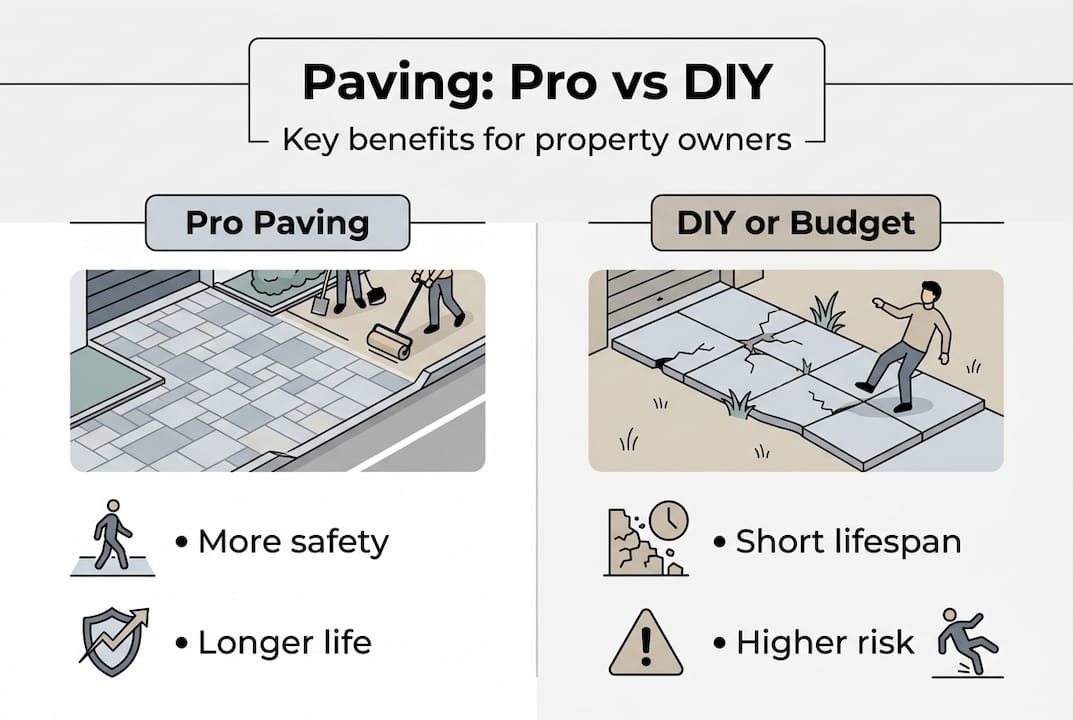
Pro Tip: Schedule a professional pavement condition assessment every two to three years. Catching early-stage cracking or drainage issues before they become structural failures can save 60 to 80 percent of what a full reconstruction would cost.
Understanding the full paving process explanation helps property managers set realistic expectations and communicate effectively with contractors. When you know what proper installation looks like, you can hold your paving team accountable to the right standards.
For organizations across Alberta, our Alberta asphalt services page outlines the specific service options available for both new construction and maintenance programs.
Choosing the right paving solution for Edmonton properties
Not every paving challenge calls for the same solution. A municipal road with heavy truck traffic has different requirements than a corporate parking lot serving passenger vehicles. Getting the match right between site conditions and paving method is where professional expertise pays off most clearly.
According to Alberta paving cost analysis, material and preparation requirements vary significantly based on intended use, traffic load, and soil conditions. That variability is exactly why a one-size-fits-all approach fails in Edmonton’s environment.
Statistic callout: Professional asphalt installation in Alberta ranges from $7 to $13 per square foot, with the higher end reflecting the climate-specific preparation that Edmonton’s freeze-thaw cycles demand.
Use these criteria to match your project to the right paving solution:
- Traffic volume and load class: Heavy commercial or municipal vehicle traffic requires thicker asphalt sections and stronger sub-base design than standard passenger vehicle areas.
- Current pavement condition: Surfaces with minor cracking respond well to crack sealing or micro-surfacing. Structural failures require full-depth reclamation or reconstruction.
- Drainage characteristics: Sites with poor natural drainage need engineered solutions built into the paving design, not applied as an afterthought.
- Budget cycle and timeline: Preventive maintenance is always cheaper than reactive repair. Aligning paving investments with your capital planning cycle maximizes value.
- Surface use requirements: Areas used for pedestrian traffic, vehicle parking, and heavy equipment access each have specific surface tolerance and marking requirements.
- Environmental exposure: South-facing surfaces in Edmonton experience more UV degradation. North-facing or shaded areas retain moisture longer. Both factors affect material selection.
Corporate clients typically prioritize appearance and liability management, while municipal clients focus on traffic safety and lifecycle cost. Both goals are best served by the same foundation: proper engineering, quality materials, and experienced installation.
Our paving solutions guide walks through the decision process in practical terms, and our paving tips and trends resource covers emerging approaches that are gaining traction in Edmonton’s commercial and municipal sectors.
What most property managers miss when investing in professional paving
Here is the uncomfortable truth: most paving failures are not caused by bad contractors. They are caused by clients who prioritized the lowest bid without asking the right questions. We see this pattern repeatedly in Edmonton, and it costs organizations far more than the savings they thought they were getting.
The first thing most property managers undervalue is climate preparation. Edmonton’s ground freezes deep, and a sub-base that works in Vancouver will fail here within a few winters. Local experience is not a marketing claim. It is a technical requirement.
The second mistake is treating paving as a one-time event rather than an asset to maintain. Even the best installation degrades without a maintenance program. Crack sealing, drainage clearing, and periodic condition assessments are what convert a 15-year pavement into a 25-year pavement.
The third oversight is ignoring the post-installation period. The first two years after installation are critical for monitoring settlement, joint performance, and drainage behavior. Contractors who disappear after the final invoice are not partners. They are vendors.
Our recommendation is straightforward. Before committing to any paving project, review advanced paving techniques used by experienced Edmonton contractors and compare them against what your bidders are proposing. The gap between what professionals do and what budget crews skip is where your long-term costs are determined.
Actionable steps to protect your investment:
- Require sub-base specifications in writing before signing any contract.
- Ask for references from comparable Edmonton projects completed in the last three years.
- Build a two-year post-installation inspection clause into your contract.
- Schedule preventive maintenance annually rather than waiting for visible deterioration.
- Partner with contractors who understand Edmonton’s specific frost depth and drainage requirements.
Connect with Edmonton’s top paving specialists
If you manage corporate property or public infrastructure in Edmonton, the decisions you make about paving directly affect your budget, your liability exposure, and the experience of everyone who uses your facilities. The educational content in this article gives you a framework, but applying it to your specific site conditions requires local expertise.
ProZone Ltd delivers professional paving and road construction solutions for both municipal and commercial clients across Edmonton and the surrounding region. Whether you need a full parking lot reconstruction, preventive micro-surfacing, or targeted repairs, our team brings the engineering knowledge and local experience that Alberta’s climate demands.
Explore our full range of Edmonton construction services or get specific details on curb and sidewalk repairs to address the complete scope of your infrastructure needs. Contact our team today to discuss your project requirements.
Frequently asked questions
How much does professional paving cost in Edmonton?
Professional paving costs in Edmonton average $7 to $13 per square foot, with the higher end reflecting climate-specific sub-base preparation and material requirements unique to Alberta’s freeze-thaw conditions.
What paving methods do municipalities in Edmonton use?
Municipalities in Edmonton use asphalt patching, micro-surfacing, and concrete raising for cost-effective and safe road repairs that extend infrastructure life without full reconstruction.
Does professional paving last longer than DIY or lowest-bid options?
Yes. Professional paving delivers 20 to 30 years of service life in Edmonton conditions, compared to 5 to 10 years for budget installations that skip proper sub-base preparation and material specification.
What are the main benefits of investing in professional paving?
Professional paving improves safety, reduces liability exposure, increases property value, and lowers long-term maintenance costs. Municipal authorities recognize these benefits as the standard for responsible infrastructure management in high-traffic environments.