
TL;DR:
- Regular maintenance, including cleaning and sealing, significantly extends concrete lifespan in Edmonton’s climate.
- Proper timing and products tailored to Edmonton’s freeze-thaw cycles are crucial for effective repairs.
- Expert professional help ensures compliance with Alberta standards and prevents costly surface failures.
Concrete is one of the most durable building materials available, yet neglected concrete deteriorates faster than most property owners expect, leading to safety hazards and repair bills that can easily outpace the cost of simple routine care. For Edmonton property managers and owners, this is not a minor concern. Freeze-thaw cycles, road salt, heavy traffic, and harsh winters put concrete under constant stress. A single overlooked crack can widen over one winter and require full slab replacement by spring. The good news is that a structured maintenance approach, applied consistently, keeps surfaces looking sharp and performing safely for decades. This guide walks you through every step, from tools and cleaning to sealing, repairs, and local climate strategies.
Table of Contents
- What you need for concrete maintenance
- Step-by-step cleaning and inspection routine
- Sealing concrete: Timing, methods, and mistakes to avoid
- Repair and compliance: Fixing issues and meeting Alberta standards
- Edmonton-specific strategies: Adapting for climate and site conditions
- Why most concrete maintenance ‘rules’ are too generic for Edmonton
- Professional help and resources for Edmonton concrete surfaces
- Frequently asked questions
Key Takeaways
| Point | Details |
|---|---|
| Routine cleaning matters | Frequent sweeping and annual power washing are crucial for preventing surface deterioration. |
| Seal for protection | Penetrating sealers applied every 2–3 years safeguard concrete from moisture and freeze-thaw cycles. |
| Inspect and repair early | Quarterly inspections and prompt repairs prevent minor cracks from becoming major problems. |
| Local standards rule | Comply with CSA A23.1-19 for durable, safe concrete in Edmonton’s climate. |
| Adapt to Edmonton’s climate | Seasonal strategies and proper drainage are essential given Edmonton’s extreme weather. |
What you need for concrete maintenance
Now that you understand why maintenance matters, let’s start with what you’ll need in your toolkit. Getting the right materials and equipment before you begin saves time and prevents mistakes that can damage surfaces or void sealer warranties.
Essential tools and materials:
- Stiff-bristle broom and leaf blower for dry debris removal
- Pressure washer (1,500 to 3,000 PSI) with a fan-tip nozzle
- pH-neutral cleaner to protect sealers and coatings without etching the surface
- Penetrating or film-forming concrete sealer suited to Edmonton’s climate
- Crack filler, epoxy injection kit, or polyurethane foam for repairs
- Safety glasses, chemical-resistant gloves, and non-slip footwear
- Inspection flashlight and measuring tape for crack assessment
Having the wrong cleaner is one of the most common and costly mistakes. Acidic or alkaline products strip sealers and open the concrete surface to moisture infiltration. Always read the label and confirm pH-neutral status before purchasing.
Seasonal timing in Edmonton:
| Task | Best timing | Frequency |
|---|---|---|
| Sweeping | Year-round | Weekly |
| Spot stain removal | As needed | Immediate |
| Power washing | Late spring or summer | Annually |
| Sealer application | Summer, dry and above 10°C | Every 2 to 3 years |
| Full inspection | Spring and fall | Twice yearly |
| Joint and crack checks | Post-winter | After every freeze-thaw season |
Edmonton’s short warm season means you have a limited window for sealing and major repairs. Plan your concrete maintenance checklist tasks by month so you never miss the optimal window. Understanding flatwork preparation basics also helps you recognize when a surface was laid correctly and what maintenance it actually needs.
Pro Tip: Pour a small cup of water on your concrete surface. If the water beads up, your sealer is still doing its job. If it soaks in within 30 seconds, it’s time to reseal. This simple test takes less than a minute and can save you from a full recoating job.
Step-by-step cleaning and inspection routine
With your checklist in hand, here’s how to carry out concrete cleaning and inspection expertly. Consistency is the key word here. Surfaces that get attention every week stay in far better condition than those cleaned once a year.
- Weekly sweeping: Remove dirt, grit, and organic debris with a stiff broom or leaf blower. Grit acts like sandpaper underfoot and accelerates surface wear over time.
- Immediate stain treatment: Address oil, grease, rust, or chemical spills the moment they appear. Blot, don’t scrub, and apply a pH-neutral degreaser. Sweeping weekly and washing annually prevents stains from bonding permanently with the surface.
- Annual power washing: Use a fan-tip nozzle at a 45-degree angle, keeping the wand at least 12 inches from the surface. Never use a zero-degree tip; it etches and pits the concrete, damaging the finish and the sealer beneath it.
- Quarterly inspection: Walk the full surface and look for hairline cracks, spalling (surface flaking), joint separation, and any areas where water pools. Inspect quarterly and after freeze-thaw cycles to catch early damage before it escalates.
- Post-winter assessment: Edmonton winters are particularly hard on concrete. After the last freeze, inspect every joint and crack carefully. Note any new damage with photos and measurements.
- Documentation: Keep a simple log with dates, photos, and notes. This historical record is invaluable when deciding whether to repair or replace, and it supports insurance or compliance documentation.
“Surfaces that are inspected and cleaned on a regular schedule last significantly longer and cost far less to maintain over a 10-year period than those serviced only when visible damage appears.”
Pro Tip: Always check concrete surfaces within two weeks after Edmonton’s last hard frost. That’s when freeze-thaw damage is freshest and easiest to address before it worsens. Your winter protection strategies should include a post-thaw walkthrough as a standard step, and your ongoing maintenance checklist should have this task scheduled every April.
Sealing concrete: Timing, methods, and mistakes to avoid
After cleaning and inspecting, sealing is your main shield against Edmonton’s climate extremes. A good sealer blocks moisture, resists freeze-thaw damage, and keeps de-icing chemicals from penetrating the slab. Choosing the wrong product or applying it at the wrong time can trap moisture and cause more damage than no sealer at all.
Penetrating vs. film-forming sealers:
| Feature | Penetrating sealer | Film-forming sealer |
|---|---|---|
| How it works | Absorbs into concrete pores | Forms a protective layer on top |
| Appearance | Natural, no sheen | Glossy or satin finish |
| Durability | 5 to 10 years | 1 to 3 years |
| Best for Edmonton | Yes, resists freeze-thaw | Limited, can peel in cold |
| Slip resistance | High | Moderate (can be slippery when wet) |
| Reapplication effort | Low | Higher, requires surface prep |
For Edmonton’s climate, penetrating sealers every 2 to 3 years provide the most reliable protection against moisture infiltration, freeze-thaw cycling, and chemical damage from road salts. Film-forming sealers can look great on interior or covered surfaces, but they tend to peel and bubble outdoors when temperatures swing dramatically.
Key sealing rules:
- Never seal new concrete before it has cured for at least 28 days
- Apply only when temperatures are above 10°C and no rain is forecast for 24 hours
- Apply thin, even coats; thick application traps air and causes bubbling
- Check sealer care tips for product-specific guidance on application and drying times
- Review Alberta concrete specs to confirm your sealer is compatible with the concrete mix used
Common sealing mistakes:
- Over-applying sealer, which leads to a cloudy, peeling surface
- Sealing over a damp or dirty surface, trapping moisture underneath
- Using a film-forming sealer on an outdoor Edmonton surface exposed to freeze-thaw
- Skipping the water bead test before resealing, which can result in unnecessary cost
Pro Tip: If you’re applying sealer to a large area like a parking lot or commercial driveway, use a low-pressure sprayer for even coverage and back-roll with a short-nap roller to work the product into the surface. This two-step method reduces lap marks and ensures no spots are missed.
Repair and compliance: Fixing issues and meeting Alberta standards
Even with good routine care and sealing, repairs and regulatory checks keep your surfaces truly safe and compliant. Knowing when to handle a repair yourself and when to call a professional is one of the most important judgment calls a property manager makes.
Common repair scenarios and methods:
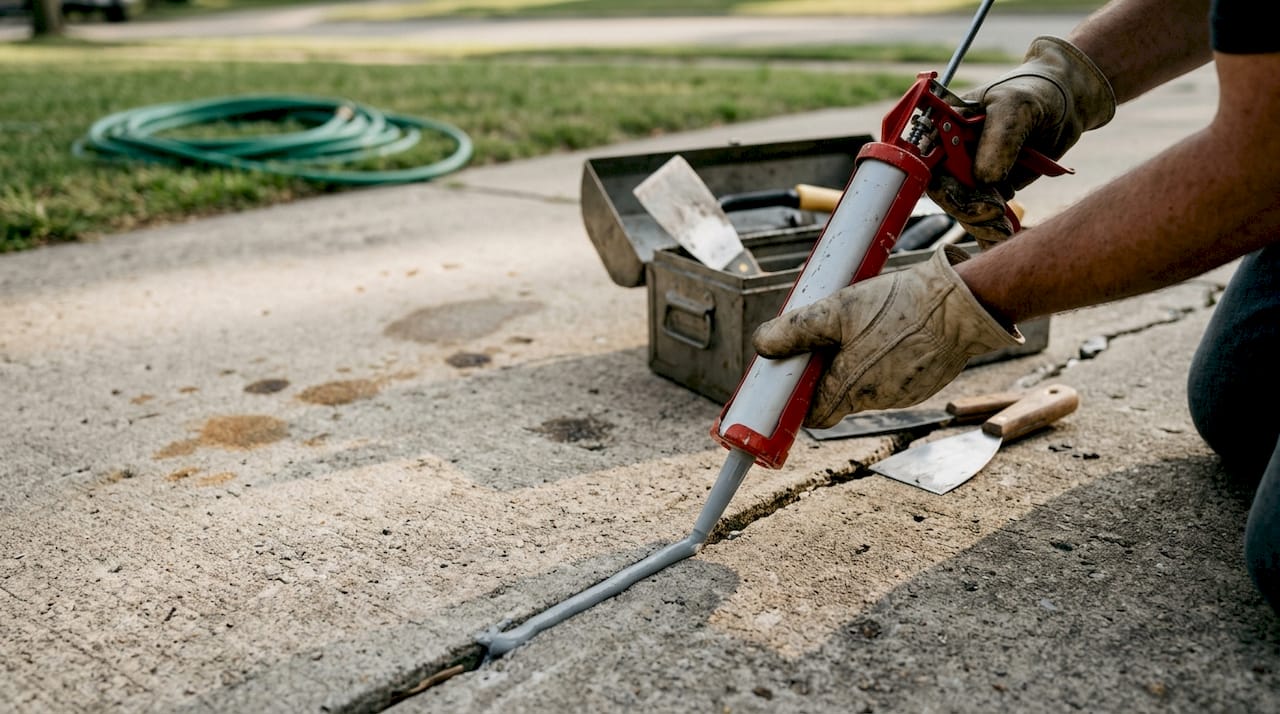
- Hairline cracks (under 3mm wide): Fill with a flexible polyurethane sealant. These cracks are mostly cosmetic but can widen if left open to moisture.
- Structural cracks (over 3mm or with vertical displacement): Require epoxy injection or professional assessment. Do not attempt surface-only patching.
- Spalling (surface flaking): Caused by freeze-thaw damage or de-icing salt. Clean the area, apply a bonding agent, and resurface with a polymer-modified overlay.
- Joint failure: Remove deteriorated joint filler and replace with a backer rod and flexible sealant rated for outdoor use.
- Large-scale surface failure: If more than 25% of a surface shows cracking, spalling, or delamination, full replacement is typically more cost-effective than patching.
“Early crack sealing can save thousands compared to delayed structural repairs.”
For crack repair methods matched to specific damage types, or a step-by-step repair walkthrough, detailed guidance is available for Edmonton conditions. Understanding what causes concrete to crack in the first place also helps you prevent recurrence after repairs.
Repair decision table:
| Damage type | DIY appropriate? | Professional threshold |
|---|---|---|
| Hairline crack | Yes | If recurring after repair |
| Wide or structural crack | No | Always |
| Minor spalling (under 10%) | Yes | If bonding fails |
| Major spalling (over 25%) | No | Always |
| Joint failure | Yes | If subbase is compromised |
Repair cracks promptly using sealants, epoxy, or polyurethane foam based on the type and cause of the damage. Delaying even a small crack repair through one Edmonton winter can turn a $200 fix into a $2,000 replacement. Alberta’s CSA A23.1-19 standard governs concrete mix design, air entrainment, and exposure class requirements. Compliance is not optional for commercial properties; it directly affects liability and insurance coverage. Review coating maintenance guidelines to ensure your repair products also meet applicable standards.
Edmonton-specific strategies: Adapting for climate and site conditions
To truly master maintenance, let’s get specific on Edmonton’s local conditions and how they shape your approach. Generic maintenance guides written for mild climates simply don’t account for what Edmonton concrete goes through every year.
Edmonton’s freeze-thaw reality:
Edmonton averages over 100 freeze-thaw cycles per year. Each cycle forces water to expand inside micro-cracks, widening them slightly. Over a decade, this cumulative stress is the primary cause of surface failure on properties that skip regular maintenance. Seasonal maintenance including spring inspections, summer sealing, and fall joint preparation is not optional here; it’s the minimum standard for surface longevity.
Drainage and landscaping:
- Grade soil and landscaping away from concrete slabs to prevent water pooling
- Clean drains and catch basins every fall before freeze-up
- Avoid planting trees with aggressive root systems within 1.5 meters of concrete edges
- Use permeable gravel borders along slab edges to redirect surface runoff
Slip resistance and safety:
- Specify broom-finished or exposed aggregate surfaces for outdoor areas subject to ice
- Apply anti-slip coatings or grit additives to existing smooth surfaces before winter
- Review sidewalk safety strategies to meet municipal accessibility standards
- Follow winterizing concrete protocols every October before the first hard frost
Statistic callout: Properties that follow CSA-compliant maintenance routines in freeze-thaw climates see at least a 30% reduction in premature surface failure compared to those using non-compliant or generic maintenance approaches.
Pro Tip: Switch from chloride-based de-icers (rock salt) to sand or calcium magnesium acetate on concrete surfaces. Chloride salts accelerate rebar corrosion and surface spalling. The upfront cost difference is small; the long-term savings are significant.
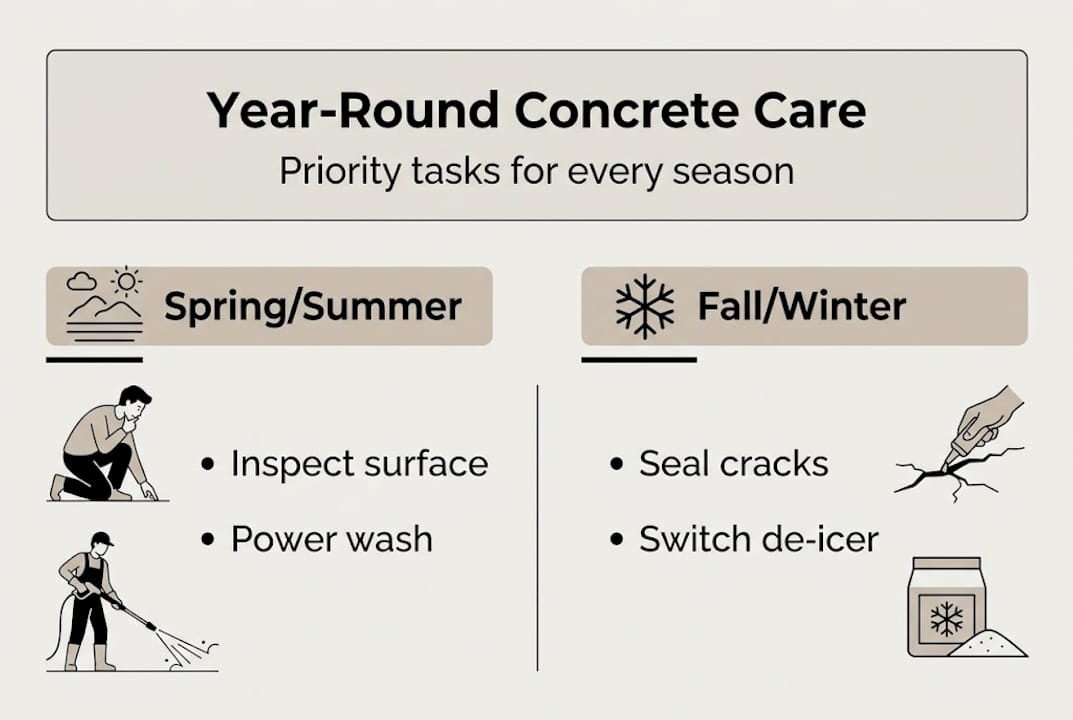
Seasonal action calendar:
| Season | Priority tasks |
|---|---|
| Spring | Inspect, document damage, begin crack repairs |
| Summer | Power wash, reseal, address spalling |
| Fall | Clean joints, apply joint sealant, check drainage |
| Winter | Use safe de-icers, monitor for new cracking |
Why most concrete maintenance ‘rules’ are too generic for Edmonton
Those are the technical steps, but there’s a key perspective Edmonton property managers should hear. Most of the maintenance advice available online was written for climates that experience a handful of frost events per year. Edmonton’s reality is categorically different, and following generic checklists without local adaptation is one of the most common reasons we see preventable surface failures.
The use of gravel and sand for winter traction, combined with aggressive freeze-thaw cycling, creates a specific wear pattern that national guides simply don’t address. Spring arrives quickly in Edmonton, and the window between the last frost and the first warm, dry stretch suitable for sealing is narrow. Miss it, and you’re waiting another year. That delay costs property managers real money.
We’ve also seen properties where owners applied film-forming sealers because a general guide recommended them, only to find the sealer peeling by November. Local flatwork guidance accounts for these realities. The properties that hold up best over time are not the ones following the most detailed generic checklist. They’re the ones whose managers understand that Edmonton concrete needs Edmonton-specific care, applied at the right time of year, with the right products for this exposure class. That’s the difference between a surface that lasts 30 years and one that needs replacing in 12.
Professional help and resources for Edmonton concrete surfaces
If you’d rather have a team ensure flawless surface care, here are resources for expert backup. Some maintenance tasks are well within reach for a hands-on property manager. Others, including structural crack repair, large-scale resealing, or compliance verification under CSA A23.1-19, carry enough risk that professional involvement pays for itself quickly.
ProZone Ltd works with commercial property owners, residential managers, and municipal clients across Edmonton to deliver concrete maintenance and repair that meets Alberta standards. Whether you need a one-time post-winter assessment or an ongoing maintenance program, our team brings the equipment, expertise, and local knowledge to do it right. Explore our Edmonton concrete experts page for service details, download a ready-to-use maintenance checklist to guide your seasonal routines, or get in touch about sidewalk and curb repair for your property. Protecting your investment starts with one call.
Frequently asked questions
How often should I seal concrete in Edmonton?
Apply penetrating sealers every 2 to 3 years for reliable protection in Edmonton’s climate. Always use the water bead test before resealing to confirm whether the existing sealer has actually worn down.
What is the best way to clean concrete surfaces safely?
Use only pH-neutral cleaners and avoid acids or harsh chemicals that strip sealers and open the concrete to moisture damage. A pressure washer with a fan-tip nozzle and a neutral cleaner handles most cleaning tasks effectively.
Why do cracks keep coming back after repairs?
Recurring cracks usually signal underlying movement, subbase settlement, or ongoing freeze-thaw stress rather than a surface-only problem. Repair methods matched to crack cause produce lasting results; surface-only patching without addressing the root cause will fail again.
What standard regulates concrete durability in Alberta?
CSA A23.1-19 dictates mix design and exposure class requirements for concrete in Alberta, covering air entrainment and durability specifications for freeze-thaw environments. Compliance is required for commercial properties and directly affects liability.
How do I check if my sealer is still effective?
Pour a small amount of water on the surface; if it beads on the surface, the sealer is still performing. If the water soaks in within 30 seconds, the sealer has worn down and reapplication is needed before the next freeze season.