
TL;DR:
- Structural concrete is engineered to carry loads and meet strict building codes in Alberta.
- Proper frost protection and site-specific design are critical for long-lasting Alberta structures.
- Local expertise ensures selecting the right concrete type, mix, and detailing for Alberta’s climate.
Most property managers in Alberta assume that concrete is concrete. If it’s gray, hard, and poured on site, it must all work the same way. That assumption leads to costly mistakes, from footings that crack under frost to slabs that fail to meet building codes. Structural concrete is a distinct category of material, engineered to carry real loads, meet strict codes, and survive Alberta’s brutal freeze-thaw cycles. This article breaks down exactly what structural concrete is, how it works, which types suit Alberta’s commercial projects, and what design details separate a safe, long-lasting structure from an expensive failure. If you manage commercial or municipal property in this province, this is information you need before your next project.
Table of Contents
- What is structural concrete? Key definitions and standards
- How structural concrete works: Mechanics and material properties
- Types and applications of structural concrete in Alberta construction
- Design nuances, benchmarks, and frost protection: What Alberta owners must know
- Why traditional approaches to structural concrete miss the mark in Alberta
- Next steps for Alberta managers: Concrete services and expert guidance
- Frequently asked questions
Key Takeaways
| Point | Details |
|---|---|
| Structural concrete separates load-bearing from decorative | Only structural concrete is designed and coded for bearing heavy loads in Alberta property projects. |
| Mechanics: Strength and safety | Concrete handles compression; steel reinforcement manages tension, enabling robust structural systems. |
| Climate-specific design | Alberta projects demand frost-protected footings and advanced thermal strategies for durability. |
| Application: Cast-in-place, precast, ICF | Managers must choose the right structural concrete type for their site – each offers unique pros and cons. |
| Expert benchmarking prevents mistakes | Understanding local strength standards and protection measures ensures safety and longevity in commercial construction. |
What is structural concrete? Key definitions and standards
Not all concrete is created equal. The term “concrete” covers a wide spectrum of materials, from decorative overlays to high-strength load-bearing systems. Understanding where structural concrete sits on that spectrum is the first step toward making informed decisions for your property.
Structural concrete is a construction material engineered to bear and transfer structural loads, distinct from non-structural uses like pavements or decorative finishes. It combines Portland cement, aggregates (sand and gravel), water, and typically steel reinforcement to handle tensile forces that plain concrete cannot resist on its own. The steel handles tension; the concrete handles compression. Together, they form a composite system that can safely carry the weight of floors, walls, columns, and foundations.
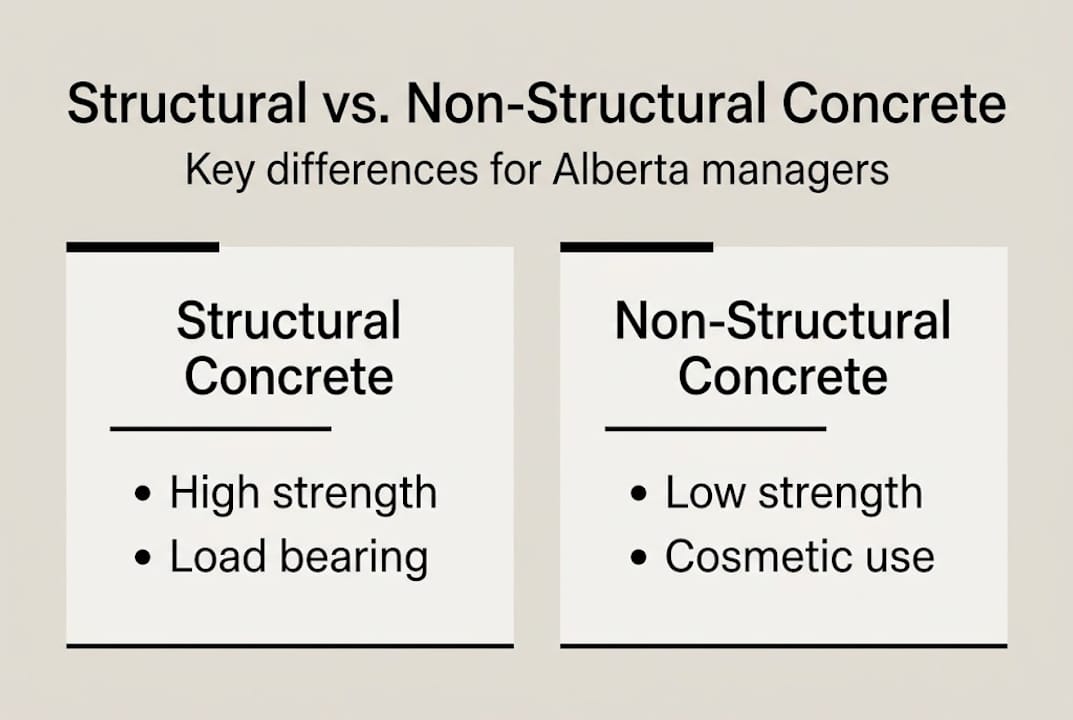
Non-structural concrete, by contrast, is used where loads are minimal or cosmetic. Think of a decorative pathway, a lightweight topping slab, or a curb. These applications use lower-strength mixes, often in the C10 to C20 range, and are not designed to carry building loads.
Key differences at a glance:
| Property | Structural concrete | Non-structural concrete |
|---|---|---|
| Compressive strength | Min. C25/30 (25 MPa+) | C10 to C20 |
| Steel reinforcement | Required | Optional or absent |
| Governing code | ACI 318, CSA A23.3 | Project-specific |
| Typical use | Foundations, columns, slabs | Sidewalks, overlays, curbs |
| Tensile strength | 2 to 5 MPa | Not a design factor |
In Alberta, structural concrete projects must comply with CSA A23.3, the Canadian standard for concrete design, which aligns closely with the American ACI 318 code. These codes set minimum compressive strength requirements, reinforcement ratios, cover depths, and durability provisions for exposure classes. Alberta’s cold climate means exposure class C-XL (extreme exposure) is common, requiring higher cement content, lower water-cement ratios, and air entrainment to resist freeze-thaw damage.
What the numbers mean for your project:
- Compressive strength for structural concrete ranges from 20 to 80 MPa, depending on application
- Tensile strength is roughly 8 to 12% of compressive strength, typically 2 to 5 MPa
- The modulus of elasticity follows the formula Ec = 4700√f’c MPa, which governs how much a member deflects under load
- Structural minimum is C25/30; anything below that is not considered structural grade
For Alberta property managers, the practical takeaway is this: specifying the wrong concrete mix for a structural application is not just a performance issue, it is a code violation. Before any pour, confirm your mix design meets both the strength and durability requirements for your specific exposure conditions. You can learn more about how this applies to finished surfaces in our concrete flatwork guide, and if you are dealing with existing concrete that may have been underspecified, our concrete repair steps resource walks through remediation options.
How structural concrete works: Mechanics and material properties
Knowing the definition is useful. Understanding the mechanics is what separates a manager who can ask the right questions from one who simply signs off on whatever the contractor recommends.
Concrete is exceptionally strong in compression. Push down on it, and it resists. Pull it apart, and it fails quickly. That is the core challenge of structural design: real buildings experience both forces. A beam bends under load, creating compression at the top and tension at the bottom. Without reinforcement, the bottom cracks and the beam fails. Steel rebar placed in the tension zone solves this problem. The compressive strength of structural concrete typically ranges from 3,000 to 8,000 psi (20.7 to 55 MPa), while steel handles the tension side of the equation.
Load paths are the invisible highways that carry forces through a building. A floor slab transfers loads to beams, beams transfer to columns, columns transfer to foundations, and foundations transfer to the soil. Every element in that chain must be designed for the loads it receives. If any link is undersized or made from the wrong material, the whole system is compromised.
How loads move through a structural concrete system:
- Live loads (people, equipment, stored goods) apply to the slab surface
- The slab transfers those loads to supporting beams or walls
- Beams carry the load to columns or load-bearing walls
- Columns deliver the load to spread footings or pile caps
- Footings distribute the load to the bearing soil below
For longer spans, standard reinforced concrete may not be the most efficient solution. Prestressed and post-tensioned concrete add pre-compression to the member before service loads are applied. This counteracts the tension that would otherwise crack the concrete, allowing for thinner slabs and longer spans without excessive deflection. Post-tensioned slabs are common in commercial parkades and large floor plates in Alberta’s commercial sector.
Practical benchmarks for Alberta commercial projects:
| Application | Typical f’c (MPa) | Reinforcement type |
|---|---|---|
| Residential foundation | 25 to 30 | Conventional rebar |
| Commercial slab on grade | 32 to 40 | Rebar or post-tension |
| Parkade structure | 35 to 45 | Post-tensioned |
| High-rise columns | 50 to 80 | High-strength mix + rebar |
The modulus of elasticity (Ec = 4700√f’c MPa) tells engineers how stiff the concrete is. A stiffer mix deflects less under load, which matters for serviceability. A floor that meets strength requirements but deflects too much will crack finishes, jam doors, and alarm occupants, even if it never actually fails structurally.
Pro Tip: When reviewing project specs, ask your engineer to confirm both the strength and serviceability checks. A slab that passes the strength check but fails the deflection limit is still a problem for your tenants and your liability.
For a broader look at how different concrete types are matched to specific project needs, our guide on right concrete types for Alberta projects is a practical starting point.
Types and applications of structural concrete in Alberta construction
Alberta’s commercial construction landscape uses several distinct forms of structural concrete, each with real tradeoffs that affect your project’s cost, schedule, and long-term performance.
Cast-in-place (CIP) vs. precast concrete
Cast-in-place concrete is poured and cured on site. It offers design flexibility, strong monolithic connections, and is generally more economical when local labor costs are factored in. CIP is economical for labor and materials balance, while precast is faster but carries higher transport costs, particularly in Alberta where precast plants may be located far from rural project sites.
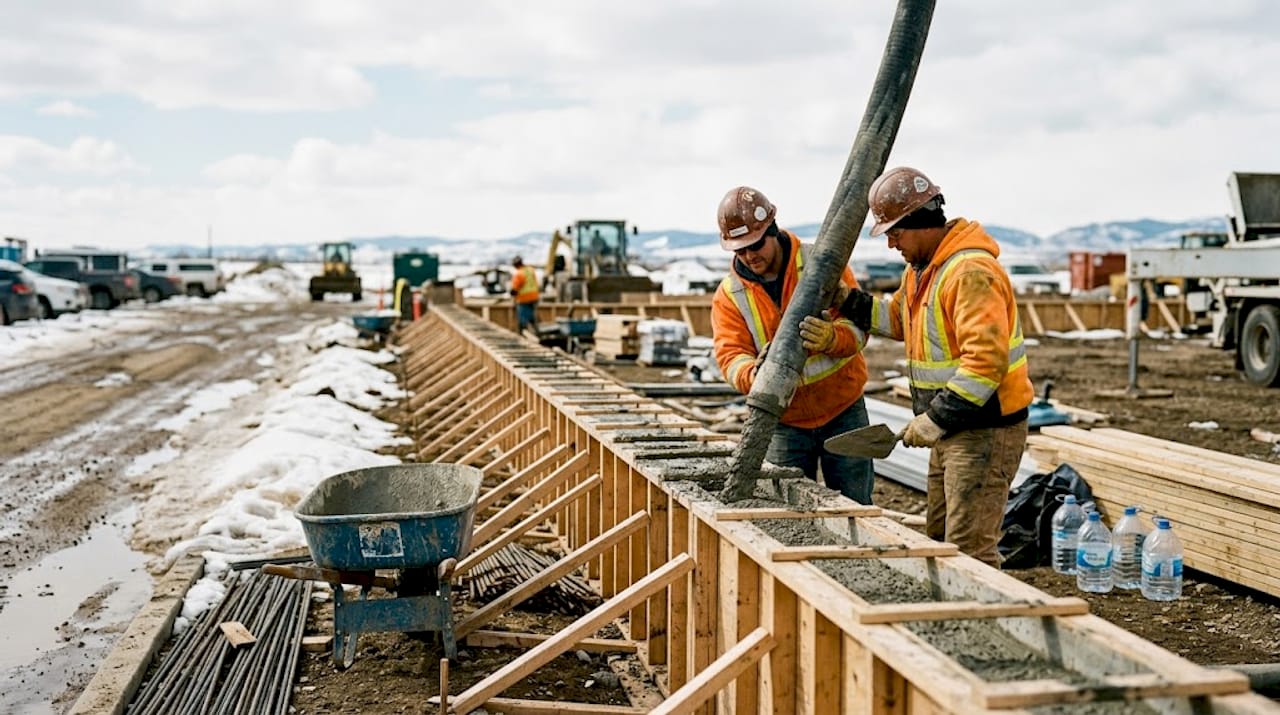
Precast concrete is manufactured off-site under controlled conditions, then delivered and erected. Quality control is excellent, and installation is fast. But transportation adds cost and logistical complexity, and connections between precast elements require careful detailing to ensure structural continuity, especially in seismic or high-wind zones.
Key considerations when choosing between CIP and precast:
- Project size: Larger projects often justify precast’s upfront costs
- Site access: Tight urban sites may favor CIP to avoid crane logistics
- Schedule: Precast erection is faster once pieces arrive on site
- Climate: CIP pours in winter require heated enclosures and curing blankets
- Connection complexity: CIP provides better monolithic behavior for irregular geometries
Insulated Concrete Forms (ICF) for Alberta foundations
ICF construction uses interlocking foam blocks as permanent formwork, filled with reinforced concrete. The result is a wall or foundation with continuous insulation on both sides. In Alberta’s climate, where heating costs are significant and frost penetrates deep into the ground, ICF offers a measurable thermal advantage over conventional formed concrete walls. The continuous insulation reduces heat loss and eliminates thermal bridging at the foundation level.
For commercial property managers, ICF foundations are worth serious consideration for new construction. The upfront cost is slightly higher than conventional forming, but energy savings over the building’s life often justify the premium, particularly for heated warehouses, office buildings, or facilities with high occupancy.
Pro Tip: If your project is in a rural Alberta location with limited access to precast suppliers, CIP with ICF forming is often the most practical and cost-effective structural solution for foundations and below-grade walls.
Alberta’s freeze-thaw cycles are among the most aggressive in North America. Concrete that performs well in Vancouver or Toronto may not survive an Edmonton winter without proper air entrainment and mix design adjustments. For more on protecting your investment through seasonal changes, our guide on protecting concrete in winter covers the key precautions.
Design nuances, benchmarks, and frost protection: What Alberta owners must know
The technical basics get you started. But the details are where projects succeed or fail, especially in Alberta’s demanding environment.
Frost protection is non-negotiable
Alberta’s frost depth can exceed 4 feet in many regions. Footings must be placed below 4 ft frost depth or designed as frost-protected shallow foundations (FPSF) using insulation to prevent frost penetration. A footing that sits above the frost line will heave seasonally, causing cracking, settlement, and structural distress. This is one of the most common and costly mistakes on Alberta commercial projects.
Advanced design considerations for Alberta property managers:
- High-strength concrete mixes above 55 MPa require specialized admixtures and quality control protocols
- Prestressed systems work best for spans in the 25 to 45 foot range, where conventional reinforced concrete becomes uneconomical
- Serviceability checks for deflection and vibration are just as critical as strength design, particularly for office floors and parkade slabs
- Joint and connection detailing is where freeze-thaw damage most often begins
- Corrosion-resistant reinforcement (epoxy-coated or stainless rebar) is worth considering in parking structures exposed to road salt
Connection and joint detailing
Joints and connections are the most common failure points in structural concrete systems. Water infiltrates joints, freezes, expands, and pries the concrete apart over repeated cycles. In Alberta, this process is accelerated by road salt, which lowers the freezing point of water and increases its penetration into concrete pores. Connections and joints are key failure points that must be detailed for corrosion and water resistance in Alberta’s freeze-thaw environment.
“Serviceability, including deflection and vibration control, is often as critical as strength in commercial concrete design. A structure that is strong enough but too flexible will generate tenant complaints and maintenance costs long before it reaches any structural limit.”
Pro Tip: Ask your structural engineer to provide a written serviceability report alongside the strength calculations. If deflection limits, vibration criteria, and joint waterproofing details are not explicitly addressed, request that they be added before construction begins.
Sustainability and advanced materials
Supplementary cementitious materials (SCMs) like fly ash and slag cement are increasingly used in Alberta structural concrete. They reduce Portland cement content, lower the carbon footprint of the mix, and often improve durability in freeze-thaw and sulfate exposure conditions. Many Alberta municipalities now encourage or require SCM use in public infrastructure projects. If sustainability is a priority for your portfolio, ask your concrete supplier about SCM-blended mixes that still meet CSA A23.3 structural requirements.
For ongoing maintenance of structural concrete surfaces, our guide on how to maintain concrete surfaces covers the inspection and repair cycle that keeps structural assets performing long-term. When you are ready to engage a contractor, our Edmonton concrete contractor page outlines the services available for your project.
Why traditional approaches to structural concrete miss the mark in Alberta
Here is the uncomfortable truth: a lot of the generic advice about structural concrete was written for climates that are nothing like Alberta’s. Minimum code compliance in a mild climate is not the same as a well-designed structure in Edmonton. When engineers or contractors apply southern Ontario or U.S. Sun Belt standards to an Alberta project, they are leaving out the most important variable: what happens to that concrete over 30 winters.
Serviceability is consistently underweighted in standard practice. Strength is easy to specify and easy to test. Deflection limits, vibration thresholds, and joint waterproofing are harder to enforce and easier to cut when budgets tighten. But those are exactly the details that determine whether your tenants are satisfied or filing maintenance requests every spring.
Frost protection is another area where conventional wisdom falls short. Many project teams treat frost depth as a checkbox rather than a genuine engineering challenge. The result is footings that heave, slabs that crack, and repair bills that dwarf the original savings.
Our experience working on commercial and municipal projects across Alberta has reinforced one consistent lesson: local knowledge outperforms general recommendations every time. Choosing the right mix, the right forming system, and the right joint detail for your specific site conditions is not optional. It is the difference between a 40-year asset and a 10-year problem. If you are evaluating concrete options for an upcoming project, our resource on choosing Alberta concrete reflects the regional realities that generic guides overlook.
Next steps for Alberta managers: Concrete services and expert guidance
Understanding structural concrete is the foundation of good decision-making, but applying that knowledge to a real project requires local expertise and hands-on experience. ProZone Ltd works with commercial property managers, municipal clients, and private owners across Edmonton and the surrounding region to deliver concrete solutions that are matched to Alberta’s climate, codes, and project realities.
Whether you need guidance on concrete types, are planning a new structural pour, or are managing an existing asset that needs inspection and repair, our team brings the regional experience that generic contractors cannot offer. Explore the full range of construction services Edmonton property managers rely on, review our dedicated Edmonton concrete contractor services, or start with our concrete flatwork Alberta guide to understand how surface concrete fits into your broader property maintenance plan. Reach out to ProZone Ltd to discuss your project and get advice tailored to your site.
Frequently asked questions
What makes structural concrete different from regular concrete?
Structural concrete is engineered to carry loads and meet building codes, while regular concrete is used for non-load-bearing surfaces like sidewalks or decorative finishes that do not require the same strength or reinforcement standards.
What compressive strength is required for structural concrete in Alberta?
Structural concrete requires a minimum of C25/30, or 25 MPa compressive strength, with high-strength mixes above 55 MPa used for specialized applications like high-rise columns or heavily loaded transfer slabs.
Why is frost protection essential for concrete projects in Alberta?
Footings below 4 ft frost depth or frost-protected shallow foundation designs are required because Alberta’s deep seasonal frost causes heaving and structural damage when concrete elements are not properly insulated or buried below the freeze line.
Should Alberta property managers use cast-in-place or precast structural concrete?
CIP is often more economical for local labor and materials balance, while precast is faster but adds transport costs; ICF forming is an excellent option for Alberta foundations where thermal performance matters as much as structural performance.
What are common mistakes in structural concrete design for Alberta properties?
The most frequent errors include underestimating frost depth requirements, skipping serviceability checks for deflection and vibration, and poor joint and connection detailing that allows water infiltration and freeze-thaw corrosion to degrade the structure over time.