
TL;DR:
- Alberta road maintenance requires regular PCI assessments to prioritize treatment and schedule interventions.
- Proactive maintenance significantly extends road lifespan and reduces long-term costs compared to reactive fixes.
- Proper planning, timing, and professional support are essential for effective, cost-efficient road management.
Road deterioration costs Alberta property managers and municipalities far more than most budgets anticipate. A single season of deferred maintenance can turn a manageable crack seal into a full-depth reconstruction project, multiplying costs by a factor that no annual budget is designed to absorb. Beyond the dollars, poorly maintained roads create real safety liabilities, accelerate vehicle wear for users, and quietly erode the value of the properties they serve. This guide walks you through a practical, Alberta-specific approach to road maintenance, starting with condition assessment, moving through scheduled interventions, and finishing with performance verification. Every step is built around tools and standards that actually work in this climate.
Table of Contents
- Assessing road conditions: PCI scoring and preparation
- Planning proactive maintenance: Scheduling, treatments, and budgeting
- Executing maintenance: Methods for paved and gravel roads
- Verifying outcomes and optimizing long-term performance
- Why shifting from reactive to preventive maintenance pays off in Alberta
- Get professional support for your road maintenance program
- Frequently asked questions
Key Takeaways
| Point | Details |
|---|---|
| Preventive beats reactive | Investing in scheduled maintenance yields huge savings and durability compared to emergency repairs. |
| Use PCI for decisions | Proper PCI tracking ensures roads are fixed at the right time with the right method for Alberta conditions. |
| Follow Alberta standards | Relying on provincial manuals and municipal standards guarantees compliant, long-lasting infrastructure. |
| Optimize for each road type | Tailor maintenance frequency and methods for paved versus gravel roads in Alberta’s climates. |
| Leverage professional help | Partnering with road maintenance experts streamlines planning, repairs, and upgrades for better results. |
Assessing road conditions: PCI scoring and preparation
Before you can fix anything, you need to know exactly what you’re dealing with. That sounds obvious, but a surprising number of property managers and municipal road crews still operate on intuition and complaint-driven responses rather than structured assessment. The result is spending money in the wrong places while the real problems quietly worsen.
The accepted standard for pavement assessment is the Pavement Condition Index, or PCI. This is a numeric scale running from 0 to 100, where 100 represents a brand-new surface and 0 indicates complete failure. Municipal road maintenance involves PCI scoring, treatment selection by deterioration stage, and scheduling crack seals, slurry seals, and overlays based on PCI range. In practical terms, a PCI score between 70 and 100 calls for preservation treatments like sealcoating or crack sealing. A score between 40 and 69 signals that patching and minor rehabilitation are needed. Anything below 40 typically requires major rehabilitation or reconstruction.
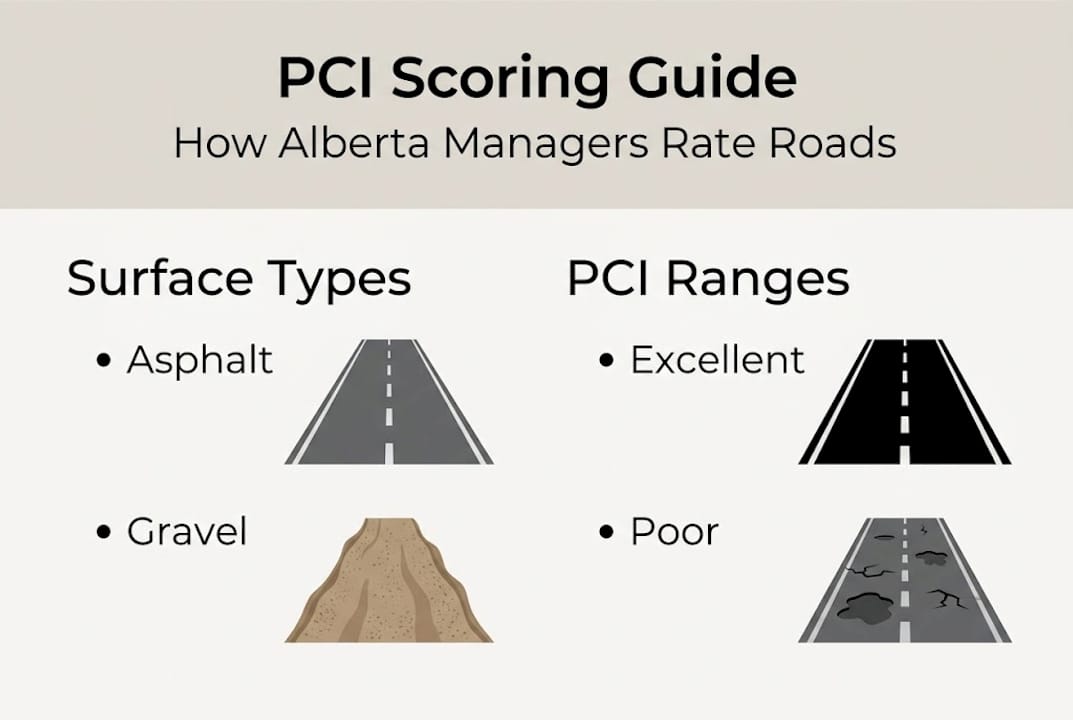
For Alberta managers, the MSSM for Alberta standards provides additional design and maintenance benchmarks that complement PCI-based decisions. Understanding these standards is critical because Alberta’s freeze-thaw cycles, spring load restrictions, and seasonal temperature swings accelerate pavement aging faster than in milder climates.
Here’s how a structured PCI assessment works in practice:
- Visual walk-through: Identify surface distress types including alligator cracking, rutting, potholes, raveling, and edge cracking. Document each distress type by location and approximate area.
- Rating distress severity: Classify each distress as low, medium, or high severity based on depth, width, and extent.
- Calculating the PCI score: Use standardized deduct values for each distress type and severity. Software tools and inspection apps now simplify this significantly.
- Recording and storing data: Tie scores to GPS-tagged locations so changes can be tracked over multiple inspection cycles.
For gravel roads, PCI is adapted slightly but the logic holds. You’re looking at surface deterioration, drainage adequacy, gravel loss, and grading quality rather than pavement cracking.
The table below summarizes PCI ranges and the treatments they signal:
| PCI Range | Condition | Recommended Action |
|---|---|---|
| 85-100 | Excellent | Routine preventive sealing |
| 70-84 | Good | Crack sealing, sealcoating |
| 55-69 | Fair | Patching, minor overlay |
| 40-54 | Poor | Rehabilitation, structural overlay |
| 25-39 | Very Poor | Major rehab or reconstruction |
| 0-24 | Failed | Full reconstruction |
For a deeper look at surface types and their inspection characteristics, the paving process overview covers how asphalt and concrete behave differently under Alberta conditions. This background matters because treatment decisions for an asphalt surface differ considerably from those for concrete, as the asphalt vs concrete pros comparison explains.
Pro Tip: Document every PCI assessment with photos, GPS coordinates, and a consistent scoring date each year. This paper trail dramatically improves your chances during grant applications and budget justification cycles because you’re showing trends, not just snapshots.
Planning proactive maintenance: Scheduling, treatments, and budgeting
Once you have PCI scores and condition data in hand, the next move is building a forward-looking maintenance schedule rather than waiting for problems to force your hand. The difference between proactive and reactive maintenance is not just philosophical. It is financial.
“Preventive road maintenance saves $7 for every $1 spent, compared to reconstruction costs.”
That ratio changes how you should think about even modest preventive investments. Spending $8,000 on crack sealing a section of road this fall is far more defensible than spending $56,000 or more on resurfacing or rebuilding the same section three years from now because the cracks were left to grow.
Comparing proactive and reactive approaches makes the case clearly:
| Factor | Proactive maintenance | Reactive maintenance |
|---|---|---|
| Cost per km | Lower, predictable | Higher, unpredictable |
| Road lifespan | Extended by 5-15 years | Shortened significantly |
| Safety incidents | Reduced | Elevated |
| User satisfaction | High | Low |
| Budget planning | Straightforward | Difficult |
Here is a practical sequence for building your proactive maintenance plan:
- Sort roads by PCI score and traffic volume. High-traffic corridors in poor condition are your first priority regardless of budget pressure.
- Match treatments to PCI ranges. Use your assessment data to schedule crack sealing for PCI 70+, patching and minor overlays for PCI 55 to 70, and rehabilitation planning for anything lower.
- Align timing with Alberta’s seasonal calendar. Crack sealing works best in fall before freeze-up. Overlays and paving should happen during warm, dry weather, typically May through September.
- Set a realistic annual budget. Include materials, labor, equipment, and contingency for weather-related delays.
- Plan for five-year cycles, not just one year. A single-year view will always feel expensive. A five-year asset plan shows the true cost savings.
For roads with aging asphalt, the strategies covered in extend asphalt lifespan are directly applicable here. And when you’re evaluating which repair approach to budget for, top repair methods offers a current breakdown of cost and durability trade-offs that maps well to Alberta’s 2026 material pricing environment.
A key detail many managers miss is that scheduling matters as much as the treatment itself. Applying a slurry seal to a road just before winter gives you little benefit because the material doesn’t have enough time to cure and bond properly. The full cost-savings breakdown reinforces why timing precision is as important as treatment selection.
Executing maintenance: Methods for paved and gravel roads
With a scheduled plan in place, the hands-on work of keeping roads functional and safe can proceed in a structured, efficient way. Alberta’s road network includes both paved surfaces and gravel roads, and each type demands a different maintenance approach.
Paved roads: Step-by-step execution
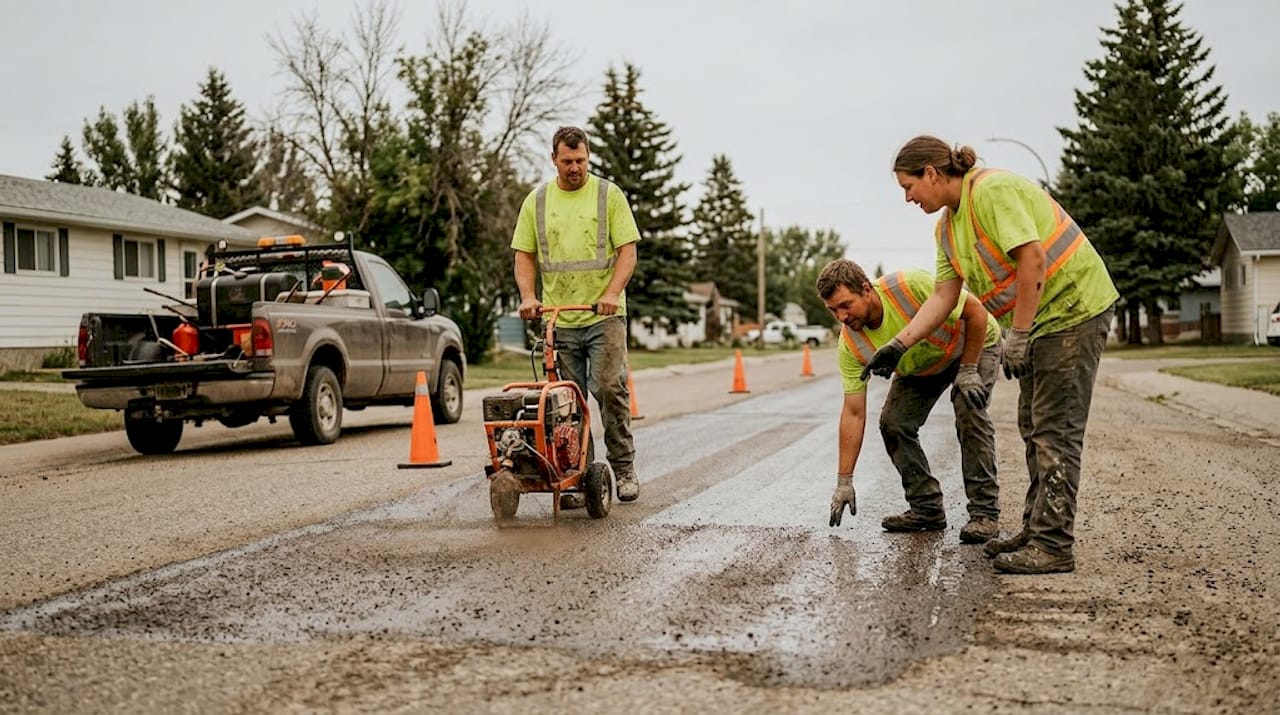
- Pothole patching: Clean the hole of debris and standing water, apply tack coat, fill with hot-mix or cold-mix asphalt depending on season, compact thoroughly with a hand tamper or plate compactor.
- Crack sealing: Route cracks wider than 3mm, clean with compressed air, and apply hot-poured rubberized sealant. Best done in fall at temperatures above 5°C.
- Surface treatments (slurry seal or chip seal): Applied to PCI 70+ roads to slow surface oxidation and water penetration. Requires clean, dry surfaces and consistent warm temperatures.
- Asphalt overlay: For PCI 55 to 70 roads, milling the top layer and applying a new asphalt course restores structural integrity without full reconstruction. The asphalt resurfacing steps guide details this process for Edmonton-area conditions.
- Base repairs: When rutting or cracking traces back to a failed base, surface treatment alone won’t solve the problem. Proper base course best practices for Alberta’s subgrade conditions are essential before any overlay goes down.
Gravel roads: Step-by-step execution
For Alberta municipalities, gravel road maintenance involves grading every 10 to 20 days depending on road class, applying 150 tonnes per kilometer of gravel every one to five years, and managing drainage through shoulder pulls and ditching.
- Motor grading: Restore the road crown (typically 3 to 4 percent cross-slope) to shed water effectively.
- Gravel application: Calculate tonnage based on traffic class and observed gravel loss per season. Distributing material evenly prevents washboard formations.
- Shoulder pulls and ditching: Pull road material back from the shoulders to reestablish drainage channels. Clean ditches annually or after major rain events.
- Dust suppression: Apply calcium chloride or magnesium chloride in spring and early summer to reduce surface erosion and dust complaints.
Pro Tip: Request your grader operator log pass dates, road sections covered, and notable issues like washouts or drainage failures in a simple field logbook. This data feeds directly into your annual reporting and helps justify equipment and material costs during budget reviews.
Verifying outcomes and optimizing long-term performance
Executing maintenance is only part of the job. What separates strong road management programs from weak ones is what happens after the work is done: systematic verification, performance tracking, and a willingness to adjust when results fall short.
Post-maintenance inspection should happen within two to four weeks of any treatment. For crack sealing, look for adhesion failures or re-opening along sealed joints. For overlays, check for delamination, edge cracking, or early rutting that suggests base issues weren’t fully resolved. For gravel roads, assess crown retention and drainage performance after the first significant rain event.
The table below summarizes key performance benchmarks you should be tracking:
| Maintenance type | Success indicator | Reinspect timeline |
|---|---|---|
| Crack seal | No reopening, adhesion intact | 6 months |
| Chip/slurry seal | Consistent coverage, no stripping | 3 months |
| Asphalt overlay | No delamination, no edge cracking | 12 months |
| Gravel grading | Crown maintained, drainage functional | After first rain |
| Pothole patch | No settlement, edge adhesion | 3-6 months |
For tracking performance over time, maintain a maintenance log for each road segment. Include the initial PCI score, treatment applied, date of treatment, cost, and follow-up inspection results. This data builds the evidence base you need to refine future budgets and justify investment in specific corridors.
Troubleshooting common recurring issues:
- Drainage failures causing premature cracking: Review ditch grades and cross-slopes. Water infiltration through the base is usually the real problem.
- Potholes returning in the same locations: Indicates a subbase issue. Surface patching alone won’t hold.
- Gravel roads washing out repeatedly: Increase ditch cleaning frequency and evaluate culvert sizing.
- Overlays cracking within two years: Reassess base stability before the next treatment cycle.
For Alberta managers, standardized maintenance verification protocols provide design-level benchmarks that work as a verification framework. Alongside this, the PCI-based approach to tracking scheduled versus reactive actions, combined with provincial resources like GAP-01 for bridges and Rural Municipalities of Alberta funding programs, gives you a complete toolkit for sustained improvement.
For practical workflow improvements, the optimize repair workflow resource covers how to sequence repairs for maximum efficiency, while the cost vs durability assessment helps prioritize which surface types to invest in over a long horizon.
Pro Tip: Lock in an annual review meeting every October, just before winter. Use it to evaluate your PCI trends, compare actual spend to budget, and update next year’s maintenance schedule based on what you learned from the current season’s work.
Why shifting from reactive to preventive maintenance pays off in Alberta
Here’s the uncomfortable truth that rarely gets said directly in road maintenance planning sessions: most organizations know preventive maintenance saves money, but they still default to reactive fixes when budgets get tight. It feels more urgent to fix the pothole someone complained about than to seal cracks on a road that still looks functional.
That instinct is exactly what drives long-term infrastructure costs upward. Alberta’s climate makes this worse than most places. Freeze-thaw cycles turn a 3mm crack into a structural problem within a single winter if left unaddressed. The cost of deferred action is especially brutal in rural Alberta, where reactive approaches dominate due to funding gaps, leaving roads to deteriorate past the point where cost-effective intervention is even possible.
The practical solution is not to demand a perfectly funded preventive program from day one. It’s to use PCI data strategically to make the case for incremental improvements, year over year. Show decision-makers the trend line, not just the current snapshot. A road dropping 8 PCI points per year is a budget emergency in slow motion. Present it that way.
Strategic partnerships with experienced contractors also reduce the gap between what you plan and what gets delivered. Seeing real results from completed road and infrastructure projects helps set realistic expectations for what quality maintenance actually looks like on the ground in Alberta’s conditions. The asset management mindset is not complicated. It just requires consistency, documentation, and the discipline to treat maintenance as an investment rather than a cost.
Get professional support for your road maintenance program
Knowing the right strategies is one thing. Having the crew, equipment, and field experience to execute them on Alberta roads is another. ProZone Ltd works directly with property managers and municipal authorities throughout Edmonton and the surrounding region, handling everything from initial condition assessments to full-scale pavement rehabilitation.
When your in-house resources are stretched or you’re managing a backlog of deferred work, bringing in a professional team accelerates timelines, improves treatment quality, and reduces the risk of rework. Explore Edmonton road construction services to see how we support municipal and commercial road programs.
For surface-specific guidance, the concrete surface maintenance guide and the asphalt laying guide give you detailed, Alberta-tested procedures to complement your internal planning. ProZone is ready to help you close the gap between strategy and execution.
Frequently asked questions
What is PCI scoring and why is it important for Alberta road maintenance?
PCI scoring rates pavement condition on a 0 to 100 scale and directly guides which treatments to apply and when, making it the most practical tool for cost-effective road management in Alberta’s climate. Municipal road maintenance schedules crack seals, slurry seals, and overlays specifically based on where a road falls within the PCI range.
How often should Alberta gravel roads be graded and graveled?
Collector roads typically require grading every 10 days and local roads every 20 days, with gravel applied at 150 t/km every one to five years based on road class and traffic volume.
What’s the cost benefit of preventive vs. reactive road maintenance?
Every $1 invested in prevention saves up to $7 in reconstruction costs by delaying major repairs and extending pavement life significantly.
Which Alberta resources and manuals should managers consult for road upkeep?
Start with the Medicine Hat MSSM for design and maintenance benchmarks, then add the provincial Pavement Design Manual and GAP-01 for bridge structures to your reference library.
How can managers secure funding for road maintenance projects?
Alberta managers can pursue grants through the Rural Municipalities of Alberta and strengthen applications with PCI tracking data that demonstrates deterioration trends and documents the cost-effectiveness of requested interventions.