
Air entrained concrete is concrete produced with a controlled system of microscopic air voids, introduced through an admixture, that gives the material its main practical advantage: a marked increase in resistance to freeze-thaw cycling and surface scaling. The voids act as pressure-relief chambers for water as it freezes and expands inside the concrete matrix. The trade-off is a modest reduction in compressive strength, one that experienced mix designers offset through adjustments to cement content and water-cement ratio.
Table of Contents
- What air entrainment is and why designers specify it
- How entrained air protects concrete: air-void system and performance parameters
- Effects on fresh and hardened properties
- Mixing, admixtures, dosage and material interactions
- Placing and finishing best practices to protect the air-void system
- Specifying and testing: standards and field verification
- When not to use air-entrained concrete and key trade-offs
- ProZone field perspective: checklist and on-site recommendations
- Engineering perspective summary
- How ProZone can help with your next concrete project
- Sources
- FAQ
What air entrainment is and why designers specify it
Concrete always contains some air, but not all of it is useful. Entrapped air forms as large, irregular voids from mixing and consolidation, and it does nothing for durability. Entrained air is different: it is a network of small, spherical, evenly distributed bubbles created deliberately with an air-entraining admixture (AEA).
That distinction matters because only the engineered system protects concrete from freeze-thaw damage. Designers specify air entrainment wherever concrete faces repeated freezing and thawing while saturated, particularly where de-icing chemicals are present.
Typical applications include:
- Exterior flatwork such as driveways, sidewalks and patios exposed to winter moisture
- Pavements and parking structures subject to de-icing salts
- Bridge decks, curbs and any structural element exposed to freeze-thaw cycling and chlorides
Guidance from the American Concrete Institute confirms that properly entrained air substantially increases resistance to both freeze-thaw cycling and de-icer scaling, which is why the practice is standard on nearly every exterior concrete specification in a climate with hard winters.
How entrained air protects concrete: air-void system and performance parameters
The protection mechanism is straightforward. As water within the concrete’s capillary pores freezes, it expands by roughly 9% in volume. Without space to relieve that pressure, the expansion cracks the surrounding paste. Entrained air bubbles sit close enough to the capillary network to give that expanding water somewhere to go, relieving the internal pressure before it can do damage.
The number that matters most is not total air content but spacing factor, the average distance between air voids in the hardened paste. The ACI’s guidance on air entrainment recommends a spacing factor no greater than 0.2 millimetres, with bubbles larger than 3 micrometres, to reliably relieve freezing pressure.
- Spacing factor near 0.2 mm is the benchmark most standards reference for durable performance
- Bubble size above 3 micrometres is needed for the void to function as a pressure-relief point
- Bulk air percentage alone tells you little if the voids are poorly distributed or too large
A spacing factor of roughly 0.2 mm, with an air content near 9% of the mortar fraction, is generally sufficient to protect concrete from freeze-thaw damage, according to ACI. That is why laboratories increasingly rely on Air Void System (AVS) analysis of hardened concrete rather than fresh air content alone. AVS testing measures spacing factor and bubble size distribution directly, giving a far more reliable read on expected durability than a pressure meter reading taken at the truck.
Effects on fresh and hardened properties
Air entrainment changes concrete before it ever hardens. The bubbles act like tiny ball bearings in the mix, improving workability and reducing bleeding, the tendency of mix water to rise to the surface. Less bleeding often means a more consistent, easier-to-finish surface, particularly useful on flatwork poured in cooler conditions.
The trade-off shows up in hardened strength. Historical research from Purdue’s joint highway research program documents that air entrainment increases water requirement and can produce a modest reduction in flexural strength and modulus of elasticity, even as it improves durability.
- Compressive strength typically drops as air content rises, unless compensated in mix design
- Reducing water-cement ratio or adjusting cementitious content offsets most of the strength loss
- Water reducers and supplementary cementing materials (SCMs) can interact with the air-void system, sometimes destabilizing it if not tested together
None of this makes air entrainment a poor trade. It makes it a mix design decision that has to be engineered, not assumed.
Mixing, admixtures, dosage and material interactions
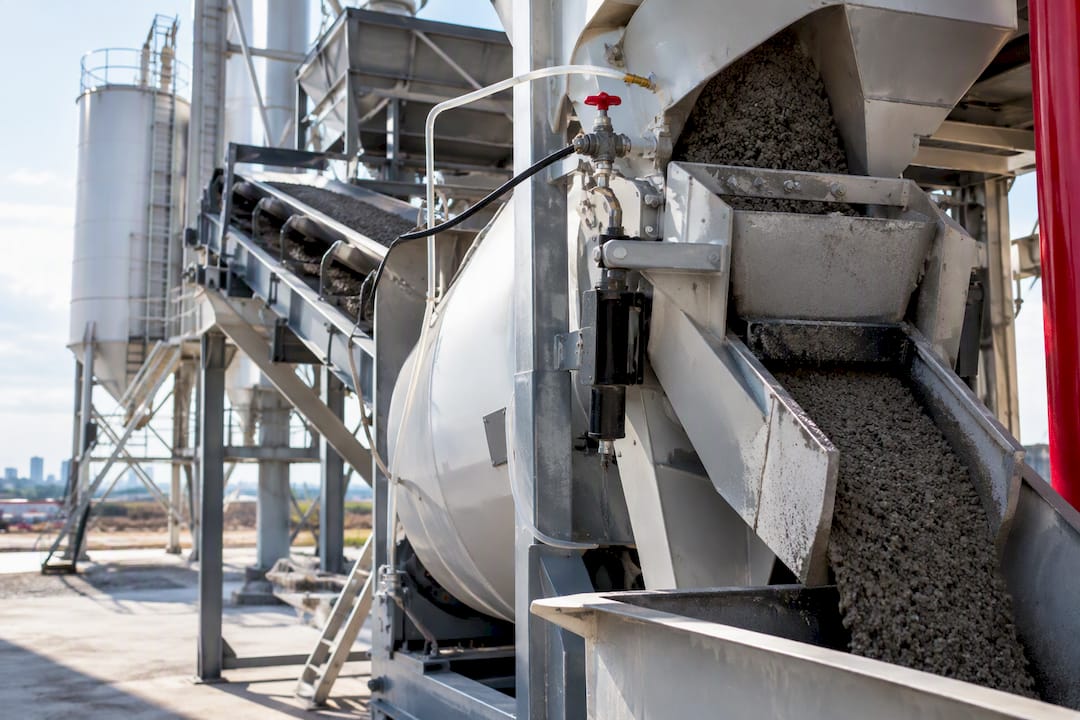
Air-entraining admixtures come in several chemical families, including vinsol resin, synthetic detergents and synthetic hydrocarbon surfactants, each with its own dosing sensitivity. Dosage is never a fixed number: it depends on cement fineness, temperature, mixing time and the presence of other admixtures.
- Start with the AEA manufacturer’s recommended dosing range and confirm it against a trial batch, not a data sheet alone
- Adjust dosage in small increments and retest air content before scaling up to production volumes
- Monitor concrete and ambient temperature closely, since warmer conditions reduce entrained air and colder conditions can increase it
- Retest whenever the batch plant changes cement source, aggregate gradation or supplementary materials
Portland-limestone cement (often labelled GUL or PLC) and SCMs such as fly ash or slag change how a mix responds to an AEA. The Cement Association of Canada’s primer on Portland-limestone cement notes that PLC can match or exceed general use cement for freeze-thaw and scaling resistance, but the transition requires trial batching, since bleed rates and air response shift with the finer cement particle size.
Pro Tip: Never assume last season’s dosage rate still applies after a plant switches cement type. Run a fresh trial batch and confirm air content and spacing factor before the first structural pour.
Placing and finishing best practices to protect the air-void system
The air-void system is fragile after placement. Overworking a mix with excessive vibration or aggressive re-tempering collapses bubbles near the surface, stripping away the very protection the mix was designed to deliver.
- Vibrate only enough to consolidate the mix, never to the point of visible paste migration to the surface
- Bullfloat and darby promptly, then edge and joint on schedule rather than waiting for excess bleed water
- Avoid steel trowelling air-entrained flatwork, since it densifies the surface paste and can cause significant scaling and durability problems, a point Concrete Canada’s residential flatwork guidance makes explicit
- Protect fresh concrete from early freezing with insulated blankets or enclosures, and maintain curing temperature above 10°C for the first several days
Pro Tip: A broom or float finish preserves the surface air-void structure far better than a hard steel trowel, especially on exterior flatwork exposed to winter moisture. For finishing sequence details specific to flatwork, ProZone’s concrete flatwork guide covers the full process.
Specifying and testing: standards and field verification
Specifications should reference recognized standards rather than a generic percentage. CSA A23.1 sets exposure classes and air content ranges for Canadian conditions, while OPSS and provincial pavement design documents assign air categories and water-cementitious ratio limits tied to exposure, such as a 32 MPa mix with Air Category 1 and a W/CM limit of 0.45 for non-structural concrete exposed to chlorides and freeze-thaw.
- Pressure air meters and volumetric meters confirm fresh air content at the point of placement
- Laboratory AVS analysis of hardened cores confirms spacing factor and bubble size distribution after the fact
- Rapid Chloride Permeability (RCP) testing and salt-scaling protocols verify how the finished durability performance actually holds up
Where possible, specifying performance-based acceptance criteria, tied to scaling resistance or RCP results rather than fresh air content alone, gives a truer picture of long-term durability. ProZone’s approach to construction quality control follows this logic on every exterior pour.
When not to use air-entrained concrete and key trade-offs
Air entrainment is not universal. Interior slabs, foundations and any concrete permanently protected from moisture and freezing gain nothing from it and lose some compressive strength for no durability benefit.
High-strength structural elements with low water-cement ratios can also conflict with entrained air targets unless the mix design specifically compensates for it. A simple decision checklist helps: confirm the exposure class, confirm whether the element will see freeze-thaw cycling while saturated, and confirm whether the strength target or finish expectation (a burnished floor, for example) rules entrainment out.
ProZone field perspective: checklist and on-site recommendations
Consistent freeze-thaw performance in an Edmonton-area climate comes down to discipline before the pour, not repairs after it. Air entrainment should be treated as a specification item that gets verified, not assumed.
- Confirm expected air content and cement type with the supplier before the truck arrives on site
- Ask for recent plant trial data whenever cement source or SCM content has changed
- Preserve mixing energy on site and avoid excessive rehandling, which drives fines to the surface and disturbs the air-void system
- Schedule finishing crews to hit the window between bleed water disappearance and initial set, avoiding steel trowelling on any exterior flatwork
- Take a first-load air content reading at the point of placement, not just at the plant
These checks align with the Alberta Safety Codes framework ProZone follows on every commercial and municipal pour, and they connect directly to the freeze-thaw prevention practices outlined in ProZone’s freeze-thaw damage checklist.
Engineering perspective summary
The projects that hold up through repeated freeze-thaw seasons share one trait: the air-void system was engineered and verified, never left to chance at the batch plant. Coordinated mix design, a genuine plant trial and finishing crews who understand why steel trowelling is off-limits matter more than any single number on a spec sheet. Early communication with suppliers about cement changes prevents most field failures before they start. Simple QC checkpoints, applied consistently, beat ad-hoc remedies every time.
How ProZone can help with your next concrete project
Getting air entrainment right takes coordination between mix design, batching and site finishing, and that coordination is where ProZone’s concrete and flatwork teams focus their attention. From trial batching and air content verification through to placement supervision and finishing sequencing, ProZone treats the air-void system as a specification requirement on every exterior pour, not an afterthought.
ProZone’s concrete services cover flatwork, curb and sidewalk work, and structural concrete for commercial, municipal and residential clients across the Edmonton area, backed by materials sourced to match Alberta Safety Codes requirements rather than generic substandard practice. If you are planning a pour that needs to survive a real Alberta winter, call ProZone directly or complete the online form for a free on-site estimate.
Sources
- Concrete: ACI frequently asked questions (air entrainment and freeze-thaw protection)
- Effect of air entrainment on the durability characteristics (Purdue Research)
FAQ
When should you not use air-entrained concrete?
Air entrainment is unnecessary for interior slabs, foundations or any concrete permanently shielded from moisture and freezing, since there is no freeze-thaw exposure to protect against. It can also conflict with high-strength, low-permeability mix targets unless the mix design specifically compensates for the strength trade-off.
How do you finish air-entrained concrete?
Use a bullfloat and darby promptly, then edge and joint before excess bleed water accumulates. Avoid steel trowelling, since Concrete Canada’s flatwork guidance confirms it can densify the surface and cause significant scaling problems on exterior work.
What is the purpose of air-entrained concrete?
Its purpose is to protect concrete from freeze-thaw damage and de-icer scaling by giving freezing water microscopic voids to expand into instead of cracking the paste. ACI confirms that properly spaced entrained air substantially increases resistance to both freeze-thaw cycling and scaling.
How do you tell if concrete is air-entrained?
Fresh concrete air content is checked on site with a pressure or volumetric air meter at the point of placement. For a definitive answer on hardened concrete, a laboratory Air Void System (AVS) analysis measures spacing factor and bubble size distribution directly from a core sample.