
TL;DR:
- Edmonton’s climate requires a structured, seasonal pavement maintenance workflow to prevent costly damage.
- Proper planning, tools, and timing are essential for effective crack sealing, patching, and winter care.
- Proactive maintenance significantly extends pavement lifespan and reduces liability risks for property managers.
Edmonton’s freeze-thaw cycles are brutal on pavement. A single winter can turn a hairline crack into a pothole wide enough to trip a pedestrian or damage a delivery truck’s suspension. For property managers and commercial owners, skipping a structured maintenance workflow doesn’t just mean higher repair bills – it means exposure under Alberta’s Occupiers’ Liability Act, where liability prevention strategies start with documented, proactive care. This guide walks you through every step of an efficient pavement maintenance workflow, from spring inspections to winter anti-icing, with seasonal task breakdowns, tool prep, and troubleshooting tactics tailored to Edmonton’s unique climate conditions.
Table of Contents
- Why a structured pavement maintenance workflow matters
- Tools, materials, and prerequisites for effective workflow
- Step-by-step: The seasonal pavement maintenance workflow
- Avoiding common mistakes and troubleshooting
- Measuring results and maximizing workflow ROI
- Why traditional maintenance workflows fall short in Edmonton
- Next steps: Edmonton pavement experts at your service
- Frequently asked questions
Key Takeaways
| Point | Details |
|---|---|
| Prevention saves money | A structured, proactive workflow extends pavement life and cuts costs dramatically compared to reactive repairs. |
| Seasonal workflow is crucial | Each stage – spring to winter – has specific tasks that address Edmonton’s unique climate hazards. |
| Preparation determines success | Thorough cleaning and readiness checks directly affect maintenance lifespan and safety outcomes. |
| Document and verify | Track maintenance, check compliance, and adjust your plan each year to maximize return on investment. |
Why a structured pavement maintenance workflow matters
Edmonton sits in a climate zone where pavement takes a beating from two directions at once: extreme cold in winter and rapid temperature swings throughout spring and fall. These freeze-thaw cycles force water into tiny pavement voids, expand them as ice forms, and leave larger fractures when the ice melts. Add road salt and sand into the mix, and surface degradation accelerates faster than most property managers expect.
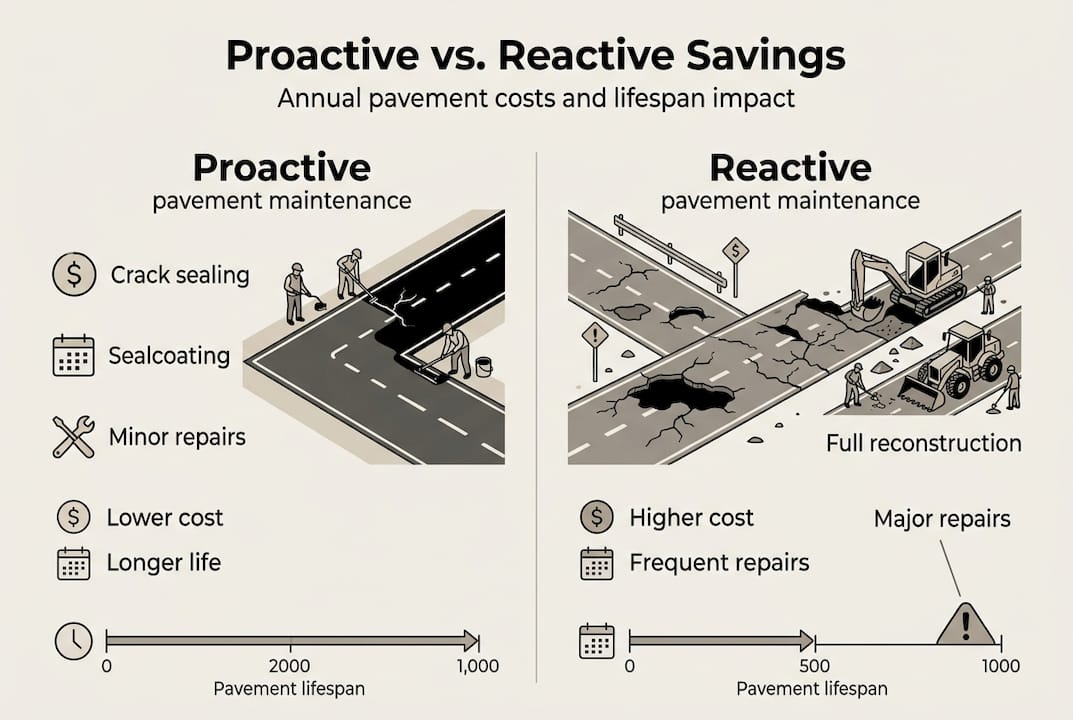
The financial argument for structure is straightforward. Reactive maintenance – fixing problems only after they become visible failures – almost always costs more per square meter than addressing issues early. Empirical benchmarks show proactive maintenance saves $6–10 for every $1 spent, a return no other infrastructure budget item can match. Yet many commercial property teams still operate without a formal maintenance calendar.
Annual cost comparison: proactive vs. reactive pavement maintenance
| Approach | Typical annual cost per 1,000 sq ft | Expected pavement lifespan | Major repair frequency |
|---|---|---|---|
| Proactive | $400–$700 | 20–25 years | Every 10–15 years |
| Reactive | $1,200–$2,500+ | 10–12 years | Every 4–6 years |
Beyond cost, there’s the safety and legal dimension. Unaddressed pavement damage creates trip and slip hazards that expose your organization to insurance claims and regulatory scrutiny. Understanding the full range of paving processes in Edmonton helps you prioritize which repairs belong in which season rather than treating every crack as an emergency.
Risks of neglecting a structured workflow include:
- Increased liability exposure under Alberta’s Occupiers’ Liability Act
- Higher insurance premiums after documented incident claims
- Accelerated surface failure requiring full-depth reclamation sooner
- Loss of tenant or customer confidence due to visible disrepair
- Reduced property valuation during asset assessments
These asphalt lifespan tips reinforce why consistent workflows outperform ad hoc repairs across every metric.
Pro Tip: Schedule your annual pavement audit every spring, ideally in late April or early May in Edmonton. Winter damage is most visible before new vegetation or debris covers the surface, and booking contractors early beats the summer rush.
Tools, materials, and prerequisites for effective workflow
Getting the workflow right starts before anyone touches pavement. You need the right people, equipment, and materials staged and ready before each season begins.
Personnel decisions matter. In-house staff can handle routine tasks like debris clearing, drainage checks, and minor crack monitoring. But asphalt patching, sealcoating, and hot-mix repairs require trained operators and commercial equipment. Knowing when to keep work in-house versus when to call a licensed contractor directly affects both quality and liability.
Equipment you’ll need by task type:
- Crack sealing: Router saws, heat lances, crack banders, and compressed air blowers
- Sealcoating: Squeegee or spray sealcoat rigs, surface brooms, and primer applicators
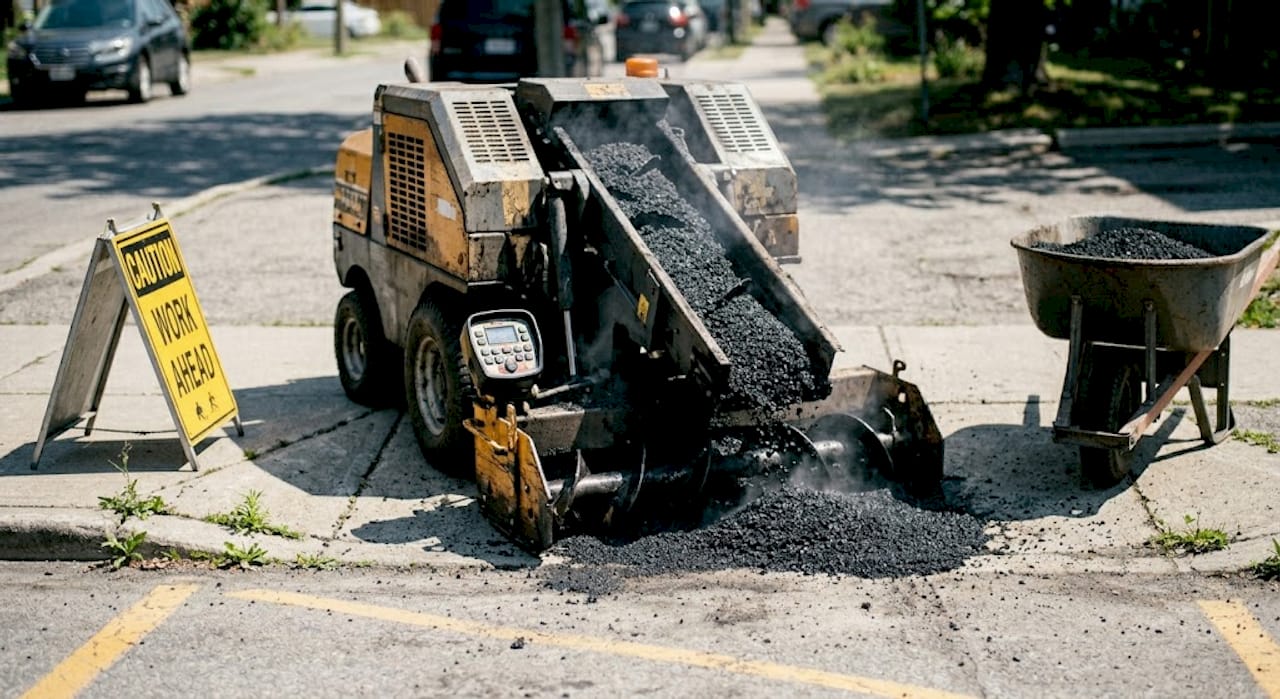
- Patching: Infrared heaters, cold patch tampers, hot mix kettles, and vibratory plate compactors
- Snow and ice removal: Plow trucks, spreaders (for sand/salt), and anti-icing sprayers
Core maintenance methods include crack sealing equipment, sealcoat rigs, cold/hot patch tools, routing saws, and de-icing supplies – and having them staged before the season begins prevents costly delays when conditions are right for a narrow repair window.
Manual vs. professional service comparison:
| Factor | In-house / manual | Professional contractor |
|---|---|---|
| Upfront cost | Lower | Higher |
| Quality consistency | Variable | High |
| Equipment investment | Significant | Included |
| Liability coverage | Your organization | Contractor’s insurance |
| Best for | Monitoring, minor tasks | Sealing, patching, overlays |
Before each season, run a readiness check:
- Confirm equipment is calibrated and tested
- Verify material inventory (crack filler, sealant, patch mix, sand)
- Review last season’s inspection reports for flagged areas
- Ensure staff are trained on current safety protocols
- Check drainage systems for blockages or settlement damage
Reviewing sealcoating essentials ahead of the fall season gives your team clarity on surface temp requirements and application rates, while checking road repair methods helps match the repair approach to crack severity. Watch for asphalt warning signs like surface raveling or edge cracking that suggest deeper structural issues.
Step-by-step: The seasonal pavement maintenance workflow
A structured, season-by-season approach prevents gaps and keeps your pavement performing year-round. Edmonton’s seasonal workflow follows a logical cycle: spring inspections, summer repairs, fall sealing, and winter snow and ice management. Here’s how to execute each phase.
1. Spring (April to May): Assess and repair winter damage
Walk every paved surface after snowmelt to map cracks, potholes, heaving, and drainage issues. Use a pavement condition index (PCI) scoring sheet to prioritize by severity. Address all cracks wider than 1/4 inch immediately, and schedule pothole repairs before surface temperatures climb above 85°F, which affects patch adhesion. Review proper asphalt repair workflow steps before launching repairs at scale.
2. Summer (June to August): Maintenance and monitoring
Summer is your window for high-quality patching and structural repairs. Warm, dry conditions improve material bonding and curing times. Focus on drainage maintenance, dust control on unpaved edges, and line marking refresh. Inspect commercial parking lot repairs monthly and document everything with photos and dates.
3. Fall (September to October): Seal before the cold arrives
Sealcoating requires surface temperatures above 50°F and at least 24 hours of dry weather post-application. Early fall is ideal. Address all alligator cracking (interconnected surface cracks resembling a crocodile’s back) before sealing – sealcoat over structural failure just delays the problem. Confirm that asphalt installation steps for any new sections are complete before freeze risk returns.
4. Winter (November to March): Protect and de-ice
Switch to anti-icing protocols, applying liquid brine before snow events rather than reactive salting after. Use rubber-edged snow removal equipment to avoid gouging sealed surfaces. Limit heavy equipment idle time on pavement in extreme cold, as thermal stress compounds existing micro-cracks.
Seasonal maintenance task summary:
| Season | Priority tasks | Key deadline |
|---|---|---|
| Spring | PCI assessment, crack/pothole repair | Before June |
| Summer | Patching, drainage, line marking | Before September |
| Fall | Sealcoating, alligator crack repair | Before first frost |
| Winter | Snow removal, anti-icing, monitoring | Ongoing |
“75% of unsealed cracks become potholes within three years.” Sealing cracks is consistently the highest-ROI action a property manager can take, and it costs a fraction of full-depth patching.
Pro Tip: Schedule sealcoating in early September in Edmonton. You get warm surfaces, predictable dry weather, and enough curing time before temperatures drop below 40°F. Waiting until late October is a gamble. Refer to proven crack sealing methods to select the right filler for each crack width and depth.
Avoiding common mistakes and troubleshooting
Even well-intentioned maintenance programs fail when timing or technique is off. These are the errors Edmonton property managers make most often – and how to avoid them.
Mistake 1: Working in the wrong conditions. Applying sealcoat or crack filler when surface temperature is below 40°F, when rain is forecast within 24 hours, or when the pavement is even slightly damp guarantees adhesion failure. The single biggest factor for repair quality and longevity is clean, dry surface preparation.
“Preparation is critical – clean and dry surfaces triple the repair lifespan.” Skipping this step and hoping for the best is how short-cure failures happen.
Mistake 2: Sealing over structural problems. Alligator cracking, rutting, and base failure can’t be fixed at the surface level. Applying sealcoat or a thin overlay over these issues just hides them temporarily while the underlying damage worsens.
Mistake 3: Skipping routing for wide cracks. Any crack wider than 1/4 inch requires routing (mechanically widening and cleaning the crack channel) before filling. Without routing, filler bonds only to loose edges and fails quickly under traffic.
Mistake 4: Ignoring drainage and snow/ice annually. Blocked drains cause standing water, which accelerates base saturation and freeze-thaw damage. A full drainage audit each spring and fall is non-negotiable.
Your troubleshooting checklist when repairs fail:
- Short cure or bubbling: Was the surface dry and above temperature minimums?
- Failed adhesion: Was routing performed before filling wide cracks?
- Premature cracking after patch: Was compaction adequate? Was hot mix used where cold patch was insufficient?
- Sealcoat peeling: Was primer applied to oxidized or porous surfaces first?
Pro Tip: Before any major overlay project, verify your Pavement Condition Index score. A PCI below 40 usually means the pavement needs reconstruction, not just resurfacing. Overlaying a failing base wastes budget. Reviewing a solid pavement sealing guide helps your team apply surface treatments only where structurally appropriate. For broader technical grounding, consult preservation best practices from NAPA’s updated 2025 handbook.
Measuring results and maximizing workflow ROI
A maintenance workflow without measurement is just guesswork. Tracking what you spend, what you repair, and how the pavement responds over time is what separates high-performing property teams from those constantly chasing problems.
Document every action. Create a simple maintenance log that records inspection dates, crack measurements, repair types, material volumes, contractor invoices, and weather conditions during application. This log becomes your legal defense if an incident occurs, and your budget justification when requesting capital repairs.
Safety and compliance checks to run each cycle:
- Confirm no trip hazards exceed 1/2 inch vertical differential
- Check that drainage routes water away from building entrances
- Verify line markings and accessibility markings are visible
- Confirm no pooling water persists more than 24 hours after rain
ROI calculation framework. Compare your annual proactive spend against the cost of reactive repairs you avoided. If you spent $3,000 on crack sealing and avoided a $20,000 mill-and-overlay, your documentation supports the investment. Proactive maintenance extends pavement life from 10–15 to 15–25 years, which dramatically shifts your capital replacement schedule.
Tracking PCI scores annually gives you a trend line. A score dropping more than 5 points per year signals accelerating deterioration that your current workflow isn’t addressing. Adjust material choices, repair timing, or contractor scope accordingly.
Review your sidewalk restoration guide alongside pavement records – pedestrian surfaces often deteriorate on similar timelines and need coordinated repair cycles. For crack-specific outcome tracking, compare pre- and post-repair data against crack sealing outcomes benchmarks.
Five questions to review each season:
- Did any area we repaired last season fail before expected? Why?
- Are our PCI scores trending up, flat, or down across the property?
- Did we stay within budget, and where did overruns occur?
- Are there areas that need contractor escalation rather than in-house maintenance?
- Did we complete all tasks within the seasonal weather windows?
Why traditional maintenance workflows fall short in Edmonton
Most pavement maintenance guides are written for temperate climates where temperatures stay predictably mild and freeze-thaw cycles happen once or twice a season. Edmonton doesn’t work that way. Temperatures can swing 30°C in a week during spring and fall, and a single late-season frost after sealcoating can undo an entire application. Generic workflows simply can’t account for this.
The biggest gap we see is rigidity. A calendar-based approach – “sealcoat in October” – ignores the reality that Edmonton’s weather makes some Octobers impossible for quality surface work. Successful property teams build buffer time into their schedules and keep contingency material stock on hand so they can act when conditions are right, not just when the calendar says so.
Years of working through Edmonton’s climate have also shown us that sand and salt residue from winter operations needs to be power-swept before any spring inspection or repair. Skipping that step means inspectors miss cracks hidden under debris, and repair adhesion suffers. Understanding paving processes explained in an Edmonton context helps your team recognize why local adaptations matter more than generic checklists.
The most effective workflows we’ve refined are living documents. They’re updated after each season based on what worked, what failed, and what conditions surprised us. A one-size-fits-all approach doesn’t survive Edmonton winters.
Next steps: Edmonton pavement experts at your service
Putting this workflow into practice is straightforward when you have the right partner. ProZone Ltd supports Edmonton property managers with professional asphalt maintenance, sealcoating, crack repair, and winter snow removal services built specifically for Alberta’s demanding conditions. Whether you need a full-season maintenance plan or a targeted repair before freeze-up, we bring the equipment, materials, and experienced crews to get it done right the first time.
For a closer look at surface preparation and installation quality, review our Edmonton asphalt installation guide. When winter arrives, our professional snow removal team keeps your pavement protected and your liability exposure low. Contact ProZone Ltd today to schedule a spring assessment and take the first step toward a structured, cost-saving maintenance program.
Frequently asked questions
What is the best season to sealcoat pavement in Edmonton?
Fall is the best season for sealcoating in Edmonton, ideally in early September when surfaces are warm and dry. Never apply sealcoating below 40°F or on a wet surface, or the coating will fail prematurely.
How often should I inspect commercial pavement for damage?
Inspect pavement at least twice a year: in early spring after snowmelt and in late summer before fall sealing. Edmonton’s workflow also calls for post-event checks after major freeze-thaw cycles.
What are signs I need immediate pavement repairs?
Large cracks wider than 1/4 inch, active potholes, pooling water, or faded accessibility markings all require urgent attention. Crack width over 1/4 inch and pothole formation are the clearest signals that delay will multiply repair costs.
How much can I save with proactive maintenance?
Proactive maintenance consistently delivers $6 to $10 in savings for every $1 invested upfront, based on lifecycle repair cost comparisons across commercial properties.
Can pavement repairs be done in Edmonton winters?
Specialized methods like heat lance crack sealing can be used in winter conditions, but winter crack sealing costs 10–15% more than warm-weather applications and should be reserved for urgent safety repairs only.