
Pea gravel from 1/8 inch to 3/8 inch suits low-traffic walkways, while driveways need a layered base with 2 to 4 inch angular sub-base stone under a compacted 3/4 inch wearing layer. Decorative beds and dry creek beds perform best with 1 to 6 inch river rock, and French drains call for clean 3/4 inch crushed stone with no fines. Finish every application at 3 to 4 inches deep, choose rounded stone for movement and drainage or angular stone for stability, and confirm sizing with a supplier like ProZone before you order.
Table of Contents
- Landscape rock size chart: ranges, common names, and uses
- Best rock size by project: driveways, walkways, beds, drainage
- How much rock and finished depth do you need?
- Rounded river rock vs angular crushed stone: which one?
- Installing landscape rock in a freeze-thaw climate
- Cost and maintenance: rock vs mulch over time
- ProZone’s perspective on choosing the right rock
- How ProZone can help with your rock project
- Sources
- FAQ
Landscape rock size chart: ranges, common names, and uses
Rock is sold by particle size, and that size determines almost everything about how it performs once it’s on the ground. Fines compact and shift underfoot. Boulders stay put through a decade of Alberta freeze-thaw cycles. Everything between those two extremes has its own job.
The chart below groups common landscape rock into working categories rather than exact quarry specifications, since naming conventions shift slightly between suppliers. Use it as a starting reference, then confirm exact dimensions with your material supplier.
| Common name | Size range | Typical use | Caution |
|---|---|---|---|
| Fines / decomposed granite | Under 1/8" | Compactable base under pavers, fine path surfacing | Compacts hard when wet; poor drainage on its own |
| Pea gravel | 1/8" to 3/8" | Walkways, playground borders, low-traffic paths | Best for light foot traffic; shifts under vehicle weight |
| Small decorative / rock chips | 3/8" to 3/4" | Garden bed topping, drainage layers, winter traction sanding | Can migrate onto lawns if not edged |
| Medium river rock | 1" to 2" | Dry creek beds, drainage swales, accent borders | Rounded stones roll on slopes over 10% grade |
| Large river rock | 2" to 6" | Water feature edging, erosion control, focal accents | Heavy to place by hand past 4 inches |
| Boulders | 6" and larger | Retaining features, single focal points, seating rock | Requires equipment for placement; budget accordingly |
Several of ProZone’s stocked products map directly onto these bands. Pea rock covers the walkway category, limestone in the 10 to 20mm range fits the small decorative and compactable-path tier, and limestone at 30 to 65mm works as a medium decorative stone. River rock at 20 to 40mm and river rock at 100 to 300mm cover the medium and large accent categories, while rock chips at 5 to 10mm handle fine drainage and traction work. Road crush fills the sub-base role for anything load-bearing.
Best rock size by project: driveways, walkways, beds, drainage
Matching size to function is the single biggest factor separating a landscape rock installation that lasts fifteen years from one that needs redoing after two winters.
Driveways need a genuine multi-layer system, not a single dump of stone. A large angular sub-base of roughly 2 to 4 inches gives the load-bearing structure, topped by a middle layer such as #57 stone around 3/4 inch, then a compacted wearing surface. Skipping the sub-base is the most common shortcut behind rutted, pothole-prone gravel driveways across Edmonton properties.
Walkways and patios call for a different logic. Pea gravel in the 1/8 to 3/8 inch range works best for low foot traffic, while a slightly coarser 3/8 to 3/4 inch blend balances comfort underfoot with better drainage. Edge restraints (steel, aluminum, or concrete curbing) are not optional here; without them, pea gravel migrates into lawns within a season.
Planting beds perform best with decorative stone at 1.5 inches or larger, laid over commercial-grade landscape fabric. Anything smaller tends to work into the soil and disappears within a few years.
Drainage features are size-sensitive in a way most homeowners underestimate:
- French drains: 3/4 inch clean crushed rock, washed and free of fines
- Dry wells and dry creek beds: rounded stone from 7/8 to 1 1/2 inches
- Swales carrying moving water: medium to large river rock, 1 to 2 inches, to resist washout
Ponds and large accents benefit from mixing sizes deliberately, pairing a few boulders for visual weight with medium river rock filling the space between them. A pond edge built entirely from one size looks flat and uniform in a way that reads as artificial.
Pro Tip: Order your edging material before your rock delivery arrives. Setting restraints first means the crew places stone once, instead of shovelling it twice to make room for a border installed after the fact.
How much rock and finished depth do you need?
Volume calculations for rock follow one formula: cubic yards equal area in square feet multiplied by depth in inches, divided by 324.
A 100 square foot bed at a 3 inch finished depth works out to (100 × 3) ÷ 324, or roughly 0.93 cubic yards. Round up to 1 yard once you account for settling.
- Measure the square footage of the area you’re covering.
- Multiply by your target depth in inches.
- Divide by 324 to get cubic yards.
- Add 5 to 10 percent to cover compaction and uneven sub-grade.
- Confirm dump access and placement space before delivery day.
Depth targets vary by application. Weed suppression in beds needs a consistent finish depth. Walkways under regular foot traffic often need a deeper base layer beneath the visible surface. Driveways need the thickest total profile once you count the sub-base.
A finished depth around 3 to 4 inches is generally recognized as effective for weed suppression when rock is used as ground cover. Shallower depths allow enough light to sustain weed growth beneath the stone; deeper layers add cost without widely recognized additional benefits.
When ordering, ask your supplier whether the quoted price is delivered-only or delivered-and-placed. Placement service saves significant labour on larger jobs, but it changes how precisely you need to calculate your own volume beforehand.
Rounded river rock vs angular crushed stone: which one?
Shape matters as much as size once you get past the ordering stage.
Larger stone creates more void space and drains faster, and angular crushed rock locks together under load while rounded stone shifts more freely. That single distinction explains why driveways almost always use angular material and why decorative water features almost always use rounded stone. Angular rock is what holds a slope in place; rounded rock is what looks natural beside a stream feature.
Cleanliness matters just as much as shape for anything touching drainage. “Washed” stone has had fines and silt removed during processing, leaving open void space between particles for water to move through. Stone that hasn’t been washed clogs with fine particles over a season or two, and a French drain built with unwashed material can lose most of its drainage capacity before the warranty period on your landscaping even ends.
Before you commit to an order, ask your supplier these four questions:
- What percentage of fines remains in this load?
- Is this stone washed, and can you confirm the wash spec?
- What’s the size tolerance on this product, plus or minus?
- Where does this material come from, and is it local?
That last question carries real financial weight. Locally sourced stone reduces transport costs and tends to match regional soil chemistry and freeze-thaw behaviour better than imported material, which matters directly for anything installed in Alberta’s climate. A granite or limestone product quarried within the region has already proven it can survive the seasonal cycle you’re asking it to withstand.
Installing landscape rock in a freeze-thaw climate
Edmonton’s freeze-thaw cycle punishes shortcuts. Water trapped under rock expands when it freezes, and that expansion is what heaves driveways, cracks pathway bases, and undermines drainage trenches within a few seasons of substandard installation.
Base preparation is the step that actually determines longevity. That means excavating to the correct depth, compacting the sub-grade in lifts rather than all at once, and installing edge restraints before the rock goes down. A non-woven geotextile fabric between soil and stone keeps the two layers separated, which stops fines from migrating up into your drainage rock over time.
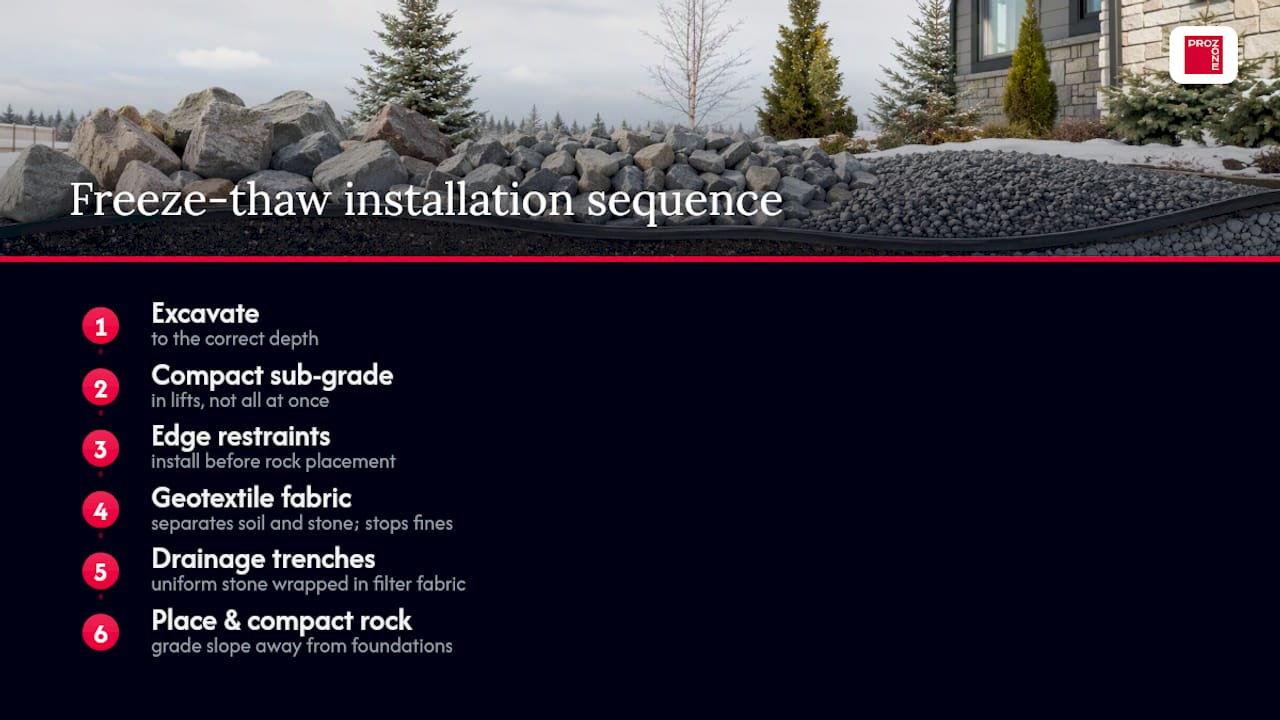
Drainage trenches need uniform stone size throughout, wrapped in filter fabric. Mixing sizes inside a trench reduces the total void space and cuts flow capacity, which defeats the purpose of building the drain at all.
Pro Tip: Grade every rock installation to slope away from foundations and structures, even by a modest degree. Positive drainage combined with a properly compacted base is the difference between a stable installation and one that heaves every spring.
This is the kind of detail that separates a certified installation crew from a generic contractor. ProZone’s crews work to Alberta Safety Codes standards on every excavation and base build, and the landscaping aggregate guide covers additional installation specifics for readers planning their own project sequencing.
Cost and maintenance: rock vs mulch over time
Material type, delivery distance, ordered depth, and site prep labour drive most of the cost variation between rock projects. A driveway with a full sub-base costs more upfront than a decorative bed topped with the same volume of stone, simply because of the layers involved.
Maintenance differs sharply from mulch. Rock needs occasional weeding, leaf clearing in fall, and topping up only after settling. It also retains more heat than organic mulch, which extension research on mulch and soil health confirms can affect nearby plant roots and soil moisture during summer.
- Choose rock when permanence and low annual upkeep matter more than initial cost
- Choose mulch near edible gardens or heat-sensitive plantings where soil moisture retention matters
- Budget for a top-up every several years regardless of which material you choose
ProZone’s perspective on choosing the right rock
For most homeowner projects, we recommend pea gravel or small decorative stone for walkways, 3/4 inch clean crushed for drainage, and layered angular base material for driveways. ProZone stocks each size, delivers, and installs to Alberta Safety Codes standards. Request a free estimate before you order.
— ProZone
How ProZone can help with your rock project
Sourcing the right size is only half the job. Getting it delivered in the right volume, placed on a properly prepared base, and compacted to hold through an Edmonton winter is where most DIY landscaping projects run into trouble.
ProZone supplies pea rock, limestone in both 10 to 20mm and 30 to 65mm grades, river rock from 20 to 40mm through 100 to 300mm, rock chips, and road crush, all sourced with regional durability in mind. Beyond material supply, our crews handle site preparation, base compaction, and full installation for driveways, walkways, and drainage features, backed by certified work practices rather than generic contractor guesswork.
Browse the full landscape supplies catalogue to check current stock and sizing, or call ProZone directly to discuss your project scope and get a free estimate. For larger commercial or municipal jobs, our construction services overview outlines full project capability.
Sources
External references used above include the PNW drain rock sizing guide, Cedarbridge Landscape’s driveway base guidance, and Penn State Extension’s mulch overview. For ProZone products, see the landscape material selection guide and the aggregate types guide.
- The difference the right rock and sand landscaping products make for drainage and weed control
- Selecting Right Stone, Gravel & River Rock for Your Project
- Which landscaping stone is best for your cottage and the environment?
- Mulch: a survey of available options (Penn State Extension)
FAQ
What size rock is best for landscaping?
It depends on the job: 1/8 to 3/8 inch pea gravel suits walkways, 3/4 inch crushed stone suits drainage, and 1 to 6 inch river rock suits decorative beds and dry creek edges.
What are standard rock sizes?
Common landscape categories run from fines under 1/8 inch, through pea gravel (1/8" to 3/8"), small decorative stone (3/8" to 3/4"), medium and large river rock (1" to 6"), up to boulders at 6 inches and beyond.
What size do rocks come in?
Suppliers typically sell rock in named bands rather than exact single dimensions, such as ProZone’s limestone at 10 to 20mm or river rock at 100 to 300mm, so always confirm the range against your project’s needs.
How much does 1 yard of rock cover?
One cubic yard covers roughly 100 square feet at a 3 inch finished depth, based on the formula of area multiplied by depth in inches, divided by 324.