
TL;DR:
- The base course is essential for load distribution and pavement longevity.
- Proper materials, preparation, and compaction are critical, especially in Alberta’s freeze-thaw climate.
- Cutting corners or skipping testing often leads to early pavement failures and costly repairs.
The asphalt you see on a parking lot or road isn’t what keeps that surface from cracking and sinking. That credit belongs to what’s underneath. The base course, a compacted layer of aggregate sitting between the subgrade and your asphalt or concrete, is the true backbone of any pavement structure. Yet it’s routinely treated as an afterthought on job sites across Alberta. Contractors and property managers who understand how the base course works, what materials to use, and how to install it correctly will consistently produce pavement that outlasts competing projects by years. This article breaks down everything you need to know.
Table of Contents
- What is a base course in paving?
- Types of base course materials and their selection
- Installation best practices: Placement, compaction, and quality control
- Common challenges and expert solutions for Alberta pavement projects
- Why base course failures happen and what most contractors overlook
- Get expert installation for your Alberta paving project
- Frequently asked questions
Key Takeaways
| Point | Details |
|---|---|
| Base course definition | The base course is a compacted aggregate layer providing foundational strength beneath asphalt or concrete. |
| Material selection matters | Choosing well-graded, frost-resistant materials prevents failure in Alberta’s climate. |
| Proper installation | Layered placement and thorough compaction are essential for pavement longevity. |
| Address local challenges | Freeze-thaw cycles and drainage require expert strategies for a durable base course in Alberta. |
What is a base course in paving?
Most pavement structures are built in layers, each serving a specific role. The base course is one of the most critical of those layers. Defined precisely, a structural layer of compacted aggregate material, typically crushed rock or gravel with well-graded 20 to 75mm sizes, is placed directly above the subbase or subgrade and below the asphalt or concrete wearing course. That definition might sound technical, but the function is straightforward: the base course is what keeps your surface pavement stable under load.
When a truck drives over a road or a forklift crosses a commercial lot, that weight doesn’t just press straight down into the ground. The base course spreads that load laterally, distributing pressure so no single point below the surface is overwhelmed. Without it, even the best asphalt mix will crack, rut, and fail within a few seasons.
For Alberta specifically, the base course has to work harder than in more temperate regions. Freeze-thaw cycles can repeat dozens of times each winter, and each cycle stresses the pavement from below. A well-built base course, using frost-resistant, well-graded material, absorbs much of that stress before it ever reaches the surface. The road crush base material commonly used in Edmonton-area projects is specifically graded for these conditions.
Here’s where the base course sits within the typical pavement structure:
| Layer | Position | Primary role |
|---|---|---|
| Wearing/surface course | Top | Traffic contact, weathering resistance |
| Binder course | Below surface | Connects surface to base |
| Base course | Middle | Load distribution, structural support |
| Subbase | Below base | Additional support on weak subgrades |
| Subgrade | Bottom | Natural or prepared ground |
The most common base course materials in Alberta projects include:
- Crushed gravel: Affordable, widely available, and effective for most commercial and municipal applications.
- Road crush: A processed blend well-graded to resist compaction displacement, ideal for heavy-duty applications.
- Well-graded angular aggregate: The angular particle shape interlock provides superior load transfer compared to rounded stone.
- Recycled crushed concrete: Useful in reconstruction scenarios where sustainability is a project priority.
“The base course does the structural heavy lifting. It’s not glamorous, but skipping proper attention here will cost far more in repairs than it ever saves upfront.”
Proper aggregate selection in base courses goes beyond just picking a gravel size. Gradation, angularity, and frost resistance all factor into whether a base course performs or fails under Alberta conditions.
Types of base course materials and their selection
Not all base course materials are equal, and choosing the wrong one for your project conditions is one of the most expensive mistakes a contractor can make. There are two broad categories to understand before you specify anything.
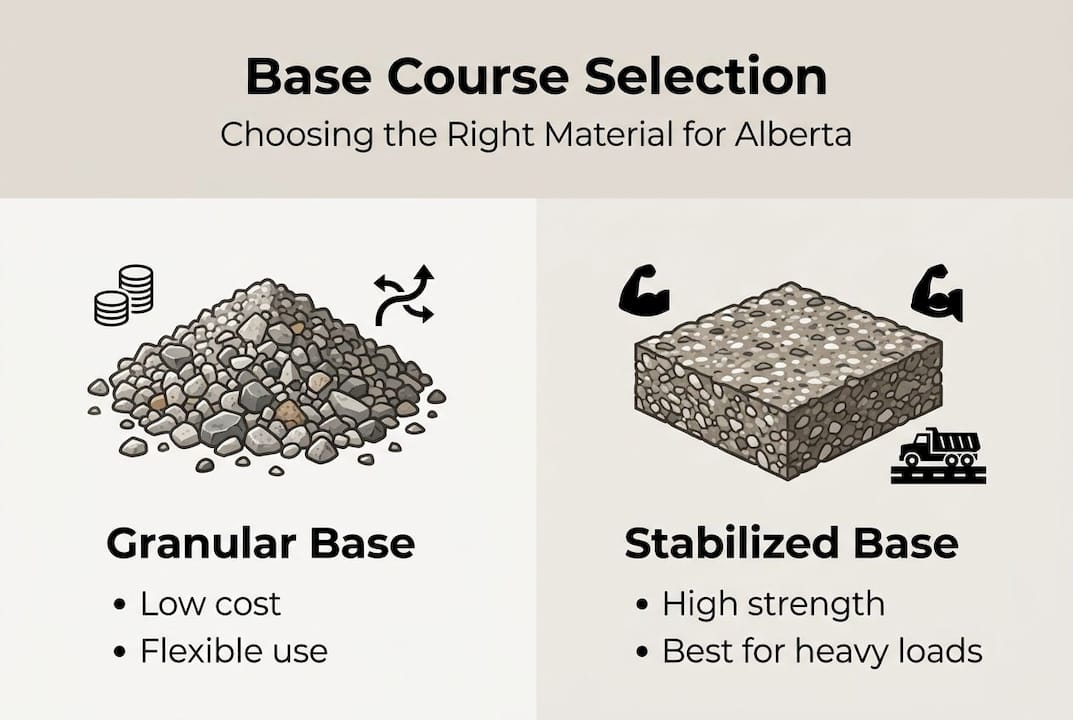
Unbound granular base (UGB): This is the most common choice for driveways, parking lots, and lower-traffic municipal roads. It relies on particle interlock and compaction to achieve strength. It drains well, which is critical in freeze-thaw climates, and it can flex slightly without cracking under moderate loads. Think of it as the resilient option.
Hydraulically stabilized base (HSB): This category includes cement-treated or lime-stabilized aggregate. It’s used when traffic loads are heavy and consistent, like commercial haul roads or industrial yards. The binding agent significantly increases stiffness and load-bearing capacity, but reduces flexibility and drainage compared to unbound material.
Here’s a side-by-side comparison to help you choose:
| Factor | Unbound granular base | Hydraulically stabilized base |
|---|---|---|
| Best use | Parking lots, paths, light roads | Heavy haul roads, industrial pads |
| Drainage | Excellent | Limited |
| Flexibility | High | Low |
| Cost | Lower | Higher |
| Frost resistance | Depends on gradation | Moderate to high |
| Installation speed | Faster | Slower (cure time required) |
Selecting the right type also depends on what’s already in the ground. According to material investigation standards, unbound granular is preferred for paths and driveways, while hydraulically stabilized mixes suit higher load demands. On strong subgrades with low traffic volumes, a subbase layer can sometimes be omitted entirely. In reconstructions, existing base material may be preserved if it still meets gradation and compaction specs.
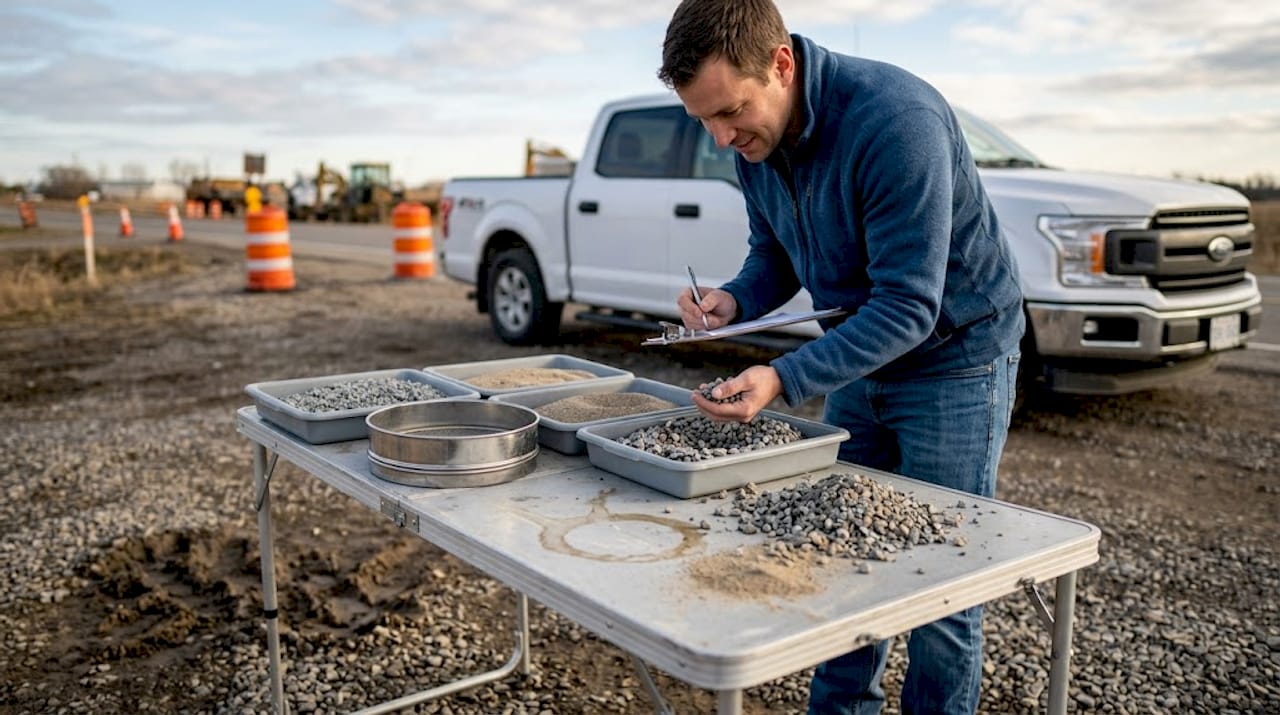
For Alberta contractors, frost resistance is non-negotiable in material selection. A poorly graded unbound base will trap water, freeze, and heave. Every project should start with a gradation analysis and a frost-susceptibility check on the proposed aggregate. This applies even to road crush aggregate sourced locally, since quarry blends can vary.
Key selection criteria for Alberta base courses:
- Well-graded particle distribution to minimize void space and water retention
- Angular crushed aggregate for maximum particle interlock
- Low fines content (typically below 8% passing the No. 200 sieve) to prevent frost heave
- Confirmed frost-resistance classification before delivery to site
- Compatibility with planned asphalt or concrete overlay (review the asphalt paving guide for overlay specs)
Pro Tip: Never let budget pressure drive you to a cheaper aggregate with higher fines content. The savings disappear fast when you’re repairing heaved pavement two winters later.
Installation best practices: Placement, compaction, and quality control
The best materials in the world won’t perform if installation is rushed or cut short. Base course installation requires a disciplined, step-by-step approach, and Alberta’s variable site conditions make quality control even more important than in milder climates.
Here’s the process that consistently delivers results:
- Prepare the subgrade. Remove all soft spots, organic material, and debris. Any weak zones must be stabilized or undercut before the base course goes down. A poorly prepared subgrade will migrate into the base course and reduce its structural capacity over time.
- Establish grade control. Set string lines or laser grade targets before spreading any material. An uneven base course creates uneven asphalt, and uneven asphalt fails faster.
- Spread in controlled lifts. Placed in lifts of 100 to 200mm compacted thickness, aggregate must be spread uniformly across the full lane or pad width. Dumping in piles and spreading cold or wet material are both common mistakes that reduce compaction quality.
- Compact with vibratory rollers. Use a vibratory drum roller sized appropriately for the lift thickness. Make overlapping passes in a consistent pattern. Skipping passes or running too fast reduces density at depth where you can’t see it.
- Proof-roll for acceptance. A loaded tandem axle truck driven slowly over the finished base course surface will reveal any soft spots. Deflection or rutting under the proof-roll indicates areas that need rework before paving.
- Test compaction before paving. Nuclear density gauge testing or sand cone testing should confirm that target density has been achieved. Don’t accept a visual inspection as sufficient.
- Check moisture content. Material that’s too dry won’t compact well. Material that’s too wet will displace under the roller. Moisture control is a detail that separates average installs from lasting ones.
This process, drawn from base course installation standards, is not optional on projects where pavement life matters. It also ties directly into how the laying asphalt steps are executed above, since asphalt performance depends heavily on the quality of the surface beneath it.
Common installation mistakes that lead to road repair methods far sooner than necessary:
- Placing full depth in a single lift (density at depth is nearly impossible to achieve)
- Compacting with equipment too light for the lift thickness
- Paving over a wet base course after rain without re-checking moisture
- Failing to proof-roll before the paving crew arrives
Pro Tip: Uniform compaction is the single biggest predictor of base course longevity. One undertreated area will create a surface failure that propagates outward, costing far more to repair than the original compaction testing would have cost.
Common challenges and expert solutions for Alberta pavement projects
Even when contractors follow the right procedures, Alberta’s environment creates specific challenges that aren’t found in milder climates. Understanding these issues in advance is what separates proactive project management from reactive repair cycles.
Freeze-thaw damage: Edmonton and surrounding areas can experience 40 or more freeze-thaw cycles per year. Each cycle pushes water through any available void space in the base course, and when that water freezes, it expands. If the base material has too many fines or isn’t frost-resistant, the result is heaving, cracking, and surface displacement. As noted in base course research, frost-resistant gradation is critical in freeze-thaw climates, and compaction uniformity is what prevents early failure. Selecting the right gradation before installation is far cheaper than repairing frost heave after the fact.
Poor drainage leading to base saturation: Water that pools in or under the base course weakens it significantly. Proper cross-slope, perimeter drainage, and a low-fines aggregate blend all reduce this risk. On sites with high water tables or heavy spring runoff, a granular subbase with a drainage outlet should be considered even if traffic loads wouldn’t otherwise require it.
Heavy traffic on undersized bases: Industrial properties, fleet yards, and commercial loading zones generate concentrated axle loads that unbound granular bases may not handle alone. If the original design called for light traffic and actual use has changed, the base is already being overstressed. Stabilized base overlays or full reconstruction with proper material may be required.
Key expert strategies for Alberta projects:
- Test aggregate for frost susceptibility before accepting delivery
- Specify maximum fines content in all base course material contracts
- Include proof-rolling as a contractual acceptance requirement, not an optional step
- Design site drainage before designing the pavement structure
- Inspect and remediate asphalt base preparation conditions whenever existing pavement shows early distress
“Base course quality is more important than subbase when it comes to long-term pavement success.”
That insight is supported by real outcomes across Alberta job sites. Properties that invest in quality base material and proper compaction consistently outperform those that prioritize surface treatments while skimping on what’s underneath. The parking lot maintenance tips that extend pavement life all trace back to the same foundational principle: you can’t maintain your way out of a poorly built base.
Why base course failures happen and what most contractors overlook
After working on pavement projects across Alberta, a pattern emerges with failures that repeat across different sites and different contractors. The root cause is almost always the same: the base course was rushed, under-resourced, or accepted without proper verification.
Budget pressure is the most common driver. When a project comes in over estimate, the base course is where cuts get made because it’s invisible once the asphalt goes down. Compaction testing gets skipped. Proof-rolling gets dropped. Material specs get loosened to use a cheaper aggregate. The surface looks fine on day one. The problems show up in year two or three, usually after a hard winter.
Another pattern we see repeatedly: project managers who trust visual inspection over density testing. A base course can look flat and firm and still be significantly under-compacted at depth. A loaded truck will find those weak spots in the first heavy season, and by then the asphalt is already down.
Contrary to what some contractors believe, a thicker or higher-quality surface course cannot compensate for a failing base. The load path goes through the asphalt first, but it reaches the base course before it dissipates. A failed base will destroy a quality surface in one winter.
Practical takeaways from hard experience:
- Always obtain and verify material gradation certificates before base course placement
- Never skip density testing, even on small projects where it feels like overkill
- Require proof-rolling as a formal acceptance step in your subcontractor agreements
- Reusing existing base material in a reconstruction can be smart, but only after testing confirms it still meets current gradation and compaction standards
For a broader view of how these principles connect across a full project, the paving process insights available from ProZone walk through how each layer decision affects the one above it.
The contractors who deliver the longest-lasting pavement in Alberta aren’t using secret materials. They’re simply refusing to cut corners on the layer nobody sees.
Get expert installation for your Alberta paving project
Understanding base course principles is the first step. Executing them correctly on every project requires experience, the right equipment, and a quality-first approach that doesn’t bend under schedule or budget pressure. At ProZone Ltd, we apply these standards to every paving project we take on in Edmonton and across Alberta, from commercial parking lots to municipal road construction.
Our team manages the full process: material selection and verification, controlled placement in proper lifts, compaction testing, and proof-rolling before any asphalt goes down. If you want to see how a professional base course installation fits into a complete paving project, the asphalt installation steps we follow are a good starting point. For large-scale infrastructure, our road construction services are built for municipal and commercial needs across the region. Property managers can also review our asphalt paving explained resource to understand exactly what you should expect from any contractor you hire. Contact us to discuss your next project.
Frequently asked questions
How thick should a base course be in Alberta?
A typical base course is placed in lifts of 100 to 200mm compacted thickness per layer, but total depth depends on traffic loading and the strength of the underlying subgrade.
Can the base course be reused during pavement reconstruction?
Yes, existing base material can be preserved and reused in reconstructions, but only after testing confirms it meets current gradation, frost-resistance, and compaction requirements.
What is the difference between subbase and base course?
The base course sits directly below the asphalt or concrete and uses well-graded aggregate for structural load distribution, while the subbase is a lower layer of less refined material that provides additional support on weaker subgrades.
Why is compaction so important when installing a base course?
Compaction uniformity creates the density and interlock that prevent rutting, settlement, and premature surface failure, especially through Alberta’s demanding freeze-thaw cycles.